Accessorial Charge Audit Software: Which Charges Get Inflated and How to Catch Them
Researched and written with AI assistance. Reviewed by the Laneproof team.
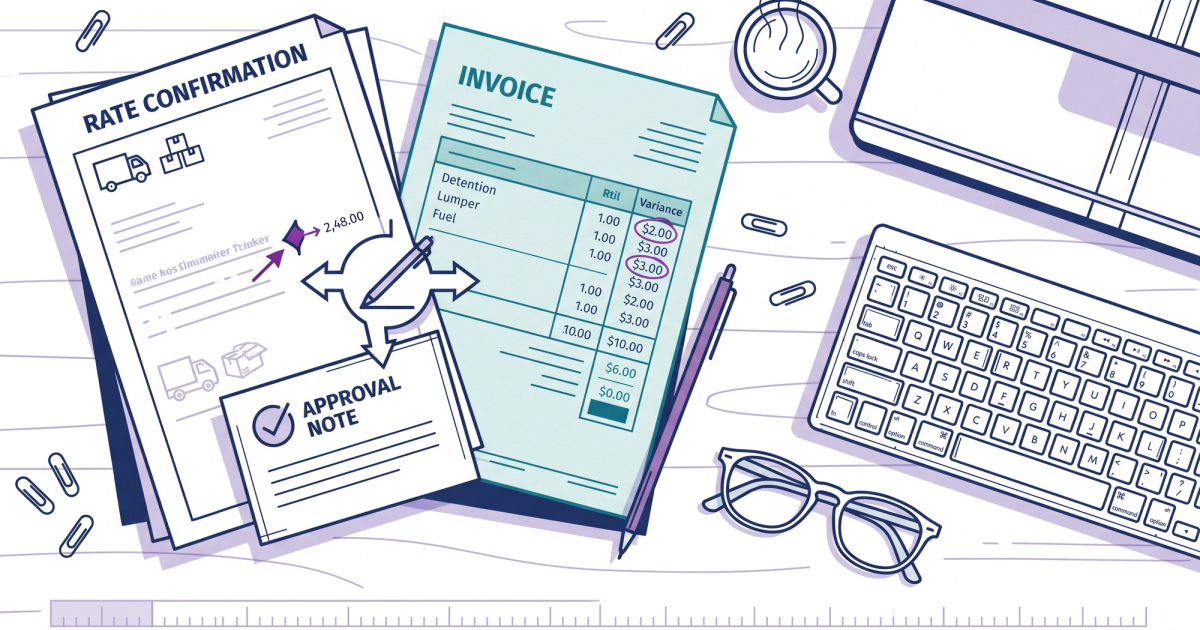
A broker running 500 loads per month at an average freight invoice of $1,800 faces roughly $34,200 in monthly overbilling exposure if carriers inflate accessorials at a rate of just 3.8%. That is not a hypothetical. According to Intek Logistics' analysis of industry-wide billing accuracy, the average freight invoice error rate falls between 5% and 8%, and accessorial charges are where most of those errors hide. Accessorial charge audit software exists to catch these charges before they clear payment. But most brokers do not know which specific charges get inflated, what documentation they need to dispute each one, or how the audit workflow actually functions from flagged invoice to recovered dollars. This post covers all three.
What Are Accessorial Charges and Why They Keep Costing You Money
Accessorial charges are fees billed on top of linehaul for services or circumstances beyond standard pickup and delivery. They include detention, lumper fees, fuel surcharges, layover, TONU, liftgate service, residential delivery surcharges, and dozens of other line items. According to Fleetworks' 2025 guide to accessorial charges in freight, these charges cover everything from driver wait time to specialized equipment to reclassified delivery zones.
The problem is not that accessorial charges exist. The problem is that they are difficult to verify, easy to inflate, and time-consuming to dispute manually. Per AMZ Prep's freight bill audit analysis, accessorial charges can add 8% to 20% to base LTL transportation costs. When you are processing hundreds of carrier invoices per month, even a small percentage of inflated accessorials compounds fast.
Why Manual Review Misses So Many Overcharges
Most brokers rely on a billing coordinator to review carrier invoices against rate cons before approving payment. The math on that approach does not hold up. A billing coordinator spending 12 hours per week on invoice review at $28 per hour costs the business $17,472 per year in labor. As of 2026-04-01, average hourly earnings in truck transportation were $32.41/hr (BLS), which means the people generating those invoices on the carrier side are not cheap either, and neither is the time your team spends chasing them.
Worse, manual review consistently misses charges. A coordinator scanning 40 invoices per day is checking linehaul against the rate con. They are not cross-referencing detention timestamps against BOL dock times. They are not verifying that the fuel surcharge percentage matches the contractual mileage band. They are not confirming that a lumper receipt exists before approving a $450 reimbursement. Those are the charges that add up to real money over time.
The Six Accessorial Charges Carriers Inflate Most Often
Not all accessorials carry the same overbilling risk. Based on Transportation Insight's freight audit and payment analysis, 3% to 6% of freight invoices contain errors, and the majority of those errors come from accessorial charges. The following six categories account for the bulk of overbilling exposure.
1. Detention Charges
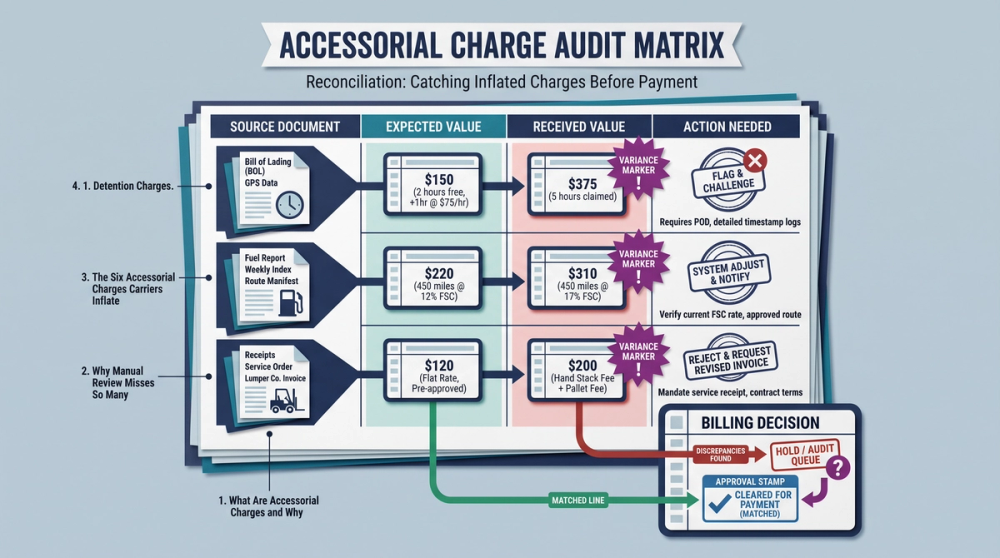
Detention is the single most disputed accessorial in freight brokerage. Carriers bill for driver wait time after a free time window (typically 2 hours) expires. The problem: without a timestamped BOL or facility gate log, you have no way to verify when the clock actually started. Rates typically run $50 to $100 per hour, and a carrier billing 4 hours of detention at $75/hour on a load where the BOL shows a 90-minute dock time costs you $300 you should not be paying. Detention disputes are covered in depth in our guide on which line items to check first in a transportation audit.
2. Lumper Fees
Lumper fees cover third-party loading or unloading labor at warehouses or distribution centers. Carriers frequently invoice lumper charges above the cap set in the rate con, or without the required signed lumper receipt. A common scenario: the carrier invoices $450 for lumper services on a load where the rate con capped lumper reimbursement at $275 and required a signed receipt. Without the receipt, many billing teams approve the full amount because disputing it takes time they do not have.
3. Fuel Surcharges
According to Business Solutions US, fuel surcharges alone account for 20% to 35% of total overbilling. The most common error is applying the wrong mileage band or using an outdated DOE fuel index to calculate the surcharge percentage. A carrier applying a 24.6% FSC based on the wrong mileage band can overbill by $61 on a single load. Multiply that across 200 similar loads per month, and that single carrier is overcharging you $12,200 per year.
4. TONU (Truck Ordered, Not Used)
TONU charges apply when a load is cancelled after a truck has been dispatched. The typical TONU fee ranges from $200 to $500. The overbilling risk comes when a carrier bills TONU on a load that was never actually cancelled, or when the driver never showed up at the shipper facility. If you have an accepted load tender confirmation with a timestamp showing the driver never checked in, the TONU charge should not stand.
5. Residential Delivery Surcharges
Per Business Solutions US, residential delivery misclassification triggers $75 to $150 per incident in overcharges. Carriers sometimes apply residential surcharges to commercial addresses that happen to be in mixed-use zones. Without address validation against USPS or carrier classification databases, these charges slip through.
6. Layover and Dry Run Charges
Layover charges apply when a driver must wait overnight due to scheduling delays. Dry run charges apply when a driver arrives at a pickup or delivery location and the load is not available. Both require supporting documentation (driver logs, facility confirmation) that carriers do not always provide. Without that documentation, you are paying on the carrier's word alone.
What Documentation You Actually Need to Dispute Each Charge
Knowing which charges get inflated is only half the problem. You also need the right documentation to win a dispute. According to FreightWaves' analysis of freight invoice audits, carriers who cannot produce supporting documentation for disputed charges typically concede the claim. The issue is that most brokers do not have a documented list of what evidence they need for each charge type. Here is that list.
Detention: Timestamped Proof of Arrival and Departure
To dispute a detention charge, you need a timestamped BOL or POD showing actual dock time, a facility gate log (if available) showing truck arrival and departure, and the rate con specifying the free time window and detention rate. If the carrier cannot produce timestamps that match the billed hours, the charge should be reversed or reduced.
Lumper Fees: Signed Receipts and Rate Con Caps
For lumper fee disputes, you need the signed lumper receipt (most rate cons require this for reimbursement), the rate con specifying the lumper cap amount, and the carrier's invoice showing the billed amount. If the invoice exceeds the cap or the receipt is missing, the charge lacks rate con backing and should not be paid at full value.
Fuel Surcharges: Index Tables and Mileage Verification
Fuel surcharge disputes require the contracted FSC schedule (which DOE fuel index week applies, which mileage bands trigger which percentages), the actual mileage for the load (from the rate con or TMS mileage calculation), and the DOE national average diesel price for the applicable week. Mismatches in any of these three data points indicate an overcharge.
TONU: Load Tender and Check-In Records
To dispute a TONU charge, you need the accepted load tender confirmation with timestamp, driver check-in records (or absence thereof) at the shipper facility, and any cancellation communication with timestamps. If the load was never cancelled or the driver never arrived, the charge does not hold.
Residential Surcharges: Address Classification
Residential surcharge disputes require the delivery address from the BOL, address classification data from USPS or the carrier's own database, and proof that the address is a commercial location (business license, commercial zoning records). Audit software can automate this by cross-referencing delivery addresses against classification databases on every load.
How Accessorial Charge Audit Software Processes a Disputed Charge Step by Step
This is the section most competitors skip. Everyone talks about what freight audit software does. Nobody shows how it works from the moment a carrier invoice arrives to the moment a disputed charge gets resolved. Here is the actual workflow.
Step 1: Invoice Ingestion and Data Extraction
The carrier submits an invoice (via EDI, email, or portal upload). The software extracts every line item: linehaul, each accessorial charge, fuel surcharge, and total. According to Enveyo's audit platform documentation, the extraction layer parses both structured (EDI 210) and unstructured (PDF) invoice formats, normalizing the data into a standard schema for comparison.
Step 2: Rate Con and Contract Rule Matching
Each invoice line item is matched against the rate con for that load and the broader carrier contract. The software checks whether the accessorial type is authorized on the rate con, whether the billed amount falls within the contracted rate or cap, whether the fuel surcharge percentage matches the correct DOE index and mileage band, and whether required documentation (lumper receipts, detention timestamps) is attached. According to Item.com's accessorial charge audit documentation, the contract rule mapping engine maintains a library of carrier-specific rules that define what is billable, at what rate, and under what conditions.
Step 3: Tolerance-Based Variance Detection
Not every discrepancy triggers a dispute. Most audit software allows you to set tolerance thresholds. Per Varsity Logistics' audit software documentation, users can define tolerance rules (for example, allow variances under $5 or under 2% to pass without flagging). This prevents your team from chasing $3 discrepancies while missing $300 overcharges.
Step 4: Flag, Hold, and Route for Review
When a charge exceeds the tolerance threshold, the software flags the line item, holds the invoice from payment, and routes it to the appropriate person for review. The flag includes the specific rule violation (e.g., "lumper fee exceeds rate con cap by $175" or "detention hours exceed BOL dock time by 2.5 hours"), the supporting documentation on file, and the calculated variance amount.
Step 5: Dispute Submission and Carrier Response
The reviewer approves or modifies the dispute, and the software generates a dispute communication to the carrier. This communication includes the billed amount, the contracted amount, the variance, and the rule or documentation gap that triggered the flag. The carrier can accept the adjustment, provide additional documentation, or escalate. Most disputes resolve within one billing cycle.
Step 6: Resolution, Payment Release, and Audit Trail
Once the dispute is resolved (through carrier concession, documentation submission, or negotiated adjustment), the software releases the invoice for payment at the corrected amount and logs the entire audit trail. This trail is critical for identifying repeat overbilling patterns by carrier and for building evidence if a carrier relationship needs to be renegotiated or terminated.
Laneproof's reconciliation engine handles steps 1 through 4 automatically, flagging invoice variances against rate cons before any payment is approved. The dispute data feeds back into carrier scoring, so repeat offenders get flagged earlier on future loads.
Rule-Based vs. AI-Driven Audit Logic: What the Difference Means for Your Recovery Rate
Most accessorial charge audit software uses one of two approaches, and the distinction matters for how much money you actually recover.
Rule-Based Audit Logic
Rule-based systems compare each invoice line item against a predefined set of contract rules. If the carrier's detention rate is $75/hour and they bill $100/hour, the system flags it. If the rate con caps lumper at $275 and the invoice shows $450, the system flags it. Rule-based logic is deterministic: it catches every violation that matches a defined rule, and it never flags a charge that falls within the rules.
The advantage is predictability and auditability. You can explain every flag to a carrier with a specific contract reference. The limitation is that rule-based systems only catch what you have written rules for. If a carrier starts applying a new surcharge type that is not in your rule library, it passes through undetected.
AI-Driven Audit Logic
AI-driven systems use historical invoice data and pattern recognition to identify anomalies. They can flag a charge that is technically within contract terms but statistically unusual. For example, if a carrier's average detention charge is $150 per load and they suddenly submit 15 loads in a week with $450 detention charges, an AI system would flag the pattern even if each individual charge technically falls within the contracted rate.
The advantage is that AI catches emerging patterns and new charge types that rule-based systems miss. The limitation is explainability: telling a carrier "our algorithm flagged this" is a weaker dispute position than "this violates clause 4.2 of our contract." The most effective approach combines both. Use rule-based logic for known contract violations and AI-driven analysis for pattern detection and new charge identification.
What This Means for Recovery Rates
Freight brokers using automated accessorial audits recover between $4 and $11 per load on disputed accessorials. For a 300-load-per-month operation, that translates to $14,400 to $39,600 recovered annually. Brokers using combined rule-based and AI-driven systems typically land at the higher end of that range because they catch both contract violations and billing anomalies.

A 300-load-per-month broker recovers between $14,400 and $39,600 annually from automated accessorial charge audits. That is margin recovered, not revenue generated.
Real Scenarios: How Overbilling Adds Up Load by Load
Abstract percentages are easy to ignore. These scenarios show exactly how accessorial overcharges compound.
Example: Detention Overcharge Caught by Timestamp Mismatch. A carrier billed 4 hours of detention at $75/hour ($300) on a single load. The rate con specified a 2-hour free time window. Audit software compared the billed detention hours against the timestamped BOL, which showed the driver was at the dock for 90 minutes total. The entire detention charge was invalid. The software flagged the $300 charge, held the invoice, and the carrier conceded when presented with the BOL timestamps. On a broker running 500 loads per month, catching even five of these per month saves $18,000 per year.
Example: Lumper Fee Overbilling Without Required Receipt. A carrier invoiced $450 for lumper services. The rate con capped lumper reimbursement at $275 and required a signed lumper receipt for any lumper charge. No receipt was attached to the invoice. Audit software flagged two violations: the charge exceeded the $275 cap by $175, and the required receipt was missing. The broker paid $275 (the cap) only after the carrier produced a valid receipt. Without audit software, the billing coordinator would have paid the full $450 because manually checking lumper caps across 500 invoices per month is not realistic.
Example: TONU Charge Reversed by Check-In Records. A carrier billed a $350 TONU on a load, claiming the shipment was cancelled. The broker had an accepted load tender confirmation with a timestamp. The audit software cross-referenced the tender against facility check-in records and found the driver never checked in at the shipper. The charge was reversed. The driver either never showed up or went to the wrong facility. Either way, the broker did not cancel the load, so the TONU was not owed.
Example: Fuel Surcharge Miscalculation Across 200 Loads. A carrier applied a 24.6% fuel surcharge based on the wrong mileage band, overbilling by $61 on a single load. The contracted FSC schedule specified a 21.3% surcharge for that mileage. Across 200 similar loads per month from that carrier, the annual overpayment totaled $12,200 from fuel surcharges alone. Audit software caught the mismatch by comparing the billed FSC percentage against the contracted schedule and the correct DOE index for that billing period. A freight bill audit focused on these line items would catch this on the first invoice.
Frequently Asked Questions
What are accessorial charges in freight?
Accessorial charges are fees billed by carriers on top of the base linehaul rate for services or conditions beyond standard pickup and delivery. Common examples include detention (driver wait time), lumper fees (third-party loading/unloading), fuel surcharges, TONU (truck ordered not used), liftgate service, residential delivery surcharges, and layover charges. According to Fleetworks' 2025 accessorial charges guide, these charges cover everything from equipment requirements to reclassified delivery zones and can add 8% to 20% to base LTL costs per AMZ Prep's analysis.
How much does accessorial charge audit software cost?
Pricing models vary widely. Some platforms charge per invoice audited (typically $1 to $5 per invoice), some charge a percentage of recovered savings (15% to 30%), and some charge flat monthly fees based on load volume. For a broker running 300 to 500 loads per month, monthly costs typically range from $300 to $2,000 depending on the model. The key metric is not cost but net recovery: if you are spending $800/month on audit software and recovering $2,500/month in overcharges, the ROI is clear.
Who are the Big 4 freight audit platforms?
The industry often refers to large-scale freight audit and payment providers like Cass Information Systems, U.S. Bank Freight Payment, nVision Global, and Data2Logistics as the major players. However, these platforms primarily serve enterprise shippers moving thousands of loads per day. For SMB freight brokers handling 100 to 5,000 loads per month, purpose-built tools that focus on rate con matching and accessorial verification are typically a better fit because they are designed for the broker workflow, not the shipper workflow.
Which software is best for auditing accessorial charges specifically?
The best accessorial audit software for a freight broker does three things well: it matches every invoice line item against the rate con and carrier contract automatically, it flags charges that exceed contracted caps or lack required documentation, and it provides an audit trail you can use in carrier disputes. Look for software that supports both EDI and PDF invoice ingestion, allows custom tolerance thresholds, and integrates with your TMS. According to the Dataintelo freight audit and payment market report, the market is projected to reach $14.2 billion by 2034, meaning the tooling options for SMB brokers are expanding rapidly.
How long does it take to see ROI from accessorial audit software?
Most brokers see recovered overcharges within the first billing cycle (typically 15 to 30 days). The software begins flagging discrepancies as soon as it ingests your first batch of carrier invoices and rate cons. A billing coordinator spending 12 hours per week on manual invoice review at $28/hour costs $17,472 per year before accounting for the charges they miss. Automated audit software reduces that labor to 2 to 3 hours per week of exception review, freeing up roughly $12,000 in annual labor costs on top of the overcharges recovered.
Stop Paying Charges You Do Not Owe
Accessorial overcharges are not random billing errors. They follow predictable patterns: detention without timestamps, lumper fees without receipts, fuel surcharges calculated on the wrong index, TONU on loads that were never cancelled. The documentation rules are straightforward, and the audit workflow is repeatable. The only question is whether you are catching these charges before payment or discovering them after the money is gone.
For brokers processing 100 or more loads per month, manual review does not scale. The labor cost alone exceeds $17,000 per year, and the charges your team misses cost two to three times that. Accessorial charge audit software pays for itself by catching what manual review cannot. If you want to see how this works on your own invoices, Laneproof's reconciliation tool matches carrier invoices against rate cons and flags accessorial variances automatically. No setup call needed to see the first results.
Sources
- Freight Invoice Audits and Why They Matter — FreightWaves
- Parcel and LTL Freight Auditing Software — Varsity Logistics
- Parcel and Freight Audit Software — Enveyo
- Accessorial Charge Audit | Verify Freight Extra Fees — Item.com
- Freight Audit And Payment: Protecting Profit In Soft Rates — Transportation Insight
- How Freight Audit Platforms Identify Cost-Saving Opportunities — Business Solutions US
- Freight Bill Audit: How to Find Overcharges and Recover — AMZ Prep
- 2026 Best Freight Audit & Pay Companies (and How to Choose) — Intek Logistics
- Freight Audit and Payment Market Research Report 2034 — Dataintelo
- Accessorial Charges in Freight: Complete Guide for 2025 — Fleetworks
Related: How to Automate Accessorial Validation Before You Overpay
Related: 6 TMS Workarounds Dispatchers Use Daily (And What Each One Costs You)
Related: Freight Accessorial Charge Disputes: A Broker's Playbook
Related: Audit Preparation for Freight Ops: Pull the Right Docs in 20 Minutes
Related: Regulatory Requirements That Cost Brokers Money on Every Invoice