How to Automate Accessorial Validation Before You Overpay
Researched and written with AI assistance. Reviewed by the Laneproof team.
A broker moving 800 loads per month with a 3.8% carrier invoice error rate on an average invoice of $1,800 is absorbing roughly $54,720 in overbills per year. Most of those errors live in accessorial charges: detention, lumper fees, TONU, fuel surcharges. They're the line items most likely to be wrong and least likely to get checked. If you want to automate accessorial validation, you need more than a generic audit tool. You need validation rules mapped to each carrier's contract, a clear escalation path when charges fail, and a workflow that doesn't bottleneck your billing coordinator. This article walks through exactly how to build that, step by step, with dollar benchmarks for every charge type so you know where to start.
What Accessorial Validation Automation Actually Does (And What It Doesn't)
Let's define the term clearly, because it gets conflated with general freight audit software all the time.
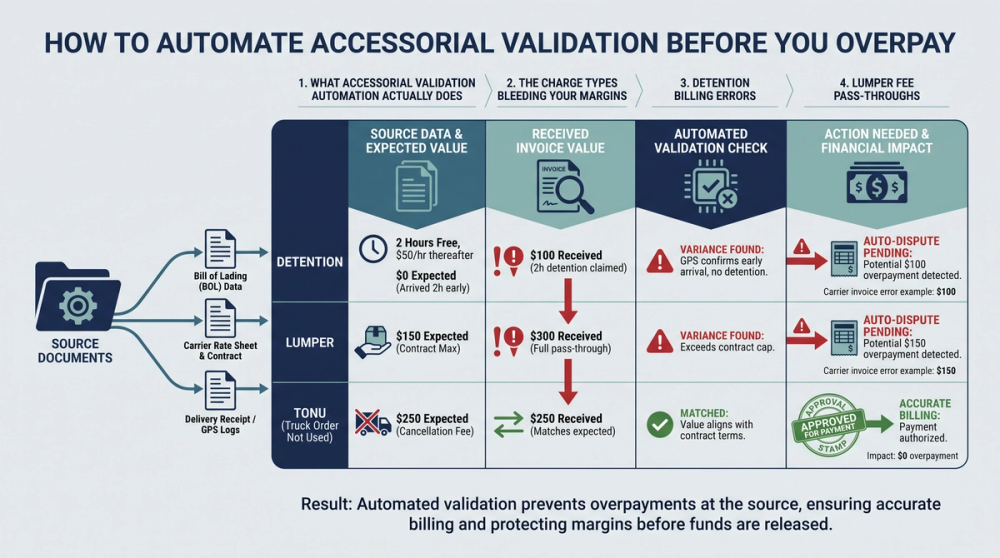
Accessorial validation automation is the process of programmatically comparing every accessorial line item on a carrier invoice against contracted rates, load documents (rate con, BOL, POD), and event data (GPS, check-call logs, timestamps) to flag discrepancies before payment. According to FreightBill.org's analysis of rule-based rate validation, accessorial charges represent the highest variance category in freight billing because they're event-driven, unlike predictable base freight rates.
Here's what it does:
- Compares each accessorial line to the specific carrier's contracted terms (not a generic threshold)
- Cross-references supporting documents: rate con caps, POD receipts, GPS timestamps
- Flags mismatches automatically before payment is released
- Routes flagged charges to a dispute queue with the relevant documentation attached
Here's what it does not do:
- Replace human judgment on edge cases (a carrier with a legit but undocumented charge still needs a person to review)
- Negotiate dispute resolution automatically (it flags the problem, your team resolves it)
- Eliminate the need for accurate carrier contracts in your system (garbage in, garbage out)
As CT Global's analysis of AI in freight audit puts it plainly: the real value is in structured rule application, not magic. If your carrier contracts aren't digitized and current, automation will validate against the wrong numbers. That's worse than manual review because it creates false confidence.
The Charge Types Bleeding Your Margins: Detention, Lumper, and TONU by the Numbers
Not all accessorial charges carry the same overbilling risk. Here's where the money actually leaks, with specific benchmarks.
Detention billing errors
Detention is the most frequently disputed accessorial charge for a reason: it's time-based, subjective, and hard to verify after the fact. A carrier invoices based on their driver's reported wait time. Your rate con specifies free time and an hourly cap. Without automated timestamp validation, you're taking the carrier's word for it.
Example: A carrier invoices 4 hours of detention at $75/hr ($300). Your rate con specifies 2 free hours with a $50/hr rate after. The correct charge is $100. The overbill is $200 on a single load. Multiply that across 30 loads a month with detention charges and you're looking at $6,000/month in potential exposure.
According to Wend AI's coverage of freight invoice automation, GPS and timestamp data can validate detention and demurrage charges by ensuring every surcharge is backed by verifiable event data, not just a driver's self-reported time.
Lumper fee pass-throughs
Lumper fees are supposed to be receipted and capped. In practice, carriers frequently pass through the full receipt amount without checking it against the rate con. If your rate con specifies a $300 lumper cap with receipt required, and the carrier passes through a $450 receipt, that $150 overage should get flagged. Without validation, it gets paid.
The fix here is straightforward: automated rules that check two things simultaneously. First, does the lumper amount exceed the contracted cap? Second, is a receipt image attached to the invoice? If either condition fails, the charge gets held. For a deeper breakdown of which charges typically lack rate con backing, see how additional charges in freight often slip through without documentation.
TONU disputes
Truck Order Not Used charges are uniquely frustrating because they're binary: either the load was canceled after dispatch or it wasn't. But carriers sometimes invoice TONU when a load was simply reassigned, or when their truck never actually left the origin terminal.
Example: A carrier invoices a $250 TONU. Your load tracking data shows the truck never departed the origin terminal. A validation rule cross-references the GPS log or check-call record and auto-disputes the full $250. Without that cross-reference, your billing coordinator has to manually pull tracking data, and at volume, that doesn't happen.
Fuel surcharge mismatches
These are the quietest margin killers. A carrier applies a 28% fuel surcharge against linehaul, but your contract specifies the DOE weekly index capped at 24%. On a $2,200 linehaul, that's an $88 overbill per load. Easy to miss manually when you're processing hundreds of invoices. Hard to miss when a rule checks the FSC percentage against the contracted formula automatically.
How to Build a Carrier-Contract-Aware Validation Rule Library
The biggest mistake in accessorial validation is applying blanket rules across all carriers. Carrier A might allow a $75 flat layover fee per 24 hours. Carrier B contracts at $150. If both get validated against the same threshold, you either generate false disputes (wasting your team's time on Carrier B) or false approvals (letting Carrier A's overcharges through).
Here's how to build a rule library that accounts for carrier-specific terms.
Step 1: Extract accessorial terms from every active carrier contract
Pull the rate con or carrier packet for each active carrier. Document every accessorial term: detention free time, detention hourly rate, lumper caps, TONU flat fees, fuel surcharge formulas, layover rates, and any other accessorial that appears on more than 5% of that carrier's invoices. This is the foundation. If this step is incomplete, every downstream rule is unreliable.
Step 2: Define per-carrier rule sets
For each carrier, create a rule set that mirrors their specific contract terms. Each rule has three components:
- Trigger: the accessorial charge code on the invoice (e.g., DET, LMP, TONU, FSC)
- Validation logic: the mathematical check (e.g., detention hours × contracted rate, minus free hours, must equal invoiced amount within $5 tolerance)
- Document requirement: what supporting document must be present (e.g., lumper receipt image, GPS timestamp, signed POD)
According to Banyan Technology's breakdown of accessorial verification, automated accessorial flagging compares every accessorial line to contracted rates and flags mismatches before payment. But the key word is "contracted." Generic rate tables catch generic errors. Carrier-specific rules catch the errors that actually show up on your invoices.
Step 3: Set tolerance thresholds
Not every variance is worth disputing. A $3 rounding difference on a fuel surcharge is noise. A $200 detention overbill is signal. Set dollar and percentage tolerance thresholds per charge type:
- Detention: flag if variance exceeds $25 or 10% of expected charge
- Lumper: flag if amount exceeds cap by any amount (lumper caps are firm)
- TONU: flag all TONU charges for GPS/check-call verification (no tolerance)
- Fuel surcharge: flag if applied percentage deviates more than 0.5% from contracted formula
Step 4: Maintain the library
Carrier contracts change. Rates get renegotiated. New accessorial terms get added. Assign someone, ideally your ops manager or billing coordinator, to update the rule library whenever a carrier contract is renewed or amended. A rule library that's 6 months out of date will generate more false positives than real catches, and your team will start ignoring the flags.
The 3-Way Match Workflow: Rate Con, BOL, POD, and Where It Breaks Down
The standard workflow for catching carrier overbilling through freight bill audit involves a 3-way match: compare the carrier invoice against the rate confirmation and the delivery documentation (BOL and POD). For linehaul charges, this is relatively straightforward. For accessorials, it's where things break down.
Why accessorials break the 3-way match
Linehaul has a single agreed number on the rate con. Accessorials are conditional. Detention only applies if the driver waited beyond free time. Lumper only applies if unloading assistance was used. TONU only applies if the load was actually canceled after dispatch. The 3-way match for accessorials requires a fourth element: event verification data.
That fourth element could be:
- GPS or geofence data confirming arrival and departure times (for detention)
- A receipted lumper image attached to the POD (for lumper fees)
- Check-call logs or tracking data confirming truck status (for TONU)
- DOE fuel index data for the load week (for fuel surcharge verification)
A Debales AI analysis of 300,000 freight invoice line items totaling $5M in charges found approximately a 20% discrepancy rate, resulting in over $1M in billing errors. The majority of those discrepancies clustered in accessorial and surcharge categories precisely because the event data needed to validate them was either missing or disconnected from the audit workflow.
Making the match work at scale
For a broker processing 300 to 600 loads per month, manual 3-way matching on accessorials is not sustainable. As of 2026-04-01, average hourly earnings in truck transportation were $32.41/hr (BLS Current Employment Statistics, series CEU4348400008). A billing coordinator earning a burdened $22/hr who spends 11 hours per week on accessorial disputes costs $12,584 per year in labor alone, and that doesn't count the dollars lost on disputes they never got to.
The practical solution is to automate the document matching and reserve human review for the exceptions. The system checks: does the invoice accessorial match the rate con terms? Is the supporting document present? Does the event data confirm the charge? If all three pass, the charge is approved. If any one fails, it routes to a dispute queue.
Operations teams using automated 3-way matching report catching 60-70% more accessorial discrepancies than manual review, with average recovery of $4,200 to $7,800 per month at 300 to 600 load/month volumes.
When a Charge Fails Validation: Escalation Paths That Don't Stall Payments
Flagging a bad charge is only half the problem. The other half is what happens next. A lot of operations teams set up validation rules but never build the escalation workflow, so flagged charges sit in a queue, payments get delayed, carriers get frustrated, and eventually someone just approves everything to clear the backlog.
Here's an escalation path that actually works:
Tier 1: Auto-resolve (no human needed)
Charges that fail validation but fall within a predefined tolerance band get auto-adjusted and approved. Example: detention invoiced at $102 but contract calculation yields $100. The $2 variance is within your $25 tolerance. Approve it. Don't waste anyone's time.
Tier 2: Billing coordinator review (24-hour SLA)
Charges that exceed tolerance but have supporting documentation attached go to your billing coordinator for manual review. The documentation is already pulled and attached by the system. The coordinator's job is to verify the documents match the charge and either approve with justification or reject. Set a 24-hour SLA so these don't pile up.
A signed delivery receipt attached to the invoice can resolve many of these disputes immediately, confirming what services were actually rendered at delivery.
Tier 3: Carrier dispute (48-hour SLA)
Charges that exceed tolerance and lack supporting documentation get auto-disputed back to the carrier with a specific explanation of what's missing. Example: "Detention charge of $300 exceeds rate con cap of $100. Invoiced hours not supported by GPS data. Please provide timestamp documentation or adjust invoice." Give the carrier 48 hours to respond before escalating further.
Tier 4: Operations manager override
Disputes that remain unresolved after 48 hours or involve amounts above a dollar threshold (say $500) escalate to the ops manager for a judgment call. Sometimes the business relationship matters more than winning a $200 dispute. That's a human decision, and the system should make it easy to make, not make it for you.
The key principle: never stall a clean invoice because of a flagged accessorial. Approve the linehaul and undisputed charges. Hold only the disputed line item. This keeps carrier relationships intact and cash flowing.
Real-Time vs Batch Validation: Which One Fits Your Load Volume
Not every operation needs real-time validation. The right choice depends on your load volume, your billing cycle, and how fast you need to catch errors.
Batch validation (best for under 500 loads/month)
Batch validation processes all incoming carrier invoices at a scheduled interval, typically once or twice daily. Invoices arrive, queue up, and get validated as a group. This works well for smaller operations where the billing coordinator reviews a batch of flagged items each morning.
Advantages:
- Simpler to set up and maintain
- Lower processing overhead
- Easier to audit (you can review a day's worth of flags in one session)

Disadvantages:
- Errors aren't caught until the next batch cycle
- Disputed charges may already be approaching payment deadlines
Real-time validation (best for 500+ loads/month)
Real-time validation checks each invoice as it arrives. The moment a carrier submits an invoice, the system runs it against the rule library and flags issues immediately. For operations processing 500 or more loads per month, this prevents the backlog problem. By the time your billing coordinator starts their day, every invoice has already been validated and only the exceptions need attention.
As noted by Portcast's analysis of automated freight audit software, AI-driven freight audit workflows automatically identify discrepancies in rates such as incorrect tariffs and unapproved accessorial fees, reducing manual intervention in the billing cycle. For high-volume operations, real-time validation makes this reduction practical rather than theoretical.
The volume threshold isn't absolute. If you're processing 300 loads/month but your carriers submit invoices in bursts (common with asset carriers who batch their own billing weekly), real-time validation prevents those bursts from creating a review bottleneck.
Putting the Numbers Together: What Automated Validation Actually Recovers
Here are three scenarios with full dollar calculations, so you can benchmark against your own operation.
Scenario 1: Mid-size broker, 800 loads/month
Setup: 800 loads per month, average invoice of $1,800, observed 3.8% carrier invoice error rate on accessorial charges.
Annual overbill exposure: 800 loads × $1,800 × 3.8% error rate = $54,720/year in unvalidated accessorial overbills.
Manual review cost: Billing coordinator spending 11 hours/week on accessorial disputes at $22/hr burdened labor cost = $12,584/year. And this catches maybe 30-40% of errors because manual review at this volume means sampling, not comprehensive checking.
With automated validation catching 60-70% of discrepancies: Recovery of $32,832 to $38,304 per year in overbills, plus reduction of manual review time to 3-4 hours/week (focused only on Tier 2 and 3 exceptions). That's roughly $40,000 to $45,000 in combined savings and recovery annually.
Laneproof's reconciliation engine checks each of these fields automatically, flagging variances before payment goes out and routing only the exceptions to your billing team.
Scenario 2: Small carrier broker, 200 loads/month
Setup: 200 loads per month, average invoice of $2,100, 3.8% error rate.
Annual overbill exposure: 200 × $2,100 × 3.8% = $15,960/year.
Recovery at 60% catch rate: $9,576/year. Not a massive number, but when your annual margin on 200 loads/month might be $180,000 to $240,000, that's 4-5% of your margin recovered from a single process fix.
Scenario 3: Fuel surcharge mismatch at volume
Setup: 400 loads/month, 15% of loads have a fuel surcharge applied at 28% instead of the contracted 24%, average linehaul of $2,200.
Monthly overbill: 60 loads × $2,200 × 4% excess FSC = $5,280/month, or $63,360 per year. On a single charge type. That number alone justifies the entire cost of setting up automated validation. As of 2026-05-01, truck transportation employed 1,465 thousand workers (BLS CES series CES4348400001), and at that scale of industry activity, even small per-load variances compound into significant freight billing discrepancies across the supply chain.
For a full breakdown of how these charges get categorized and disputed, see accessorial charges explained with overbilling traps and how to fight back.
Frequently Asked Questions
How long does it take to set up automated accessorial validation rules?
For a broker with 20 to 50 active carriers, expect 2 to 4 weeks to digitize carrier contracts, define per-carrier rule sets, and test validation logic against historical invoices. The biggest time sink is extracting accessorial terms from carrier packets and rate cons, not the software configuration itself. If your contracts are already in a TMS, the setup time drops significantly.
What if my carrier contracts don't specify every accessorial rate?
Many carrier contracts are incomplete on accessorial terms. When a contract is silent on a specific charge (say, layover), you have two options: set a default industry threshold for that charge type as a fallback rule, or flag any instance of that charge for manual review. The second option is safer. An uncontracted charge that gets auto-approved because of a generic threshold is a dispute you never knew you lost.
Does automating accessorial validation damage carrier relationships?
No, and it usually improves them. Carriers prefer clear, specific dispute communications ("your detention charge exceeds the rate con by $200, here's the contracted rate") over vague pushback or delayed payments. Automated disputes include documentation, which speeds resolution. Most carriers would rather fix a $200 error quickly than chase an unpaid $1,800 invoice for weeks.
Can I automate accessorial validation without a TMS?
Yes, but it's harder. A TMS provides the structured data (rate con terms, load details, carrier codes) that validation rules need to run against. Without a TMS, you need another source of structured contract data. Some operations use spreadsheet-based rule libraries connected to invoice processing tools. It works at low volumes but breaks down above 200 to 300 loads per month.
What's the minimum load volume where automated validation makes financial sense?
Based on the scenarios above, even a 200-load/month operation recovers nearly $10,000 per year. If your automation tool costs less than that annually, the math works. The real question is whether your error rate is high enough to justify the setup effort. If you're not sure, audit 30 days of invoices manually against rate cons. If you find more than 2% of invoices with accessorial errors, automation will pay for itself.
Where to Start
The single highest-impact step you can take this week: pull 30 days of carrier invoices with accessorial charges and compare every detention, lumper, and TONU line item against the corresponding rate con. Track the dollar variance. That number tells you exactly how much automated accessorial validation is worth to your operation.
If the number is north of $3,000/month, you can't afford to keep doing this manually. If it's under $1,000, your contracts are either unusually clean or your sample is too small.
Either way, the workflow is the same: digitize your carrier contract terms, build per-carrier rule sets, automate the 3-way match, and route exceptions to the right person at the right tier. That's the whole system. The tools that automatically flag invoice discrepancies and match them to rate cons exist today. The question is whether your current process is catching what they'd catch, or whether you're absorbing the difference.
Sources
- Rule-Based Rate Validation & Accessorial Auditing — FreightBill.org
- Why Accessorial Verification is Critical to Controlling Freight Spend — Banyan Technology
- Freight Invoice Automation — Wend AI
- Freight Audit Process Flaws: Disconnected Data, Generic Rules — Debales AI
- Cutting Costs and Errors: How Automated Freight Audit and Payment Software is Changing Logistics — Portcast
- AI in Freight Audit – What's Real and What's Hype? — CT Global
Related: Accessorial Charge Audit Software: Which Charges Get Inflated and How to Catch Them