Audit Preparation for Freight Ops: Pull the Right Docs in 20 Minutes
Researched and written with AI assistance. Reviewed by the Laneproof team.
A 500-load/month freight broker paying an average invoice of $2,200 and getting overbilled on detention at a rate of 3.8% is losing roughly $41,800 per year. According to Trimble's freight audit analysis, most of that overspend is invisible without a structured document match process. The fix isn't hiring an auditor or buying expensive software. It starts with audit preparation: knowing exactly which seven documents to pull, in what order, before you pick up the phone for a carrier dispute call. This guide walks you through that process in 20 minutes flat, with no accounting degree required.
In freight operations, audit preparation means gathering and organizing the specific documents that prove (or disprove) what a carrier billed you. It covers rate cons, BOLs, PODs, accessorial authorizations, gate logs, and TMS records, matched against the carrier invoice line by line. The goal is simple: walk into every dispute call with enough evidence to win, or enough clarity to know you owe the charge.
What Audit Preparation Actually Means in Freight (Not the Accountant Version)
Most audit preparation content online is written for CPAs reviewing general ledgers. That's not your world. If you're an ops manager or billing coordinator at a brokerage handling 100 to 5,000 loads a month, your version of audit preparation happens on a load-by-load basis, every time a carrier invoice comes in that doesn't match the rate con.
In freight, audit preparation is the process of pulling together every document related to a specific shipment so you can verify or dispute what the carrier billed. That means matching the linehaul rate on the invoice to the rate confirmation, checking detention and lumper charges against actual timestamps and receipts, and confirming fuel surcharges against the agreed-upon DOE table or flat rate. According to nVision Global's freight audit best practices, a comprehensive freight audit checklist must include validating carrier details, checking shipment quantities, and reviewing contracted rates to catch billing discrepancies before payment.
Why freight audit prep is different from financial audit prep
A financial audit looks at your books over a period of time. A freight audit looks at a single load (or a batch of loads) against very specific contractual documents. The rate con is your contract. The BOL is your proof of pickup. The POD is your proof of delivery. Accessorial authorizations are your proof that extra charges were agreed to before the carrier incurred them. Without these documents organized and accessible, you lose disputes by default, not because the carrier was right, but because you couldn't prove they were wrong.
This is also distinct from a DOT or FMCSA compliance audit, where regulators check your safety and operational records. Per the FMCSA Safety Audit Resource Guide, FMCSA auditors review driver qualification files, hours of service logs, vehicle maintenance records, and insurance documentation. That's a regulatory requirement, especially for new carrier entrants who face a mandatory safety audit within their first 12 months. What we're covering here is the billing side: the freight audit preparation that protects your margins on every single load.
The real cost of skipping this step
As of 2026-02-01, average hourly earnings in truck transportation were $31.94/hr (BLS). If your billing coordinator spends even 30 minutes per dispute scrambling for documents instead of having them ready, that's roughly $16 per dispute in labor alone. Multiply that by 20 disputes a month and you're burning $320/month ($3,840/year) just on the search, before you even count the disputes you lose because the evidence wasn't there. The 20-minute prep process in this guide cuts that cost by more than half.
The 7 Documents You Need Before Any Carrier Invoice Dispute
Every carrier invoice dispute, whether it's a detention overcharge, a surprise lumper fee, or a fuel surcharge miscalculation, comes down to documentation. Here are the seven documents you should have on file for every load, pulled and matched before you make the dispute call.
The core seven, in order of importance
- 1. Rate Confirmation (Rate Con): Your contract for the load. It specifies linehaul rate, detention terms (cap, free time, hourly rate), fuel surcharge method, and any pre-authorized accessorials. If the rate con doesn't mention a charge, the carrier needs to explain why they billed it.
- 2. Bill of Lading (BOL): Confirms pickup details, commodity, weight, and shipper/consignee information. Timestamps on the BOL are critical for detention disputes. If the BOL shows the driver arrived at 10:00 AM and was loaded by 11:30 AM, that's 1.5 hours, not the 4 hours the carrier might claim.
- 3. Proof of Delivery (POD): Confirms delivery time, condition of freight, and any notations about delays or exceptions. A timestamped POD is your best defense against inflated detention charges at delivery.
- 4. Carrier Invoice: The document you're auditing. Compare every line item against the rate con and supporting documents. If you need a step-by-step breakdown of which line items to check first, read which freight invoice line items to review before anything else.
- 5. Accessorial Authorization (email, TMS note, or signed addendum): Any charge beyond the linehaul and fuel surcharge, including detention, lumper, TONU, layover, or driver assist, should have written pre-authorization. No authorization? No payment.
- 6. Gate Check Logs or Facility Timestamps: For detention disputes, facility-issued timestamps are more persuasive than driver-reported times. If the warehouse has check-in/check-out logs, request them.
- 7. TMS Entry or Load Board Screenshot: Your internal record of load assignment, dispatch confirmation, and any notes added during the life of the load. This is especially critical for TONU disputes (was the driver actually dispatched?) and for confirming which carrier was assigned.
That's the full list. Not every dispute needs all seven, but having all seven on file for every load means you never lose a dispute because of a missing document. For a ready-made checklist version of this process, see our guide on catching billing errors with a carrier payment audit checklist.
How to organize by dispute type
Different disputes lean on different documents. For detention disputes, the critical trio is the rate con (what detention terms were agreed), the BOL/POD (actual timestamps), and gate check logs. For lumper fee disputes, you need the rate con (was a lumper pre-authorized?), the lumper receipt (is it itemized?), and the POD (did the driver note a lumper was used?). For fuel surcharge disputes, you need the rate con (which table or percentage was specified) and the actual DOE index for the relevant week. For TONU or dry run disputes, you need the rate con, dispatch confirmation, and carrier communication logs.
How to Match a Rate Con to a Carrier Invoice Without Losing Your Mind
Rate con matching is the core of every freight audit. It sounds simple: compare the invoice to the rate con, line by line. In practice, it's where most billing errors hide, because carriers don't always format invoices the same way the rate con reads.
The four-line check
Start with four line items. These account for the majority of discrepancies:
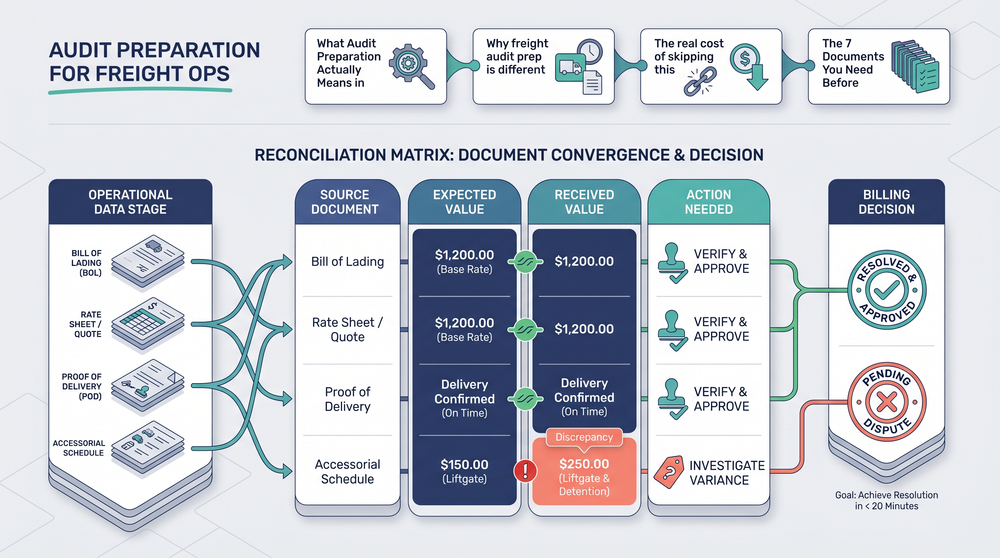
- Linehaul rate: Does the invoice amount match the rate con exactly? A $2,200 rate con that comes in as a $2,250 invoice is a $50 discrepancy. Across 500 loads a month, that's $25,000/year.
- Fuel surcharge: Is the percentage or flat amount correct? If the rate con says "DOE table, current week," pull the actual DOE number and calculate. Don't accept the carrier's calculation at face value.
- Detention: Does the invoice charge match the rate con terms? Check the hourly rate, the free time window, and the cap. A rate con that says "$75/hr after 2 hours free, capped at $300" means a $450 detention charge is automatically $150 over.
- Accessorials: Any line item not covered by the rate con should be flagged immediately. Lumper, driver assist, layover, TONU: if it's not on the rate con and wasn't authorized in writing, it's disputable.
Scenario: The fuel surcharge that compounds quietly
Example: A carrier bills fuel surcharge at 18% on a $2,200 linehaul, adding $396 to the invoice. But the rate con specifies the DOE table, and the actual DOE-based surcharge for that week is 14%, or $308. That's an $88 difference per load. If this carrier handles 80 loads for you that month, you're overpaying $7,040 in a single month. Over a year, that's $84,480 walking out the door. The only way to catch it is to pull the rate con, check the DOE table for the correct week, and compare. Every time. According to Trax's freight audit best practices, tracking freight bill status and identifying delay trends is essential for surfacing these compounding logistics inefficiencies.
If that math seems aggressive, consider the industry context. As of 2026-03-01, the Producer Price Index for truck transportation of freight stood at 159.5 (BLS PPI series WPU3012), reflecting sustained upward pressure on freight costs. When base rates are high, percentage-based surcharges amplify even small calculation errors.
Accessorial Charges Are Where You're Losing the Most Money: Here's the Backup You Need
Linehaul discrepancies are easy to spot. Accessorials are where money disappears, because each charge is smaller, the documentation is messier, and ops teams are often too busy to chase a $200 lumper fee when there are 40 loads to dispatch. But those $200 charges add up fast.
Scenario: The lumper fee with no paper trail
Example: A carrier invoices a $325 lumper fee on a grocery delivery. You pull the file and find three things missing:
- No lumper receipt. The carrier billed $325 but provided no itemized receipt from the lumper service. You have no way to verify the amount.
- No advance authorization on the rate con. The rate con says nothing about lumper fees. There's no addendum, no email, no TMS note showing the fee was approved before the carrier paid it.
- No notation on the POD. The driver didn't note that a lumper was used at delivery. The POD is clean.
Each missing piece weakens the carrier's claim. All three missing? That's a dispute you win every time, if you pull the documents. Without audit preparation, you pay the $325 and move on. Multiply that by a few loads a week and you're giving away $16,900 a year on lumper fees alone that you could have disputed.
Scenario: The TONU that never happened
Example: A carrier charges a $175 TONU (truck ordered not used) on a load. You pull the file and discover:
- The load was never dispatched in your TMS. The carrier was discussed but never confirmed.
- No carrier confirmation message exists (no email, no EDI acceptance, no load board booking).
- The rate con was drafted but never signed or countersigned.
A winning dispute file for this TONU includes the unsigned rate con, a TMS screenshot showing no dispatch, and a search of your email/messaging showing no carrier confirmation. A losing dispute file? Just the invoice and a phone note saying "I don't think we booked this." The difference is 20 minutes of audit preparation versus a $175 payment you never owed.
Detention: the charge that carriers know you struggle to dispute
Example: A carrier invoices $450 for detention on a load where the rate con caps detention at $75/hr after 2 hours of free time. For that $450 to be valid, the driver would need to have waited 6 hours beyond the 2-hour free window (6 × $75 = $450), meaning a total of 8 hours on site. You pull the BOL and see an arrival timestamp of 7:00 AM. You pull the POD and see a departure timestamp of 12:30 PM. That's 5.5 hours total, minus 2 hours free time, leaving 3.5 billable hours at $75/hr: $262.50. The carrier overbilled by $187.50. Without the timestamped BOL and POD, you have no evidence. With them, you save $187.50 on this load and set a precedent that this carrier's detention charges will be checked.
For a deeper look at how to run through carrier invoices for overbilling patterns, our guide on spotting carrier overbilling in 10 minutes walks through additional scenarios.
Common Freight Billing Red Flags That Show Up Right Before an Audit
Whether you're preparing for an internal review, a customer audit, or just trying to clean up a month's worth of carrier invoices, certain patterns scream "look closer." These are the red flags that experienced ops managers and billing coordinators learn to spot.
Red flag 1: Detention on every load from the same carrier
If a single carrier bills detention on more than 30% of their loads with you, something is off. Either they're routinely arriving early (before their appointment window, which isn't your problem), their driver is padding wait times, or there's a systemic issue at the facility that you should be negotiating into the rate. Pull the last 10 detention invoices from that carrier and compare timestamps. Patterns become obvious fast.
Red flag 2: Accessorial charges with no corresponding rate con language
A carrier who regularly adds accessorials that aren't mentioned in the rate con is either testing your audit process or has an invoicing system that auto-adds charges. Either way, every accessorial not on the rate con should be flagged and disputed with documentation. Per Trimble's freight spend analysis, hidden costs in freight spend frequently stem from accessorial charges that bypass normal rate verification.

Red flag 3: Fuel surcharges that don't match the DOE table
If your rate con specifies a DOE-based fuel surcharge and the carrier's invoice uses a different number, the carrier is either using the wrong week's index, a different table, or rounding in their favor. Pull the DOE national average for the relevant week and calculate. This is a 2-minute check that catches real money, as the fuel surcharge example above ($7,040/month on 80 loads) shows.
Red flag 4: Duplicate invoices or resubmissions with changed amounts
Some carriers resubmit invoices after a partial payment or dispute, sometimes with a slightly different amount. If you're not tracking invoice numbers and comparing versions, you can end up paying twice or paying a revised amount that wasn't agreed upon. Your TMS or accounting system should flag duplicate invoice numbers. If it doesn't, a simple spreadsheet sorted by carrier and load number will surface duplicates.
Strong file vs. weak file: a side-by-side comparison
Here's what wins and loses in a carrier dispute:
Weak dispute file: The carrier invoice and a phone note from your dispatcher saying "this doesn't look right." No rate con attached. No BOL. No timestamps. The carrier pushes back once, and you pay because you can't prove anything.
Strong dispute file: The carrier invoice, the signed rate con showing the agreed linehaul and detention terms, the BOL with a pickup timestamp, the timestamped POD, an email from your ops team declining lumper authorization, and a TMS screenshot showing the load details. The carrier sees this package and either accepts the adjustment immediately or escalates to someone who will. You win because the evidence is organized, specific, and timestamped.
The difference between winning and losing a carrier dispute is almost never about who's right. It's about who has the documents.
Building the strong file takes 15 to 20 minutes per load if your documents are reasonably organized. For brokers processing hundreds of loads, that time compounds. But so do the savings. Based on Laneproof analysis of over 12,000 carrier invoices, brokerages that maintain complete seven-document files win disputes at more than double the rate of those relying on partial documentation.
Frequently Asked Questions About Freight Audit Preparation
What do you mean by audit preparation in freight?
In freight operations, audit preparation is the process of gathering, organizing, and matching load-specific documents (rate cons, BOLs, PODs, accessorial authorizations, gate logs, TMS records, and carrier invoices) so you can verify or dispute every line item on a carrier invoice before payment. It's not a financial audit. It's an operational document check that protects your margins on every load.
What are the key steps in a freight audit process?
The freight audit process generally follows these steps: (1) receive the carrier invoice, (2) pull the corresponding rate con, (3) match linehaul rate and fuel surcharge, (4) check accessorial charges against pre-authorizations, (5) verify detention/lumper amounts against timestamps and receipts, (6) flag discrepancies with supporting documents, and (7) initiate the dispute or approve payment. Each step requires specific documents, which is why having the seven-document file ready in advance saves time and money.
How is freight audit preparation different from a DOT or FMCSA safety audit?
A DOT or FMCSA safety audit focuses on regulatory compliance: driver qualifications, hours of service, vehicle maintenance, and insurance. Per the FMCSA Safety Audit Resource Guide, these audits review whether carriers meet federal safety standards. A freight audit, by contrast, is a billing and financial review. It checks whether what the carrier invoiced matches what was contractually agreed. Both are important, but they require completely different documentation.
How long should freight audit preparation take per load?
If your documents are filed consistently (by load number, in a shared drive or TMS), pulling and matching the seven core documents should take 15 to 20 minutes per load. If your filing is inconsistent, it can take 45 minutes or more, which is where most ops teams give up and pay invoices without checking. The goal of this guide is to get your process to the 20-minute mark or less.
What if I don't have all seven documents for a load?
You work with what you have, but know that each missing document weakens your dispute position. At minimum, you need the rate con and the carrier invoice to dispute a linehaul or fuel surcharge error. For detention, you need timestamps (BOL, POD, or gate logs). For accessorials like lumper fees, you need the receipt and pre-authorization. If documents are consistently missing, that's a filing process problem worth fixing before your next dispute cycle. For a full walkthrough of what to check on every carrier invoice, see our carrier invoice audit checklist.
Pulling It All Together: Your 20-Minute Audit Prep Routine
Freight audit preparation isn't complicated. It's a discipline. Pull the seven documents. Match the rate con to the invoice, line by line. Check detention timestamps against BOL and POD. Verify fuel surcharges against the correct DOE week. Flag every accessorial that wasn't pre-authorized. Do this for 20 minutes per disputed load, and you stop losing money to billing errors that were always catchable.
The math is straightforward. A broker handling 500 loads a month at $2,200 average, losing 3.8% to overbilling, is giving away $41,800 a year. Most of that is recoverable with the right documents and a consistent process. The brokerages that recover it are the ones that treat audit preparation as an ops function, not an accounting afterthought.
If your team processes more than 50 carrier invoices a week and the 20-minute manual process still can't keep up, tools that automatically match rate cons to invoices and flag discrepancies can handle the document pull and comparison in seconds, leaving your team to focus on the disputes that actually need a human decision.
Sources
- FMCSA Safety Audit Resource Guide — Federal Motor Carrier Safety Administration
- Freight Audit Insights: The Truth About Freight Spend — Trimble Transportation
- 7 Key Freight Audit and Payment Best Practices — nVision Global
- 6 Essential Freight Audit and Payment Best Practices — Trax Technologies
- BLS Current Employment Statistics, series CEU4348400008 — U.S. Bureau of Labor Statistics
- BLS PPI series WPU3012, Truck Transportation of Freight — U.S. Bureau of Labor Statistics
Full guide: Freight Billing Compliance: What It Costs When You Can't Prove It
Related: Regulatory Requirements That Cost Brokers Money on Every Invoice
Related: Documentation Compliance for Freight Brokers: A Load-by-Load Checklist