6 TMS Workarounds Dispatchers Use Daily (And What Each One Costs You)
Researched and written with AI assistance. Reviewed by the Laneproof team.
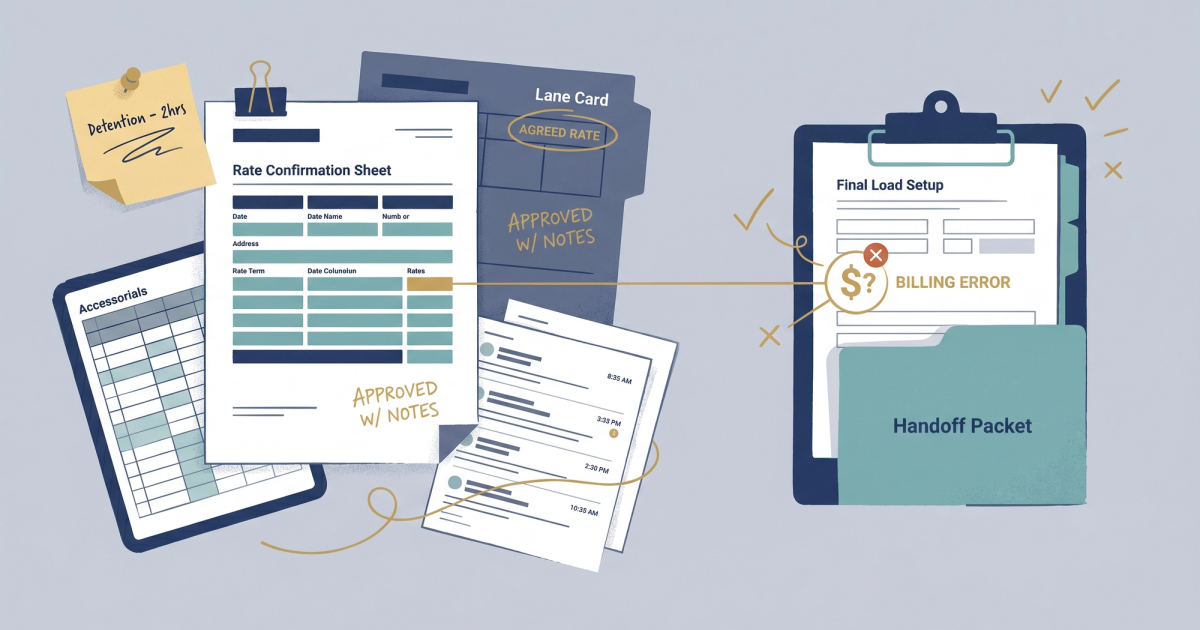
A single transposed lumper fee ($175 entered as $75) opens a carrier dispute that takes three hours to resolve. A detention window tracked on a sticky note gets thrown away before billing closes, and $150 walks out the door. Multiply that across 40 loads a month, and you're looking at $6,000 in unbilled detention per year from one dispatcher's desk. Every freight ops team has a collection of TMS workarounds: side spreadsheets, email folders, whiteboards, Google Drives full of PODs that should be in the system but aren't. These workarounds exist because your TMS has gaps. The problem isn't that you're using them. The problem is that each one introduces a specific billing error, and most teams can't trace the error back to the workaround that caused it. This guide documents six of the most common manual freight workflow fixes dispatchers and billing coordinators use every day, traces each one to a dollar amount, and helps you decide which ones to fix first.
Your TMS Wasn't Built for How You Actually Work
Every TMS promises to be the single source of truth for your freight broker operations. According to DAT's overview of TMS capabilities for freight brokers, a good TMS should handle load management, carrier selection, document storage, invoicing, and reporting from one platform. On paper, that covers your entire workflow. In practice, it covers about 70% of it.
The other 30% is where your team improvises. A dispatcher builds loads in a spreadsheet because the TMS load board is too slow. A billing coordinator copies accessorial charges from email into a separate tracker because the TMS doesn't have a clean field for lumper fees. An onboarding coordinator saves carrier packets to Gmail because the TMS document upload crashes on files over 5MB.
These aren't edge cases. In a Reddit thread where logistics professionals shared their biggest TMS workarounds, the recurring themes were clear: repeated address fixes that the TMS won't save, manual load-building outside the system, and parallel spreadsheet tracking because built-in reporting is too limited or too slow. These are ops and dispatch professionals describing their daily reality, not a sales pitch about what a TMS should do.
The gap between TMS design and freight ops reality is where workarounds are born. And every workaround is a place where data moves from a structured system into an unstructured one: a sticky note, a spreadsheet cell, a Slack message, a whiteboard. That transition is where billing errors enter your workflow.
Why TMS data entry gaps keep growing
Your operation changes faster than your TMS does. You add new accessorial types. You start running reefer loads with different detention rules. You onboard carriers who need different packet documents. Each change introduces a new data point that your TMS may not have a clean field for. Instead of customizing the system (which costs money and time), your team builds a workaround. According to Transfix's guide on knowing when to replace a TMS, signs that a TMS is driving workaround behavior include slow reporting, disconnected pricing tools, and over-reliance on spreadsheets. All of these are symptoms of TMS data entry gaps that compound over time.
The 6 TMS Workarounds Freight Ops Teams Use Every Single Day
These aren't hypothetical. These are the exact workarounds we see in freight broker and carrier operations running 100 to 5,000 loads per month. If you manage dispatchers, billing coordinators, or ops staff, you'll recognize at least three of these immediately.
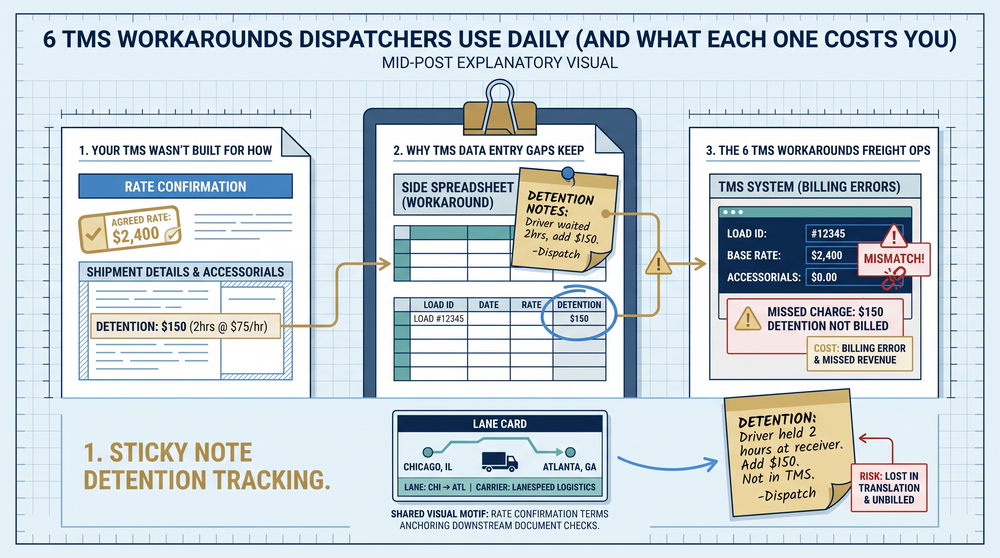
1. Sticky note detention tracking
The dispatcher gets a call from the driver: "I've been sitting at the receiver for two hours." The dispatcher writes the time on a sticky note or a notepad, intending to log it in the TMS later. Later never comes, or the note gets lost, or the detention window doesn't get entered before the invoice goes out. The TMS may have a detention field, but it's buried three clicks deep, or it requires a specific format the dispatcher doesn't have time to use mid-shift.
2. Side spreadsheet for accessorials
Lumper fees, pallet exchanges, reweigh charges, driver assist fees. These come in via email, text, or phone call. The billing coordinator logs them in a spreadsheet because the TMS either doesn't have dedicated accessorial fields or requires too many steps to add each charge to a load. The spreadsheet becomes the working document for reconciliation, and the TMS record stays incomplete.
3. Email thread rate confirmation workaround
A freight broker agrees to a revised rate with a carrier over email after the TMS has already generated the original rate con. The updated rate con lives in an email thread. The TMS still shows the original rate. When the carrier invoices, the billing team references the TMS and either overpays or underpays based on stale data.
4. Manual fuel surcharge calculation
The TMS rate engine isn't synced to the current DOE diesel rate, or the fuel surcharge table hasn't been updated. The dispatcher pulls up the DOE site manually, calculates the surcharge on a calculator or in Excel, and applies it to the shipper invoice outside the TMS. But sometimes they use last week's rate, or the wrong mileage band, and the surcharge is off by $10 to $30 per load.
5. Carrier packet collected outside TMS via Gmail
The onboarding coordinator emails the carrier for their W-9, insurance certificate, and authority letter. The carrier replies with attachments. The coordinator saves them to a Gmail folder or a shared drive instead of uploading them to the TMS, either because the upload interface is clunky or because the TMS has file size limits. Six months later, the carrier sends an updated W-9 with a new EIN. It lands in the same Gmail folder. Nobody updates the TMS.
6. PODs and BOLs stored in Google Drive instead of TMS
Drivers text photos of the POD and BOL. Someone on the ops team downloads them and drops them into a shared Google Drive folder organized by load number (or date, or carrier name, depending on who created the folder). The TMS has a document attachment feature, but it's easier to just use Drive. Until you need the document during a dispute call and can't find it in time.
Where Each TMS Workaround Breaks Down and What It Costs You
Every workaround on this list functions well enough day to day. That's why they persist. The cost isn't in the workaround itself. It's in the downstream billing error, the missed charge, or the dispute that the workaround eventually produces. Here's where each one breaks.
Scenario: Sticky note detention tracking leads to unbilled charges
A dispatcher tracks detention on a sticky note for a reefer load. The driver waited 2 hours at the receiver. At $75/hour, that's $150 in billable detention. But the sticky note gets buried under a rate con printout, and the detention never gets invoiced to the shipper. This isn't a one-time miss. If your team handles 40 loads per month where detention applies and misses even 10% of them, that's 4 loads × $150 = $600/month, or $7,200/year in unbilled detention. Scale that to a team handling 200 detention-eligible loads per month and the exposure grows fast.
A single missed 2-hour detention window at $75/hour costs $150. Across 40 loads per month with a 10% miss rate, that's $7,200 per year in charges that never reach the shipper invoice.
Scenario: Spreadsheet accessorial transposition error
A billing coordinator copies a lumper fee from an email into a side spreadsheet. The actual fee is $175. The coordinator types $75. The carrier invoices for $175. The billing team sees $75 in their tracker and disputes the carrier's invoice. Three hours of back-and-forth follow. The carrier produces the receipt. The dispute is resolved in the carrier's favor, but those three hours of staff time are gone. At a loaded cost of $25/hour for a billing coordinator, that's $75 in labor for one transposition error. If this happens twice a month, you're spending $1,800/year resolving disputes caused by manual data entry mistakes. And that's before accounting for the carrier relationship damage.
Scenario: Email rate con creates linehaul discrepancy
A broker agrees to a $200 increase on a linehaul rate via email. The TMS still shows the original rate. The carrier invoices at the agreed-upon higher rate. The billing coordinator, working from TMS data, flags it as an overbill and short-pays the carrier by $200. Multiply that by 12 loads in a month, and you've underpaid a carrier by $2,400 in a single billing cycle. That triggers a formal dispute, possible payment hold, and potential loss of a reliable carrier. The root cause: the revised rate con lived in an email thread, not in the TMS.
Scenario: Stale fuel surcharge data undercharges the shipper
A dispatcher calculates fuel surcharges manually because the TMS rate engine hasn't been updated. They use last week's DOE rate instead of the current week's. The difference is $0.02 per mile on a 900-mile load, which works out to $18 per load. At 300 loads per month, that's $5,400 in monthly exposure where the shipper is being undercharged. Over a quarter, that's $16,200 in revenue your company earned but didn't invoice for.
Scenario: Outdated W-9 triggers 1099 correction
A carrier sends an updated W-9 with a new EIN. The email goes to the onboarding coordinator's inbox and gets filed in a Gmail folder, but the TMS still has the old EIN. Payments go out under the wrong EIN all year. At tax time, the 1099 is filed incorrectly. The correction process takes 2 to 3 weeks of accounting time and can delay carrier payments, straining the relationship. The cost isn't just the accounting hours. It's the carrier who decides to stop hauling for you because they got a bad 1099.
Scenario: Missing POD costs $320 in a dispute
A shipper disputes a $320 accessorial charge. The broker needs the POD to prove the charge is valid. The POD is in a shared Google Drive, but it was saved under the wrong load number. The broker can't produce it during the dispute call. The shipper holds firm, and the broker concedes the $320 rather than spend more time searching. If your team handles 500 loads per month and can't locate documents on 2% of disputed loads, that's 10 loads where you're conceding charges you legitimately earned.
These are the kinds of hidden margin losses that small freight brokers absorb without realizing it. The workaround works in the moment. The cost shows up weeks later in reconciliation, disputes, or missed revenue.
The Billing Errors That Show Up Downstream from Manual Workflows
The six workarounds above produce a predictable set of billing errors. Once you know the pattern, you can audit for them.
Reconciliation failures from split data sources
When your invoice reconciliation process pulls from the TMS but your actual working data lives in spreadsheets and email threads, the reconciliation is guaranteed to miss discrepancies. The TMS shows one linehaul rate. The spreadsheet shows a different accessorial total. The email shows a third version of the rate con. No single system has the complete picture. This is why reconciliation takes hours per week for most freight broker operations: your billing coordinator is manually cross-referencing three or four data sources that should all be one.
If your team is still entering BOL data by hand and reconciling across disconnected sources, the billing errors described above aren't occasional. They're structural.
The five most common downstream errors
- Unbilled detention and layover: Charges tracked outside the TMS that never make it to the shipper invoice.
- Transposed accessorial amounts: Manual data entry from email to spreadsheet to invoice introduces digit errors on lumper fees, driver assist, and reweigh charges.
- Stale rate con references: Carrier invoices don't match TMS records because the agreed-upon rate was revised via email and never updated in the system.
- Fuel surcharge undercharges: Manual calculation using outdated DOE rates leaves money on the table on every load.
- Missing TONU charges: A dry run charge of $150 tracked on a whiteboard gets erased before billing closes. The load is re-tendered, the TONU is forgotten, and the broker absorbs the cost.
Each of these errors traces directly back to a specific workaround. The detention error comes from sticky note tracking. The transposition comes from the side spreadsheet. The rate con mismatch comes from the email thread workflow. The fuel surcharge gap comes from manual calculation. The TONU miss comes from the whiteboard. When you audit your billing, don't just look for the error. Look for the workaround that caused it.
When to Fix the Workaround vs. When to Fix the TMS
Not every workaround justifies a TMS overhaul. Some are cheap to fix with a process change. Others signal that your TMS has a fundamental gap that no amount of discipline will close. Here's how to think about it.
Fix the workaround when the TMS has the feature but your team isn't using it
If your TMS has a detention field and your dispatchers aren't using it because it takes too many clicks, that's a training and process problem. Build it into the dispatch workflow as a required step before load status can be updated. Same with accessorial fields: if they exist but are buried in a sub-menu, work with your TMS admin to surface them. The cost of retraining is a few hours. The cost of not retraining is thousands per year in billing errors.
Fix the TMS when the feature doesn't exist or can't be customized
If your TMS doesn't have a clean way to attach rate con revisions to a load, no amount of dispatcher discipline will prevent the email thread workaround. That's a system gap. According to PCS Software's outline of essential TMS requirements, a TMS should handle document management, rate management, and carrier communication in an integrated way. If yours can't, you're either looking at a vendor feature request, a third-party integration, or a platform change.
Per Dashdoc's analysis of hidden costs from TMS gaps, a U.S.-based shipper using a well-implemented TMS achieved $2.2 million in logistics cost avoidance in one year. You don't need to be that size to benefit from closing your biggest gaps. Even fixing one workaround that's costing you $5,000 per year justifies most integration costs.
The decision framework
- Step 1: List every workaround your team uses. Be specific: who does it, how often, and what data moves outside the TMS.
- Step 2: Trace each workaround to a billing outcome. Does it cause unbilled charges, transposition errors, reconciliation delays, or dispute exposure?
- Step 3: Estimate the monthly cost. Use the scenarios in this article as a starting framework.
- Step 4: Check if your TMS can handle the workflow. If yes, retrain your team. If no, evaluate whether a process layer (like a document automation tool) can bridge the gap without replacing the TMS entirely.
- Step 5: Prioritize by cost. Fix the workaround with the highest monthly dollar exposure first.
Most ops teams don't need a new TMS. They need to close two or three specific gaps where manual freight workflow is leaking money. The key is identifying which gaps those are before you spend six months evaluating platforms.
Frequently Asked Questions About TMS Limitations in Freight Operations
Why wouldn't a TMS work for certain freight workflows?
A Transportation Management System fails to handle certain workflows cleanly when the data inputs don't match the fields the system was designed for. Accessorial charges that arrive via email, rate con revisions negotiated by phone, detention tracked in real time by drivers: these are all common freight scenarios where the TMS data entry process is too rigid or too slow for the actual pace of operations. The result is a dispatcher workaround that moves critical billing data outside the system.
How do I know if my TMS workarounds are costing me money?
Audit your last 30 days of carrier invoice disputes. For each dispute, trace the discrepancy back to its data source. If the root cause is a spreadsheet entry, an email thread, a sticky note, or any record that lives outside your TMS, that's a workaround-driven billing error. Multiply the disputed amount by the frequency, and you have your monthly exposure. Most freight broker operations find $2,000 to $10,000 per month in workaround-related billing errors once they start looking.
Should I replace my TMS or add tools to fill the gaps?
Replacing a TMS is a 6 to 12 month project with significant switching costs. Before going that route, identify whether your gaps are in data capture (getting information into the system), document management (storing and retrieving BOLs, PODs, rate cons), or reconciliation (matching carrier invoices to load records). Many TMS limitations in freight can be addressed with targeted tools that sit alongside your existing system rather than replacing it entirely.
What's the most expensive TMS workaround for small freight brokers?
For brokerages running 100 to 500 loads per month, the most expensive workaround is typically manual fuel surcharge calculation. A $18 per load undercharge across 300 loads is $5,400 per month in revenue that should have been invoiced. Unlike detention or accessorial errors that affect individual loads, fuel surcharge errors touch every single load and compound quickly. The second most expensive is usually rate con version control through email, where linehaul discrepancies can reach $2,400 per month on a relatively small volume.
How do I get my dispatch team to stop using workarounds?
You don't, at least not by mandate alone. Dispatchers use workarounds because they're faster than the TMS process. The only way to eliminate a workaround is to make the correct process equally fast or faster. That means simplifying TMS data entry for the specific fields your team skips, automating document capture so PODs and BOLs get indexed without manual upload, and building required checkpoints into load status updates so detention and accessorial data gets captured before a load can be marked complete.
Conclusion: Trace the Error Back to the Workaround
Your team's TMS workarounds aren't a sign of laziness. They're a sign that the system doesn't match the work. But every workaround is also a place where billing data gets lost, transposed, or delayed. Detention tracked on sticky notes becomes unbilled revenue. Accessorials logged in spreadsheets become transposition errors. Rate cons revised via email become carrier disputes. The fix starts with mapping each workaround to its downstream cost, then deciding whether the solution is retraining, a process change, or a tool that closes the gap.
If your team processes more than 50 invoices per week and you're seeing recurring disputes tied to data that lives outside your TMS, tools that automatically capture and match freight documents to load records can close the gaps covered in this guide without requiring a full platform switch. Start by auditing the six workarounds above. The ones that cost you the most are the ones to fix first.
Sources
- The Best TMS System for Freight Brokers — DAT
- Ops/Dispatch folks: what's your biggest "TMS workaround" — Reddit r/logistics
- How Do I Know It's Time to Replace My TMS? — Transfix
- Essential Transportation Management System Requirements — PCS Software
- The Real Cost of Not Having a TMS: Hidden Expenses — Dashdoc
Full guide: TMS Limitations Every Freight Ops Team Hits (But Nobody Talks About)