Transportation Audit: Which Line Items to Check First
Researched and written with AI assistance. Reviewed by the Laneproof team.
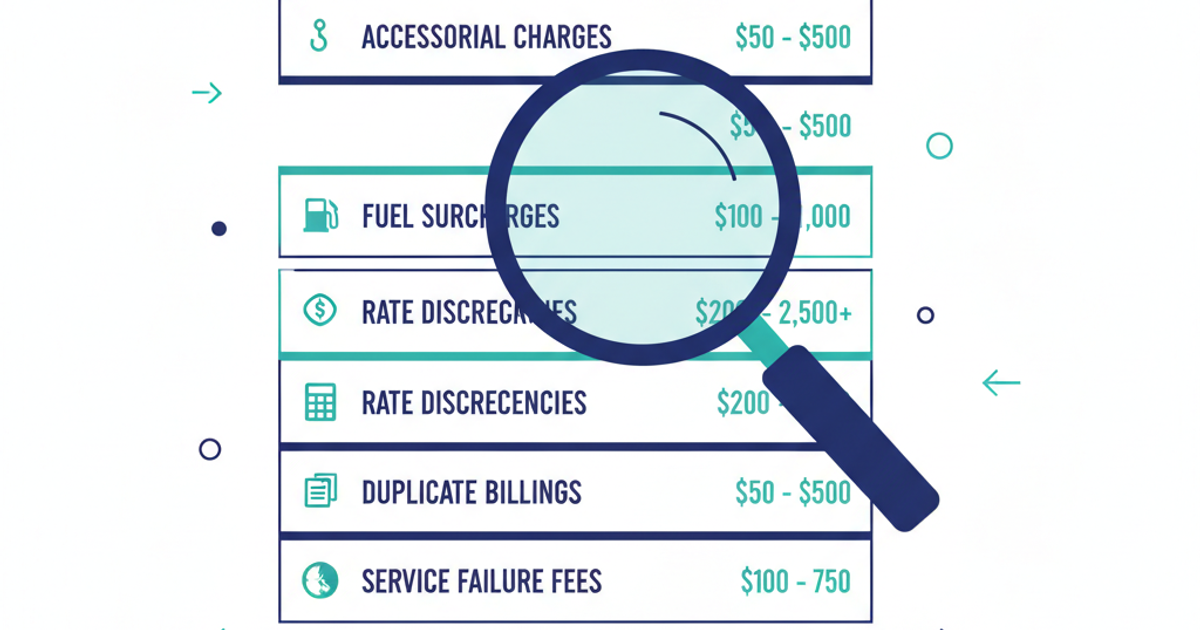
A transportation audit is the process of verifying every line item on a carrier invoice against your rate confirmation, BOL, POD, and load tender to catch overbilling, recover costs, and confirm carrier compliance before payment goes out. Its core purposes: freight cost recovery, accessorial charge verification, and billing accuracy. If you run 500 loads a month at a $2,000 average load rate and your overbill rate sits at even 3.8%, you are leaving roughly $38,000 per month on the table. According to Transportation Insight's freight audit analysis, between 3% and 6% of all freight invoices contain errors, with most stemming from accessorial charges. That is not a rounding error. That is someone's salary walking out the door every month because nobody checked the math.
This guide does not rehash the textbook definition and move on. It gives you a prioritized checklist of exactly which invoice line items to audit first, what each error type costs in real dollars, and how to build a repeatable audit workflow that takes hours off your week without hiring a dedicated audit team or outsourcing to a third party.
What Is a Transportation Audit (and Why the Textbook Definition Misses the Point)
Every freight ops article defines a transportation audit as "a review of freight invoices to ensure accuracy." That is technically correct and practically useless. If you manage 200 to 500 loads per month, you already know invoices need checking. The question you actually need answered: which line items cause the most damage, and where should you spend your limited audit time?
The Regulatory Framework (and Where It Stops Helping You)
The federal government takes transportation payment auditing seriously, at least for its own spending. 41 CFR Part 102-118 establishes the statutory and policy framework governing transportation payment and audit mechanisms for federal agency transportation services. It covers prepayment audits, postpayment audits, and the procedures for recovering overcharges. The DOT Office of Inspector General runs its own audit programs across Department of Transportation expenditures.
Here is the problem: none of that regulatory structure was built for a 15-person brokerage trying to reconcile 300 carrier invoices a week. The principles are sound (verify before you pay, audit after you pay, recover what you overpaid), but the execution has to look completely different at SMB scale. You do not have a dedicated audit department. You have an ops manager, maybe a billing coordinator, and a stack of invoices that grows every morning.
What a Practical Audit Actually Looks Like
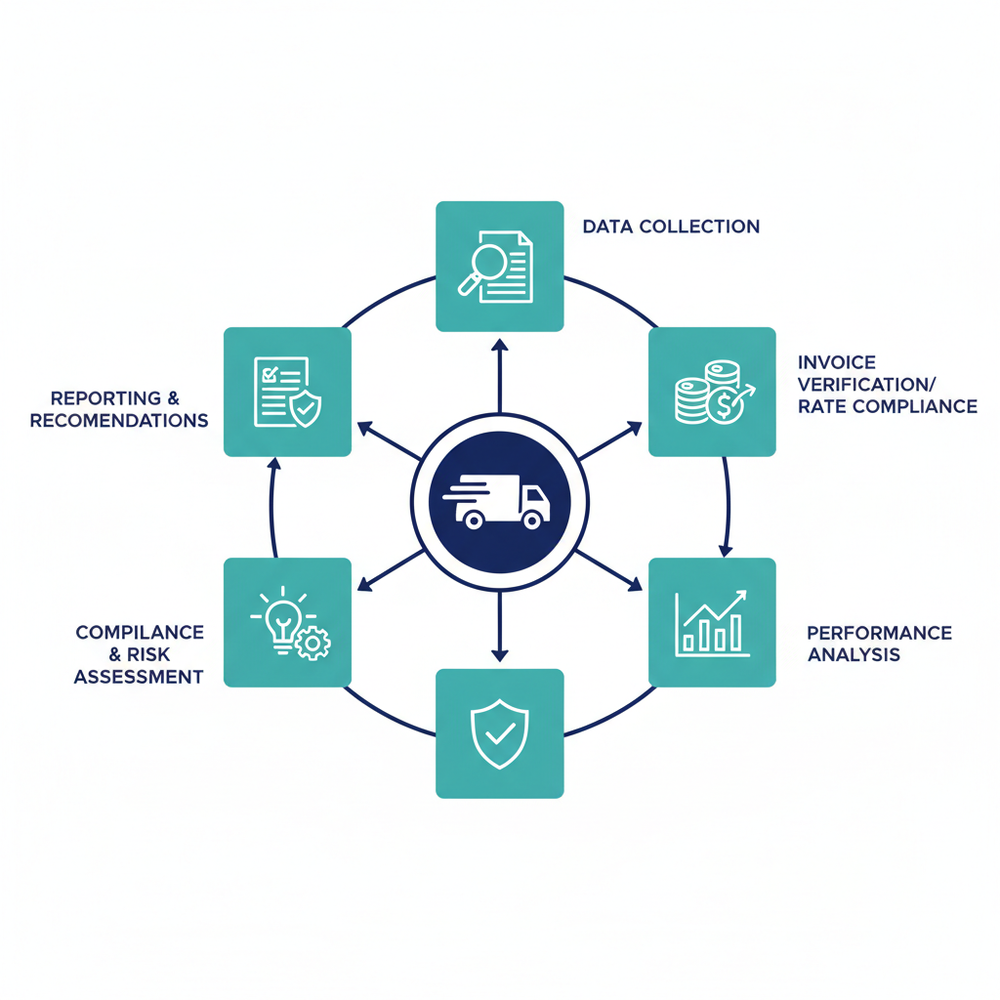
A useful transportation audit for a small broker or carrier has five core steps, according to Ship4WD's freight audit process overview: data collection, invoice verification, compliance checks, exception handling, and dispute resolution. The sixth step they list, cost allocation, matters more for enterprise shippers with complex GL coding. For you, the money is in steps two through five.
Invoice verification means matching the carrier invoice to the rate con line by line. Compliance checks mean confirming the charges comply with the contracted terms. Exception handling means flagging anything that does not match. Dispute resolution means getting the money back. Simple framework, hard execution when you are doing it manually across hundreds of loads. That is why the order you check things matters more than checking everything.
The Line Items That Cost Small Brokers the Most Money
Not all billing errors cost the same amount. If you are going to audit manually (and most small brokers do), you need to prioritize the line items with the highest dollar exposure per error. Here is the ranked list, based on where the most money leaks out on a per-load and per-month basis.
1. Detention Charges
Detention is the single most overbilled line item for small brokers. The math is straightforward but the disputes are not. Carriers bill detention based on time at the dock, but many invoices round up aggressively or misrepresent the actual dwell time.
Example: A carrier bills 2 hours of detention at $75/hour ($150 total), but the BOL timestamp shows a 55-minute dock time, which falls inside free time. That is a $112.50 overcharge on a single load. Run 200 loads per month and assume even 10% have a similar discrepancy. That is $22,500 in annual exposure from detention alone. The fix: always compare the BOL arrival/departure timestamps against the detention hours billed. If the carrier cannot produce a signed detention letter with timestamps, you have grounds to dispute.
2. Fuel Surcharge Miscalculations
Fuel surcharges should be calculated against a specific base rate using the current DOE National Average Diesel index. Two common errors: carriers applying FSC to the gross linehaul instead of the contracted base, or using an outdated DOE index week.
Example: On a $1,200 linehaul, applying the fuel surcharge percentage to the gross amount instead of the contracted base rate can inflate the load by $40 to $90, depending on the current DOE index. Across 300 loads per month, even a $50 average overcharge means $15,000 per month or $180,000 per year. Check the FSC calculation method specified in your rate con, then verify the DOE index date used on each invoice.
3. Lumper Fees Without Receipts
Lumper fees are legitimate charges for loading or unloading services at facilities. Average lumper charges run $150 to $350 per stop. The problem is when carriers bill lumper fees without a signed lumper receipt tied to the BOL. Without that receipt, you have no way to verify the fee was actually incurred, the amount is accurate, or the service was even performed.
Your audit rule: no lumper receipt, no payment. This one rule, applied consistently, can save a mid-size brokerage thousands per month. For a deeper breakdown of how to structure this kind of freight bill audit check, including the specific documents to match, that guide walks through the full process.
4. TONU and Dry Run Charges
Truck Order Not Used (TONU) charges range from $150 to $300 per occurrence and are one of the most commonly disputed accessorials in the industry. TONU is a valid charge when a carrier dispatches a truck and the load cancels. It is not valid when the rate confirmation includes a no-TONU clause.
Example: A carrier invoices a $250 TONU on a load that has a signed rate confirmation with a no-TONU clause. That is a straightforward dispute, but only if someone actually compares the invoice to the rate con. At scale, these slip through because the ops team is already onto the next load by the time the invoice arrives.
5. Layover Charges Without Proof
Layover fees ($250 to $400 per day) apply when a carrier is held at a facility overnight or beyond a reasonable window. The audit issue: layover charges frequently appear on invoices without a load tender timestamp proving the carrier was actually held. Without that documentation, you are paying based on the carrier's claim alone. Always require the load tender or dispatch record showing the original appointment time and the actual departure time.
6. Duplicate Invoice Submissions
This one is not a hidden fee. It is a process failure that costs real money. Duplicate invoices get submitted, approved, and paid more often than most ops teams want to admit.
Example: A duplicate invoice is caught 18 days after payment. At that point, recovery requires a collections-style dispute process: formal demand, proof of duplicate, back-and-forth with the carrier's accounting team. Compare that to catching it within 3 days, which is typically a simple email and a credit memo. The earlier you catch duplicates, the cheaper the recovery.
How to Run an Invoice Audit Without a Dedicated Audit Team
Most small brokers do not have audit staff. The billing coordinator handles invoices along with carrier packets, POD collection, and half a dozen other tasks. The goal is not to audit every detail on every invoice. The goal is to build a 30-minute daily routine that catches the highest-dollar errors first.
The 5-Step Daily Audit Routine
This workflow is designed for an ops manager or billing coordinator processing 50 to 200 invoices per week. It follows the core audit procedure steps (data collection, verification, compliance check, exception handling, dispute resolution) adapted for a one-person audit function.
- Step 1: Batch by carrier. Group incoming invoices by carrier. High-volume carriers get audited first because they represent the most total dollar exposure. If one carrier handles 40% of your loads, they get 40% of your audit attention.
- Step 2: Rate con match. Pull the rate con for each invoice. Compare linehaul rate, contracted accessorial terms, and fuel surcharge method. Flag anything that does not match. This single step catches the majority of billing discrepancies on accessorial charges.
- Step 3: Timestamp check. For any invoice with detention or layover charges, pull the BOL and compare timestamps. If the math does not add up, move it to the dispute queue.
- Step 4: Receipt verification. For lumper fees, TONU, and any other accessorial that requires supporting documentation, confirm the receipt or proof document is attached. No receipt means no approval.
- Step 5: Duplicate scan. Before approving any invoice for payment, search your system for the same carrier, same load number, and same dollar amount within the last 30 days. This takes 10 seconds per invoice and prevents the most expensive process error in freight billing.
Auditing rate con vs. invoice match on 50 loads can take 4 to 6 hours manually but catches discrepancies on roughly 1 in 8 loads for operators without an existing audit process. That time investment pays for itself many times over. If you want to understand how much money a consistent freight audit process saves for a small brokerage, the numbers are laid out there.
Carrier Billing Tactics That Hide Inside Normal-Looking Invoices
Most overbilling is not fraud. It is a billing department applying charges in the way that benefits the carrier, using ambiguity in the rate confirmation or missing documentation as cover. Knowing what to look for helps you dispute faster and negotiate better terms.
Gross vs. Base Rate Fuel Surcharge Application
As covered above, some carriers apply the fuel surcharge percentage to the gross linehaul rather than the contracted base rate. On a single load, the difference is $40 to $90. Across a year, it compounds into five figures. Your rate confirmation should specify the FSC calculation method. If it does not, add it. If the carrier's invoice uses a different method, dispute every occurrence and update the carrier packet for future loads.
Detention Rounding
Carriers that bill detention in 1-hour increments (rather than 15-minute increments) effectively round up every detention event. A driver who waits 1 hour and 10 minutes gets billed as 2 hours. At $75/hour, that rounding adds $65 per event. Specify 15-minute detention increments in your rate confirmation and audit against that standard.
Accessorial Charges With No Rate Con Notation
This is the catch-all category. Charges appear on the invoice (inside delivery, liftgate, residential delivery, reweigh) that have no corresponding notation on the rate confirmation. Sometimes these are legitimate charges for services that were needed at delivery. Sometimes they are line items the carrier's billing system adds automatically. The only way to know: compare every accessorial line item to the rate con. If it is not on the rate con, it requires documentation or it does not get paid. For guidance on handling these disputes without damaging carrier relationships, this freight invoice dispute process guide covers the communication side.
In-House vs. Outsourced Auditing: What Actually Makes Sense at Your Volume
The freight audit and payment market is growing fast. According to Mordor Intelligence's Freight Audit and Payment Market report, the market is estimated at USD $0.97 billion in 2025 and is expected to reach USD $1.89 billion by 2030, representing a CAGR of 14.2%. That growth is driven by companies outsourcing what they used to do manually. But outsourcing is not the right move for everyone.
When In-House Auditing Works
In-house auditing makes sense when you process fewer than 500 loads per month, your billing coordinator has capacity for a 30-minute daily audit routine, and your average load rate is high enough that catching 1-in-8 discrepancies pays for the time invested. At 200 loads per month with a $2,000 average rate, a 3.8% error rate (per Transportation Insight's invoice error analysis) means roughly $15,200 per month in potential overbilling. Even recovering half of that more than justifies the hours.
The key is having a structured process, not just "eyeballing" invoices. The 5-step routine above gives you structure. Without it, in-house auditing tends to be inconsistent: thorough during slow weeks, skipped entirely during peak volume.
When Outsourcing Starts to Make Sense
Outsourced freight audit and payment services typically charge on a per-transaction basis or take a percentage of recovered savings. They make sense when your volume exceeds what one person can audit consistently (usually above 500 loads/month), when you are losing more to unaudited invoices than the service costs, or when your team's time is more valuable spent on load execution than invoice review.
Loop's freight audit best practices guide recommends centralizing all freight data before deciding on an audit approach, whether in-house or outsourced. The reasoning is practical: you cannot audit what you cannot find. If your invoices live in email threads, your rate cons are in a TMS, and your BOLs are in a file cabinet, the audit process breaks down regardless of who does it.
The Hybrid Approach
Many brokers in the 200 to 800 load/month range use a hybrid model: in-house audit for the top five error categories (detention, fuel surcharge, lumper, TONU, duplicates) and periodic outsourced audits on the full invoice set to catch what the daily routine misses. This keeps costs low while still recovering the bulk of overbilling.

Between 3% and 6% of all freight invoices contain errors. For a broker running 500 loads per month at a $2,000 average rate, that is $30,000 to $60,000 in monthly exposure. Most of it hides in accessorial charges.
Real Dollar Examples: What Unaudited Invoices Actually Cost
The percentages are useful, but dollar examples make the case to whoever approves your time spent on auditing. Here are three scenarios at different volumes.
Scenario 1: Small Broker, 100 Loads/Month
Average load rate: $1,800. At a 3.8% error rate (per Transportation Insight), that is roughly $6,840 per month in potential overbilling. If your billing coordinator spends 5 hours per week on the 5-step audit routine and catches half the errors, you recover $3,420 per month, or $41,040 per year. That is a strong return on 20 hours of monthly labor.
Scenario 2: Mid-Size 3PL, 500 Loads/Month
Average load rate: $2,000. At a 3.8% error rate, you are looking at $38,000 per month in potential overbilling, or $456,000 per year. Even a partial audit process that catches the top three error categories (detention, fuel surcharge, and lumper fees) will recover a significant portion of that. At this volume, the 5-step routine needs to be supplemented with batch automation or a dedicated part-time audit function.
Scenario 3: The Delayed Duplicate
A carrier submits invoice #4471 for a $2,350 load on March 3. Payment goes out March 7. On March 21, the same carrier submits invoice #4471-R (labeled as a "revised" invoice) for $2,350. Nobody catches it. Payment goes out March 25. Total overpayment: $2,350. Discovery happens during month-end reconciliation on April 2. Recovery takes 6 weeks of back-and-forth because the carrier's AP team processes refunds monthly. If someone had run a duplicate check on March 21 (Step 5 of the audit routine), the catch would have taken 10 seconds and the fix would have been a single email.
Frequently Asked Questions
What is a transportation audit?
A transportation audit is the process of reviewing carrier invoices against contracted rates, supporting documents (rate con, BOL, POD), and load tender records to verify billing accuracy. Its core purposes are freight cost recovery, carrier compliance verification, and identifying billing discrepancies before (or after) payment. For federal agencies, the audit process is governed by 41 CFR Part 102-118. For private brokers and carriers, it is a self-imposed financial control that directly protects margins.
What are the 5 audit procedures in a freight context?
The five core steps are: (1) data collection, gathering all invoices, rate cons, BOLs, and PODs for the audit period; (2) invoice verification, matching billed charges to contracted rates line by line; (3) compliance checks, confirming charges comply with the terms of the rate confirmation and any carrier agreements; (4) exception handling, flagging and categorizing discrepancies by type and dollar amount; and (5) dispute resolution, contacting carriers with documentation to recover overcharges or correct future invoices.
How long does a transportation audit take for a small brokerage?
It depends on volume and process. Auditing rate con vs. invoice match on 50 loads takes 4 to 6 hours manually. A structured daily routine checking the top five error categories (detention, fuel surcharge, lumper fees, TONU, duplicates) takes roughly 30 minutes per day for a billing coordinator processing 50 to 200 invoices per week. The time investment drops significantly with document extraction tools or TMS integrations that pre-match rate cons to invoices.
What are the most common freight billing errors?
The highest-dollar errors for small brokers are detention overcharges (billing more hours than BOL timestamps support), fuel surcharge miscalculations (applying FSC to gross linehaul instead of contracted base rate), lumper fees billed without receipts, TONU charges on loads with no-TONU rate con clauses, and duplicate invoice submissions. According to Transportation Insight, 3% to 6% of all freight invoices contain errors, with accessorial charges being the primary source.
Is it worth outsourcing a freight audit for a small brokerage?
At volumes below 500 loads per month, in-house auditing with a structured daily routine usually delivers a better cost-to-recovery ratio than outsourcing. Above 500 loads, outsourced or hybrid models start to make financial sense because the volume exceeds what one person can consistently audit. The deciding factor: are you losing more to unaudited invoices than the outsourced service would cost? If the answer is yes (and at a 3.8% error rate on 500 loads at $2,000 each, it is $38,000/month in exposure), outsourcing pays for itself.
Build the Audit Habit Before You Buy the Tool
The biggest takeaway from this guide is not which software to buy. It is which line items to check first and in what order. Detention, fuel surcharge, lumper fees, TONU, and duplicate invoices represent the bulk of overbilling exposure for small brokers and carriers. A disciplined 30-minute daily routine checking those five categories will recover more money than a sporadic, check-everything-once-a-month approach.
Start with the 5-step workflow. Build the habit over two weeks. Track what you catch and how much you recover. Once you have the data proving your error rate and monthly exposure, you will know exactly whether to keep auditing manually, hire for it, or invest in tools that automatically match invoices to rate cons and flag discrepancies before you pay. The process comes first. The savings follow.
Sources
- DOT Office of Inspector General Audits — U.S. Department of Transportation
- 41 CFR Part 102-118: Transportation Payment and Audit — Electronic Code of Federal Regulations
- Freight Audit Insights: The Truth About Freight Spend — Trimble Transportation
- Freight Audit and Payment Market Size & Growth to 2030 — Mordor Intelligence
- Freight Audit and Payment: Protecting Profit in Soft Rates — Transportation Insight
- Freight Audit and Payment Best Practices — Loop
- Freight Audit: Meaning, Process & Best Practices — Ship4WD
Full guide: Freight Audit for SMB Brokers: What It Costs to Skip It