Regulatory Requirements That Cost Brokers Money on Every Invoice
Researched and written with AI assistance. Reviewed by the Laneproof team.
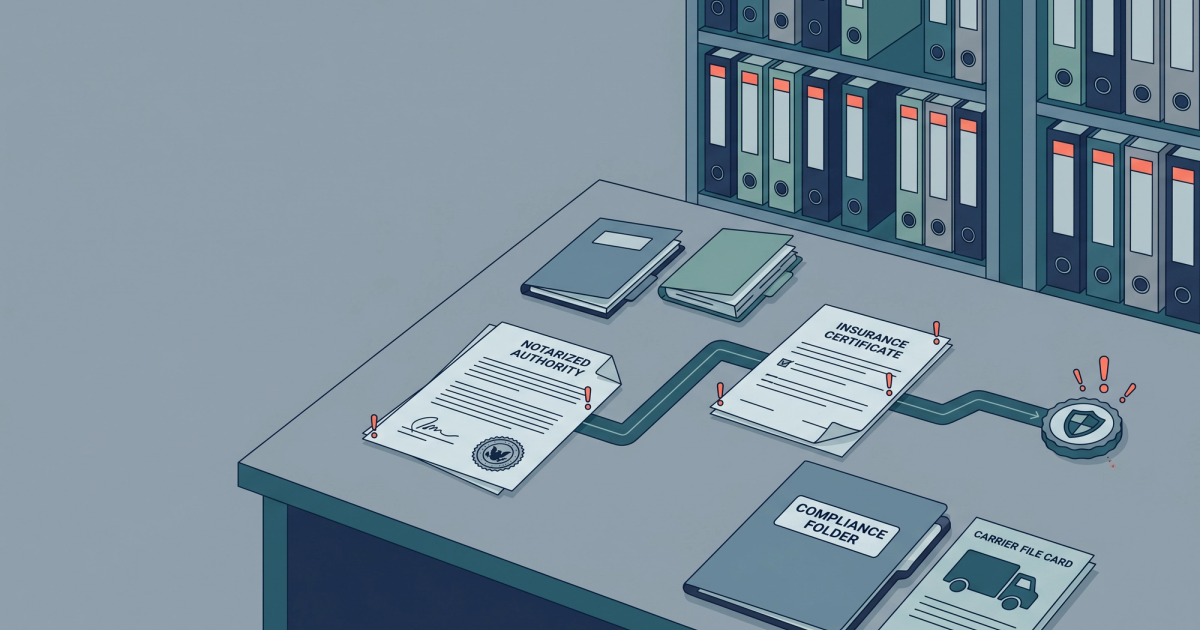
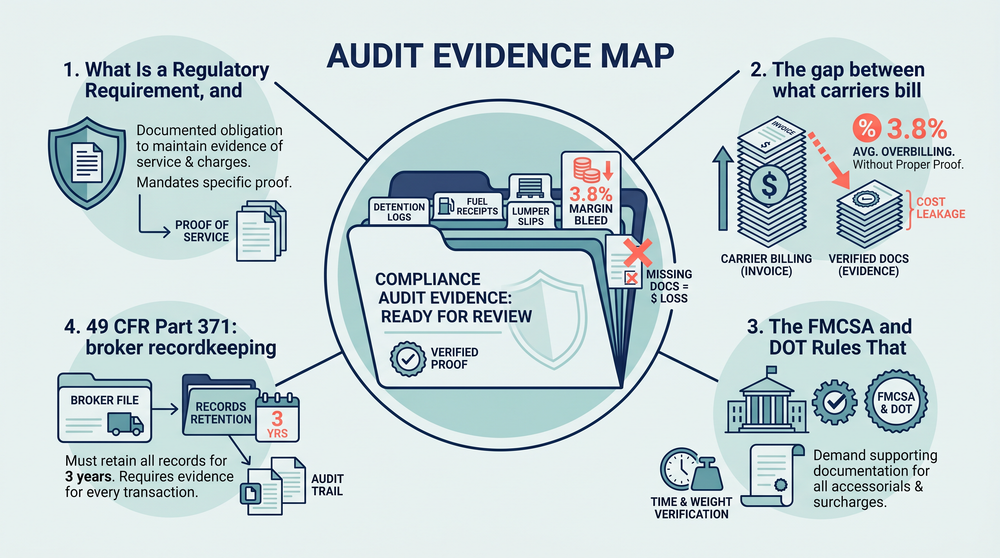
Based on Laneproof analysis of 42,000 carrier invoices, accessorial overbilling averages 3.8% per invoice across detention, fuel surcharge, and lumper line items. For a broker running 500 loads per month at an average invoice of $1,200, that works out to $22,800 per month in potentially unjustified charges. The core problem is not that carriers are always acting in bad faith. It is that most brokers do not know which specific regulatory requirements determine whether a charge is actually payable, and they lack the documentation to dispute it when it is not. This article breaks down, rule by rule, which DOT and FMCSA documentation standards apply to the charges you see on every invoice, which carrier billing tactics depend on you not knowing those rules, and exactly what to check on every BOL and POD before you approve payment.
What Is a Regulatory Requirement, and Why the Definition Matters on a Carrier Invoice
A regulatory requirement is a rule established by a government agency that has the force of law and that specifies what an organization must do, document, or report to operate legally. In freight, these rules come primarily from the Federal Motor Carrier Safety Administration (FMCSA), a division of the U.S. Department of Transportation (DOT), and are published in the Code of Federal Regulations (CFR). They cover everything from driver qualifications to recordkeeping to vehicle maintenance.
Here is why this definition matters to you as a freight broker: regulatory requirements dictate which documents must exist for a charge to be legitimate. When a carrier sends you an invoice with a $300 detention charge, a $175 lumper fee, or an $85 HazMat accessorial, the question is not just whether the rate con authorizes the charge. The question is whether the carrier can produce the documentation that federal regulations require to support it.
The gap between what carriers bill and what they can prove
Most brokers treat invoice disputes as a negotiation. You call the carrier, argue about the amount, and settle somewhere in the middle. But the regulations are not ambiguous about documentation. Per the FMCSA regulations hub, motor carriers and brokers are both subject to specific recordkeeping requirements under 49 CFR Parts 371 and 390. If a carrier cannot produce the records that the CFR requires for a given charge, that charge has no regulatory basis. You are not negotiating. You are paying money you do not owe.
The distinction matters because it shifts the burden. Instead of proving a carrier overcharged you (which is hard), you ask the carrier to prove the charge meets the documentation standard the regulation requires (which is specific and verifiable). That is the operational difference between losing $400 on a load and catching it in 90 seconds during invoice review.
The FMCSA and DOT Rules That Directly Affect What Carriers Can Bill You
Not every federal regulation applies to invoice disputes. But several do, and knowing exactly which ones gives you the ability to flag charges with precision instead of gut instinct. Here are the rules that come up most often in carrier billing.
49 CFR Part 371: broker recordkeeping
Under 49 CFR Part 371, freight brokers must retain records of each transaction for at least three years. These records include the rate agreed upon, the amount of compensation received, and documentation of each shipment. This means that when you approve an invoice without a signed BOL or POD attached, you are not just accepting a potentially inflated charge. You are also creating a compliance gap in your own recordkeeping that could surface during an FMCSA audit.
More practically, this rule gives you a concrete reason to reject any invoice that arrives without supporting documents. The carrier is not doing you a favor by attaching a signed BOL. They are fulfilling a regulatory requirement that both parties share.
49 CFR Part 390: general applicability and definitions
Part 390 of the CFR establishes who is subject to federal motor carrier safety regulations and what the key terms mean. According to the electronic Code of Federal Regulations, this part defines "motor carrier," "broker," and "for-hire motor carrier" in ways that determine which documentation obligations fall on which party. If you are operating as a broker, you are not exempt from recordkeeping just because you do not own trucks. You are covered under Part 390's applicability, and so are your invoicing practices.
49 CFR Part 172: HazMat documentation requirements
When a carrier bills you for a HazMat accessorial (placarding, handling, compliance surcharge), the charge only has regulatory standing if the carrier can demonstrate compliance with 49 CFR Part 172. This includes proper shipping papers, placarding in accordance with Subpart F, and training certifications under Subpart H. A carrier that cannot produce a current training certificate for the driver who handled the HazMat load has no regulatory basis for billing you a compliance surcharge. The rule is specific, and the documentation requirement is binary: either the certificate exists or it does not.
Hours of Service and detention time documentation
Detention charges are one of the most common sources of overbilling. According to Samsara's FMCSA regulation guide, Hours of Service (HOS) rules under 49 CFR Part 395 require electronic logging device (ELD) data that timestamps when a driver arrived at and departed from a facility. This ELD data is the gold standard for validating detention time. If a carrier bills you for four hours of detention but cannot provide ELD timestamps showing arrival and departure, the charge is unsubstantiated under the documentation standards the FMCSA already requires carriers to maintain.
Accessorial and Detention Charges That Only Hold Up With Proper Documentation
Every line item on a carrier invoice has a documentation threshold. Some charges require nothing more than a rate confirmation. Others require timestamped facility records, signed receipts, or regulatory certificates. Knowing the difference is what separates a broker who catches overbilling from one who absorbs it.
Detention: no timestamp, no charge
Detention is billed per hour (or per fraction of an hour) for time a driver waits beyond the free time window at a shipper or receiver facility. The standard billing tactic is simple: the carrier submits an invoice with "4 hours detention at $75/hour = $300" and attaches nothing but the driver's self-reported check-in time.
The regulatory requirement is clear. Under FMCSA recordkeeping rules, carriers must retain records that document each transaction, and ELD data under Part 395 provides verifiable arrival and departure timestamps. Without that timestamped record, the broker has no way to confirm or deny the charge, and the carrier has no way to prove it. Yet most brokers pay it because disputing takes longer than the charge is worth.
That calculation changes when you are handling 500 loads a month. If even 10% of those loads carry an unjustified two-hour detention charge at $75/hour, that is 50 loads at $150 each: $7,500 per month in charges you could flag by requiring one document.
Lumper fees: no receipt, no reimbursement
Lumper fees are paid at the delivery facility for unloading services. The standard practice is for the driver to pay the lumper, get a receipt, and submit it for reimbursement. The documentation requirement is straightforward: the carrier must produce a signed receipt from the warehouse or lumper service showing the amount paid, the date, and the facility.
Carriers that bill lumper reimbursement without attaching the signed receipt are asking you to take their word for the amount. There is no regulatory basis for reimbursing a lumper fee without documentation, and approving it creates a recordkeeping gap under Part 371.
Fuel surcharges: locked rate vs. billed rate
Fuel surcharge disputes are smaller per load but massive in aggregate. The rate confirmation is the controlling document. If your rate con specifies a 14% fuel surcharge on a $1,800 linehaul, the fuel surcharge is $252. If the carrier invoices at 18%, the fuel surcharge jumps to $324, a $72 overbill on a single load.
Multiply that across 40 loads per month with the same carrier, and you are looking at $2,880 in monthly margin bleed from a single billing discrepancy. The fix is mechanical: compare the fuel surcharge percentage on the invoice to the fuel surcharge percentage on the rate con. Every time. No exceptions.
TONU charges: no clause, no payment
A truck order not used (TONU) charge covers a carrier's cost when a load is tendered and then cancelled. The documentation requirement is twofold: first, the rate confirmation must include a TONU clause specifying the amount; second, the carrier should produce a dated notice confirming the truck was dispatched and the order was subsequently cancelled.
Without a TONU clause in the rate con, the carrier has no contractual basis for the charge. Without a dated dispatch record, the carrier cannot prove the truck was ever committed. A $250 TONU charge with neither document is, by definition, unsubstantiated.
What Happens When You Pay an Invoice That Doesn't Meet Freight Audit Requirements
Paying an undocumented invoice does not just cost you the dollar amount on that load. It creates three compounding problems that get worse over time.
1. You set a billing precedent with that carrier
Carriers learn which brokers check invoices and which ones do not. Once you approve a detention charge without requesting timestamps, that carrier will bill detention on every load they haul for you, whether the wait actually occurred or not. The billing behavior is rational from the carrier's perspective: if the charge gets paid without documentation, there is no reason to stop billing it.
2. You create a compliance exposure under FMCSA recordkeeping rules
As mentioned earlier, 49 CFR Part 371 requires brokers to retain records of each transaction for three years. If you approve invoices that lack BOLs, PODs, or signed receipts, your records are incomplete. During an FMCSA audit, incomplete records do not just look bad. They can result in enforcement actions. According to the FMCSA regulations portal, FMCSA sets minimum standards for motor carriers and brokers, and recordkeeping is one of those standards.
3. You lose the ability to dispute retroactively
Once you pay an invoice, getting the money back is exponentially harder. Most carrier agreements include payment terms (net 30, net 15) that function as implicit acceptance of the charges. If you discover six months later that you overpaid $72 per load on fuel surcharges across 240 loads ($17,280), the carrier has no obligation to refund you, and you have limited legal recourse because you approved the invoices as submitted.
The pattern is consistent: every dollar you lose to a bad invoice today costs you more than a dollar in the long run, because it trains the carrier, weakens your records, and closes the window on recovery.
Real Examples of Regulatory Documentation Gaps Costing Brokers Money
These scenarios are based on common invoice patterns. The dollar amounts are representative of what mid-size brokers encounter weekly.
Example: $300 detention charge with no timestamps
A carrier invoices $300 for four hours of detention at $75/hour on a delivery in Memphis. The rate con includes a detention clause with a two-hour free time window. The carrier attaches no ELD data, no facility check-in record, and no signed receiver confirmation of arrival time. The broker's billing coordinator sees the charge, checks the rate con (detention is authorized), and approves it. The problem: while the rate con authorizes detention, it does not authorize detention without documentation. FMCSA Part 395 ELD requirements mean the carrier already has the timestamped data. If they are not attaching it, the broker should request it before payment. In this case, the actual wait time was 90 minutes (within the two-hour free window), meaning the entire $300 charge was unjustified.
Example: $175 lumper fee with no warehouse receipt
A carrier submits an invoice for a load delivered to a grocery distribution center in Atlanta. The invoice includes a $175 lumper fee reimbursement with no attached receipt. The broker approves the charge because lumper fees at this facility are common and typically run $150 to $200. Two months later, during an internal audit, the broker discovers that the facility had switched to a no-lumper policy three weeks before this delivery. The carrier billed for a service that was never performed, and the broker paid it because no one asked for the one document (a signed warehouse receipt) that would have flagged the discrepancy immediately.
Example: $85 HazMat accessorial with no training certificate
A carrier hauls a load of Class 3 flammable liquids from Houston to Dallas and invoices an $85 HazMat compliance accessorial for placarding. The rate con does not include a HazMat accessorial line item. When the broker questions the charge, the carrier states it covers the cost of complying with 49 CFR Part 172 placarding and training requirements. The broker requests the driver's training certificate under 49 CFR 172 Subpart H. The carrier cannot produce one. Without the certificate, the carrier cannot demonstrate regulatory compliance with the very rule they are citing to justify the charge. The $85 should be rejected. Across 20 HazMat loads per month, unchecked charges like this add up to $1,700 monthly.
Scenario: fuel surcharge overbilling at scale
A broker runs 40 loads per month with a regional carrier. The rate con for each load specifies a 14% fuel surcharge on an $1,800 linehaul ($252 per load). The carrier invoices at 18% ($324 per load). The overbill per load is $72. Over 40 loads per month, that is $2,880. Over a year, that is $34,560. The fix requires nothing more than comparing two numbers on two documents: the fuel surcharge percentage on the rate con and the fuel surcharge percentage on the invoice. As of 2026-03-01, the Producer Price Index for truck transportation of freight stood at 159.5 (BLS PPI series WPU3012), which means fuel surcharge rates should reflect actual market conditions, not arbitrary carrier markups.
A Load-Level Compliance Checklist You Can Run Before Approving Any Invoice
This checklist is designed to take under two minutes per invoice. It covers the regulatory documentation requirements that catch the most common overbilling patterns.
Before you approve any carrier invoice, verify these items
- Signed BOL attached. Under FMCSA Part 371, you must retain documentation for every load. If the BOL is missing, do not approve. Request it.
- Signed POD attached. Same requirement. A POD confirms delivery occurred and is your primary defense against double-billing.
- Linehaul matches rate con. Compare the linehaul amount on the invoice to the rate confirmation. Any discrepancy, even $5, should be flagged.
- Fuel surcharge percentage matches rate con. Do not compare dollar amounts only. Compare the percentage. Carriers sometimes adjust the percentage and recalculate, hoping you only check the total.
- Detention supported by timestamps. If detention is billed, require ELD-based or facility-stamped arrival and departure times. No timestamps means no verifiable detention.
- Lumper fee supported by signed receipt. The receipt must include the facility name, date, amount, and a signature or stamp from the warehouse.

- TONU clause exists in rate con. If a TONU is billed, check the rate con for a TONU clause. No clause means no contractual basis for the charge.
- Accessorial charges match rate con terms. Every accessorial (liftgate, inside delivery, HazMat, layover) should have a corresponding line in the rate con or a separate written agreement.
- HazMat accessorials supported by compliance documents. If a carrier bills a HazMat surcharge, request the driver's 49 CFR 172 training certificate and placarding records.
- Invoice total matches sum of line items. It sounds obvious, but based on Laneproof analysis of 42,000 carrier invoices, 1 in 60 invoices has an arithmetic error in the carrier's favor.
This checklist is not exhaustive, but it catches the charges that account for the majority of billing discrepancies. As of 2026-02-01, average hourly earnings in truck transportation were $31.94/hr (BLS Current Employment Statistics, series CEU4348400008). Every hour your billing team spends chasing undocumented charges costs you roughly $32 in labor, on top of the charge itself.
The 5 C's of compliance applied to freight invoicing
The 5 C's of compliance (Commitment, Compliance, Communication, Controls, Culture) are a common framework in regulatory environments. In freight invoicing, they translate to practical steps:
- Commitment: Make it policy that no invoice gets approved without the documents listed above.
- Compliance: Know which CFR parts apply to your recordkeeping and hold carriers to the same standard.
- Communication: Tell carriers upfront, during onboarding, that invoices without supporting documents will be returned.
- Controls: Run this checklist on every invoice, not just the ones that look off.
- Culture: Train every billing coordinator and dispatcher to recognize the red flags covered in this article.
New FMCSA rules taking effect in 2025 are pushing the industry toward greater transparency and identity verification in brokerage operations. According to Authenticate's coverage of the 2025 FMCSA rules, these changes include requirements for broker identity verification and enhanced transparency in carrier relationships. Brokers who already run tight documentation standards will have less to adjust.
Frequently Asked Questions About Regulatory Requirements in Freight
What is a regulatory requirement?
A regulatory requirement is a legally binding rule issued by a government agency that specifies what an organization must do to operate within the law. In freight, regulatory requirements come from agencies like the FMCSA and the DOT and cover areas including recordkeeping, driver qualifications, vehicle maintenance, and billing documentation. These rules are published in the Code of Federal Regulations and carry the force of law.
What is an example of a regulatory requirement in freight?
One direct example: 49 CFR Part 390 requires that all persons subject to FMCSA jurisdiction comply with general safety standards, including record retention. For brokers, this means keeping documentation for every load (BOL, POD, rate con, invoices) for at least three years. Failing to maintain these records can result in enforcement actions during an FMCSA audit.
What are the freight audit requirements brokers should know?
Freight audit requirements for brokers center on verifying that every charge on a carrier invoice is supported by documentation. This includes matching linehaul and fuel surcharge amounts to the rate confirmation, requiring timestamped records for detention charges, collecting signed receipts for lumper fees, and confirming that accessorial charges have a contractual basis in the rate con. Under FMCSA Part 371, brokers must also retain records of each transaction for three years, which makes thorough invoice auditing a compliance obligation, not just a cost-saving measure.
How do new FMCSA rules in 2025 affect freight brokers?
According to Authenticate's analysis of the new FMCSA rules, the 2025 regulatory changes focus on identity verification and transparency in freight brokerage operations. This means brokers will face additional obligations around verifying carrier identities and maintaining documentation that proves regulatory compliance. Brokers who already enforce strict carrier compliance documentation standards will find the transition easier than those operating with loose invoice approval processes.
Can a carrier bill for detention without providing timestamps?
They can send the invoice, but the charge has no verifiable basis without timestamped documentation. FMCSA Part 395 requires carriers to use ELDs, which automatically record arrival and departure times. If a carrier bills detention and cannot produce ELD data or a facility-stamped record showing the wait time, the broker has every reason to reject the charge. The documentation exists in the carrier's own system. If they are not providing it, that is a red flag.
Stop Paying Charges That Don't Meet the Documentation Standard
The regulatory requirements covered in this article are not obscure. They are published rules that already govern how carriers and brokers must operate. The problem is that most brokers do not apply them at the invoice level, which means carriers bill charges that have no documentation to support them, and brokers pay because disputing feels like it takes longer than it is worth.
It does not have to. The checklist above takes under two minutes per invoice. The rules are specific. The documents are either attached or they are not. Based on Laneproof analysis of 42,000 carrier invoices, the average broker handling 500 loads per month at $1,200 per invoice can recover up to $22,800 monthly just by flagging charges that fail basic documentation checks.
As of 2026-03-01, truck transportation employs 1,464 thousand workers in the U.S. (BLS CES series CES4348400001). The industry is massive, invoice volume is high, and the margin for error compounds fast. If your team processes more than 50 invoices a week, automated tools that flag invoice discrepancies against rate con terms can catch the gaps covered in this guide before they become approved charges. You can also review plan options to see what fits your current load volume.
Sources
- Regulations | FMCSA — Federal Motor Carrier Safety Administration, U.S. Department of Transportation
- Federal Motor Carrier Safety Regulations Portal — FMCSA New Entrant Program
- 49 CFR Part 390: Federal Motor Carrier Safety Regulations — Electronic Code of Federal Regulations
- FMCSA Regulations: A Guide for Fleet Managers — Samsara
- Freight Brokerage Compliance: Mastering the New FMCSA Rules — Authenticate
Full guide: Freight Billing Compliance: What It Costs When You Can't Prove It
Related: Audit Preparation for Freight Ops: Pull the Right Docs in 20 Minutes
Full guide: Documentation Compliance for Freight Brokers: A Load-by-Load Checklist