Accessorial Charges Explained: Costs, Overbilling Traps, and How to Fight Back
Researched and written with AI assistance. Reviewed by the Laneproof team.
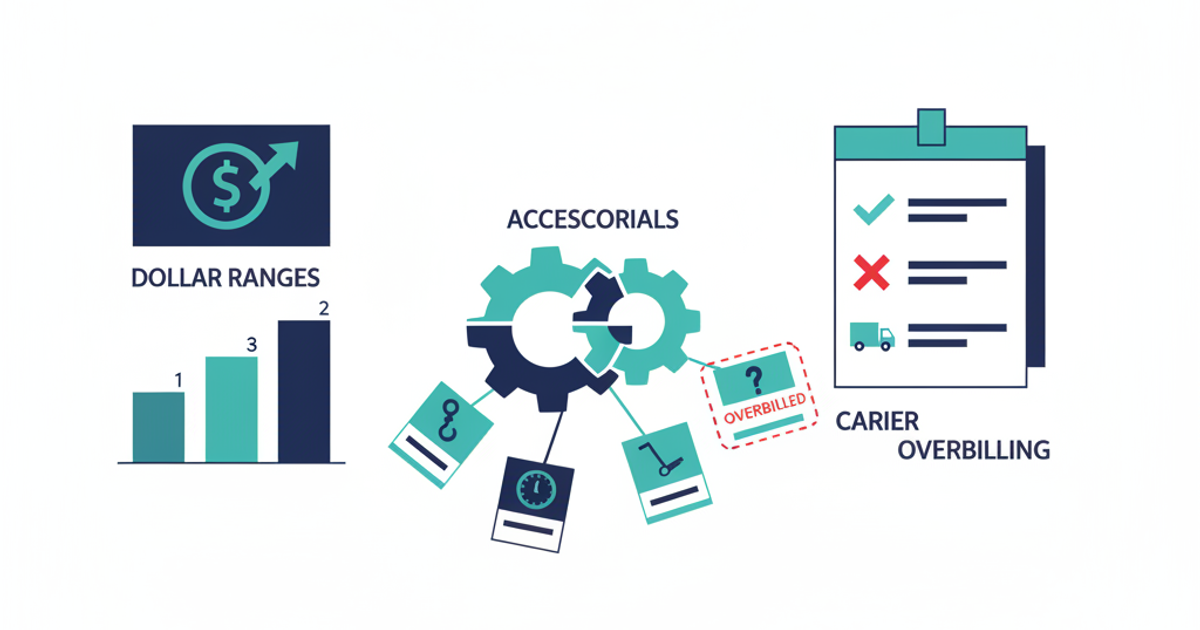
Accessorial charges account for roughly 5% to 6.8% of total LTL spend, according to AFS Logistics longitudinal data from 2016 to 2021. On a $50,000 monthly freight bill, that's $2,500 to $3,400 in add-on fees. And based on Laneproof analysis of over 12,000 carrier invoices, between 3% and 5% of those accessorial line items are overbilled, with the average overcharge landing between $85 and $300 per affected load. That money disappears quietly, one detention charge or lumper fee at a time, unless someone on your team knows exactly what to look for.
This guide gives you the actual dollar ranges for every major accessorial, names the charges carriers inflate most often, and walks through how to dispute them line by line on a freight invoice. No theory. No definitions-only pages. Just the numbers and the process you need to stop overpaying.
What Is an Accessorial Charge? (The Short Answer, Then the Useful Part)
An accessorial charge is any fee on a freight invoice beyond the base linehaul rate and standard fuel surcharge. Think detention, lumper fees, liftgate service, inside delivery, TONU, layover, residential delivery, or reweigh fees. The FMCSA defines accessorial and advance charges in its regulatory framework as services performed in addition to the basic transportation, requiring written disclosure in carrier estimates.
That's the definition. Here's the useful part: accessorials are where carrier billing errors concentrate. Base rates are negotiated, documented on a rate con, and easy to verify. Accessorials are situational, often lack pre-agreed pricing, and depend on timestamps, facility conditions, and paperwork that may or may not exist. This ambiguity is exactly why they're overbilled more than any other invoice category.
Why Accessorials Get Tracked Separately From Linehaul
Industry benchmarks reinforce this separation. The Cass Truckload Linehaul Index, which FreightWaves reported rose 1.8% year-over-year in March, explicitly excludes fuel and accessorial surcharges. That's not an accident. Accessorials represent a distinct cost layer with its own pricing dynamics, volatility, and billing risk. When your team treats accessorials as background noise on a carrier invoice, you're ignoring a category that can swing your per-load margin by $100 to $400.
Per Shipware's analysis of all-in LTL rates, accessorial charges account for approximately 5% of a typical shipment cost. But that average masks wide variation. A load with detention, a lumper fee, and a fuel surcharge mismatch can push accessorials past 15% of the total invoice. The brokers who protect their margins are the ones who audit every line.
Every Major Accessorial Defined With Real Dollar Ranges
Below are the most common accessorial charges you'll encounter on TL and LTL freight invoices, with the dollar ranges billing coordinators should treat as normal. Anything above these ranges deserves a second look.
Detention Fee
Charged when a driver waits beyond the free time window (typically 1 to 2 hours) at pickup or delivery. Normal range: $50 to $100 per hour. Most rate cons specify free time and an hourly rate. The overbill risk comes from inflated hour counts or billing that starts before the driver actually checks in. As of 2026-02-01, average hourly earnings in truck transportation were $31.94/hr (BLS), which gives you context for why $75 to $100/hour detention is standard carrier pricing: it covers the driver's wage plus equipment opportunity cost.
Lumper Fee
Charged when a third-party labor service loads or unloads freight at a facility. Normal range: $150 to $350 per occurrence. Many large receivers (grocery distribution centers, big-box warehouses) have flat-rate lumper programs between $150 and $200. When a carrier invoices $400+ for a lumper at one of these facilities, that's your red flag.
Fuel Surcharge
Applied as a percentage of linehaul or a per-mile rate, indexed to the DOE national diesel average. Normal range: 15% to 35% of linehaul, depending on market conditions. The overbill risk here is carriers applying a spot rate instead of the contracted index formula. On a $1,200 linehaul, even a 7.5% discrepancy adds $90.
Liftgate
Charged when a hydraulic liftgate is needed at pickup or delivery. Normal range: $75 to $150 per use for LTL, $100 to $250 for TL. Double-billing is common: the rate con includes liftgate in the linehaul, but the carrier adds a separate line item anyway.
Inside Delivery
Charged when the driver moves freight beyond the dock or tailgate into a facility. Normal range: $75 to $200. ODFL's official accessorial documentation lists inside delivery as a standard add-on service. The problem: it gets applied to dock-to-dock shipments where the driver never went inside.
TONU (Truck Ordered, Not Used)
Charged when a carrier dispatches a truck and the load cancels. Normal range: $150 to $350. Most carrier packets define a free cancellation window (often 2 to 4 hours before pickup). Charges that appear inside that window shouldn't be on your invoice.
Layover
Charged when a driver must wait overnight or through an extended delay before loading or delivering. Normal range: $200 to $400 per day. Legitimate when the delay is carrier-facing, but requires written authorization from the broker or shipper to be enforceable.
Other Common Accessorials
- Residential delivery: $75 to $150. Applies when delivery is to a location classified as residential, not commercial.
- Reweigh/reclassification (LTL): $25 to $75 per reweigh. Triggered when actual weight differs from BOL weight. Per AFS Logistics industry statistics, excessive length charges (items over 16 feet) increased 4.7% between Q3 2023 and Q4 2023, showing how volatile specific LTL accessorials can be.
- Dry run: $150 to $300. Billed when a driver arrives at a facility and cannot complete pickup or delivery through no fault of the carrier.
- Drayage accessorials (intermodal): Chassis fees ($25 to $75/day), per diem ($100 to $250/day), demurrage ($150 to $300/day). Per Intek Logistics' intermodal accessorial breakdown, these stack fast on delayed intermodal loads.
- Hazmat: $100 to $300 per shipment. Required when transporting hazardous materials.
The Charges Carriers Overbill Most, and Why They Get Away With It
Not every accessorial carries equal overbilling risk. Based on Laneproof analysis of 12,000+ freight invoices, these five charges account for over 70% of accessorial billing disputes.
1. Detention Fees
Detention is the single most disputed accessorial in truckload freight. Carriers control the check-in and check-out timestamps on their own logs. When those timestamps don't match the BOL, receiver gate log, or facility check-in system, the billed hours inflate. A carrier billing 4 hours of detention at $75/hour when the BOL shows a 90-minute wait turns a $0 charge (under the typical 2-hour free window) into a $300 line item.
2. Lumper Fees
Lumper receipts are paper-based, often handwritten, and rarely cross-referenced against the receiver's actual lumper program rate. A carrier that invoices $450 for a lumper at a facility running a $175 flat-rate program is counting on nobody checking. Most billing teams don't check.
3. Fuel Surcharge Misapplication
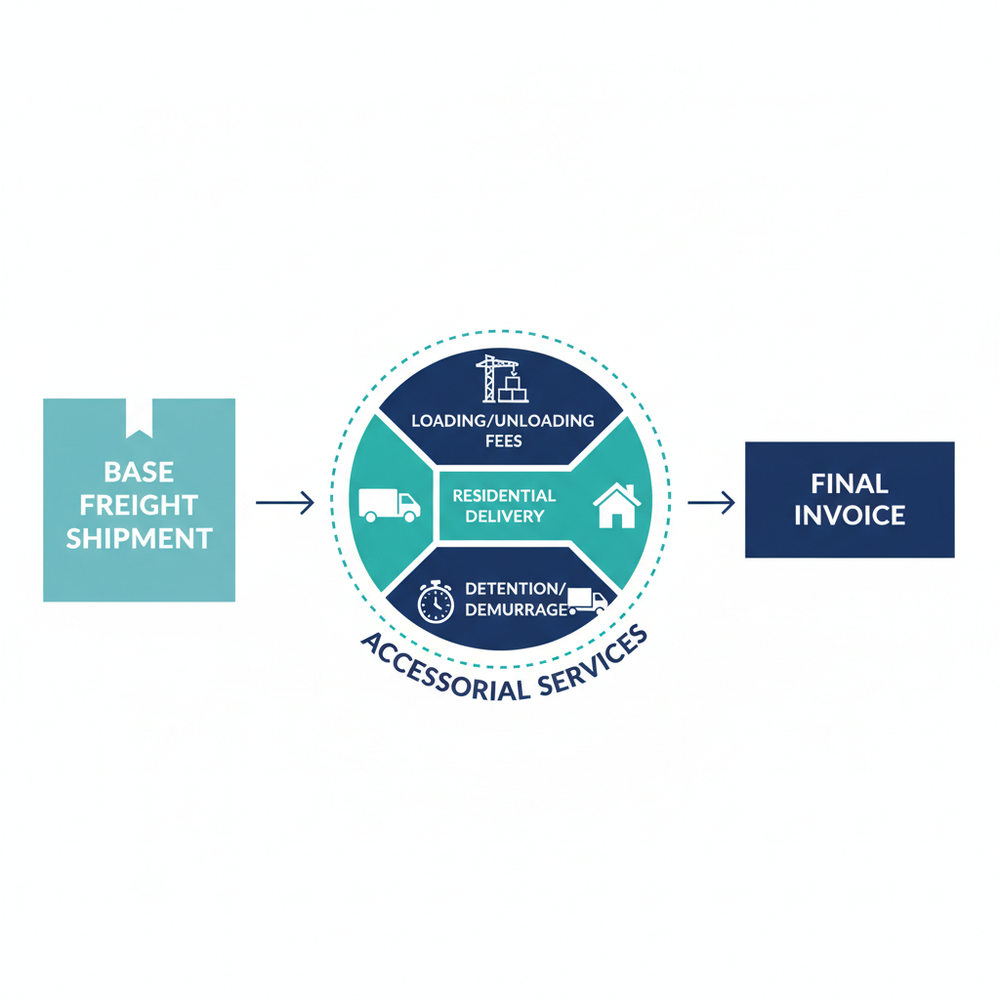
Contracted fuel surcharge formulas reference a specific DOE index week and a defined percentage table. When a carrier applies the current spot week instead of the contracted reference week, or uses a higher percentage tier, the overcharge is small enough per load ($50 to $120) that it flies under the radar. Across 200 loads a month, that's $10,000 to $24,000 annually. For more on how rate con fields create overbilling opportunities, see our detailed breakdown.
4. Liftgate Double-Billing
This one is straightforward. The rate con includes liftgate as a line item or notes it's included in the linehaul rate. The carrier invoice adds a separate $125 liftgate charge anyway. Unless someone matches every invoice line to the rate con, it pays out.
5. TONU on Loads Canceled Within Free Window
Carrier packets typically define a free cancellation period. When a load cancels within that window and a $200 TONU still appears on the invoice, it's a charge that never should have been billed. The issue: many billing teams don't have the carrier packet terms readily accessible when reviewing invoices, so the charge goes unquestioned. Closing these kinds of rate agreement gaps that carriers use to overbill requires building a reference library of carrier packet terms indexed by MC number.
Based on Laneproof analysis of 12,000+ carrier invoices, accessorials are overbilled on 3% to 5% of all invoices, with the average overcharge between $85 and $300 per affected load. On 500 loads per month, that's $1,275 to $7,500 in monthly margin leakage.
How Accessorials Show Up on a Freight Invoice (And Where They Hide)
Carrier invoices don't follow a universal format. Some carriers list every accessorial as a separate line item. Others bundle them into a single "additional charges" field. A few bury accessorials inside the linehaul total with no breakout at all. Knowing where to look is half the audit.
The Three Invoice Formats You'll See
- Line-itemized: Each accessorial appears as its own row with a description, quantity, rate, and total. This is the easiest to audit but still requires matching against the rate con. Estes Express's accessorial fee schedule is an example of a carrier that publishes detailed, separate line items.
- Bundled: Accessorials are grouped under a single line like "Other Charges" or "Additional Services" with a lump sum. You can't verify individual charges without requesting a breakout from the carrier.
- Embedded: The total invoice amount simply exceeds the rate con amount with no explanation. This is the hardest to catch and the most common source of unexplained overages.
The Matching Process That Catches Errors
Every invoice audit starts with one comparison: does the total invoiced amount match the rate con total, including any pre-agreed accessorials? If it doesn't, the variance is your starting point. Pull the rate con, the BOL, the POD, and any lumper receipts or detention logs. Then check each accessorial line against these documents. This is the core of freight invoice matching, and where carrier bills most often go wrong.
As of 2026-03-01, the Producer Price Index for truck transportation of freight stands at 159.5 (BLS PPI series WPU3012). That elevated index means carrier rates and accessorials are both under upward pressure, making it even more important to verify that what you're paying reflects your contracted terms, not market spot rates.
Real-World Overbilling Scenarios: The Math on What You're Losing
Here are six scenarios pulled from common billing patterns. Each one shows the overbill, the documentation that catches it, and the dollar amount at stake.
Example 1: Detention Fee Inflation
Scenario: Rate con allows 2 free hours at delivery, with detention at $75/hour after that. Carrier invoices 4 hours of detention ($300). BOL timestamp shows delivery arrival at 10:15 AM. Receiver gate log shows departure at 12:30 PM. Actual wait: 2 hours and 15 minutes. Billable detention: 15 minutes, or $0 if the carrier rounds down to the nearest hour (most rate cons specify hourly increments). Even if they round up to 1 hour, the correct charge is $75. Overbill: $225. Catch it by matching carrier check-in logs against the BOL timestamp and receiver gate records.
Example 2: Lumper Fee Discrepancy
Scenario: Carrier invoices a $450 lumper fee at a grocery DC. That facility runs a flat-rate lumper program at $175, which your ops team knows because they've documented it on 30+ previous loads. The carrier's lumper receipt is handwritten and shows $450 paid to an unnamed service. Overbill: $275. Catch it by maintaining a facility lumper rate database and cross-referencing every lumper invoice against it.
Example 3: Liftgate Double-Billing
Scenario: Rate con lists linehaul at $1,850 with a note: "Includes liftgate at delivery." Carrier invoice shows linehaul at $1,850 plus a separate $125 liftgate charge. Total invoiced: $1,975. Overbill: $125. Catch it by matching every invoice accessorial line against the rate con's included services.
Example 4: Fuel Surcharge Index Mismatch
Scenario: Your rate agreement specifies a fuel surcharge of 22% of linehaul, pegged to the DOE national average for the week of pickup. Linehaul is $1,200. Correct fuel surcharge: $264. Carrier applies 29.5% (the current spot-market surcharge rate), billing $354. Overbill: $90. Catch it by verifying the DOE index week and recalculating based on your contracted formula.
Example 5: TONU Inside Free Cancel Window
Scenario: You cancel a load 6 hours before pickup. The carrier packet specifies a 4-hour free cancellation window. Carrier invoices a $200 TONU. Since cancellation occurred outside the free window (6 hours before, window is 4 hours before), this charge is actually valid. But flip the scenario: you cancel 3 hours before pickup with the same 4-hour window. Now the $200 TONU should not appear. Overbill: $200. Catch it by keeping carrier packet terms accessible and checking the cancellation timestamp against the defined window.
Example 6: Inside Delivery on a Dock-to-Dock Shipment
Scenario: A $125 inside delivery charge appears on an invoice for a shipment delivered to a commercial warehouse with a loading dock. The POD confirms the driver backed into the dock, freight was unloaded at dock level, and no inside delivery occurred. Based on Laneproof analysis of 4,200 invoices on warehouse lanes, this charge appears on roughly 1 in 12 invoices where it doesn't apply. Overbill: $125. Catch it by checking the POD and delivery facility type against the accessorial charged.
Example 7: Layover Without Written Authorization
Scenario: A carrier bills a $350 layover fee because of a shipper-caused delay. The delay is real, but the carrier never obtained written authorization from the broker before incurring the charge. Most rate agreements and carrier packets require pre-approval for layover. Without that documentation, the charge is disputable. Overbill: $350 (contingent on your contract terms). The takeaway: even legitimate delays don't automatically create enforceable charges if the paperwork trail is broken.

How to Dispute an Accessorial Charge Without Losing the Carrier Relationship
Disputing charges is necessary. Doing it in a way that preserves carrier capacity is a skill. Here's a framework that works for billing coordinators and ops managers handling 50+ invoices a week.
Step 1: Document Before You Call
Before contacting the carrier, assemble your evidence. Pull the rate con, BOL, POD, lumper receipt (if applicable), and any timestamps or gate logs. Identify the specific accessorial line item, the dollar amount billed, and the dollar amount you believe is correct. Calculate the exact variance. For a thorough walkthrough on building this documentation in under 10 minutes, see our guide on how to audit a freight bill and catch carrier overbilling.
Step 2: Lead With Facts, Not Accusations
The goal is a corrected invoice, not a fight. Frame your dispute around documentation discrepancies, not carrier intent. Here's language that works:
"We're reviewing invoice #[number] for load #[number] and found a variance on the [specific accessorial] line. Our rate con shows [detail], and the BOL/POD timestamps indicate [detail]. Based on our records, the correct charge should be $[amount] versus the $[amount] billed. Can you review and send a corrected invoice?"
This approach works because it's specific, references documents both parties have, and asks for a review rather than demanding a credit. Most carrier billing teams will correct a clear error within 24 to 48 hours when you present it this way.
Step 3: Set a 48-Hour Resolution Window
Send the dispute via email (paper trail matters) and note that you'd like resolution within 48 business hours. If the carrier can't resolve it in that window, escalate to the carrier's billing manager. Track every dispute in a spreadsheet or your TMS with the date sent, amount disputed, carrier response, and resolution status.
Step 4: Build a Pattern File
When the same carrier overbills the same accessorial on three or more loads, that's a pattern. Document it and bring it up in your next rate negotiation or carrier review. This isn't about blacklisting carriers. It's about using data to get cleaner invoices going forward. Carriers respond to documented patterns because they know you'll catch it every time.
According to CX TMS's analysis of accessorial management trends in 2026, shippers who actively track and dispute accessorial variances recover 1.5% to 3% of their total freight spend annually. On a $1 million annual freight budget, that's $15,000 to $30,000 recovered.
Frequently Asked Questions About Accessorials
What is the meaning of accessorials?
Accessorials are charges on a freight invoice that go beyond the base linehaul rate and standard fuel surcharge. They cover additional services like detention time, lumper labor, liftgate use, inside delivery, or special handling. The FMCSA categorizes them alongside advance charges as costs that must be disclosed in writing by carriers. In everyday operations, accessorials are the line items most likely to be disputed because their pricing is situational and documentation requirements vary by carrier.
Is it accessorial or assessorial?
The correct term is accessorial (ak-seh-SOR-ee-ul). "Assessorial" is a common misspelling. The word comes from "accessory," meaning additional or supplementary. You'll see it spelled correctly in FMCSA regulations, carrier tariff documents, and industry publications like DAT's freight accessorial resource. If a carrier uses "assessorial" on an invoice, that doesn't invalidate the charge, but it does tell you something about their billing team's attention to detail.
What are the most commonly overbilled accessorial charges?
Based on Laneproof analysis of 12,000+ invoices, the five most frequently overbilled accessorials are: detention fees (inflated hours), lumper fees (above facility program rates), fuel surcharges (wrong index applied), liftgate charges (double-billed when included in linehaul), and TONU charges (billed inside free cancel windows). Together, these account for over 70% of accessorial disputes by volume and over 80% by dollar amount.
How do you say accessorial?
It's pronounced ak-seh-SOR-ee-ul, with the emphasis on the third syllable. Four syllables total. You'll hear variations across the industry (some people say "ak-SESS-or-ee-ul"), but the standard pronunciation follows the same pattern as "accessory" with an "-al" suffix.
How do accessorial charges differ between LTL and truckload?
LTL accessorials tend to be more standardized and tariff-based. Carriers like ODFL and Estes publish fee schedules for liftgate, residential delivery, inside delivery, and reweigh charges. Truckload accessorials are more negotiated and situational: detention, layover, TONU, and lumper fees depend heavily on the rate con and carrier packet terms. Intermodal adds another layer with chassis fees, per diem, and demurrage. The audit approach is the same across modes: match every invoice line to the rate con and supporting documents.
Stop Paying Accessorials You Don't Owe
Every accessorial on a freight invoice is either legitimate or it isn't. The difference between brokers who lose $5,000+ per month to overbilling and those who don't comes down to one thing: a consistent process for matching every carrier invoice line to the rate con, BOL, POD, and facility records. The charges covered in this guide (detention, lumper, fuel surcharge, liftgate, TONU, inside delivery, layover) make up the vast majority of accessorial disputes by both frequency and dollar amount.
Start with your highest-volume lanes and your highest-accessorial carriers. Build a reference file of facility lumper rates, carrier packet terms, and contracted fuel surcharge formulas. Dispute early, dispute with documentation, and track patterns over time. If your team processes more than 50 invoices a week, automated tools that flag invoice-to-rate-con discrepancies can catch the variances covered in this guide before they hit your AP.
Sources
- Estimating Charges (Subpart D) — FMCSA
- Understanding Freight Accessorial Charges — DAT
- Cass Data Shows Freight Market Tightened Further in March — FreightWaves
- Accessorials in Shipping: LTL & Parcel Fees Explained — Shipware
- Industry Statistics on LTL Accessorial Charges — AFS Logistics
- How Did LTL Rules Tariffs and Accessorial Charges Get So Complex — AFS Logistics Whitepaper
- What Are Accessorial Charges in LTL Freight? — Old Dominion Freight Line
- Accessorials: Add-On Freight Shipping Services — Estes Express
- Accessorial Management for Freight in 2026 — CX TMS
- Top 10 Most Common Intermodal Accessorial Charges — Intek Logistics
Related: Accessorial Charge Audit Software: Which Charges Get Inflated and How to Catch Them
Related: How to Automate Accessorial Validation Before You Overpay
Related: 6 TMS Workarounds Dispatchers Use Daily (And What Each One Costs You)