Rate Confirmation Generator: The Fields Most Brokers Miss
Researched and written with AI assistance. Reviewed by the Laneproof team.
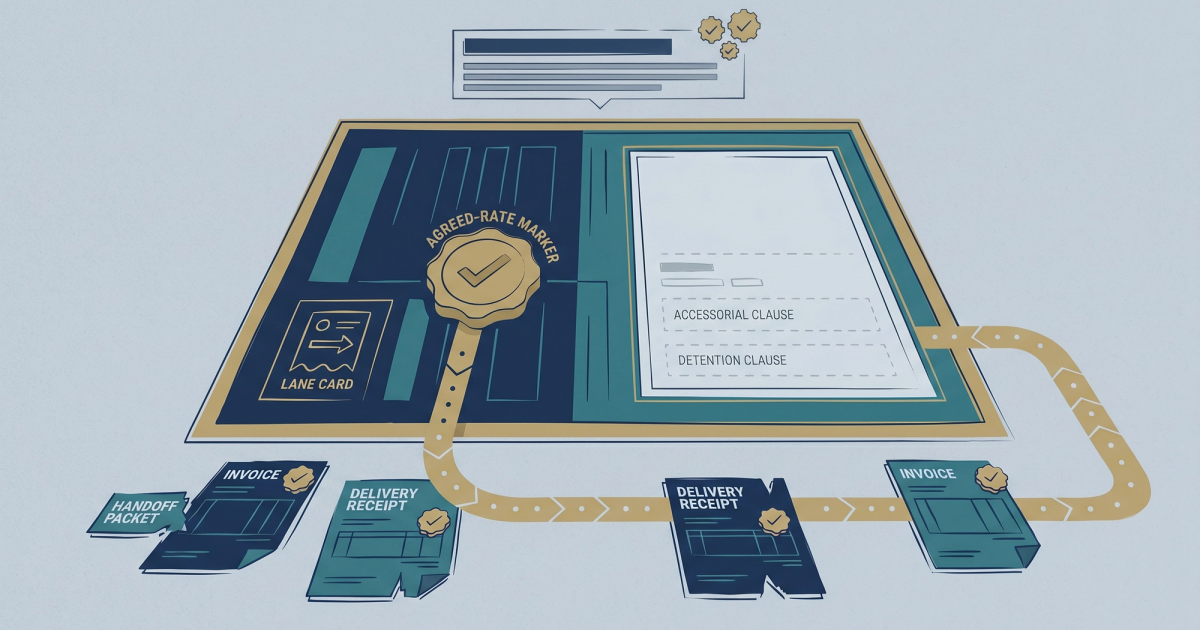
A broker running 300 loads per month with an average $45 uncontested accessorial error per load leaves $13,500 on the table every month. That is $162,000 per year, gone, because the rate confirmation didn't include the right clauses. Most rate confirmation generator tools will fill in your origin, destination, linehaul rate, and pickup date. That is the easy part. The hard part, the part that actually protects your margin, is everything those generators leave blank: detention free-time windows, accessorial pre-authorization language, fuel surcharge index references, cancellation cutoff terms, and layover definitions. Those missing fields are where carriers win disputes. Not because the carrier is wrong, but because you gave them nothing in writing to dispute against. This post covers every field your rate con needs, with real dollar amounts showing what each missing clause costs you.
What Most Rate Confirmation Generators Actually Give You (And What They Leave Out)
Search for "rate confirmation generator" and you will find a collection of tools that produce a clean PDF with the basics: broker name, carrier name, MC numbers, pickup and delivery locations, dates, and the agreed linehaul rate. Tools like the free rate confirmation generator from Trulos and the freight broker templates offered by ArkTMS handle these fields well. They get a document into the carrier's hands quickly.
The problem is that these templates treat the rate confirmation as a form to fill in, not as a carrier agreement document that defines the financial terms of every possible scenario on that load. According to a comprehensive guide on rate confirmation components, rate confirmations function as binding agreements between brokers and carriers that define load terms, rates, and responsibilities. When those terms are incomplete, you have a binding agreement that binds you to pay whatever the carrier invoices, because you never documented otherwise.
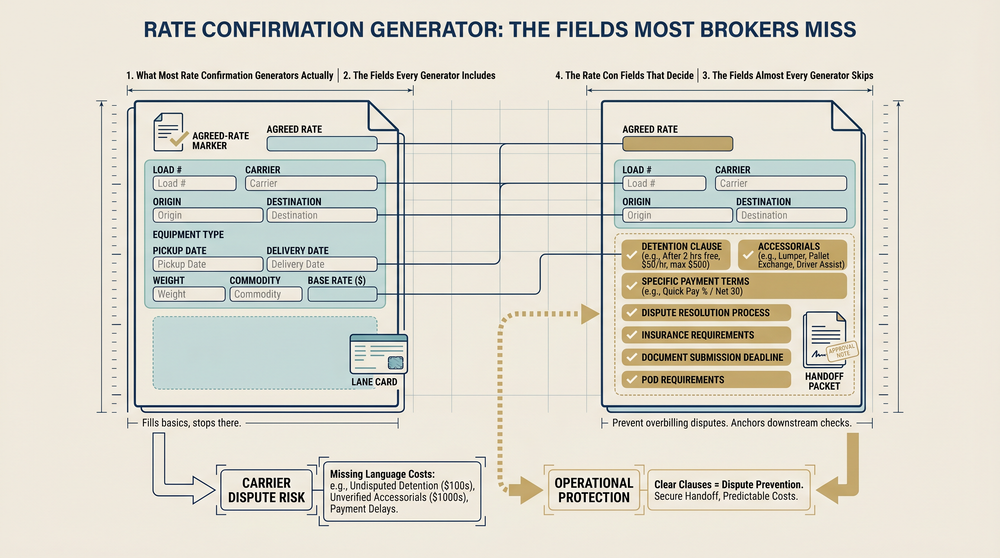
The Fields Every Generator Includes
- Broker and carrier company names, MC numbers, and contact info
- Pickup and delivery addresses
- Load number and reference numbers
- Linehaul rate
- Pickup and delivery dates
- Equipment type and commodity description
These are the minimum. They get you a document. They do not get you a dispute-proof document.
The Fields Almost Every Generator Skips
- Detention free-time window (in hours) before charges begin
- Detention hourly rate and daily cap
- Accessorial pre-authorization requirements and who approves them
- Lumper fee policy: whether the broker pays, the reimbursement cap, and required documentation
- Fuel surcharge table or index reference date
- TONU and cancellation window (hours before pickup)
- Layover and overnight detention terms
- Dry run charge conditions and required proof
- Delivery appointment time (not just date) and site contact name
- Digital signature or acceptance confirmation method
If your current freight broker template does not include these fields, every load you book is a potential margin loss. Not a theoretical one. A real one, with a dollar amount attached, that shows up on a carrier invoice you cannot dispute. For a deeper look at which specific fields create the most disputes, read the rate con fields carriers use to overbill you.
The Rate Con Fields That Decide Who Wins a Carrier Dispute
Carrier invoice disputes do not get resolved based on who remembers what was said on the phone. They get resolved based on what is written in the rate confirmation. That document is the single source of truth. If a field is missing, the carrier's version of the terms wins by default, because you have no documentation to counter it.
As FreightAmigo's guide on rate confirmation templates explains, the rate confirmation functions as both an operational instruction set and a financial contract. Missing fields create ambiguity, and ambiguity always costs the broker money.
Detention and Free-Time Language
Detention is the single most disputed accessorial in freight brokerage. The dispute almost never comes down to whether the driver waited. It comes down to whether the rate confirmation defined how long they could wait for free before charges started. Without a free-time window, a carrier can claim detention from the moment they arrive. With one, you have a clearly documented starting point for billable time.
A solid detention clause includes four elements: the number of free hours (typically 2), the hourly rate after free time expires, the daily cap, and the required documentation (check-in and check-out times on the BOL or a facility timestamp). The BOL serves as your corroborating document here. If the rate con says 2 hours free and the BOL shows the driver was on-site for 2 hours and 45 minutes, you owe 45 minutes of detention. Without that language, you owe whatever the carrier invoices.
Fuel Surcharge Index Reference
Fuel surcharges should never be a floating number. Your rate con needs to specify the FSC table or index you are using (DOE national average is standard), the reference date (typically the Monday of the pickup week), and the per-mile or percentage calculation method. When the rate con does not lock in these details, the carrier picks the index date and calculation method that benefits them. On a $2,200 linehaul, that discrepancy runs roughly $83 per load if the carrier's calculation runs 3.8% higher than what you budgeted. Across 100 loads per month, that is $8,300 in uncontested fuel surcharge overcharges.
Accessorial Pre-Authorization
Every rate confirmation needs a clause that states: no accessorial charges will be paid unless pre-authorized in writing by the broker prior to the charge being incurred. This one sentence saves you thousands per month. Without it, carriers can submit lumper receipts, detention invoices, and layover charges after the fact, and you have no documented basis to deny payment. The clause should also name the specific person or role authorized to approve accessorials, and the method of approval (email, TMS note, or phone followed by written confirmation).
For more on how missing rate con terms lead to overbilling, see what brokers get wrong about rate confirmations and what it costs them.
How to Write Detention and Accessorial Clauses That Carriers Can't Argue With
Vague language is the enemy. "Detention charges may apply" protects nobody. Here is how to write clauses that hold up when a carrier disputes an invoice.
Detention Clause Template
Your detention clause should read something like this: "Carrier is allowed 2 hours of free time at each stop. Detention begins after the free-time window expires and is billed at $75 per hour, not to exceed $300 per day. Carrier must provide facility check-in and check-out timestamps on the BOL or via a facility-issued receipt. Detention charges submitted without timestamped documentation will not be paid."
That clause does four things: defines when the clock starts, sets the rate, caps the exposure, and specifies what proof you need. A carrier cannot argue with a clause that clearly says "$75 per hour after 2 hours free" when the BOL shows they were on-site for 3 hours.
Lumper Fee Clause Template
"Lumper fees, if applicable, must be pre-authorized by [Broker Contact Name] via email or TMS message prior to the service being performed. Maximum reimbursable lumper fee is $[amount]. Carrier must submit an itemized lumper receipt. Lumper fees submitted without prior authorization or without a receipt will not be reimbursed."
Without this clause, a carrier drops at a grocery warehouse, pays a lumper $275, submits a receipt, and you have no documented basis to refuse. With the clause, you have both a cap and a pre-authorization requirement. If they did not get approval first, the charge is on them.
TONU and Cancellation Clause Template
"If this load is cancelled by the broker more than [X] hours prior to the scheduled pickup time, no Truck Order Not Used (TONU) fee applies. If cancelled within [X] hours of the scheduled pickup time, a TONU fee of $[amount] will be paid. Carrier must not have dispatched a truck to the pickup location. If the carrier has arrived at the pickup location, the TONU fee of $[amount] applies."
This is where you define the cancellation window. Without it, a carrier can claim a TONU fee even if you cancelled 24 hours out. The rate con needs a specific cutoff time, not just "reasonable notice."
Every rate con missing an accessorial clause is an open invitation for a carrier to bill whatever they want. The clause does not need to be long. It needs to be specific.
Rate Confirmation vs. Load Confirmation: They Are Not the Same Document
This distinction trips up brokers more often than you would expect. A load confirmation is the internal document or TMS record that captures the shipper's load tender details: commodity, weight, pickup and delivery windows, and any special requirements. A rate confirmation is the outward-facing carrier agreement document that defines the financial and operational terms between the broker and the carrier.
The load confirmation tells you what the shipper needs. The rate confirmation tells the carrier what they are agreeing to, and more importantly, what they cannot bill for outside those terms. Mixing these up or treating them as interchangeable creates gaps in your rate con documentation.
Why This Matters for Disputes
When a carrier disputes a charge, they point to the rate confirmation. They do not care about your internal load confirmation or what the shipper told you. If the load confirmation says "delivery appointment: 2:00 PM" but the rate confirmation only says "delivery date: March 15," the carrier has grounds to dispute a dry run charge if they showed up at 8:00 AM and the facility was not ready.
Your rate con must include every operationally relevant detail from the load confirmation, translated into carrier-facing language. Delivery appointment times, facility contact names, and special instructions all need to cross from the internal document to the external one. If it is not on the rate con, it does not exist for dispute purposes.
What Belongs on Each Document
Load confirmation (internal): Shipper name, shipper contact, commodity details, weight, dims, special handling instructions, pickup and delivery windows, reference numbers, customer rate.
Rate confirmation (carrier-facing): All of the above except customer rate, plus: carrier linehaul rate, fuel surcharge terms, detention clause, accessorial pre-authorization clause, lumper fee policy, TONU/cancellation terms, layover terms, driver requirements, insurance requirements, and acceptance/signature method.
FMCSA regulations under 49 CFR Parts 300-399 establish broker-carrier documentation requirements that include transparency obligations relevant to rate confirmations. The FMCSA-2023-0257 rulemaking on broker transparency further reinforces the expectation that brokers provide clear, complete rate confirmation documents to carriers. Your rate con is not optional paperwork. It is a compliance document with legal weight.
Carrier Acceptance and Digital Signature: How to Prove They Agreed
A rate confirmation is only as strong as the proof that the carrier accepted it. If a carrier can claim they never saw the rate con, never agreed to the terms, or that the version they received was different from the one you have on file, your documentation falls apart.
Three Methods of Carrier Acceptance
Email confirmation: The carrier replies to the rate con email with "confirmed" or similar language. This is the most common method for small brokerages. It works, but you need to save the email thread and tie it to the load number in your TMS.
Digital signature: The carrier signs the rate con electronically through a platform like DocuSign, or through your TMS if it supports e-signatures. This is the strongest proof of acceptance because it creates a timestamped, tamper-evident record.
Dispatch as acceptance: Some brokerages include a clause stating that dispatching a driver to the pickup location constitutes acceptance of the rate con terms. This is better than nothing, but weaker than a signature because the carrier can argue they dispatched before reviewing the final terms.
What to Do When Carriers Push Back on Signing
Some carriers, especially owner-operators, resist signing documents before dispatch. They want to get rolling. The simplest approach is to make the rate con available immediately after verbal agreement, with a clause that states: "Carrier's dispatch of a driver to the pickup location constitutes acceptance of all terms in this rate confirmation." Then, follow up with an email requesting written confirmation. You now have two layers of documentation: the dispatch-as-acceptance clause and the email thread.
The point is not to create friction with carriers. The point is to have clear proof of agreement before a dispute arises. The five minutes it takes to get a signed rate con saves you the 45 minutes (or more) it takes to fight a disputed invoice with no documentation.
If you are still processing rate confirmations manually, copying data between emails, TMS screens, and PDF generators, you are spending time on formatting instead of on the language that protects your margin. Tools that automatically extract data from freight documents cut the data entry time so you can focus on the clauses that matter.
Real Examples: What Missing Fields Cost Brokers
These scenarios are based on common carrier disputes that come down to missing rate con fields. Each one could have been prevented with specific, documented language.
Example 1: $350 Detention Charge With No Free-Time Window
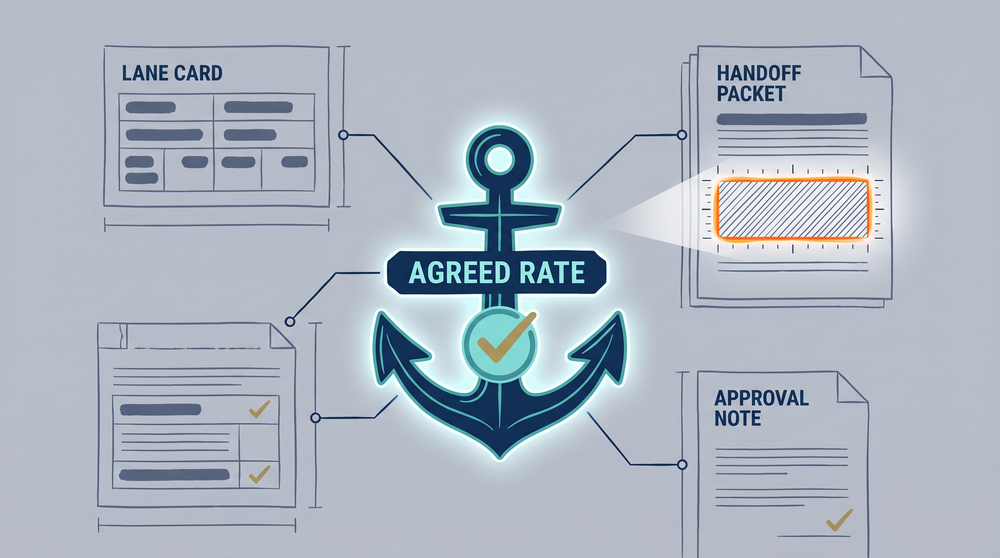
A broker books a flatbed load with a $1,800 linehaul rate. The carrier arrives at the delivery facility and waits 3 hours for unloading. The carrier submits a $350 detention invoice claiming 2 hours of billable detention at $175/hour. The broker's rate con listed "detention: as per agreement" with no free-time window, no hourly rate, and no daily cap. The broker pays the $350 because there is no written term to dispute against.
What should have been on the rate con: "2 hours free time at delivery. Detention billed at $75/hour after free time, capped at $300/day. Timestamped check-in/check-out required on POD or facility receipt." With this language, the broker owes $75 for 1 hour of detention (3 hours on-site minus 2 hours free), not $350.
Example 2: $275 Lumper Fee With No Pre-Authorization Clause
A reefer load delivers to a grocery warehouse. The carrier pays a $275 lumper fee and submits the receipt for reimbursement. The rate con says nothing about lumper fees. The broker has no written basis to deny the charge, even though the broker would normally cap lumper reimbursement at $150 and require pre-approval.
What should have been on the rate con: "Lumper fees must be pre-authorized by [name] via email before the service is performed. Maximum reimbursable amount: $200. Itemized receipt required. Unauthorized lumper fees will not be reimbursed."
Example 3: $150 TONU With No Cancellation Window
A broker cancels a load 18 hours before the scheduled pickup. The carrier submits a $150 TONU invoice. The rate con has no cancellation clause. The carrier had not yet dispatched a truck. The broker pays the $150 because there is no documented cutoff time defining when a TONU applies.
What should have been on the rate con: "No TONU fee applies if load is cancelled more than 4 hours before scheduled pickup. TONU of $150 applies if cancelled within 4 hours of pickup or after carrier has dispatched to the origin. Carrier must provide proof of dispatch if claiming TONU after cancellation."
Example 4: $500 Layover With No Overnight Detention Terms
A driver arrives at a delivery facility at 4:00 PM. The facility closes at 5:00 PM and the load cannot be unloaded until 7:00 AM the next day. The carrier submits a $500 layover charge. The rate con has no layover clause and no distinction between daytime detention and overnight detention. The broker pays the $500.
What should have been on the rate con: "Layover applies only when the delay exceeds 12 hours and is caused by the shipper or consignee facility schedule, not by carrier late arrival. Layover rate: $250 per night. Carrier must provide facility closure documentation or a timestamped check-in showing arrival during posted facility hours."
Example 5: $200 Dry Run Dispute With No Delivery Appointment Details
A carrier arrives at a delivery location at 9:00 AM. The consignee says the appointment was at 2:00 PM and refuses to receive the load. The carrier leaves and submits a $200 dry run charge. The rate con listed only "delivery date: March 15" with no appointment time and no facility contact name. The broker cannot prove the carrier was given the correct delivery window.
What should have been on the rate con: "Delivery appointment: March 15, 2:00 PM. Facility contact: [Name], [Phone]. Carrier must deliver within the scheduled appointment window. Dry run charges apply only if the carrier arrives within the appointment window and is refused by the consignee." With this language, the broker has grounds to deny the dry run charge because the carrier arrived outside the documented appointment time.
Every one of these examples comes back to the same root cause: the rate con was treated as a load summary instead of a carrier agreement document. For a detailed look at how rate agreement gaps create overbilling opportunities, that post walks through additional scenarios with specific dollar impact.
Frequently Asked Questions About Rate Confirmations
Is a rate confirmation legally binding?
Yes. A rate confirmation functions as a binding agreement between the broker and carrier that defines the load terms, rates, and responsibilities for a specific shipment. According to Fulfill's glossary on rate confirmation components, these documents carry legal implications in freight logistics. Once accepted by the carrier (via signature, email confirmation, or dispatch), the terms in the rate con govern the financial relationship for that load.
What is the difference between a rate confirmation and a BOL?
A rate confirmation is the financial and operational agreement between the broker and the carrier. It defines the rate, accessorial terms, and conditions. A BOL (bill of lading) is the shipping document that travels with the freight and serves as a receipt of goods, proof of delivery (POD), and transfer of custody record. The BOL does not contain rate information. Both documents are needed: the rate con sets the terms, and the BOL provides the operational proof that supports or contradicts those terms in a dispute.
Do I need a separate rate confirmation for every load?
Yes. Even if you run dedicated lanes with the same carrier every week, each load should have its own rate confirmation with the specific pickup and delivery details, dates, and applicable accessorial terms. A master carrier agreement can establish baseline terms, but the rate con is the load-level document that specifies the exact rate and conditions for that shipment. Relying on a master agreement alone leaves gaps when load-specific circumstances (different facilities, different commodities, different equipment) create billing disputes.
What should I do if a carrier refuses to sign a rate confirmation?
Include a clause in your rate confirmation stating that dispatching a driver to the pickup location constitutes acceptance of the terms. Send the rate con via email and save the delivery confirmation. If the carrier disputes terms later, you have the sent email with the terms and the fact that they dispatched, which satisfies most dispute resolution processes. That said, working with carriers who consistently refuse to acknowledge rate con terms is a risk you should evaluate carefully.
Can a carrier charge accessorials not listed on the rate confirmation?
They can invoice them, but whether you are obligated to pay depends on your rate con language. If your rate confirmation includes a pre-authorization clause requiring written broker approval before any accessorial charge is incurred, you have documented grounds to deny unauthorized charges. If your rate con is silent on accessorials, the carrier has a stronger position to argue that the charges are standard and should be paid. The clause is your defense.
Sources
- FMCSA Regulations and Interpretations, 49 CFR Parts 300-399 — Federal Motor Carrier Safety Administration
- Free Rate Confirmation Generator — Trulos
- Mastering the Trucking Rate Confirmation Template — FreightAmigo
- Free Freight Broker Templates — ArkTMS
- Rate Confirmation Template: The Fields Most Brokers Skip — Laneproof
- Rate Confirmation: Definition, Components & Best Practices — Fulfill
Stop Losing Money on Fields Your Rate Con Generator Skips
Your rate confirmation is not a formality. It is the only document that stands between you and every carrier billing dispute you will face this month. The fields that most generators skip (detention windows, accessorial pre-authorization, FSC index references, TONU cutoffs, layover terms, delivery appointment details) are the exact fields that decide whether you pay a disputed charge or deny it with documentation.
Go back to your last 10 rate cons. Check whether they include a detention free-time clause, an accessorial pre-authorization requirement, and a fuel surcharge index reference. If any of those are missing, you are exposed on every one of those loads.
Laneproof builds rate con documentation into an automated workflow that catches missing fields before they become disputed invoices. See how it works and what it costs on the pricing and plans page.
Related: Rate Confirmation Template Excel: Fields You're Missing
Related: Rate Confirmation Template Free: Fields That Protect You
Related: Rate Confirmation Template Word: Every Field That Protects You