Rate Confirmation Template: The Fields Most Brokers Skip
Researched and written with AI assistance. Reviewed by the Laneproof team.
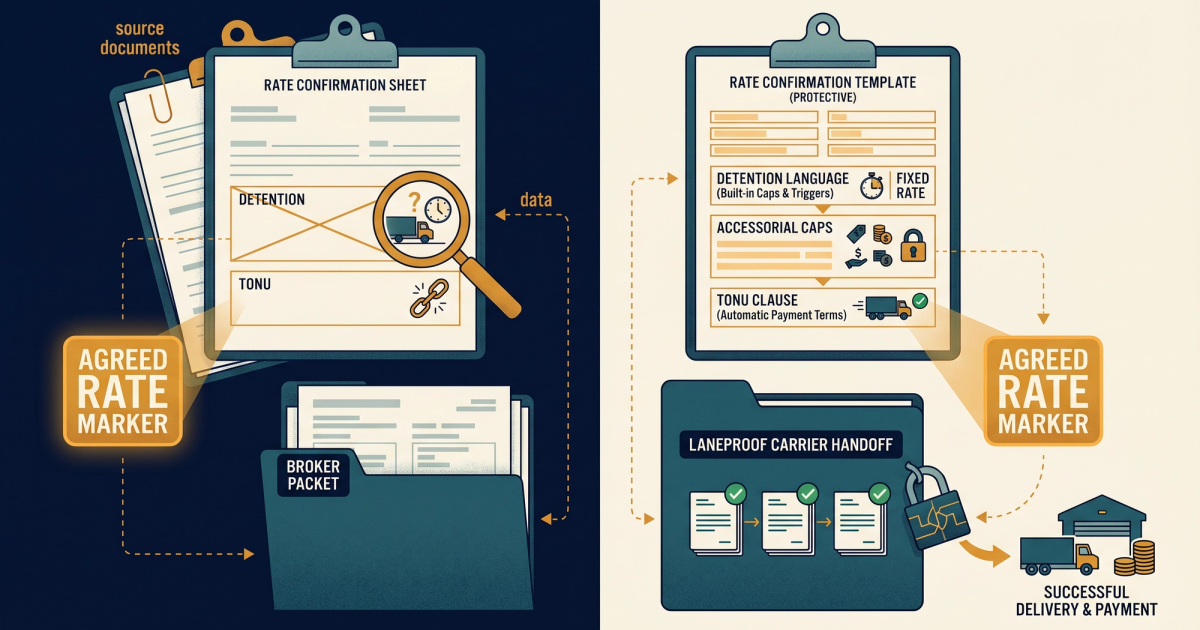
A broker pays a $450 detention charge because the rate confirmation template had no cap language. A $300 TONU invoice sticks because there was no cancellation window defined. A lumper fee comes in at $185 when the shipper agreed to $75, and the broker eats the difference. These are not edge cases. They happen every week, on loads where the rate con was technically "filled out" but left the fields that actually matter blank or vague. According to FreightWaves' breakdown of rate confirmation components, a rate confirmation is a legally binding contract between broker and carrier. That means every empty field, every "may apply" clause, and every missing cap is a binding decision: you just decided to pay whatever the carrier invoices.
What Is a Rate Confirmation Sheet and Why Most Templates Miss the Point
A rate confirmation sheet is the binding agreement between a freight broker and a carrier that defines the load details, compensation, and terms governing a specific shipment. It covers pickup and delivery information, commodity description, weight, agreed linehaul rate, and any applicable accessorial charges. According to Fulfill.com's rate confirmation glossary, every rate con must include a load number or reference ID, commodity description, weight, piece count, and any special handling requirements as core required fields.
The essential fields in a rate confirmation include:
- Load/reference number for tracking and reconciliation
- Broker and carrier legal names, MC numbers, and contact information
- Pickup and delivery addresses with appointment dates and times
- Commodity description, weight, and piece count
- Agreed rate (linehaul, fuel surcharge, and any pre-approved accessorials)
- Accessorial terms with specific dollar caps and approval requirements
- Detention, TONU, layover, and dry run language with defined triggers and limits
- Signature block or electronic acceptance mechanism
Most free templates you find online include the first four or five items. They give you boxes for origin, destination, commodity, and rate. That is the easy part. The fields that actually protect your margin, the accessorial caps, detention triggers, cancellation windows, and fuel surcharge tables, are either missing entirely or filled with throwaway language like "additional charges may apply."
Under FMCSA Docket No. FMCSA-2023-0257, brokers are expected to provide rate confirmation documents to carriers as part of transaction transparency requirements. This is not optional best practice. It is regulatory expectation. And when a dispute lands on your desk, the rate con is the first document everyone reaches for.
The problem is not that brokers skip rate confirmations. The problem is that the carrier agreement document most brokers send reads more like a load summary than a binding contract. And that gap between summary and contract is exactly where margin disappears.
The Rate Con Fields Brokers Skip That Cost Real Money Later
If you have ever spent an hour on the phone arguing a $200 charge you know should not be there, the root cause was almost certainly a rate con field that was left empty or vague. Here are the specific fields that create billing exposure, and what they cost when they are missing.
Detention Language (or Lack of It)
Most rate confirmations either omit detention entirely or include a single line: "Detention may apply." That phrase is an open checkbook. When a carrier sits at a shipper facility for three hours and invoices $450, the broker has no contractual basis to push back. The carrier waited, the rate con acknowledged detention exists, and no cap was set.
Example: A broker receives a carrier invoice with a $450 detention charge on a load where the shipper's facility had a known two-hour wait time. The rate con said "Detention: per carrier's standard schedule." The carrier's "standard schedule" turned out to be $75/hour with no free time. The field that should have been on the rate con: "Detention: $25/hr after 2 free hours, max $150 per occurrence, requires signed BOL timestamp as documentation." That single line would have saved the broker $300 on this load alone.
For a deeper look at which rate con fields create the most billing exposure, see rate con fields carriers use to overbill you, which breaks down the math on the most common overcharges.
Fuel Surcharge References
Fuel surcharge is one of the most commonly disputed line items in freight billing. When the rate con says "FSC included" or "fuel surcharge per current rates," there is no anchor. The carrier can invoice FSC at 18% of linehaul while your shipper contract assumes DOE-indexed rates that would calculate to 14%.
Example: A carrier invoices a fuel surcharge at 18% of linehaul on a $2,200 load. That is $396. The broker's shipper agreement was based on DOE national average diesel pricing, which would have calculated FSC at approximately 14.2%, or $312. The difference: $84 per load. On 40 loads per month with the same carrier, that is $3,360 per month in margin erosion. The fix: specify the FSC table, index source, and effective date directly on the rate con.
Accessorial Caps and Pre-Approval Requirements
"Lumper may apply" is not a cap. It is permission for the carrier to pass through whatever the facility charges. When a lumper fee comes in at $185 and the shipper agreed to cover $75, the broker absorbs $110 because the rate con authorized the charge without a limit.
The difference between a rate con that costs you money and one that protects you often comes down to ten words. Compare these two versions:
- Weak: "Additional charges may apply"
- Binding: "No accessorials will be paid unless pre-approved in writing by broker and documented on BOL or POD"
The second version does not eliminate accessorials. It establishes a process. And when a carrier disputes the denial of an unapproved charge, the broker has a clear contractual position. For more on where rate agreements create billing gaps, read rate agreement gaps carriers use to overbill on every load.
What Protective Accessorial and Detention Language Actually Looks Like
Generic advice says "include detention terms on your rate con." That is not useful. Here is what specific, enforceable accessorial language actually looks like, field by field, so you can build it directly into your rate confirmation template.
Detention Clause (Complete)
A complete detention clause has four components: free time, rate, cap, and documentation requirements. Here is a model clause:
"Detention: $25.00 per hour after 2 free hours at each stop, not to exceed $150.00 per occurrence. Carrier must provide signed BOL or facility timestamp showing actual arrival and departure times. Detention claims submitted without documentation will not be honored. Detention must be reported to broker within 24 hours of occurrence."
Every piece of that clause serves a purpose. The free time window eliminates charges for normal loading delays. The hourly rate is explicit (not "per carrier schedule"). The cap limits total exposure. The documentation requirement gives the broker grounds to deny unsubstantiated claims. And the 24-hour reporting window prevents carriers from stacking detention charges onto an invoice 30 days later.
Accessorial Pre-Approval Clause
This clause should cover every charge that is not linehaul or the pre-agreed fuel surcharge:
"No accessorial charges (including but not limited to lumper fees, pallet exchange, inside delivery, lift gate, or stop-off charges) will be paid unless approved in writing by broker prior to the charge being incurred. Approved accessorial charges must be documented on the BOL or POD. Lumper fees: maximum reimbursement $75.00 per occurrence with original lumper receipt required."
Notice the lumper cap is a specific dollar figure. It matches what the shipper agreed to cover. If the facility charges $185, the carrier knows upfront that the broker's obligation is $75, and the carrier can negotiate with the facility or decline the load before dispatch. This eliminates post-delivery disputes entirely.
Fuel Surcharge Clause
Pin the FSC to a verifiable index:
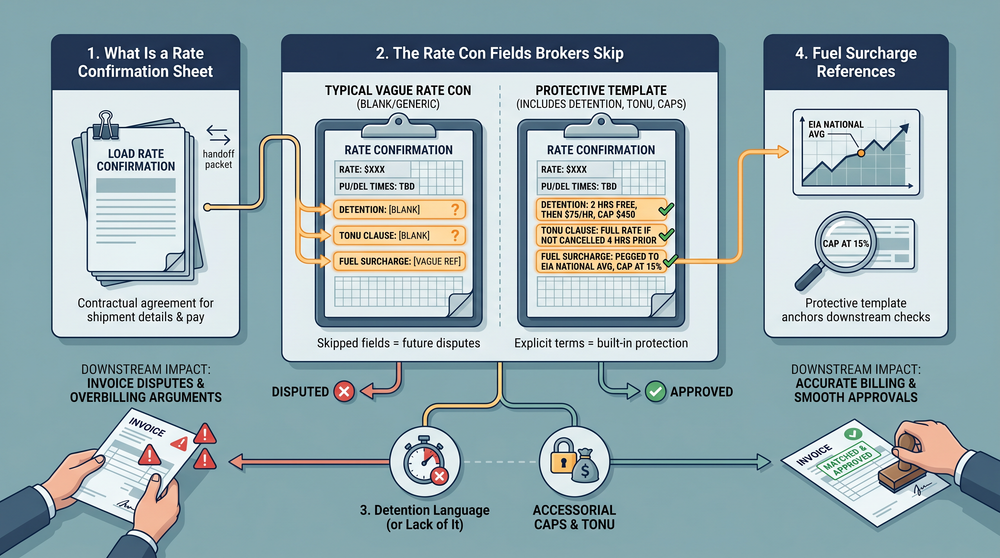
"Fuel surcharge calculated per DOE National Average Diesel Price as published on the Monday preceding the pickup date, applied at the rate schedule attached as Exhibit A. FSC is a percentage of linehaul only (excludes accessorials). No retroactive FSC adjustments will be accepted."
This clause does three things: it names the data source, defines the calculation base, and blocks retroactive billing. A carrier cannot invoice FSC at an arbitrary percentage when the calculation method is spelled out.
TONU, Layover, and Dry Run Clauses: If It's Not on the Rate Con, You're Paying It
TONU (truck ordered, not used), layover, and dry run charges are where brokers lose disputes fastest. These charges are inherently situational, which means carriers have wide latitude to define rates and triggers when the rate con is silent. And silence always favors the party sending the invoice.
TONU: Define the Cancellation Window
Scenario: A carrier invoices a $300 TONU on a load the broker cancelled four hours before the scheduled pickup. The carrier had not yet dispatched a driver. The rate con had no cancellation clause. The broker had no recourse and paid the full $300.
A rate confirmation template with a proper TONU clause would have prevented this:
"TONU: If load is cancelled by broker more than 4 hours prior to scheduled pickup, no TONU charge applies. If load is cancelled within 4 hours of pickup or after carrier has dispatched, TONU of $150.00 flat applies. No TONU will be paid if carrier has not confirmed dispatch. TONU claims must be submitted within 48 hours of cancellation."
The four-hour window and the dispatch confirmation requirement are both critical. Without the dispatch clause, a carrier can claim TONU on a load they never actually moved equipment toward.
Layover: Require Broker Authorization
Scenario: A broker attempts to dispute a $225 layover fee 30 days after delivery. There was no layover language on the rate con and no signed carrier acknowledgment of layover terms. The dispute was lost in under ten minutes because the broker had no contractual basis to challenge the charge.
Layover language needs a trigger, a rate, a cap, and a pre-approval requirement:
"Layover: $200.00 per 24-hour period, maximum 1 occurrence per load. Layover must be pre-approved by broker dispatch in writing (email or TMS message) before the layover period begins. Unapproved layover charges will not be paid."
Dry Run: Specify Who Bears the Cost
A dry run occurs when the carrier arrives at the pickup location and the load is not available. The rate con should define who pays, under what circumstances, and with what documentation:
"Dry run: $200.00 flat rate, payable only if carrier arrives at pickup facility within the scheduled appointment window and load is not available due to shipper fault. Carrier must provide facility check-in documentation and notify broker within 1 hour of arrival. Dry run charges are not payable if carrier arrives outside the appointment window."
The appointment window condition matters. It prevents carriers from showing up two hours early, finding the load is not ready, and invoicing a dry run.
How to Make Your Rate Confirmation Legally Enforceable and Dispute-Ready
A rate confirmation with perfect language is worthless if a carrier can argue they never agreed to it. Enforceability comes down to three things: acceptance mechanism, document retention, and reconciliation speed.
Acceptance: Signed, Acknowledged, or Performed
According to Truckstop.com's overview of critical freight broker documents, a rate confirmation functions as a legally binding agreement. But "binding" requires some form of acceptance. There are three common methods:
- Signature: Physical or electronic signature on the rate con before dispatch. This is the strongest form of acceptance.
- Written acknowledgment: Carrier replies to the rate con email with confirmation (e.g., "confirmed" or "accepted"). Weaker than a signature but still defensible.
- Performance: Carrier picks up the load, which constitutes acceptance by performance. This is common but creates the most disputes because the carrier can claim they did not read the accessorial terms.
If you are relying on performance-based acceptance, your rate con should include a clause that explicitly states: "Carrier's pickup of freight constitutes acceptance of all terms and conditions contained in this rate confirmation." According to a real-world rate confirmation reviewed on Scribd, broker-carrier agreements commonly include third-party beneficiary clauses naming both shipper and consignee as protected parties, reinforcing the document's contractual weight.
Document Retention and Matching
A rate con that cannot be pulled up in under 60 seconds is a rate con that cannot protect you in a dispute. When a carrier calls about a $225 layover charge, you need the original rate con, the carrier's acknowledgment, the BOL, and the POD on screen while you are still on the phone.
This is where most brokers running 200 or more loads per month hit a wall. With vague rate con language, a broker can spend an estimated 6 to 9 hours per week on dispute calls, pulling documents, comparing fields, and negotiating charges that should have been defined upfront. When accessorial language is pre-defined and documents are matched automatically, that drops to under one hour per week. The difference is not just time. It is the difference between resolving disputes from a position of strength (with the clause on screen) versus negotiating from weakness (hoping the carrier will accept a partial payment).
According to TuringIT Labs' analysis of rate confirmation processing, rate confirmation processing is identified as a significant time drain in freight operations, with automation solutions reducing the manual data entry burden across high-volume brokerage environments. If your team is manually keying rate con data into your TMS, that is time stolen from dispute resolution and margin protection. Tools that automatically extract data from freight documents can match rate con terms to carrier invoices before a human ever sees the discrepancy.
Reconciliation: Match the Invoice to the Rate Con, Line by Line
The rate con is only useful as a billing protection tool if someone (or something) actually compares it to the carrier invoice. Every invoice should be checked against the rate con for:
- Linehaul match: Does the invoiced linehaul match the agreed rate?
- FSC calculation: Does the invoiced fuel surcharge match the agreed index and formula?
- Accessorial verification: Was each accessorial charge pre-approved in writing? Does it fall within the cap?
- Detention/TONU/layover documentation: Did the carrier provide the required timestamps, receipts, or broker authorization?
- Invoice timing: Was the invoice submitted within the agreed billing window?
For a broader look at what brokers get wrong in this process, see what brokers get wrong about rate confirmations and what it costs.

Side-by-Side: Weak Rate Con Language vs. Binding Language
Here is a direct comparison across six common rate con fields. The left column is what most templates include. The right column is what actually holds up in a dispute.
Detention
- Weak: "Detention may apply per carrier schedule"
- Binding: "Detention: $25/hr after 2 free hours, max $150 per occurrence, requires signed BOL timestamp"
Lumper Fees
- Weak: "Lumper may apply"
- Binding: "Lumper: max reimbursement $75.00 per occurrence, original receipt required, must be pre-approved by broker"
TONU
- Weak: "TONU per agreement"
- Binding: "TONU: $150 flat if cancelled within 4 hours of pickup or after dispatch confirmed. No TONU if cancelled more than 4 hours prior. Must submit within 48 hours."
Fuel Surcharge
- Weak: "FSC per current rates"
- Binding: "FSC per DOE National Average Diesel, rate schedule Exhibit A, applied to linehaul only, no retroactive adjustments"
General Accessorials
- Weak: "Additional charges may apply"
- Binding: "No accessorials paid unless pre-approved in writing by broker and documented on BOL or POD"
Layover
- Weak: No mention
- Binding: "Layover: $200/24-hr period, max 1 occurrence, must be pre-approved by broker dispatch in writing before layover begins"
Every "weak" example above represents real money lost. Not because the carrier is acting in bad faith (though some do), but because the rate con gave them contractual permission to bill at their discretion.
Frequently Asked Questions About Rate Confirmation Templates
What is a rate confirmation sheet?
A rate confirmation sheet is the legally binding document between a freight broker and a carrier that defines the terms of a specific shipment. It includes load details (origin, destination, commodity, weight, piece count), agreed compensation (linehaul rate, fuel surcharge, pre-approved accessorials), and governing terms (detention caps, TONU provisions, cancellation windows, and documentation requirements). According to FreightWaves, the rate confirmation outlines all load-specific terms and serves as the carrier's authorization to pick up and transport freight.
Who receives the rate confirmation?
The broker creates and sends the rate confirmation to the carrier (or the carrier's dispatcher). The carrier must acknowledge or sign the rate con before pickup, though in practice many carriers accept by performance (picking up the load). Some rate confirmations also name the shipper and consignee as third-party beneficiaries, as noted in broker-carrier agreement examples reviewed on Scribd. The broker retains the original signed copy for billing reconciliation and dispute resolution.
How do you create a rate confirmation?
Start with your TMS or a dedicated template that includes all required fields: load number, broker and carrier information, pickup and delivery details, commodity and weight, rate breakdown, and accessorial/detention/TONU terms with specific dollar caps. Do not use generic templates that lack accessorial language. Build your standard clauses (detention, TONU, layover, FSC, pre-approval) into the template as defaults, then adjust per-load only when the situation requires different terms. Every rate con should be saved and linked to the load record for reconciliation.
What does a rate confirmation look like?
A rate confirmation is typically a one to two page document with header fields (broker name, carrier name, MC numbers, load number), a body section with pickup and delivery details, a rate section breaking out linehaul, FSC, and any pre-approved accessorials, and a terms section containing detention, TONU, layover, and general accessorial clauses. It ends with a signature or acknowledgment block. According to Fulfill.com, it must include a load reference number, commodity description, weight, and piece count as minimum required fields.
Is a rate confirmation different from a BOL?
Yes. A rate confirmation is the agreement between broker and carrier covering compensation and load terms. A BOL (bill of lading) is the shipping document that travels with the freight and serves as a receipt of goods, documenting what was picked up, its condition, and when it was delivered. The rate con governs the financial terms. The BOL provides the proof of execution. Both documents are needed for proper invoice reconciliation: the rate con defines what should be paid, and the BOL confirms what actually happened.
Build Rate Cons That Protect Your Margin, Not Just Confirm Your Load
The difference between a rate confirmation that costs you money and one that saves it is not length or complexity. It is specificity. Every field that says "may apply" instead of stating a dollar cap is a field where you have pre-authorized an open-ended charge. Every missing clause for TONU, layover, or dry run is a dispute you will lose before it starts.
Start with the language examples in this post. Build them into your default template. Adjust caps and terms per lane or per carrier relationship, but never send a rate con without detention limits, accessorial pre-approval requirements, and a defined FSC calculation. Your billing coordinator will thank you. Your margin will show it.
If you are reconciling rate cons against carrier invoices manually across 200 or more loads per month, the math on automation is straightforward. See how Laneproof handles rate con matching and invoice reconciliation at plans starting at $149/month for up to 400 documents.
Sources
- FMCSA Docket No. FMCSA-2023-0257: Transparency in Property Broker Transactions — FMCSA
- How to Read Your Rate Con Like a Pro — FreightWaves
- Rate Confirmation: Definition, Components & Best Practices — Fulfill.com
- Freight Broker Documents: 10 Important Forms — Truckstop.com
- Freight Rate Confirmations: Why They Drain Time and How to Automate — TuringIT Labs
- Rate Confirmation for Load 57825850 — Scribd
Related: Rate Confirmation Trucking: The Fields That Cost You Money
Related: Rate Confirmation Trucking Template: Fields Most Brokers Miss