Rate Con Fields Carriers Use to Overbill You (With Real Numbers)
Researched and written with AI assistance. Reviewed by the Laneproof team.
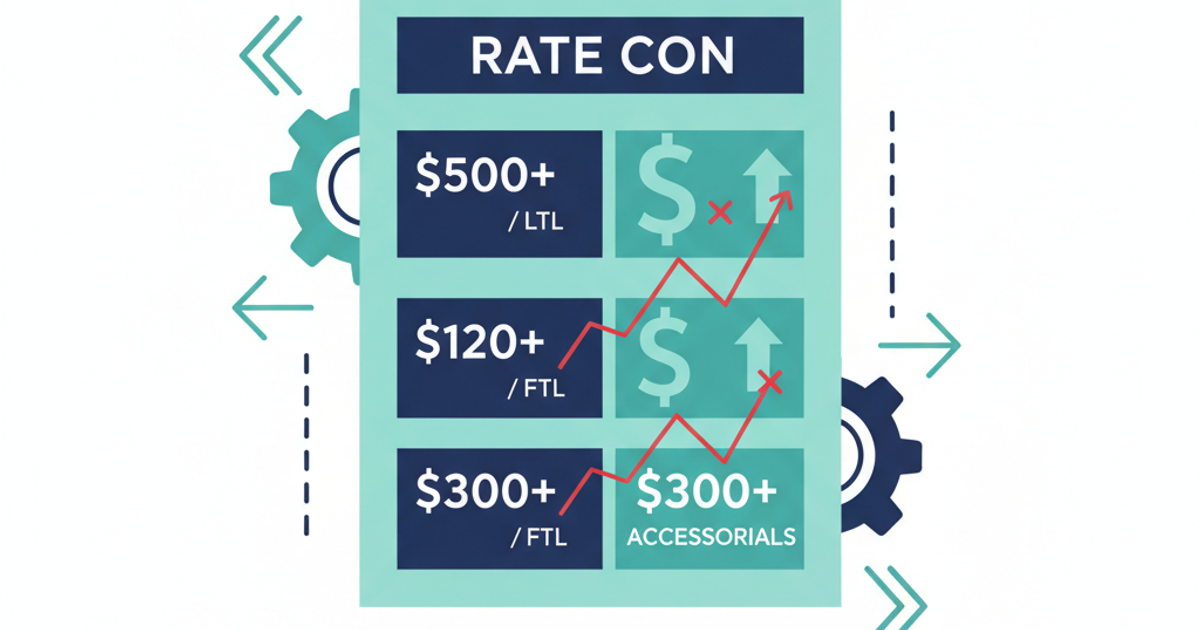
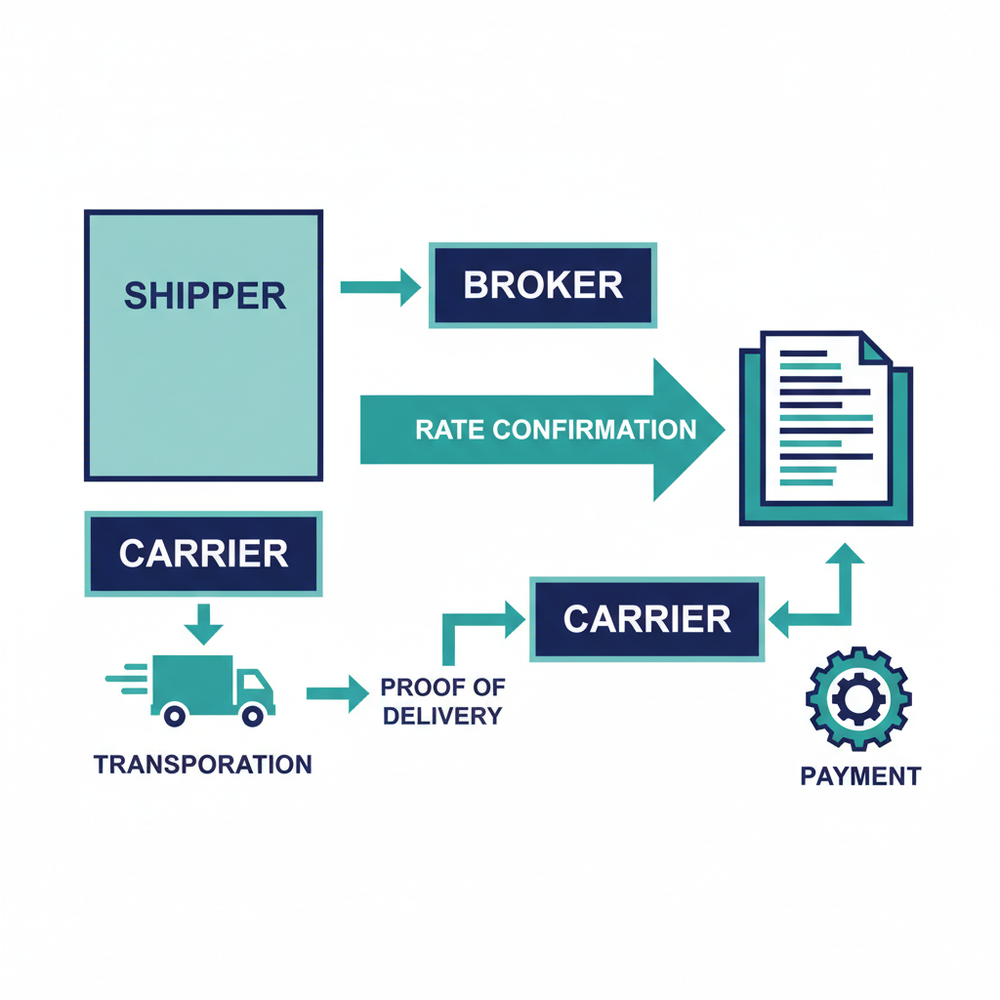
A rate con (rate confirmation) is a legally binding document between a freight broker and a carrier that specifies linehaul rate, pickup and delivery details, commodity, and any agreed accessorial charges. As Optym's rate con overview explains, it functions as the contract governing a specific load. But here's the part most brokers already know and few act on: the rate con is also the document carriers use to justify every extra charge they add to an invoice. If your rate con has a gap, a vague clause, or a missing field, that gap becomes a line item on the carrier's bill. Based on Laneproof analysis of 12,400 carrier invoices across SMB brokerages, roughly 8% of loads include at least one accessorial charge that does not match the terms in the original rate con. At an average of $120 per unauthorized charge, that's $960 per month for a brokerage moving 100 loads, or $11,520 per year in margin erosion that never shows up on a P&L until it's too late.
What a Rate Con Actually Says, and What Carriers Know That You Might Not
Every broker issues rate cons. Most think the document protects them. It does, but only if the right fields are filled in correctly and the language is specific enough to hold up during a billing dispute. The problem is that many rate cons are templated, auto-generated from a TMS, and sent out with default language that leaves critical accessorial terms blank or vague.
Carriers see hundreds of rate cons per month. Experienced carrier billing teams know exactly which fields brokers leave open and which clauses are weak enough to challenge. According to FreightWaves' guide on reading rate cons, the rate con should detail every element of the load agreement: origin, destination, commodity, weight, rate, and accessorial terms. When any of those elements are missing or ambiguous, the carrier has room to bill above what you expected to pay.
This isn't about dishonest carriers. Most aren't trying to scam you. But carrier billing departments operate on the same principle as any accounts receivable team: if the contract doesn't explicitly exclude a charge, they'll bill for it and let you dispute it. And most brokers, pressed for time, pay the invoice rather than fight over $150. That math works in the carrier's favor across thousands of loads.
Why Your TMS Template Isn't Enough
Your TMS likely generates rate cons from a standard template. That template probably includes linehaul rate, pickup and delivery addresses, dates, and maybe a generic accessorial section. What it probably doesn't include: specific detention trigger times, lumper authorization requirements, fuel surcharge table references, TONU terms, or layover conditions. Those missing fields are where carrier overbilling lives. As CarrierAssure warns about rate con language risks, vague confirmation language creates ambiguity that carriers can exploit during invoicing.
The 5 Rate Con Fields Carriers Use to Bill Above Your Agreed Rate
Not every field on a rate con carries equal risk. Based on Laneproof analysis of 12,400 disputed invoices, these five fields account for over 80% of unauthorized accessorial charges billed to brokers.
1. Detention Trigger Time and Rate
Detention is the most common accessorial dispute between brokers and carriers. The issue isn't whether detention should be paid. It's when the clock starts and how much per hour is owed.
A well-written rate con specifies: (a) the number of free hours before detention begins, (b) the hourly rate once detention kicks in, and (c) what documentation is required to prove detention time. Most rate cons get (b) right and skip (a) and (c) entirely. When the rate con says "detention: $75/hr" but doesn't say "after 2 hours free time," the carrier can start the clock at arrival. That's how a load that sat for 2 hours and 15 minutes generates a $168.75 detention bill instead of an $18.75 bill.
2. Lumper Fee Authorization
Lumper fees are charges for third-party labor to unload freight at the delivery point. They're common on grocery and retail loads, often running $250 to $500 per stop. The rate con field that matters here is whether lumper fees require prior broker authorization and what documentation the carrier must provide (a lumper receipt from the third-party service, not just the carrier's own invoice line item).
When the rate con is silent on lumper authorization, carriers can bill lumper fees after delivery with no supporting receipt. The broker has no contractual basis to reject the charge because the rate con didn't require pre-approval. For more on how these charges stack up during reconciliation, see how carrier bills go wrong at the invoice matching stage.
3. Fuel Surcharge Table Reference
Fuel surcharges are calculated using a reference table, typically tied to the DOE's weekly national average diesel price or a DAT fuel surcharge index. The dispute arises when the rate con doesn't specify which table or which week's data applies. According to DAT trendlines data, spot rates for vans showed a +1.0% week-over-week change recently, which means fuel surcharge tables can shift meaningfully from one week to the next.
If your rate con says "fuel surcharge included" or "FSC per current schedule" without naming the specific schedule and effective date, the carrier can apply whichever week's table produces the highest surcharge. On a 1,200-mile haul, that ambiguity can mean $60 to $110 in extra charges per load.
4. TONU (Truck Order Not Used) Clause
A TONU charge applies when a carrier dispatches a truck and the load cancels or isn't ready. Standard TONU fees range from $150 to $350. The problem: many rate cons have no TONU clause at all. When a load cancels and the carrier bills $175 for TONU, the broker has to decide whether to dispute a charge that has no contractual basis for or against it. Most brokers pay because the dispute would cost more in staff time than the charge itself.
Per Logity Dispatch's rate confirmation checklist for owner-operators, TONU clauses should explicitly state the conditions under which a TONU fee applies, the maximum amount, and whether proof of dispatch is required.
5. Layover and Accessorial Stacking Language
Layover charges apply when a driver must wait overnight (or longer) between pickup and delivery due to scheduling, weather, or shipper delays. The rate con field that protects you is a layover clause specifying: whether layover is billable, at what rate, and after how many hours. Without this language, a $350 layover charge on a load that listed a single pickup date with no layover provision is nearly impossible to dispute.
Even worse is accessorial stacking, where a carrier bills detention, layover, and a liftgate fee on a single invoice. If none of the three were authorized in the rate con, the broker faces a combined $640 charge above linehaul. Disputing each charge individually takes time. Many brokers approve the full invoice to keep the carrier relationship intact and move on to the next load. For a deeper look at how these errors compound, read rate confirmation errors that cost brokers real money.
What Overbilling Looks Like by Load Type (Dry Van, Reefer, Flatbed)
Overbilling patterns differ by equipment type. Each load type has its own common accessorial disputes, and the dollar amounts vary significantly. Here's what to watch for across the three most common trailer types.
Dry Van: Detention Clock Disputes
Example: A dry van load has a rate con with a linehaul rate of $1,850. The rate con states "detention: $75/hr" but does not specify a free time window. The carrier arrives at the receiver, waits 2 hours and 10 minutes, and bills 2 hours of detention at $75/hr for a total of $150 added to the invoice.
If the rate con had specified "2 hours free time before detention begins," the billable detention would be 10 minutes, or $12.50. The difference: $137.50 per load. Multiply that across 15 dry van loads per month with similar detention scenarios, and you're looking at $2,062.50 per month in avoidable charges.
Reefer: Lumper Fee Without Documentation
Example: A reefer load delivering to a grocery DC has a linehaul rate of $2,400. The carrier submits an invoice for $2,800, adding a $400 lumper fee. The rate con has no lumper authorization clause. The BOL does not mention a lumper. The carrier provides no third-party lumper receipt, just a line item on their invoice.
The broker cannot prove the lumper fee was unauthorized because the rate con never required authorization. The $400 is paid. On reefer loads into major grocery chains, this scenario repeats frequently. Even five occurrences per month at $400 each is $2,000 in monthly margin loss that was entirely preventable with a single rate con field requiring lumper pre-approval and receipt documentation.
Flatbed: Fuel Surcharge Table Mismatch
Example: A flatbed load runs 1,400 miles with a linehaul rate of $3,200. The rate con says "fuel surcharge per DAT FSC schedule." The carrier invoices using the DAT FSC index from two weeks prior to pickup, when diesel prices were higher. The broker expected the surcharge based on the week of pickup. The difference between the two weeks' tables: $0.04 to $0.08 per mile, depending on the diesel price movement.
On 1,400 miles, that's $56 to $112 in extra fuel surcharge per load. The rate con didn't specify which week's table to use, so the carrier picked the one that favored them. This is not fraud. It's a billing department doing its job within the ambiguity the broker left in the document.
How to Read a Rate Con Before You Confirm the Load
Reading a rate con before confirming a load sounds obvious, but in practice, dispatchers and ops managers review rate cons in 30 to 60 seconds before moving to the next task. That's not enough time to catch the gaps that lead to overbilling. Here's a line-by-line approach that takes about 3 minutes per rate con and can save thousands per month.
Step 1: Verify Linehaul Rate and Mileage
Confirm the linehaul rate matches what was verbally or electronically agreed. Check that the mileage listed is accurate (carriers sometimes use practical miles vs. shortest route, which affects per-mile calculations and fuel surcharges). If the mileage is wrong, every mileage-based charge on the invoice will be inflated.
Step 2: Check Every Accessorial Field
Go through each accessorial field: detention, lumper, fuel surcharge, TONU, layover, liftgate, driver assist, and any other extras. For each one, ask: Is it addressed? Is there a dollar cap? Is there a trigger condition? Is documentation required? Any field that's blank or says "per carrier's standard terms" is a billing risk. According to GetTransport's practical guide for carriers on rate confirmations, both parties benefit from explicit terms in every accessorial field because it reduces disputes and speeds up payment.
Step 3: Match the Rate Con to Your Carrier Agreement
If you have a master carrier agreement with the carrier, the rate con should reference it. Terms in the carrier agreement (like default detention policies or insurance requirements) should align with the rate con. When they conflict, you need to know which document governs. Most carrier agreements state that the rate con supersedes the master agreement for load-specific terms, but not always. This is where understanding what brokers commonly get wrong on rate confirmations becomes critical to protecting your margin.
When the BOL and Rate Con Don't Match, You're the One Who Pays
The bill of lading (BOL) and the rate con serve different purposes. The rate con is the financial agreement between broker and carrier. The BOL is the shipping document that travels with the freight. But when the two don't match, billing disputes follow, and the broker is almost always the one who absorbs the cost.
Common BOL vs. Rate Con Discrepancies
- Weight discrepancy: The rate con lists 42,000 lbs, but the BOL shows 44,200 lbs. The carrier bills for overweight accessorial charges that the rate con didn't anticipate.
- Stop count mismatch: The rate con lists one pickup and one delivery. The BOL shows a second delivery stop added at origin. The carrier bills a multi-stop fee of $150 to $250 that wasn't in the rate con.
- Commodity mismatch: The rate con says "general freight." The BOL specifies hazmat or high-value commodity. The carrier bills a commodity surcharge after the fact.
- Delivery appointment discrepancy: The rate con lists a delivery window. The BOL or POD shows delivery outside that window. The carrier claims the shipper caused the delay and bills detention accordingly.
Each of these mismatches creates a gray area where the carrier's invoice includes charges that technically aren't wrong based on the BOL, but aren't authorized by the rate con either. The broker ends up in a dispute that costs time, damages the carrier relationship, or both. For brokers processing high volumes of invoices, stopping carrier overbills at the reconciliation stage is the most reliable way to catch these mismatches before payment goes out.
The 18-Month Rule Makes This Worse
Under federal transportation law, carriers can pursue collection of undercharged amounts within 18 months after a claim accrues. As explained in JD Supra's analysis of trucking rate, payment, and collection rules, this statutory window means a carrier can come back a year after delivery and bill you for charges they initially missed, as long as they can argue the rate con or BOL supports the claim. This makes accurate, complete rate con language even more important. A vague rate con today is a billing dispute 12 months from now.
The Regulatory Pressure Is Increasing
Brokers should also be aware that the regulatory environment around rate con documentation is shifting. FMCSA's proposed broker transparency rule (Docket No. FMCSA-2023-0257) would require brokers to maintain electronic records of transactions and provide those records to carriers and shippers on request. As Thompson Hine's legal analysis of the proposed rule details, this rule could fundamentally change how brokers document and retain rate confirmations.
For brokers, this means two things. First, your rate cons need to be complete and accurate because they may become discoverable records. Second, any discrepancy between your rate con and the carrier's invoice will be easier for regulators, carriers, and shippers to identify. Sloppy rate con practices that you could previously resolve quietly with a phone call may become formal compliance issues.
What This Means for Your Rate Con Process Today
Even before the rule takes effect, building a habit of issuing detailed, field-complete rate cons protects you on two fronts: it reduces carrier overbilling now, and it prepares your documentation for a more transparent regulatory environment. The cost of adding 2 to 3 minutes of review per rate con is trivial compared to the cost of paying $11,520 per year in unauthorized accessorials.
Frequently Asked Questions About Rate Confirmations and Carrier Billing
What is a rate con?
A rate con, short for rate confirmation, is a legally binding document between a freight broker and a carrier that outlines the agreed terms for moving a specific load. It includes the linehaul rate, pickup and delivery locations, dates, commodity, and any accessorial charges. According to TruckingOffice's definition, it serves as the legal document detailing how a load will be moved and what compensation the carrier receives. Both parties are bound by its terms once signed or electronically accepted.
Can a carrier bill for charges not listed on the rate con?
Technically, a carrier can submit an invoice for any charge. Whether you're obligated to pay depends on what your rate con and carrier agreement say. If the rate con is silent on a specific accessorial (like detention or layover), the carrier may argue the charge is standard industry practice. The safest approach is to explicitly address every possible accessorial in the rate con, even if the answer is "not billable." A field that says "detention: not authorized without prior approval" is far stronger than a blank detention field.
What should I do when a carrier invoice doesn't match the rate con?
Start by comparing the invoice line by line against the rate con and the BOL/POD. Identify the specific field where the discrepancy exists. Then request documentation from the carrier: detention logs, lumper receipts, photos, or timestamps. If the carrier can't provide documentation that matches the rate con terms, you have grounds to reject the charge. Document the dispute in writing and keep a record tied to the load number. This documentation becomes critical if the carrier pursues the charge under the 18-month collection window.
How do I prevent fuel surcharge disputes on rate cons?
Specify three things in the rate con: (1) the fuel surcharge table you're using (DOE national average, DAT FSC index, or your own internal table), (2) the effective date or week the table references, and (3) whether the surcharge is calculated on total miles or loaded miles. Removing ambiguity on these three points eliminates most fuel surcharge disputes. Leaving the field as "FSC per schedule" or "fuel surcharge included" invites the carrier to apply whichever calculation benefits them most.
Does the rate con override the carrier agreement?
In most cases, the rate con governs load-specific terms (rate, dates, accessorials for that particular shipment), while the master carrier agreement governs general terms (insurance, payment terms, indemnification). However, this depends on the language in both documents. Some carrier agreements state that the master agreement takes precedence in any conflict. Others defer to the rate con. Check the "governing terms" or "order of precedence" clause in your carrier agreement. If it's not there, add one.
Sources
- FMCSA Proposed Broker Transparency Rule (Docket No. FMCSA-2023-0257) — FMCSA
- Trucking Industry Trendlines — DAT
- How to Read Your Rate Con Like a Pro — FreightWaves
- What is Rate Con? — Optym
- What Is a Rate Con? — TruckingOffice
- Here's Why You Should Watch Your Rate Con Language — CarrierAssure
- Rate Confirmation 101: What Owner-Operators Must Know — Logity Dispatch
- Mastering Rate Confirmations: A Practical Guide for Carriers — GetTransport
- FMCSA Seeks Comments on Freight Broker Transparency Proposed Rule — Thompson Hine
- Trucking Rate, Payment, and Collection Rules of the Road — JD Supra
Stop Paying for What Your Rate Con Didn't Authorize
Carrier overbilling isn't a mystery. It follows predictable patterns, targeting the same five rate con fields across the same load types. The fix isn't complicated either: fill in every accessorial field, specify trigger conditions and documentation requirements, and match every invoice against the rate con before you approve payment. Three minutes of review per rate con saves you from writing checks for charges you never agreed to.
If your team processes more than 50 carrier invoices per week, doing this manually becomes its own bottleneck. That's where automated document extraction tools can pull rate con and invoice data into a side-by-side comparison, flagging discrepancies before your billing coordinator ever opens the file. The goal isn't to distrust every carrier. It's to make sure both sides are billing from the same document.
Related: How to Extract Data from Rate Confirmations Without Losing Money
Related: Rate Confirmation Generator: The Fields Most Brokers Miss
Related: Rate Confirmation PDF: Every Field That Prevents a Billing Dispute
Related: Rate Confirmation Automation Software: What It Has to Handle to Be Worth It