Rate Confirmation Template Free: Fields That Protect You
Researched and written with AI assistance. Reviewed by the Laneproof team.
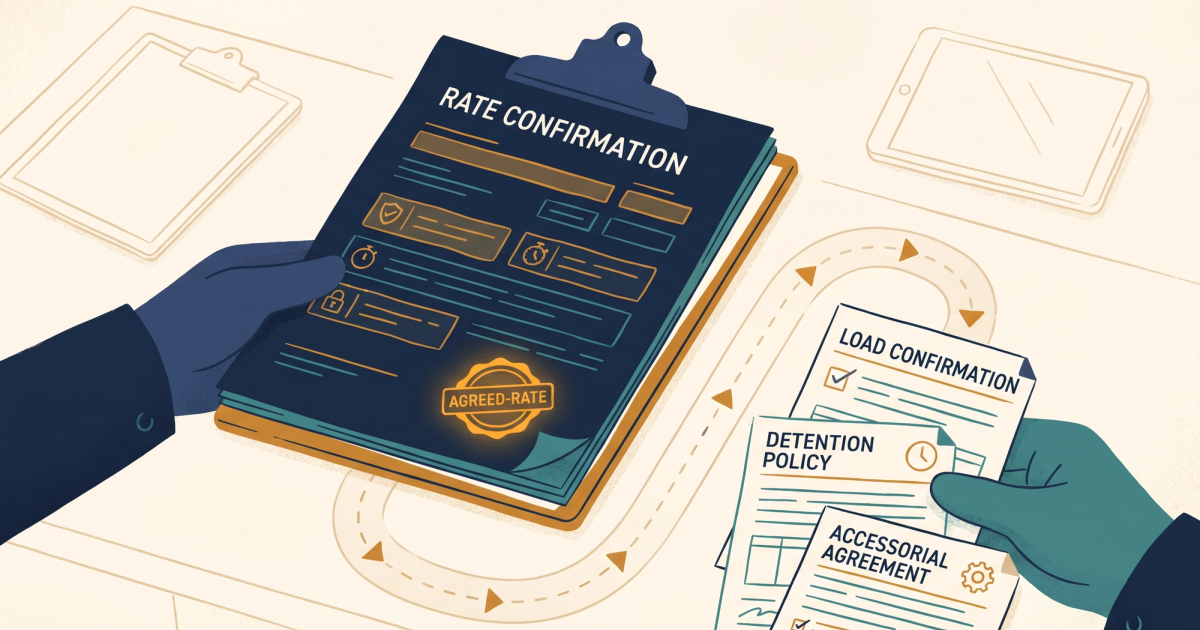
A broker moves 300 loads per month. Four percent carry an uncontested accessorial charge averaging $180. That is $2,160 every month walking out the door, or $25,920 per year, because the rate confirmation template they downloaded for free was missing three fields. The rate confirmation template free downloads that rank on the first page of Google will give you a fillable PDF. What they will not give you is the detention cap language, the accessorial authorization clause, or the fuel surcharge specificity that stops a carrier from billing you for charges you never agreed to. This guide covers every field your rate con needs, the exact language that holds up in disputes, and a free template built specifically for freight brokers who are tired of paying invoices that do not match what they booked.
A Rate Con and a Load Confirmation Are Not the Same Thing
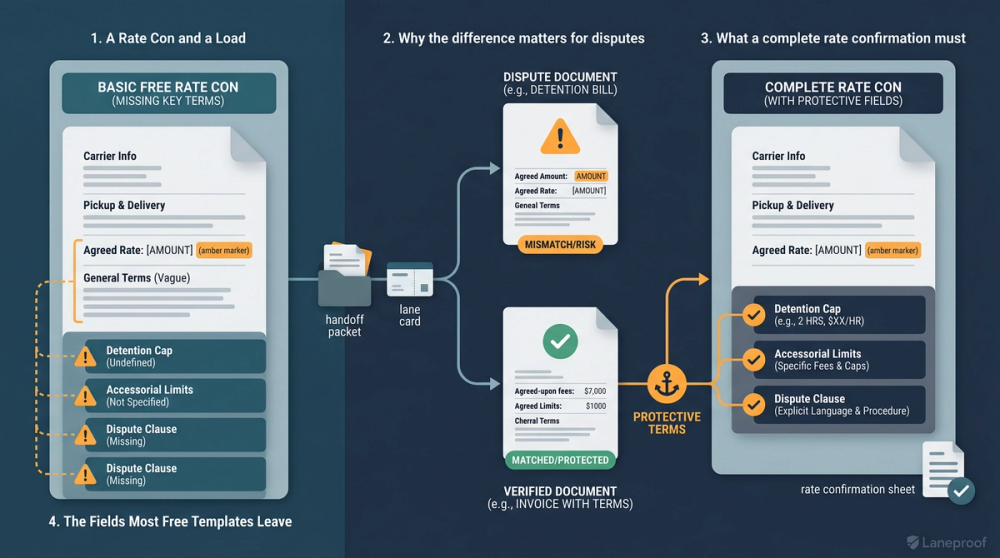
Before we get into template fields, this distinction matters because it affects what is legally enforceable. A load confirmation is a notification. It tells the carrier when to show up, where to pick up, and where to deliver. A rate confirmation is a contract. It binds both parties to specific financial terms: the linehaul rate, detention policy, accessorial limits, payment terms, and cancellation fees.
According to FMCSA Docket No. FMCSA-2023-0257, brokers already provide rate confirmation documents to motor carriers as standard industry practice. The docket treats the rate con as the primary record of the broker-to-carrier transaction. That means if your rate con is vague, incomplete, or missing key fields, you are building your dispute defense on a document the federal government considers your binding agreement, and it has holes in it.
Why the difference matters for disputes
When a carrier sends an invoice with a $150 detention charge or a $275 lumper fee you did not approve, the first document both sides pull up is the rate confirmation. If your rate con reads like a load confirmation (pickup, delivery, and a rate) with no language governing accessorials, the carrier's invoice becomes the only written record of those charges. That is how disputes get lost before they start. For a deeper look at how specific fields get exploited, read rate con fields carriers use to overbill you.
What a complete rate confirmation must include
Per Trulos' rate confirmation generator fields, a complete rate confirmation document must include billing details, carrier information, shipper details, consignee details, and all agreed-upon terms. According to Apex Capital Corp's freight billing guide, freight brokers submitting bills require three core documents: an invoice, a rate confirmation sheet, and a Bill of Lading (BOL). The rate con is the financial backbone. The BOL is the proof of delivery. The invoice is the ask. If any of the three conflict, you have a dispute on your hands.
The Fields Most Free Templates Leave Off, and Why That Costs You Money
Most free rate confirmation templates you will find online cover the basics: broker name, carrier name, MC number, pickup and delivery addresses, commodity, weight, and linehaul rate. That is enough to confirm a load. It is not enough to protect your margin. Here are the fields that get left off and what each one costs you when it is missing.
Detention cap and free time window
If your rate con does not specify a free time window and a per-hour detention rate with a maximum cap, the carrier sets the terms after the fact. We will break down the exact language below, but the field itself needs to exist on every rate con you send. It should include: free time hours at origin, free time hours at destination, per-hour rate after free time expires, and a maximum detention charge per stop.
Accessorial authorization clause
This is the single most expensive missing field. Without a clause that requires written pre-approval for any charge beyond the linehaul rate, carriers can add lumper fees, layover charges, and redelivery fees to their invoice and point to industry "standard practice" as justification. Your rate con needs a field that explicitly states: no accessorial charges will be paid unless authorized in writing by the broker prior to the charge being incurred.
Fuel surcharge method
A field that says "fuel surcharge included" is not the same as a field that says "fuel surcharge: 22% of linehaul, included in the agreed rate of $2,450." If you leave the FSC vague, a carrier can invoice using their own tariff table, which may be higher than the percentage you assumed was baked in. We will walk through a real example of this below.
TONU and dry run terms
If a load cancels after dispatch, who pays what? If the rate con does not answer this question with a specific dollar amount or percentage, the carrier will answer it for you on their invoice. A TONU (Truck Order Not Used) field with a capped amount prevents a $500 dry run claim on a $1,800 load.
Payment terms and required documents
Your rate con should specify the payment window (Net 30, Net 21, Quick Pay discount percentage) and the exact documents required for payment. At minimum: signed BOL, proof of delivery (POD), and the original rate confirmation. If you do not list required documents, you lose the ability to hold payment when backup is missing. For more on how gaps in your carrier agreement lead to overbilling, see rate agreement gaps carriers use to overbill you.
How to Write Detention and Accessorial Language That Actually Holds
Having the right fields on your template is step one. Writing the right language inside those fields is what actually protects you in a dispute. Here is the difference between language that looks protective and language that works.
Detention language: vague versus protective
Vague: "Detention may apply at origin and destination." This sentence does nothing. It acknowledges detention exists. It does not define free time, per-hour rates, or caps. A carrier can bill $75 per hour with no cap and point to this language as permission. Protective: "Detention begins after 2 hours free time at origin and 2 hours free time at destination. Detention rate: $50 per hour. Maximum detention charge: $200 per load. Detention requires a signed detention form from the facility with arrival time, departure time, and facility signature. No detention will be paid without this documentation." This language does four things: it sets a free time window, caps the hourly rate, caps the total charge, and requires third-party documentation. In a dispute, every one of those clauses gives you a reason to deny or reduce the charge.
Accessorial language: the authorization requirement
Weak: "Accessorial charges subject to approval." Subject to whose approval? When? Before or after the charge? This is unenforceable. Strong: "No accessorial charges (including but not limited to lumper fees, layover, detention, TONU, redelivery, or driver assist) will be honored unless authorized in writing by [Broker Company Name] prior to the charge being incurred. Written authorization must include the specific charge amount approved. Any accessorial invoiced without prior written approval will be deducted from the carrier's payment." This clause is specific, names the charge types, requires pre-approval, and states the consequence. That is what holds up.
Fuel surcharge language: locking down the rate
Vague: "Rate includes fuel." Protective: "The agreed all-in rate of $[Amount] includes a fuel surcharge calculated at [X]% of linehaul. No additional fuel surcharge will be accepted. Carrier agrees that no separate FSC line item will appear on the invoice. If a separate FSC is invoiced, the broker reserves the right to deduct the overage from payment." The second version eliminates the carrier's ability to add a separate FSC line to the invoice and gives you written authority to deduct if they do.
Rate Con Mistakes That Turn Into Carrier Invoice Disputes
Every field you leave blank or vague is an opening for a carrier to bill something you did not budget for. Here are real scenarios that show how specific template mistakes turn into specific dollar losses.
Scenario: the $150 detention charge you never agreed to
A broker books a dry van load from Dallas to Memphis. Linehaul rate: $1,600. The rate con lists pickup and delivery addresses, the rate, and the commodity. No detention language anywhere on the document. The driver arrives at the consignee and waits three hours. The carrier invoices $1,750: the $1,600 linehaul plus $150 in detention at $75 per hour for one hour beyond what they consider "standard" two-hour free time. The broker disputes the charge. The carrier points to the rate con: "There is no detention policy listed, so our standard tariff applies." The broker has no written basis to counter. They pay the $150. If the rate con had included a detention field stating "2 hours free time, $50/hour, $200 max, signed facility form required," the broker could have either denied the charge entirely (no facility form) or negotiated it down to $50 (one hour at the agreed rate).
Scenario: the $275 lumper fee billed without authorization
A broker sends a reefer load to a grocery distribution center. The rate con lists the linehaul rate of $2,200 and standard load details. No accessorial clause. At delivery, the facility requires a lumper service. The driver pays $275 and the carrier adds it to the invoice. The broker did not know about the lumper requirement. The carrier says, "We paid it. You owe us." Without a clause requiring written pre-approval for accessorials, the broker has no contractual ground to deny the charge. With a proper accessorial authorization clause, the broker's response is simple: "Our rate confirmation requires written approval before any accessorial is incurred. No approval was obtained. Per the terms of our agreement, this charge is not payable."
Scenario: the $94 fuel surcharge overcharge
A broker agrees to an all-in rate of $1,850 on a load from Chicago to Atlanta. The rate con says "rate includes fuel." The carrier invoices $1,944: $1,850 linehaul plus a $94 fuel surcharge calculated using the carrier's internal FSC tariff table at 5.1% of linehaul. The broker calls to dispute. The carrier says, "Your rate con says rate includes fuel, not that no FSC applies. Our tariff adds FSC to all loads." It is a stretch, but without explicit language stating that no separate FSC will be invoiced, the carrier has an argument. A rate con that states "The agreed all-in rate of $1,850 includes fuel surcharge. No separate FSC line item will be accepted" kills this dispute before it starts.
The annual cost of missing fields
Take a broker moving 300 loads per month. If 4% of those loads carry an uncontested accessorial, detention, or FSC charge averaging $180, that is 12 loads per month at $180 each. That is $2,160 per month. Over a year, $25,920 in charges that a properly built rate confirmation template could have prevented or given you grounds to dispute. That number scales with volume. At 500 loads per month, it is $43,200 per year.
One missing field on your rate con can cost more per year than the time it takes to fix your entire template.
How to Use This Template Without Creating New Problems
Having a good template is not the same as using it correctly. Here are the operational steps that keep your rate con from becoming a liability.
Step 1: Customize the template per lane, not per load
You do not need to rewrite your rate con for every load. Build lane-specific versions with pre-filled detention policies and accessorial clauses that match the facilities you serve. A grocery DC in New Jersey that always requires lumpers should trigger a rate con version that includes a pre-approved lumper fee cap. A shipper in Texas with a known 3-hour loading window should trigger a rate con with extended free time. ArkTMS offers a free template library that includes rate confirmations, carrier agreements, and BOLs as starting points. Customize from there.
Step 2: Get it signed before the truck moves
A rate confirmation is only as binding as both parties' agreement to it. If you send the rate con after dispatch, or the carrier picks up before signing, you have a document, not a contract. Your workflow should be: negotiate the rate, send the rate con, receive the signed rate con, then dispatch. No exceptions. Per Sensible's breakdown of rate confirmation documents, a signed rate confirmation typically constitutes a binding contract when it contains all essential terms and both parties agree to its provisions. "Both parties agree" means both parties signed before the work started.
Step 3: Match the rate con to the invoice on every load
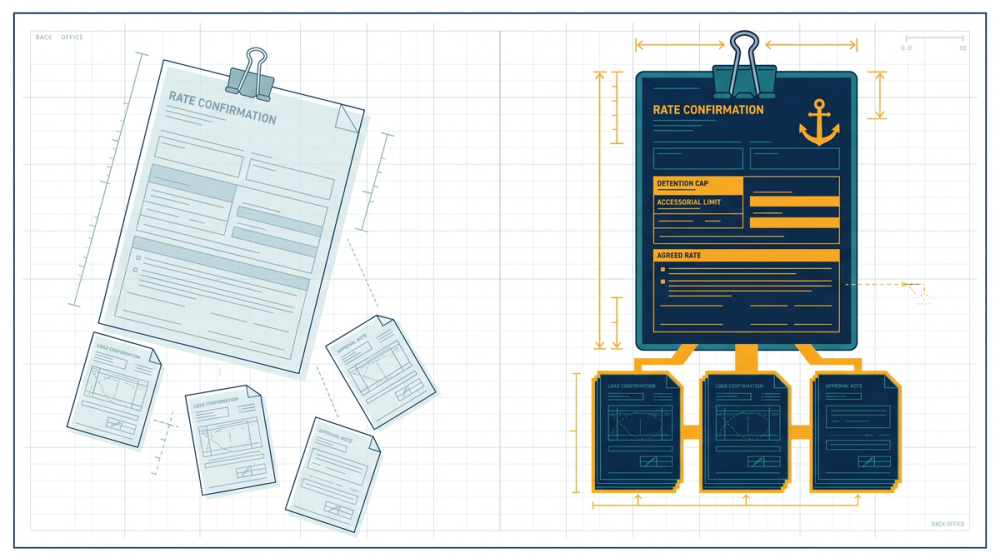
The rate con is only protective if you actually use it to check invoices. When a carrier invoice comes in, your billing coordinator or ops manager should match every line item on the invoice to the corresponding field on the rate con. Linehaul matches? Good. FSC matches? Good. Detention charge that is not on the rate con? Flag it. Lumper fee without pre-approval documentation? Reject it. This is where the process breaks down for most brokerages. Matching invoices to rate cons manually across 300 or more loads per month takes hours. It is the reason so many accessorial charges go uncontested: not because the broker agreed to them, but because nobody had time to check. If you want to read more about what brokers commonly miss in this process, this breakdown of rate confirmation mistakes covers the most expensive errors.
Step 4: Store the signed rate con with the BOL and POD
Your rate con, BOL, and POD are a three-document set. They should be stored together, indexed by load number, and retrievable in under 60 seconds. If a dispute comes in 45 days after delivery, you need to pull all three documents fast. If your team is digging through email threads or shared drives to find the signed rate con, you are losing disputes you should be winning.
For brokerages processing hundreds of documents monthly, tools that automatically extract and index rate con data cut the retrieval time from minutes to seconds and reduce the chance of misfiled or missing documents.
Step 5: Build a TONU clause that protects both sides
Here is a TONU clause written two ways. Carrier-friendly (and risky for you): "In the event of cancellation after dispatch, carrier is entitled to a reasonable dry run fee." "Reasonable" is not a number. The carrier decides what is reasonable, and you get an invoice for $400 on a $1,200 load. Broker-protective: "In the event of cancellation after dispatch confirmation but prior to loading, a TONU fee of $250 will be paid to the carrier. This amount represents the full and final compensation for the cancelled load. No additional charges will be accepted." The second version names the exact dollar amount, caps the charge, and eliminates ambiguity. If you want to tie it to a percentage instead, use: "TONU fee: 25% of the agreed linehaul rate, not to exceed $350." For a full look at how to read and evaluate carrier rate terms before they become problems, see how to read a carrier rate sheet.
Frequently Asked Questions About Rate Confirmation Templates
Is a signed rate confirmation legally binding?
Yes, when it contains all essential terms and both parties have agreed to its provisions. Per Sensible's analysis of rate confirmation documents, a signed rate confirmation typically constitutes a binding contract. The key requirements: offer (the load terms), acceptance (the carrier's signature), and consideration (the agreed rate). If any of those elements are missing or the document was signed after the work was completed, enforceability weakens.
What is the difference between a rate confirmation and a carrier agreement?
A carrier agreement (also called a broker-carrier agreement or carrier packet) is the master contract that governs the overall relationship between a broker and a carrier. It covers insurance requirements, indemnification, general payment terms, and liability. A rate confirmation is a per-load document that specifies the terms of an individual shipment: the rate, pickup and delivery details, commodity, and load-specific clauses like detention and accessorial limits. Both should be in place before a carrier hauls a load. The carrier agreement sets the relationship rules. The rate confirmation sets the load rules.
Can a carrier charge detention if it is not on the rate con?
They can invoice it. Whether you have to pay it depends on your rate confirmation language and your carrier agreement. If neither document addresses detention, the carrier may argue that industry-standard detention applies. If your rate con explicitly states that no charges beyond the agreed linehaul will be paid without written pre-approval, you have contractual grounds to deny the charge. The safest position: always include detention terms, even if it is "no detention will be paid on this load."
How many fields should a rate confirmation template have?
At minimum, a broker-facing rate confirmation should include: broker company name and MC number, carrier company name and MC number, driver name and contact, pickup location with date and time, delivery location with date and time, commodity and weight, equipment type, linehaul rate, fuel surcharge terms, detention terms (free time, hourly rate, cap, documentation requirements), accessorial authorization clause, TONU/cancellation terms, payment terms and required documents, and signature lines for both parties. That is 14 to 16 fields. Most free templates include 8 to 10.
Should I use a different template for reefer and dry van loads?
Yes, or at minimum, use a single template with conditional fields. Reefer loads should include temperature requirements, continuous monitoring language, and a clause specifying who is liable for temperature deviations. Reefer loads to grocery DCs often involve lumper fees, so a pre-approved lumper fee cap field is more critical on those rate cons. Building two or three template variants (dry van, reefer, flatbed) takes an hour and prevents field gaps that are specific to each equipment type.
Sources
- FMCSA Docket No. FMCSA-2023-0257: Transparency in Property Broker Transactions — Federal Motor Carrier Safety Administration
- Free Rate Confirmation Generator — Trulos
- Free Freight Broker Templates — ArkTMS
- Extracting Data from Rate Confirmations — Sensible
- How to Build a Freight Bill Like a Pro — Apex Capital Corp
Stop Paying Charges You Never Agreed To
Every rate confirmation you send without proper detention caps, accessorial authorization clauses, and fuel surcharge specificity is an invitation for a carrier to bill beyond the agreed rate. The fields are not complicated. The language is not long. But missing them costs brokerages thousands of dollars a year in charges they could have denied with a single sentence on the rate con.
Fix your template first. Add the fields covered in this guide. Write the protective language. Get it signed before the truck moves. Then match every invoice against it. If you are processing enough volume that manual matching is burning hours your team does not have, see how Laneproof handles this workflow. Plans start at $149/month for up to 400 documents, and every rate con, BOL, and invoice gets checked against the terms you actually agreed to.
Related: Rate Confirmation Trucking Template: Fields Most Brokers Miss