Freight Audit and Payment Jobs: What These Roles Actually Catch
Researched and written with AI assistance. Reviewed by the Laneproof team.
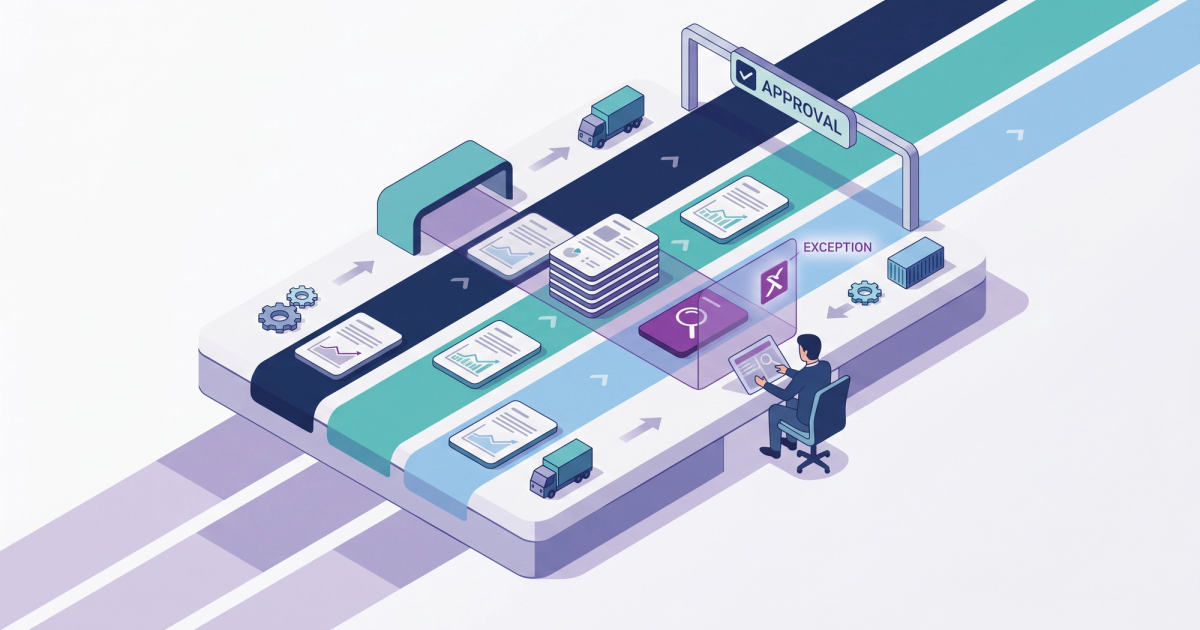
A single freight billing coordinator at a 12-person brokerage manually reconciling 300 invoices per week catches an average of 22 discrepancies. At an average overbill of $84 per discrepancy, that's $1,848 per week, or roughly $96,000 per year recovered. That's not a software demo stat. That's what one person doing freight audit and payment jobs well looks like in practice. According to Intek Logistics' analysis of billing accuracy, the average freight invoice error rate sits between 5% and 8%. On 300 invoices a week, the math is straightforward: errors are constant, and catching them is a full-time job. This guide covers what that job actually involves, hour by hour, and what it pays to get right.
What a Freight Audit and Payment Job Actually Looks Like on a Tuesday Morning
Job board descriptions for freight audit roles read like someone copied a supply chain textbook. "Ensure accuracy of freight invoices." "Reconcile carrier billing against contracts." That tells you nothing about what's on your screen at 9 AM. Here's what the role looks like in practice. You open your TMS or email queue and pull the first batch of carrier invoices. Each one needs to be matched against the rate confirmation, the BOL, the POD, and sometimes check call or GPS data. You're checking linehaul against the agreed rate. You're verifying that every accessorial, from detention to lumper fees to fuel surcharges, matches the contract terms and the actual load events. If the numbers don't match, you document the discrepancy and route it for dispute or denial before the invoice hits the payment queue.
This is invoice reconciliation at the line-item level. Not a glance at the total. Not a spot check. Every charge on every invoice gets compared to the source documents. According to Trax Technologies' freight audit guide, the freight audit process includes invoice collection, pre-audit validation, processing, payment execution, and post-payment analytics. In smaller brokerages and carriers, one person often handles all five of those steps. At larger shippers, each step might be a different team.
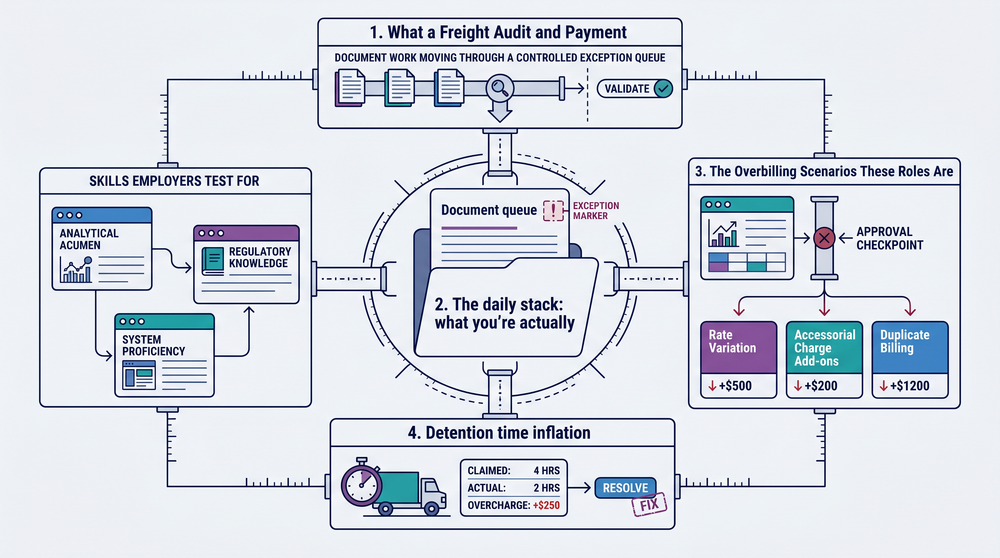
The daily stack: what you're actually reviewing
A typical day in a freight back office role involves reviewing invoices against rate confirmations for linehaul accuracy, comparing detention and layover charges to BOL timestamps, verifying fuel surcharge percentages against the contracted FSC table for that week, confirming whether lumper fees are carrier-paid or shipper-paid per the rate con, and checking for charges that don't correspond to real load events (dry runs, TONUs, accessorials). That last category is where the money hides. A charge that looks plausible on paper but doesn't match the actual sequence of events can slip through if the person reviewing it doesn't know what to look for, or doesn't have the right documents pulled up.
For anyone hiring into this role, the question isn't "can this person enter data?" It's "can this person spot a $175 dry run fee on a load where the truck actually delivered?" That's a fundamentally different skill. If you're evaluating how much these errors cost when nobody catches them, the numbers are covered in detail in what it costs to skip freight audit entirely.
The Overbilling Scenarios These Roles Are Built to Catch
Freight audit and payment jobs exist because carrier invoices contain errors at a rate of 5% to 8%, according to industry benchmarks cited by Intek Logistics. Some errors are honest data entry mistakes. Some are systematic. Either way, the freight billing coordinator is the last line of defense before your margin disappears. Here are the specific overbilling scenarios these roles catch every week.
Detention time inflation
Example: A carrier bills 4 hours of detention at $75/hour on a load where the BOL timestamps show 1.5 hours at the dock. That's $300 billed versus $112.50 owed, a $187.50 overbill on a single load. The freight audit professional catches this by matching the rate con against POD arrival and departure times. Detention disputes are among the most common and most winnable, but only if you have the timestamps documented. The FMCSA career center provides context on federal freight regulations that govern detention standards. Understanding these rules is part of the job.
Lumper fees billed to the wrong party
Example: A lumper fee of $450 appears on a carrier invoice for a load where the rate confirmation explicitly states lumper is shipper-paid. The freight billing coordinator flags it before the payment run executes and saves the full $450 margin on that lane. This isn't a gray area. The rate con is the contract. If it says shipper-paid, the carrier doesn't get to bill it. But if nobody reads the rate con side by side with the invoice, it gets paid.
Fuel surcharge miscalculations
Example: A fuel surcharge is calculated at 18.5% on a week when the carrier's contracted FSC table caps at 14.2%. On a $4,200 linehaul, that's a $176.40 discrepancy per load. Multiply that across 40 similar loads per month, and the compounding overbill reaches $7,056 monthly. This scenario is especially dangerous because the percentage difference looks small. 4.3 points doesn't jump off the page. But across volume, it's the kind of leak that quietly erodes thousands in monthly margin. Catching it requires knowing which FSC table applies to which carrier and which week, then checking every invoice against it. For a full checklist of which line items to verify first, see which line items to check in a transportation audit.
TONU charges on loads that weren't actually canceled
Example: A TONU charge of $200 appears on a load that was not a true "order not used." The driver was reassigned by the carrier, not canceled by the broker. The audit role documents the sequence of events using load tracking timestamps and denies the charge with supporting evidence. TONU disputes require clear documentation of who initiated the cancellation. Without that paper trail, it's a he-said-she-said that usually ends with the broker paying.
Layover charges that don't match the timeline
Example: An accessorial charge for a layover is billed at $350 on a load where the carrier's own check call logs show the driver was back en route within the same business day. Caught during the accessorial charge verification step before the invoice is approved. The key here: the carrier's own data disproved their own charge. Freight audit professionals learn to use every available data source, including the carrier's, to validate or deny claims.
Dry run fees on loads that actually delivered
Example: A dry run fee of $175 appears on a load where the shipper's receiving log confirms the truck arrived and was unloaded. The freight back office role requests the signed BOL and denies the charge with documentation. Dry run fees are legitimate when a driver arrives and can't load or unload due to shipper error. They're not legitimate when the load was completed. The signed BOL is the proof.
A single billing coordinator reconciling 300 invoices per week can recover roughly $96,000 per year in overbilling. The role pays for itself many times over.
Skills That Matter in Carrier Invoice Review (And Ones That Don't)
Job postings for freight audit and payment roles often list requirements that range from relevant to ridiculous. Having reviewed 139 freight audit payment job listings on LinkedIn and over 794 on Indeed, here's what actually separates the candidates who catch overbills from the ones who just enter data.
Skills that directly affect what you catch
- Rate con fluency. You need to read a rate confirmation the way a mechanic reads a diagnostic report. Every field matters: linehaul, FSC terms, accessorial allowances, lumper responsibility, detention free time. If you can't find the contracted detention free time in 10 seconds, you'll miss the overbill.
- Document cross-referencing. The core skill is comparing the invoice to the rate con, BOL, POD, and tracking data simultaneously. Not sequentially. You need to hold the details of one document in your head while scanning another for mismatches.
- Basic math accuracy. You don't need a finance degree. You need to quickly calculate whether 14.2% of $4,200 equals the fuel surcharge on the invoice. Mental math or a calculator, either works. Just don't trust the carrier's math.
- Dispute documentation. Catching an error isn't enough. You need to write a clear, evidence-backed dispute that the carrier can't argue with. That means citing specific timestamps, document references, and contract clauses.
- Knowledge of carrier billing tactics. Experienced freight audit professionals know which carriers routinely overbill on detention, which ones pad fuel surcharges, and which ones submit charges for events that didn't happen. This pattern recognition builds over time and compounds your effectiveness.
Skills that sound important but don't move the needle
- Advanced Excel modeling. You'll use spreadsheets, yes. But you're not building financial models. You're matching data across columns. Pivot tables and VLOOKUP matter more than regression analysis.
- Formal accounting certification. Helpful at senior levels, but not required for entry or mid-level freight audit roles. Understanding debits and credits matters less than understanding what a layover charge should look like.
- Generic "attention to detail." Every job posting says this. What they actually mean is: can you spot a $4.30 percentage point discrepancy on a fuel surcharge when you're reviewing your 200th invoice of the week? That's a specific kind of focus, not a personality trait.
For a structured approach to what to check on each invoice, the carrier payment audit checklist breaks the process into steps you can run through in under 10 minutes per load.
Tools and Software You're Expected to Know Before Day One
The toolset for freight audit and payment jobs varies by company size and type, but certain categories come up in nearly every listing. Knowing the category matters more than knowing one specific vendor, because companies switch tools frequently.
TMS platforms
Most freight audit work happens inside or alongside a transportation management system. At brokerages, you'll commonly see Aljex, McLeod, Tai, or MercuryGate. At larger shippers, SAP TM or Oracle Transportation Management are standard. You don't need to have used all of them, but you need to be comfortable navigating a TMS to pull rate confirmations, load details, and payment records. If a job posting lists a specific TMS, spend 30 minutes watching a demo video before the interview. That alone puts you ahead of most candidates.
Freight audit and payment platforms
Dedicated FAP platforms handle invoice ingestion, automated matching, exception flagging, and payment execution. According to Gartner's definition of FAP services, these platforms cover invoice collection, pre-audit, processing, payment, and analytics. Major names include Trax Technologies, Cass Information Systems, CTSI-Global, and nVision Global. Senior roles, like the Associate Director position at Merck, require 8+ years of supply chain or logistics experience, including 3+ years of direct freight audit experience, plus familiarity with enterprise-grade FAP systems.
Spreadsheets and reporting tools
Excel is non-negotiable. You'll use it for reconciliation workbooks, discrepancy tracking, variance analysis, and reporting to management. The functions that matter most: VLOOKUP (or INDEX/MATCH), pivot tables, conditional formatting, and basic SUM/IF formulas. Some companies use Google Sheets or BI tools like Power BI or Tableau for dashboards. But Excel proficiency is the baseline.
Document retrieval and OCR tools
Pulling BOLs, PODs, and carrier packets from email attachments, carrier portals, or shared drives is a significant portion of the job. Some companies use document management systems or OCR (optical character recognition) tools to extract data from scanned documents automatically. If you've worked with any document extraction or data capture tool, mention it. The ability to pull structured data from messy PDFs is increasingly valuable as companies try to reduce the hours spent on manual invoice reconciliation.
How This Role Fits Into a 3PL, Carrier, or Shipper Operation
Freight audit and payment jobs exist across the supply chain, but what you do day to day varies significantly depending on whether you sit inside a 3PL, a carrier, or a shipper. The core skill set is the same: match invoices to contracts and catch discrepancies. But the perspective, the volume, and the career path differ.
At a freight brokerage or 3PL
You're reviewing carrier invoices before paying them. Your job is to protect the broker's margin on every load. You're comparing what the carrier billed against the rate confirmation and the actual load events. Volume is high: a mid-size brokerage might process 300 to 1,000 invoices per week. Speed matters, but accuracy matters more. One missed overbill on a high-volume lane can cost thousands per month, as the fuel surcharge example above demonstrates ($7,056/month on 40 loads). At a brokerage, the freight billing coordinator often handles both audit and payment, making it a role that touches every load the company moves.
At a carrier
The focus flips. You're making sure your company's invoices are accurate before they go out, and you're managing incoming payment disputes from brokers and shippers. Carriers with good billing practices lose fewer disputes, get paid faster, and maintain better broker relationships. As of 05/30/2026, a carrier like JB Hunt Transport Inc (USDOT 264184) maintains an operating status of AUTHORIZED FOR Property, HHG, per SAFERWEB data. Large carriers like this have dedicated billing teams. Smaller asset carriers might have one person handling invoicing and dispute response alongside other duties.
At a shipper
Shippers audit invoices from carriers and 3PLs. The volume can be enormous. Enterprise shippers like Amazon and Merck have built dedicated freight audit teams. The Amazon Freight Audit Payment Analyst role sits within AWS Infrastructure, emphasizing analytical skills and data-driven decision-making. The Merck Associate Director role requires 8+ years of experience, signaling a defined career ladder from analyst to director. According to Mordor Intelligence, the freight audit and payment market is estimated at USD 0.97 billion in 2025 and projected to reach USD 1.89 billion by 2030, growing at a 14.2% CAGR. Technavio projects the market will grow by USD 651.2 million between 2026 and 2030 at an 11.2% CAGR. That growth means more roles, more specialization, and more upward mobility for people already in these positions.
Career progression: where this role leads
Entry-level freight audit and payment jobs (billing coordinator, freight audit analyst) typically require 1 to 3 years of logistics or back-office experience. Mid-level roles (senior analyst, audit supervisor) require 3 to 5 years, plus demonstrated ability to manage carrier disputes and reporting. Senior roles like the Merck Associate Director position require 8+ years of experience, including 3+ years directly in freight audit, according to the job posting. The path from entry to director is well-defined, and the skills are transferable across company types.
Real Scenarios: How Freight Audit Professionals Recover Money
The examples earlier in this article are drawn from the types of overbilling scenarios that freight audit and payment professionals encounter daily. Here are two more worked examples with step-by-step calculations to show how the recovery math works.
Scenario: Fuel surcharge compounding across a lane
A carrier runs 40 loads per month on a dedicated lane with a $4,200 linehaul rate. The contracted FSC table for the current week caps at 14.2%, meaning the maximum fuel surcharge is $596.40 per load. The carrier invoices fuel surcharge at 18.5%, or $777 per load. Step 1: Calculate the per-load discrepancy. $777 minus $596.40 equals $180.60. (The slight difference from the $176.40 cited earlier reflects rounding in the FSC table lookup; in practice, exact figures depend on the table's DOE index band.) Step 2: Multiply by monthly volume. $180.60 times 40 loads equals $7,224 per month. Step 3: Annualize. $7,224 times 12 equals $86,688 per year. If nobody is checking the FSC table against the invoice every week, that money is gone. The freight audit professional's job is to check it on every single load.
Scenario: Cumulative impact of small accessorial overbills
A brokerage processes 300 invoices per week. The billing coordinator identifies 22 discrepancies (a 7.3% error rate, consistent with the 5% to 8% industry average cited by Intek Logistics). The average overbill per discrepancy is $84, covering a mix of detention padding, incorrect fuel surcharges, and accessorial charges that don't match the rate con. Step 1: Weekly recovery. 22 times $84 equals $1,848. Step 2: Monthly recovery. $1,848 times 4.33 weeks equals approximately $7,996. Step 3: Annual recovery. $1,848 times 52 weeks equals $96,096. This is one person, at one brokerage, catching errors that would otherwise be paid. The role doesn't just "process invoices." It directly recovers margin. For a deeper breakdown of the audit steps that catch these overbills, see how to catch carrier overbilling in 10 minutes per invoice.
Frequently Asked Questions About Freight Audit and Payment Jobs
What's the difference between a freight billing coordinator and a freight audit analyst?
In practice, these titles often overlap, especially at smaller companies. A freight billing coordinator typically handles invoice entry, payment processing, and basic discrepancy flagging. A freight audit analyst is more focused on pre-audit validation, root cause analysis of billing patterns, and reporting on carrier compliance. At larger organizations like Amazon or Merck, the analyst role carries heavier data analysis expectations and may involve working with BI tools to identify systemic overbilling trends.
Do I need logistics experience to get into a freight audit and payment role?
Most entry-level postings ask for 1 to 2 years of logistics, supply chain, or accounts payable experience. However, candidates from adjacent fields like general AP/AR, procurement, or even customer service roles at logistics companies can transition in. The critical factor is your ability to learn freight-specific documents (rate con, BOL, POD) quickly and your comfort working with spreadsheets. Studying the terminology (accessorial, linehaul, FSC, detention, TONU, lumper fee) before applying will put you ahead of generic AP candidates.
Are freight audit and payment jobs remote or on-site?
Both. As of mid-2025, a significant number of the 794 freight payment audit jobs listed on Indeed and 139 on LinkedIn include remote or hybrid options. The work is primarily digital (email, TMS, spreadsheets), which makes it well-suited to remote execution. Larger shippers tend to offer more on-site roles because of the collaboration required with procurement and finance teams. Brokerages and 3PLs are more likely to offer fully remote positions.
How much can a freight audit role actually save a company?
It depends on invoice volume and error rate. Using the industry average invoice error rate of 5% to 8% (per Intek Logistics), a brokerage processing 300 invoices per week with an average overbill of $84 per discrepancy can expect to recover approximately $96,000 per year with one dedicated billing coordinator. At higher volumes (1,000+ invoices per week), annual recovery can exceed $300,000. The role consistently pays for itself within the first quarter.
What career path does this role lead to?
The career ladder is well-defined. Entry-level roles (billing coordinator, audit clerk) lead to mid-level positions (senior analyst, audit team lead) within 2 to 4 years. From there, supervisory and management roles (audit manager, director of freight payment) become accessible. The Merck Associate Director posting specifies 8+ years of supply chain experience and 3+ years of direct freight audit experience. Professionals who develop expertise in FAP platforms and carrier compliance analytics are especially well-positioned for director-level roles.
Conclusion: The Role That Pays for Itself
Freight audit and payment jobs aren't back-office filler. They're the reason brokerages, carriers, and shippers don't leak thousands of dollars per month through detention padding, fuel surcharge miscalculations, and accessorial charges that never should have been billed. The skills are specific: rate con fluency, document cross-referencing, dispute documentation, and pattern recognition across carrier billing behavior. The tools are learnable. The career path is defined, from billing coordinator to audit director. And the market is growing fast, with the freight audit and payment market projected to nearly double from $0.97 billion in 2025 to $1.89 billion by 2030.
If your team processes more than 50 invoices a week and you're still reconciling everything manually, tools that automatically flag invoice discrepancies can catch the same overbilling scenarios covered in this guide, faster and at higher volumes. But whether you use automation or a sharp billing coordinator with a spreadsheet, the principle is the same: every invoice gets checked, every charge gets verified, and every dollar that doesn't belong to the carrier stays where it should.
Sources
- FMCSA Career Center — U.S. Department of Transportation
- Freight Audit Payment Jobs on LinkedIn — LinkedIn
- Freight Payment Audit Jobs on Indeed — Indeed
- Freight Audit Payment Analyst, Business Operations-Variable — Amazon Jobs
- Associate Director, Freight Payment and Auditing — Merck Careers
- Freight Audit and Payment Market Size 2026-2030 — Technavio
- Freight Audit and Payment Market Size & Growth to 2030 — Mordor Intelligence
- Best Freight Audit and Payment Providers Reviews 2026 — Gartner
- The Ultimate Guide to Freight Audit — Trax Technologies
- 2026 Best Freight Audit & Pay Companies (and How to Choose) — Intek Logistics
Related: Your Freight Audit Report Is Missing These Line Items
Related: Freight Audit Software for Brokers: What Actually Recovers Money
Related: Freight Auditor Salary vs. Software: What SMB Brokers Actually Pay
Related: What Freight Audit and Payment Companies Actually Catch (And Miss)