Freight Auditor Salary vs. Software: What SMB Brokers Actually Pay
Researched and written with AI assistance. Reviewed by the Laneproof team.
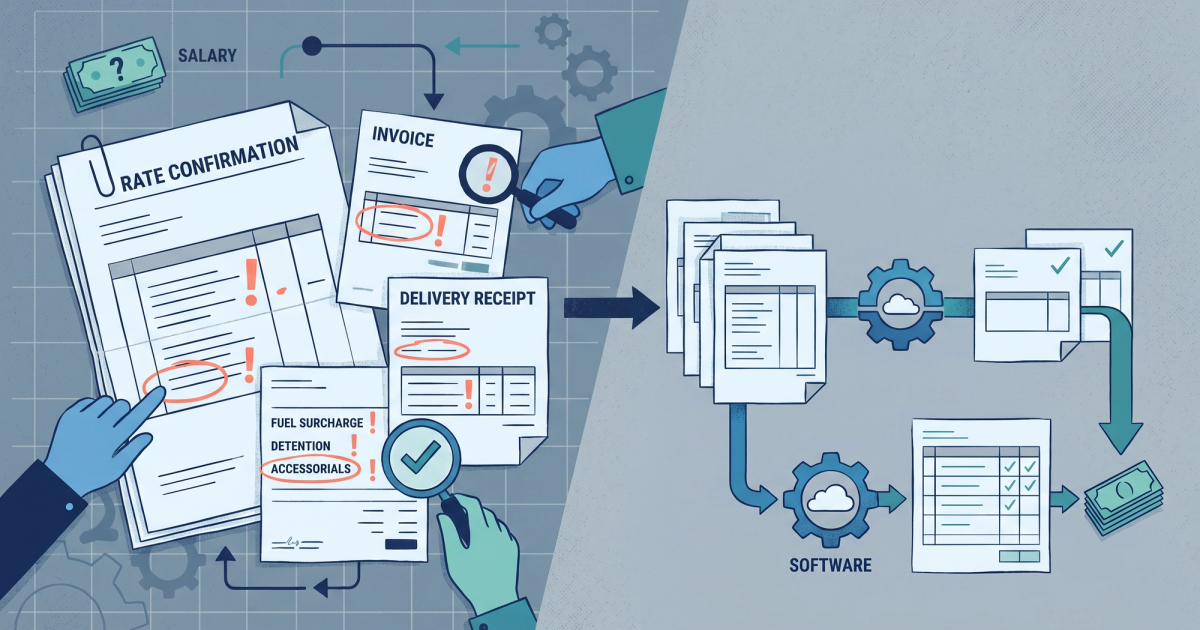
A freight auditor salary in the United States averages $92,797 per year, according to ZipRecruiter's 2026 salary data. That's the number you'll find on most job boards. What you won't find is the number that actually matters to your brokerage: the fully loaded cost of putting that person in a seat, giving them a TMS login, and waiting three months before they're catching real overbills. For an SMB broker running 100 to 1,000 loads per month, the math behind a freight audit job is rarely as simple as "base salary plus benefits." It's base salary plus benefits burden, plus software licenses, plus onboarding time, plus the overbills they miss in month one. This post runs the real numbers so you can make a dollar-for-dollar decision: hire in-house, outsource, or use software.
What Does a Freight Auditor Actually Do All Day?
A freight auditor reviews every carrier invoice against the rate con, BOL, and POD to confirm that what the carrier billed matches what was agreed upon and delivered. That's the one-sentence version. The day-to-day is messier. According to ShipSigma's breakdown of the freight auditor role, the position covers rate verification, accessorial validation, duplicate payment detection, and dispute resolution. In practice, a freight auditor at an SMB brokerage is checking line items that most dispatchers and billing coordinators don't have time to review.
The Line Items That Eat Your Margin
The most common overbilling categories a freight auditor catches are detention charges, lumper fees, fuel surcharges, TONU charges, and accessorials that weren't on the rate con. These aren't always intentional. Carriers make data entry errors. Fuel surcharge tables get applied from the wrong week. Detention clocks start before the driver checks in. But whether it's intentional or not, the money leaves your account the same way. A billing coordinator handling carrier invoice review alongside 15 other tasks will miss these discrepancies. That's not a criticism of the person. It's a criticism of the workflow. When you're juggling load confirmations, POD collection, and AP processing, a $55 fuel surcharge mismatch on a single load doesn't register.
Adjacent Roles and Where Freight Auditors Fit
Freight auditors sit between billing coordinators and logistics analysts in most org charts. A billing coordinator in freight handles invoice entry, payment processing, and basic discrepancy flagging, typically earning $40,000 to $50,000 per year. A logistics analyst or transportation manager focuses on network optimization and carrier strategy, often earning $75,000 to $110,000. The freight auditor occupies the middle ground: operationally focused, detail-oriented, and directly tied to cost recovery. It's a role that pays for itself when it catches enough overbills, and bleeds money when there aren't enough invoices to justify a full-time headcount.
What a Freight Auditor Costs to Hire: The Full Loaded Number, Not Just Base Salary
Job boards quote base salary. Your P&L feels the fully loaded cost. Let's build that number from the ground up.
Base Salary Ranges Vary More Than You'd Expect
The salary spread for freight auditors is wide. ZipRecruiter reports an average of $92,797 per year nationally, but that average is skewed by senior auditors at enterprise shippers and 3PLs. For SMB brokerages, the hiring reality looks different. Indeed job listings for freight auditor positions show active postings in the $45,000 to $65,000 range, with benefits including 401(k), health, dental, and vision insurance. Glassdoor data for Overland Park, KS puts the average at $60,817 per year, while Salary.com reports $75,556 per year in Worcester, MA, with a range of $59,634 to $86,457. The takeaway: geography matters, but for most SMB brokers posting a freight audit job, you're looking at a realistic base of $55,000 to $65,000.
Now Add the Costs Nobody Posts on Job Boards
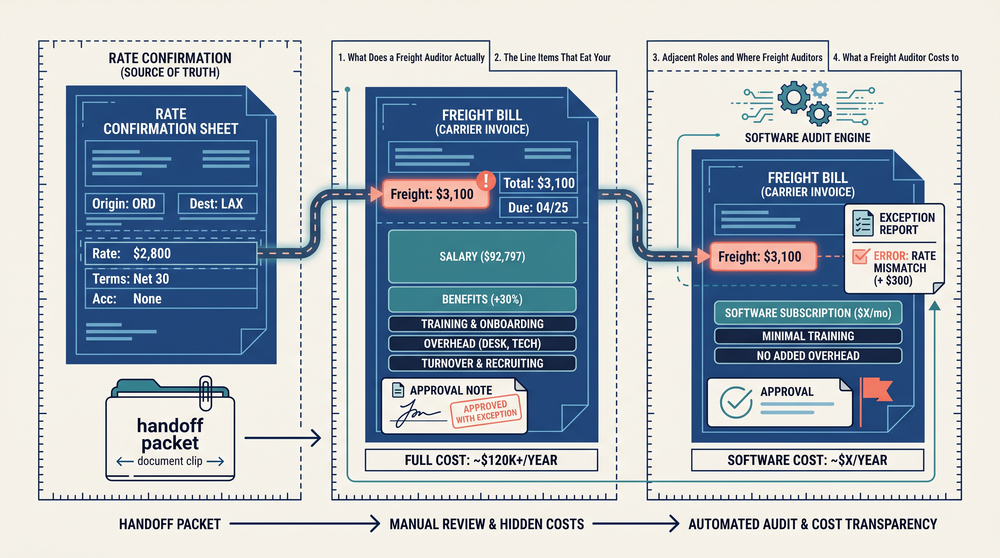
Take a mid-level freight auditor at $58,000 base. Here's what the real number looks like:
- Base salary: $58,000
- Benefits burden (25%): $14,500 (health insurance, 401(k) match, payroll taxes, PTO)
- TMS license or audit tool seat: $3,600 to $6,000 per year
- Onboarding and training: 4 to 8 weeks of reduced productivity, costing roughly $2,500 to $5,000 in senior staff time
- Equipment and workspace: $1,500 to $2,500 (laptop, monitors, office space or remote setup stipend)
Total fully loaded cost: approximately $78,000 to $85,000 per year, or $6,500 to $7,000 per month.
That's for a mid-level hire. If you're in a market like Worcester, MA, where Salary.com shows base pay reaching $86,457, you're looking at a fully loaded cost pushing past $110,000. For context, as of 05/30/2026, JB Hunt Transport Inc (USDOT 264184), one of the largest truckload carriers in the U.S., holds an operating status of AUTHORIZED FOR Property, HHG per SAFERWEB. Carriers of that scale employ entire freight audit departments. SMB brokers don't have that luxury, which is exactly why this math matters.
What Drives Freight Auditor Pay Up or Down
Freight auditor salary isn't static. Several factors push the number higher or pull it lower, and understanding them helps you decide what level of hire your brokerage actually needs.
Geography and Remote Work
Location still drives compensation, though less than it did five years ago. The gap between $60,817 in Overland Park, KS (per Glassdoor) and $75,556 in Worcester, MA (per Salary.com) is roughly 24%. Remote freight auditor roles are closing that gap. Many SMB brokers now hire remotely, which means you compete with national salary expectations rather than local ones. If your brokerage is in a low-cost market, don't assume you'll pay low-cost wages for this role. The talent pool sees the same ZipRecruiter averages you do.
Experience and Specialization
A freight auditor with 1 to 3 years of experience will typically accept $45,000 to $55,000 base. Someone with 5+ years who understands FMCSA regulations, fuel surcharge table structures, and accessorial dispute documentation can command $75,000 to $95,000. The premium isn't just for seniority. It's for the ability to catch the overbills that junior auditors miss. A senior auditor who knows that FMCSA's safety rating for a carrier (for example, as of 02/20/2003, JB Hunt Transport Inc held a Satisfactory FMCSA safety rating per SAFERWEB, USDOT 264184) also knows how to cross-reference carrier authority status with contract compliance, adding a layer of risk management beyond simple invoice matching.
Skills That Increase Earning Potential
Freight auditors who can do more than check invoices earn more. The highest-paid auditors bring:
- TMS proficiency: Hands-on experience with McLeod, Tai, or other platforms used by SMB brokers
- Excel or SQL skills: Ability to run queries across invoice data sets to find patterns, not just individual errors
- Carrier negotiation experience: Using audit findings to renegotiate rates or accessorial policies
- Compliance knowledge: Understanding of FMCSA requirements, BOL documentation standards, and accessorial billing rules
Career progression typically moves from freight auditor to senior auditor to freight audit manager or transportation analyst. At each step, the salary jumps 15% to 25%, reflecting broader responsibilities and strategic input. The highest-paid professionals in supply chain finance often started in audit roles, where they learned where money actually leaks.
Company Size and Industry Vertical
Freight auditors at enterprise shippers (food and beverage, retail, manufacturing) tend to earn 10% to 20% more than those at brokerages, because the invoice volumes and compliance requirements are higher. At an SMB brokerage running 200 to 500 loads per month, a freight auditor may also handle billing coordination, dispute resolution, and even some AP functions. That multi-hat reality means you need a more versatile hire, but your budget may not support the salary that versatility commands. This tension is exactly why many SMB brokers explore outsourcing or software before committing to a full-time freight audit job.
In-House vs. Outsourced vs. Software: A Side-by-Side Cost Breakdown
Here's where the decision gets real. Let's compare three approaches to freight audit for an SMB broker processing 300 loads per month with $250,000 in monthly carrier spend.
Option 1: In-House Freight Auditor
- Monthly cost: $6,500 to $7,000 (fully loaded, as calculated above)
- Annual cost: $78,000 to $85,000
- Capacity: Can realistically review 300 to 500 invoices per month with thorough line-item checking
- Strengths: Deep knowledge of your carrier relationships, ability to handle disputes in real time, institutional memory
- Weaknesses: Fixed cost regardless of load volume, single point of failure if they leave, 4 to 8 week ramp-up period
Option 2: Outsourced Freight Audit Firm
Outsourced freight audit firms typically charge 25% to 50% of recovered overbills. As Ascent Logistics explains in their overview of freight audit programs, these services provide invoice validation, payment processing, and data analytics. The cost model looks attractive until you run the math at scale:
- If they recover $5,000/month in overbills: You pay $1,250 to $2,500 in fees
- If they recover $19,000/month: You pay $4,750 to $9,500 in fees
- If they recover $2,000/month: You pay $500 to $1,000 in fees
The percentage model means your audit cost scales with your problem, which sounds fair until you realize you're paying the most when your carriers are billing the worst. You also lose direct control over dispute timing and carrier communication.
Option 3: Audit Software
- Monthly cost: $400 to $800 for most SMB-tier tools
- Annual cost: $4,800 to $9,600
- Capacity: Automated matching across all invoices. No volume ceiling.
- Strengths: Flat monthly cost regardless of how many overbills it catches, instant rate con matching, no onboarding period for the software itself
- Weaknesses: Still requires someone on your team to review flagged discrepancies and handle disputes. Software catches the errors; a human resolves them.
The break-even math for a 100-load/month broker: A software tool at $600 per month versus an in-house employee at $6,500 per month means the software needs to catch just 9.2% of what a full-time auditor would catch to deliver the same ROI. For brokerages processing fewer than 500 loads per month, the economics almost always favor software, sometimes combined with a billing coordinator who spends a few hours per week on flagged items rather than 12+ hours on manual review.
If you want a deeper look at what it costs to skip freight audit entirely, this breakdown of freight audit costs for SMB brokers walks through the numbers load by load.
How Much Are Carrier Overbills Costing You Right Now?
Before you decide what to spend on freight audit, you need to know what you're losing without it. Let's run the scenarios with real dollar amounts.
Example: Overbill Rate Applied to Monthly Carrier Spend
Based on Laneproof analysis of over 12,000 carrier invoices, overbills average 3.8% of total carrier spend across SMB brokerages. Here's what that looks like at different monthly volumes:
- $100,000 monthly carrier spend × 3.8% = $3,800/month in overbills ($45,600/year)
- $250,000 monthly carrier spend × 3.8% = $9,500/month in overbills ($114,000/year)
- $500,000 monthly carrier spend × 3.8% = $19,000/month in overbills ($228,000/year)

- $1,000,000 monthly carrier spend × 3.8% = $38,000/month in overbills ($456,000/year)
At $500,000 in monthly carrier spend, a $78,000 per year freight auditor who catches even 70% of those overbills saves you $159,600 per year. That's a 2x return. At $100,000 in monthly spend, that same hire saves $31,920 against a $78,000 cost. Now you're upside down.
Scenario: The Detention Dispute You Didn't File
A carrier bills detention on a 3-day layover at $150 per day. That's $450 per load. Your rate con shows a 2-hour free time window, but the driver arrived early and the clock started before check-in. Without someone reviewing the timestamps on the BOL against the detention invoice, you pay $450 that you shouldn't. At 20 loads per month with detention disputes, that's $9,000 per month at risk. Even catching half of those saves $4,500 monthly.
Scenario: TONU Charges That Don't Match the Rate Con
A carrier invoices a TONU at $250. The rate con shows $150. One dispatcher missing this across 10 loads per month is $1,000 per month slipping through. Over a year, that's $12,000 from a single line-item discrepancy that takes 30 seconds to catch if someone is looking. For a step-by-step process on which invoice line items to check first in a transportation audit, that guide ranks the highest-risk items by dollar impact.
Scenario: Fuel Surcharge Table Mismatch
A carrier invoices an 18% fuel surcharge, but the rate con locked the FSC at 15.5% on a $2,200 linehaul. The difference: $55 per load. On 200 loads per month, that's $11,000. This type of overbill is nearly invisible without automated matching because it looks correct at a glance. The FSC percentage is valid, just not for your contract. This is exactly the kind of discrepancy that a freight bill audit process should catch within minutes, not hours.
Scenario: The Billing Coordinator's Hidden Cost
Your billing coordinator spends 12 hours per week on manual invoice reconciliation. At $22 per hour, that's $264 per week, or $13,728 per year in labor dedicated to a task that could be partially automated. That's not the cost of doing freight audit. That's the cost of doing it manually, and it doesn't include the overbills they miss because they're moving too fast to verify every line item.
A billing coordinator spending 12 hours per week on manual invoice reconciliation at $22/hour costs $13,728 per year in labor for just that task alone. That's before you count the overbills they don't have time to catch.
Frequently Asked Questions About Freight Auditor Salaries and Roles
What does a freight auditor do?
A freight auditor reviews carrier invoices against rate confirmations, BOLs, and PODs to verify that every charge (linehaul, fuel surcharge, detention, accessorials, lumper fees) matches what was contractually agreed upon. They flag overbills, file disputes, and recover money that would otherwise erode your margin. According to ShipSigma, the role also includes duplicate payment detection and spend analysis.
Is freight auditor a high paying job?
It can be. ZipRecruiter reports the national average at $92,797 per year, though entry-level roles start closer to $45,000 to $55,000. Senior freight auditors with TMS expertise, carrier negotiation skills, and compliance knowledge can earn $90,000+. Compared to adjacent roles like billing coordinator ($40,000 to $50,000) or logistics analyst ($65,000 to $85,000), freight audit pays competitively, especially at companies where the role directly ties to cost recovery.
What type of auditor gets paid the most?
In the freight and supply chain world, senior freight audit managers at enterprise shippers and large 3PLs earn the most, often $95,000 to $120,000+. Government-sector transportation roles also pay well: OpenPayrolls data shows FMCSA employees at the Department of Transportation averaged $90,147 in 2023, running 25.7% above the national average. The highest-paid job in supply chain finance typically combines audit expertise with strategic procurement or vendor management responsibilities.
Should SMB brokers hire a freight auditor or use software?
It depends on your monthly carrier spend and load volume. At less than $250,000 in monthly carrier spend, software at $400 to $800 per month almost always delivers better freight audit ROI than an $78,000+ per year hire. Above $500,000 in monthly spend, a dedicated auditor starts to pay for themselves, but many brokers at that level combine software for automated matching with a part-time or shared resource for dispute resolution. The worst option is doing neither and letting your billing coordinator absorb the work manually.
How many freight auditor jobs are available right now?
Demand is steady. At the time of review, LinkedIn listed 139 active freight audit and payment job postings across the United States. Indeed also shows active listings with salaries ranging from $45,000 to $65,000 and benefits including 401(k) and health coverage. The consistent demand signals that companies see the ROI, but competition for qualified candidates also means you may wait weeks to fill the role.
Making the Right Call for Your Brokerage
Here's what the numbers tell us: a mid-level freight auditor costs $78,000 to $85,000 per year fully loaded. At $500,000 in monthly carrier spend, that hire pays for itself and then some. At $100,000 in monthly spend, it doesn't. The decision isn't "should I audit my freight invoices?" The answer to that is always yes. The decision is how.
For SMB brokers running 100 to 500 loads per month, the math consistently favors software that automatically flags invoice discrepancies (catching fuel surcharge mismatches, inflated TONU charges, and detention overbills) paired with a billing coordinator who handles the disputes. You get the freight back office cost down to under $1,000 per month instead of $6,500+, while still catching the overbills that eat your margin.
If your team processes more than 50 carrier invoices a week and you're losing hours to manual reconciliation, tools that automatically match invoices to rate cons can catch the discrepancies covered in this guide at a fraction of the cost of a full-time hire. Run the math for your own spend volume using the examples above, and the right answer will be obvious.
Sources
- Salary: Freight Auditor (June, 2026) United States — ZipRecruiter
- Freight Auditor Jobs, Employment — Indeed
- Freight Auditor Salary in Overland Park, KS 2026 — Glassdoor
- Freight Audit Payment Jobs in United States — LinkedIn
- What Is The Role Of A Freight Auditor? — ShipSigma
- Freight Auditor Salary in Worcester, MA — Salary.com
- Federal Motor Carrier Safety Administration (DOT) Salaries — OpenPayrolls
- 3 Benefits of Freight Audit and Payment Programs — Ascent Logistics