Your Freight Audit Report Is Missing These Line Items
Researched and written with AI assistance. Reviewed by the Laneproof team.
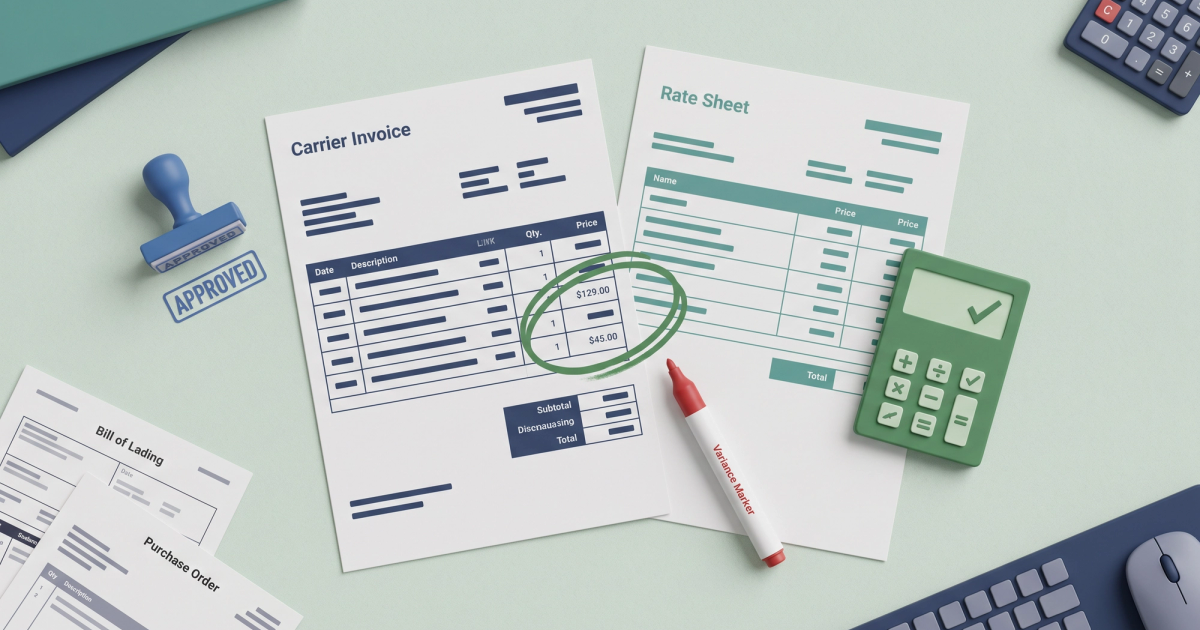
A billing coordinator at a 300-load-per-month brokerage recently told us she found $6,800 in recoverable overcharges across a single month of carrier invoices. The catch: she'd been running freight audits for a year. The problem wasn't that she skipped auditing. It was that her freight audit report wasn't built to surface the right line items. According to nVision Global's freight audit process overview, freight audits can uncover up to 15% in logistics cost savings by identifying overcharges, incorrect rates, and invalid accessorial fees. But those savings only materialize if your report is structured to catch them. Most aren't.
This article isn't a general overview of freight auditing. You know what it is. Instead, we're breaking down the freight audit report as a specific deliverable: what it must contain, which line items it should flag, and how to use its findings to recover real dollars and renegotiate carrier terms.
What Is a Freight Audit Report (and What It's Actually Supposed to Do)
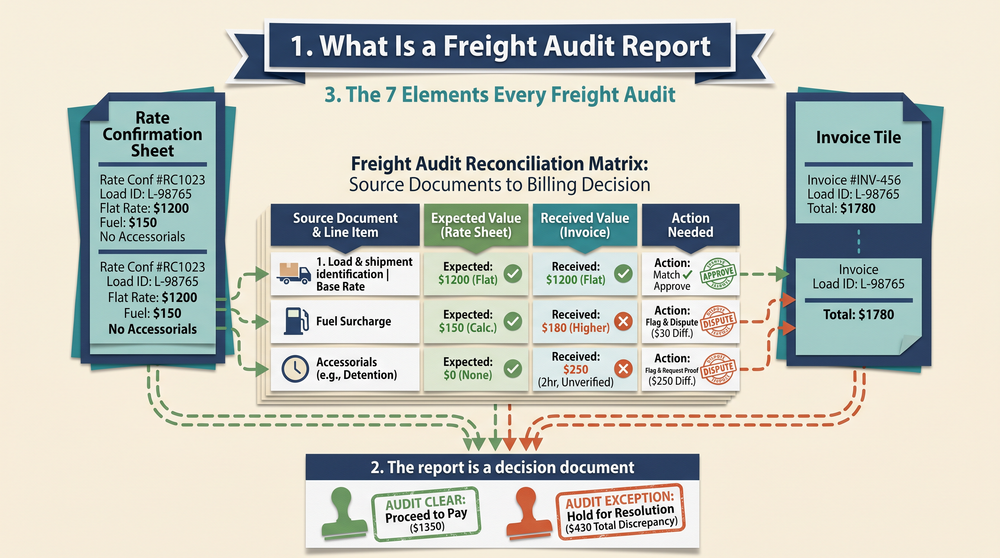
A freight audit report is a structured document that compares carrier invoices against rate confirmations, BOLs, PODs, and contractual terms to identify billing discrepancies, overcharges, and unsupported fees. It's the output of the audit process, not the process itself.
Too many operations teams treat the audit report as a checkbox. They verify that the linehaul rate matches the rate con, mark it "approved," and move to the next invoice. That covers maybe 40% of what a freight audit report should actually do.
The report is a decision document, not a receipt
A complete freight audit report serves three functions. First, it flags billing discrepancies on individual loads so you can dispute them before payment. Second, it aggregates patterns across loads, carriers, and lanes so you can spot systemic overbilling. Third, it gives you documented evidence (with timestamps, source documents, and dollar amounts) to negotiate better terms or cut underperforming carriers. As FreightWaves explains in their coverage of freight invoice audits, a freight invoice audit reviews, verifies, and corrects freight invoices to ensure companies only pay for legitimate, agreed-upon charges. Your report is where that verification lives in writing.
If your freight audit report doesn't include accessorial breakdowns, duplicate invoice checks, and rate con variance tracking, you're leaving money on the table every week. And more importantly, you can't prove it to the carriers billing you.
The 7 Elements Every Freight Audit Report Needs
When people search for "the 7 elements of an audit report," they typically find generic accounting frameworks. Here's what those elements look like when applied to freight. Every freight audit report you produce (or receive from a third party) should include these seven components.
1. Load and shipment identification
Every line in the report must tie back to a specific load number, BOL number, PRO number (for LTL), and carrier name. Without this, you can't cross-reference disputes against your TMS or accounting system. This sounds obvious, but we've reviewed reports that group findings by carrier without load-level detail, making individual disputes nearly impossible.
2. Rate con vs. invoice comparison
The core of rate con verification. The report should show the contracted linehaul rate, the invoiced linehaul rate, and any variance. It should also capture the fuel surcharge percentage on the rate con versus what was billed. Even a 2-4% fuel surcharge discrepancy on a $1,200 linehaul adds up across hundreds of loads.
3. Accessorial charge breakdown
This is where most reports fall short. Every accessorial (detention, lumper, TONU, layover, liftgate, driver assist) should appear as its own line with the billed amount, the contractual allowance, and supporting documentation status. Was a signed detention log attached? Was the lumper receipt included? A "yes/no" documentation field per accessorial is the minimum. For a deeper look at which accessorials to prioritize, see our guide on which transportation audit line items to check first.
4. Supporting document audit trail
The report should confirm which source documents were reviewed for each load: rate con, BOL, POD, lumper receipt, detention log, carrier packet. If a carrier submits an invoice with no POD attached, the report should flag it. If the BOL timestamp contradicts the detention hours billed, the report should note the discrepancy with both timestamps.
5. Discrepancy classification and severity
Not all billing errors are equal. Your freight audit report should classify each discrepancy by type (rate variance, unsupported accessorial, duplicate invoice, freight class error, etc.) and by dollar amount. This lets you prioritize disputes. A $12 rounding difference on a fuel surcharge probably isn't worth a phone call. A $325 lumper fee on a load where lumper was prepaid by the shipper absolutely is.
6. Trend and pattern analysis
Individual load audits catch errors. Pattern analysis catches carriers who overbill systematically. Your report should include a summary section showing overbilling frequency by carrier, average discrepancy amount by accessorial type, and any lanes where billing errors cluster. This is where audit reports become negotiation tools.
7. Recovery summary and action items
Every freight audit report should end with a clear recovery number: how much was overbilled, how much is recoverable, and what action is required (dispute, deduction, carrier conversation). Without this, the report is informational but not actionable. The recovery summary is what your billing coordinator actually needs to do their job.
Which Line Items Your Report Should Be Flagging Every Week
If you're running audits weekly (and you should be, especially if you process more than 100 loads per month), your freight audit report needs to flag these line items consistently. These are the areas where carrier invoice errors appear most often and cost the most.
Detention charges without matching timestamps
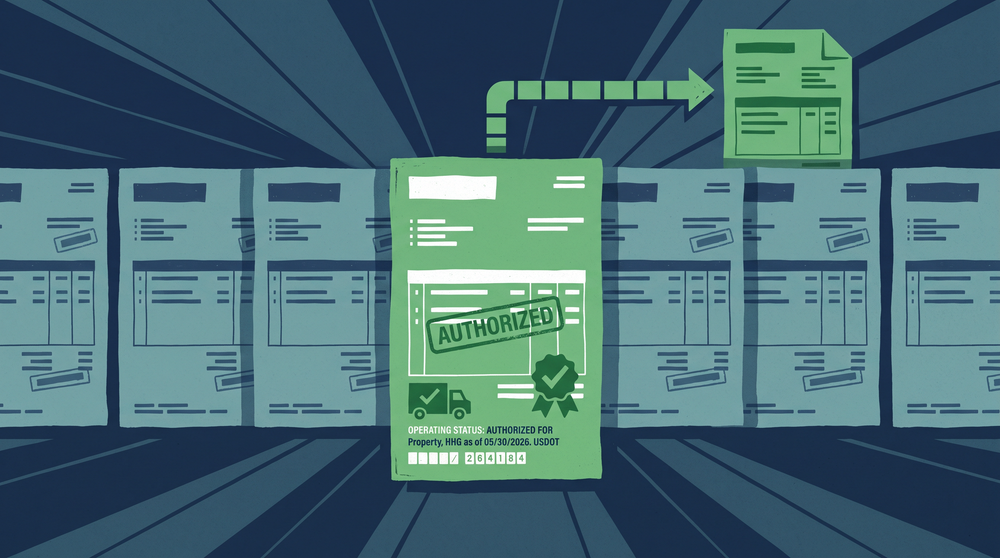
Detention is one of the most commonly overbilled accessorials. Carriers bill in full-hour increments, round up aggressively, or bill for time that doesn't match the BOL or facility check-in/check-out records. Your report should compare billed detention hours against every available timestamp. If the carrier bills 4 hours and the BOL shows 2.5 hours on-site, that's $112.50 overbilled at $75/hour on a single load. FMCSA has been tracking detention time issues across the industry, and as of 05/30/2026, even large carriers like JB Hunt Transport Inc (USDOT 264184, operating status: AUTHORIZED for Property, HHG) deal with complex detention documentation requirements.
Fuel surcharge percentage vs. rate con cap
Many rate cons cap the fuel surcharge at a specific percentage. Carriers sometimes apply a higher percentage, either intentionally or because their billing system defaults to a standard FSC table. On a $1,200 linehaul where the rate con caps FSC at 14% but the carrier bills 18%, that's a $48 difference. Multiply that across 200 loads per month and you're looking at $9,600 in annual overcharges from fuel surcharge discrepancies alone. Trimble's freight audit insights confirm that misapplied contracted rates are among the most common hidden costs in freight spend.
Lumper fees on prepaid loads
This one is straightforward but frequently missed. If the rate con or shipper agreement specifies that lumper fees are prepaid by the shipper, any lumper charge on the carrier invoice is fully recoverable. The report should cross-reference every lumper fee against the rate con terms and flag any load where a lumper was billed but was contractually covered.
Duplicate invoices
Duplicate invoices are more common than most ops managers think. A carrier submits an invoice, doesn't see payment within their expected window, and resubmits. If your TMS doesn't cross-reference invoice numbers against BOL numbers and load IDs, both can get paid. Your freight audit report should include a duplicate detection layer that matches on BOL number, load ID, carrier, and date range.
Freight class reclassification without documentation
On LTL shipments, carriers sometimes reclassify freight post-delivery (for example, from class 85 to class 100) without providing inspection documentation. This can add $200 or more to a single shipment. Your report should compare the original BOL freight class against the invoiced class and flag any reclassification that isn't supported by a weight and dimensions inspection report.
Unsupported layover and TONU charges
Layover and TONU charges require supporting documentation. A layover should have a signed driver log or carrier-side detention record. A TONU should match a documented cancellation or load reassignment from the broker. If neither exists, the charge should be flagged as unsupported. Your carrier payment audit checklist should include both of these as standard review items.
Real Dollar Examples: What Brokers and Carriers Miss Without One
The difference between having a freight audit report and having a good one comes down to dollars. Here are concrete scenarios pulled from common brokerage and carrier billing situations.
Example: Detention overbilling on a single load
A carrier invoices detention at $75/hour for 4 hours ($300). The BOL timestamp shows the driver arrived at 10:15 AM and departed at 12:45 PM, putting actual on-site time at 2.5 hours. At $75/hour, the correct charge is $187.50. The overbilled amount is $112.50. Without a freight audit report that compares billed hours against BOL timestamps, this $112.50 gets paid without question. Across 50 loads per month with detention, even a 15% overbilling rate means hundreds of dollars in unnecessary payments.
Example: Fuel surcharge cap ignored
A rate con for a $1,200 linehaul caps the fuel surcharge at 14% ($168). The carrier's invoice applies an 18% FSC ($216). The difference is $48 per load. If this carrier handles 40 loads per month for your brokerage, that's $1,920 per month or $23,040 per year in overcharges from a single carrier on a single line item.
Example: Prepaid lumper fee billed to the broker
A load's rate con states that the lumper fee is prepaid by the shipper. The carrier's invoice includes a $325 lumper charge. With the rate con and POD documentation showing the lumper was covered, the full $325 is recoverable. This is a binary check (was lumper prepaid, yes or no?) but it requires the audit report to actually cross-reference the rate con terms against each invoiced accessorial.
Example: TONU charge on a load the broker didn't cancel
A carrier charges a $250 TONU fee. The broker's records show the load was never cancelled. Instead, the carrier dispatched their driver to the wrong facility. The broker produces timestamped communications from the carrier packet showing the correct pickup location. With this documentation in the audit report, the $250 TONU is disputed and reversed. Without it, the broker eats the cost.
Example: Accessorial overbilling at scale
An accessorial audit across 200 loads per month finds an average overbilling of $34 per load. That's $6,800 per month in recoverable charges, or $81,600 per year. This number isn't hypothetical. It's what happens when you systematically compare every accessorial line item against rate con terms, contractual caps, and supporting documentation.
An accessorial audit across 200 loads per month that finds an average overbilling of $34 per load produces $6,800 per month in recoverable charges. That's $81,600 per year hiding in line items most reports never check.
Example: Duplicate invoice caught by BOL cross-reference
A carrier submits an invoice for $2,340 on load #4471. Eleven days later, a second invoice arrives for the same BOL number with a different invoice number. Without cross-referencing invoice numbers against TMS load IDs and BOL numbers, both get approved. The freight audit report catches the duplicate only because it includes a matching layer that goes beyond invoice number alone.
Example: LTL freight class reclassification without inspection
An LTL shipment originally classed as freight class 85 on the BOL is reclassified by the carrier to class 100 post-delivery. The upcharge is $210. The carrier provides no inspection documentation (no re-weigh certificate, no dimension verification). The broker disputes the reclassification using the original BOL weight and dimensions, and the $210 is reversed.
Example: Layover charge with no supporting documentation
A carrier invoices a $450 layover charge. The freight audit report checks for supporting documentation: a signed driver log, a carrier-side detention record, or facility confirmation. None exists. The charge is flagged as an unsupported accessorial and disputed. Without the report's documentation check, the $450 would have been paid as a legitimate charge.
The 4 Types of Freight Audit Reports and When to Run Each One
Not every audit report serves the same purpose. The four types of freight audit reports correspond to different timing, scope, and operational goals. Understanding which to run (and when) keeps your audit process efficient instead of just thorough.
1. Pre-payment audit report
This is the most common and most valuable type. It's generated before any carrier invoice is approved for payment. The pre-payment audit report compares every invoice against the rate con, BOL, and contractual terms in real time (or as close to real time as your process allows). The goal is to catch and dispute errors before money leaves your account. If you only run one type of audit report, this is the one. According to Trax Technologies' guide to freight audit, the pre-audit stage is where the most significant cost recovery happens because discrepancies are caught before payment, not after.
2. Post-payment audit report
This report reviews invoices that have already been paid. It's the safety net for anything the pre-payment audit missed. Post-payment audits typically run on a monthly or quarterly cadence and focus on identifying systematic errors: carriers who consistently overbill on specific accessorials, duplicate payments that slipped through, and fuel surcharge variances that accumulate over time. Recovery on post-payment findings takes longer because you're clawing back money already paid, but the aggregate amounts are often significant.
3. Periodic trend report
This isn't a load-by-load audit. It's an aggregate analysis that looks at billing patterns over 30, 60, or 90 days. The periodic trend report answers questions like: Which carriers have the highest discrepancy rates? Which accessorial types are most frequently overbilled? Are detention charges increasing on specific lanes? This report feeds strategic decisions, including carrier scorecard reviews and contract renegotiations.
4. Exception and escalation report
This report isolates high-severity findings that require immediate action. It filters the full audit for items above a dollar threshold (e.g., any single discrepancy over $200), unsupported charges, duplicate invoices, or carriers with discrepancy rates above a set percentage. The exception report is what your ops manager or owner reviews weekly. It's the "fix this now" list. The growing demand for these reports is reflected in the broader market: according to Mordor Intelligence, the freight audit and payment market is estimated at USD 0.97 billion in 2025 and is expected to reach USD 1.89 billion by 2030, growing at a CAGR of 14.2%, driven largely by the need for more granular, automated reporting.
How to Use Your Audit Report Findings to Push Back on Carriers
Finding billing discrepancies is only half the job. The freight audit report becomes a negotiation tool when you use its data to change carrier behavior and contract terms. Here's how.
Build a carrier scorecard from audit data
Your periodic trend report gives you the data to score carriers on billing accuracy. Track each carrier's discrepancy rate (percentage of invoices with errors), average overbilled amount per load, and most common error types. When it's time to renegotiate rates or decide which carriers stay in your routing guide, this scorecard is harder to argue with than a phone call saying "your invoices are always wrong." For more on the cost of skipping this step entirely, read our analysis of what it costs SMB brokers to skip freight audits.
Use documented discrepancies in rate negotiations
When a carrier's audit trail shows a 7% overbilling rate across 6 months, you have documented grounds to negotiate lower base rates, tighter accessorial caps, or penalty clauses for billing errors. The key is specificity. Don't tell a carrier "you overbill us." Show them: "Across 480 loads from January through June, your invoices contained 34 detention overcharges averaging $87 each, 12 fuel surcharge variances averaging $41, and 3 duplicate invoices totaling $6,240." That's a conversation a carrier takes seriously.
Establish documentation requirements in your carrier packet
If your audit reports consistently flag unsupported accessorials (detention without timestamps, layover without driver logs, lumper fees without receipts), update your carrier packet to require these documents at the time of invoice submission. Make it a payment condition: no documentation, no payment on that line item. This shifts the burden of proof from your billing team to the carrier, which is where it belongs.
As of 05/30/2026, JB Hunt Transport Inc (USDOT 264184, FMCSA safety rating: Satisfactory as of 02/20/2003) and other major carriers maintain detailed documentation standards precisely because large shippers and brokers require it. There's no reason your operation shouldn't hold smaller carriers to the same standard.
Set dispute SLAs tied to report cadence
Your freight audit report is only useful if discrepancies get disputed within a reasonable window. Set internal SLAs: pre-payment discrepancies disputed within 48 hours, post-payment findings submitted for recovery within 10 business days. Tie these SLAs to the report delivery schedule so nothing sits in a queue. The report drives the timeline, not the other way around.
Frequently Asked Questions About Freight Audit Reports
What is a freight audit report?
A freight audit report is a document that compares carrier invoices against rate confirmations, BOLs, PODs, and contractual terms to identify billing errors, overcharges, and unsupported accessorial fees. It includes load-level discrepancy details, supporting documentation status, recovery amounts, and pattern analysis across carriers and lanes. It's the output of the freight audit process and serves as both a billing correction tool and a carrier negotiation document.
What are the 4 types of audit reports in freight?
The four types are pre-payment audit reports (catch errors before you pay), post-payment audit reports (find errors in invoices already paid), periodic trend reports (analyze billing patterns over 30, 60, or 90 days), and exception/escalation reports (isolate high-dollar or high-severity discrepancies for immediate action). Most brokerages should run pre-payment audits on every invoice and the other three on a weekly or monthly cadence.
What are the 5 C's of audit findings?
In freight auditing, the 5 C's translate as: Condition (what does the invoice say?), Criteria (what should it say per the rate con and contract?), Cause (why is there a discrepancy?), Consequence (how much does the error cost?), and Corrective Action (what needs to happen: dispute, deduction, or carrier conversation?). Every discrepancy in your freight audit report should address all five.
How often should I run a freight audit report?
Pre-payment audit reports should run on every invoice batch, ideally daily or with each payment cycle. Post-payment audits and exception reports should run weekly. Periodic trend reports should run monthly at minimum. If you process fewer than 100 loads per month, weekly pre-payment audits and monthly trend reports are a reasonable starting cadence. At higher volumes, daily pre-payment audits are essential to keep disputes within carrier payment windows.
What's the difference between a freight audit and a freight audit report?
The freight audit is the process: reviewing invoices, comparing them to source documents, identifying discrepancies. The freight audit report is the deliverable that process produces. It documents what was found, how much is at stake, and what action is required. You can run an audit without generating a useful report, but you can't recover money or negotiate with carriers without one. The report is what makes the audit actionable.
Sources
- Freight audit insights: The truth about freight spend — Trimble Transportation
- Freight Invoice Audits and Why They Matter — FreightWaves
- The Ultimate Guide to Freight Audit — Trax Technologies
- Freight Audit And Payment Market Size & Growth to 2030 — Mordor Intelligence
- Understand the Freight Audit Process: Benefits and How It Works — nVision Global
Stop Paying for Line Items You Can't Verify
The freight audit report isn't a formality. It's the single document that stands between your brokerage and thousands of dollars in monthly overcharges. If your current report doesn't include all seven elements covered here (load identification, rate con comparison, accessorial breakdown, document trail, discrepancy classification, trend analysis, and recovery summary), you're approving invoices you can't fully verify.
Start by auditing last week's invoices against the line items in this guide. Check detention timestamps, fuel surcharge caps, lumper terms, and duplicate submissions. Track what you find. The pattern will tell you where your money is going.
If your team processes more than 50 invoices a week and invoice reconciliation is eating hours you don't have, automated document extraction and matching tools can catch the discrepancies covered in this guide before invoices reach your payment queue.
Related: Freight Audit Software for Brokers: What Actually Recovers Money
Related: Freight Auditor Salary vs. Software: What SMB Brokers Actually Pay
Related: Orca Freight Audit Reviewed: What SMB Brokers Actually Get