Carrier Payment Audit Checklist: Catch Billing Errors Fast
Researched and written with AI assistance. Reviewed by the Laneproof team.
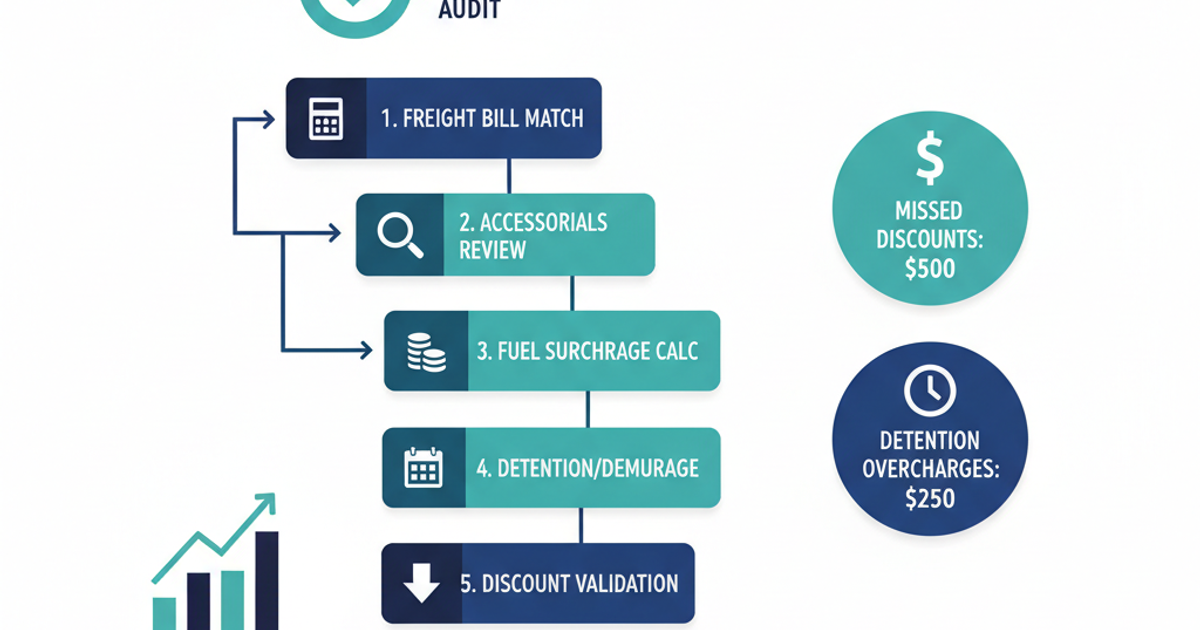
A broker moving 500 loads per month at an average of $1,800 per load can lose roughly $34,200 every month to carrier overbilling on accessorials alone. That number is not hypothetical. According to Transportation Insight's analysis of freight invoice error rates, between 3% and 6% of carrier invoices contain errors, with most tied to accessorial charges. A carrier payment audit is the only reliable way to catch those errors before they become margin loss. But most SMB brokers skip the audit entirely, either because they do not have a process or because manual invoice reconciliation already takes their ops team 6 to 9 hours per week. This guide gives you the exact checklist, step by step, to run a carrier payment audit in-house without outsourcing to a third-party freight audit and payment service.
What Is a Carrier Payment Audit, and Why Most Brokers Skip It
A carrier payment audit is a line-by-line review of every carrier invoice against the original rate confirmation, bill of lading, proof of delivery, and any supporting documentation. The goal is simple: confirm that every charge on the invoice was agreed to, actually incurred, and correctly calculated. That includes linehaul, fuel surcharge, detention, lumper fees, layover, TONU, and any other accessorial on the bill.
Most brokers know they should be doing this. Very few actually do it consistently. Here is why.
The Time Problem
Manual invoice reconciliation takes an average of 6 to 9 hours per week for a team of two ops staff. At a fully loaded cost of $28 per hour, that is $9,072 to $13,608 per year in labor just for reconciliation. When you are also dispatching, managing carriers, and handling customer issues, auditing every invoice falls to the bottom of the pile. Most teams end up spot-checking a handful of invoices and paying the rest on trust.
The "It's Close Enough" Trap
When a carrier invoice is $50 or $75 over the rate con, many ops managers just pay it. The cost of arguing feels higher than the cost of the overcharge. But those small discrepancies compound fast. On 500 loads per month, even $40 in average overbilling per load adds up to $20,000 per month or $240,000 per year. That is real margin, not rounding error.
The freight audit and payment market reflects how seriously larger shippers take this problem. According to Mordor Intelligence's market sizing report, the freight audit and payment market is estimated at $0.97 billion in 2025 and is expected to reach $1.89 billion by 2030, growing at a CAGR of 14.2%. But most of that spend is enterprise. SMB brokers need a process they can run themselves, today, without a six-figure contract.
The 7 Audit Steps You Should Run on Every Carrier Invoice
These seven steps form the backbone of a carrier payment audit. They are ordered to catch the most common (and most expensive) errors first. If you only have time for a partial audit, run steps 1 through 4 on every invoice and reserve the full seven for invoices over a dollar threshold you set (many brokers use $1,500 as the cutoff).
According to Trax's freight audit best practices guide, automating even a portion of this process reduces error rates significantly. But the steps themselves work whether you do them manually or with software.
Step 1: Match the Invoice to the Rate Con
Pull the original rate confirmation. Compare the linehaul rate, pickup and delivery addresses, and any pre-agreed accessorials. If the invoice shows a linehaul rate that does not match the rate con, stop. That is your first flag. Also check the load number or reference number to make sure you are looking at the right shipment. Mismatched load references account for a surprising number of duplicate payments.
Step 2: Verify the Fuel Surcharge Calculation
Check whether the fuel surcharge percentage is applied correctly. The FSC should apply to linehaul only, not to the total invoice including accessorials. Confirm that the FSC rate matches the DOE index date specified in the rate con or carrier agreement. A 1% error on a $2,200 linehaul is $22 per load, but that error tends to repeat on every invoice from the same carrier.
Step 3: Audit Every Accessorial Against Documentation
This is where the money is. Every accessorial charge on the invoice needs a corresponding document: detention requires check-in and check-out timestamps, lumper fees need a receipt, layover needs a BOL showing next-day delivery, and TONU needs a signed rate con showing the truck was dispatched. No documentation, no payment. For a deeper walkthrough of which line items to prioritize, see our guide on which transportation audit line items to check first.
Step 4: Cross-Reference BOL and POD Timestamps
The bill of lading and proof of delivery are your truth documents. Check that the delivery date on the POD matches the invoice. Check that pickup and delivery locations match the rate con. If a carrier bills for a two-day transit and the POD shows same-day delivery, you have a layover or detention charge to dispute.
Step 5: Check for Duplicate Charges
Search your payment records for the same load number, carrier, and dollar amount. Duplicate invoices happen more often than you would expect, especially with carriers who submit invoices through multiple channels (email, carrier portal, factoring company). Also check for lumper fees billed on the carrier invoice that were already reimbursed via Comcheck.
Step 6: Validate Rate Against Contract or Market Benchmarks
If you have a contracted rate with the carrier, confirm the invoice matches the contract rate, not a spot rate. For spot loads, compare the invoiced rate to the rate you agreed to on the load board or via email. Keep screenshots of rate agreements. They are your evidence in a dispute.
Step 7: Flag, Document, and Route for Approval or Dispute
Every invoice that clears all six checks gets routed for payment. Every invoice with a discrepancy gets flagged, documented with the specific error and supporting evidence, and routed to your dispute workflow. Do not pay invoices with unresolved flags. Once you pay, your leverage to recover disappears.
The Line Items That Get Overbilled the Most (With Dollar Examples)
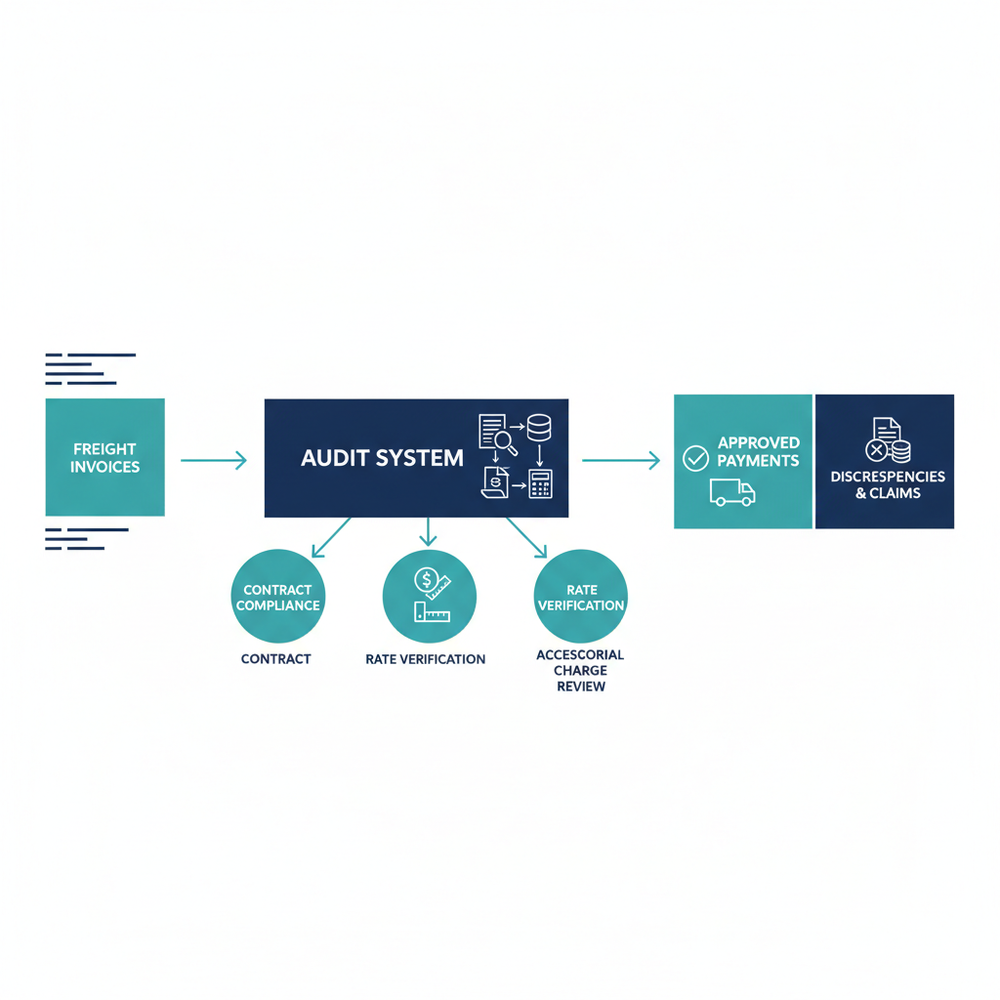
Not all line items carry the same overbilling risk. Based on the pattern that 3% to 6% of freight invoices contain errors, with most errors tied to accessorials, here are the charges that show up wrong most often, along with what each one costs you if you miss it.
Detention
Example: A carrier bills detention at $75/hour starting at hour 2. But the invoice calculates detention from arrival time instead of appointment time. If the driver arrived 2 hours early and waited 3 hours until the appointment window, the carrier might bill for 3 hours of detention ($225) when the actual billable detention is 1 hour ($75). That is $150 per load in overbilling. On 20 loads per month with the same issue, that is $3,000 per month.
Fuel Surcharge Applied to Accessorials
Example: On a load with a $2,200 linehaul and $300 in accessorials, the fuel surcharge should apply to the $2,200 linehaul only. If the carrier applies the FSC to the full $2,500, and the FSC rate is 6% to 8%, you are paying an extra $18 to $24 per invoice. That is a small number per load, but it is systematic. If a carrier does this on every invoice, it adds up to $216 to $288 per month on just 12 loads.
Lumper Fee Duplicates
Example: A carrier includes a $200 lumper fee on their invoice. You also have a Comcheck receipt for $200 issued to the driver at the delivery facility. If you pay both, you just paid $400 for a $200 service. Average duplicate lumper fee billing ranges from $175 to $250 per occurrence. These are easy to miss because the invoice and the Comcheck reimbursement often come through different channels and hit different line items in your accounting system.
TONU With No Dispatch Proof
Example: A carrier submits a TONU (Truck Ordered, Not Used) charge of $350. But there is no signed rate con, no dispatch confirmation, and no truck-ordered timestamp in your TMS. The driver was never actually dispatched. This happens when a carrier reserves a load, the load gets cancelled or reassigned, and the carrier sends an invoice anyway. Without a signed rate con, there is no contractual basis for the charge.
Layover Billed on Same-Day Delivery
Example: A carrier invoices a $250 layover charge for day 2 of a shipment. But the BOL and POD both show the load was picked up and delivered on the same day. There is no overnight wait. The layover charge has no documentation to support it. This one is easy to catch if you check the BOL timestamp against the layover charge, and easy to miss if you do not.
Dry Run Fee Outside the Cancellation Window
Example: A load is cancelled 4 hours before pickup. The rate con specifies a 2-hour free cancellation window. The carrier invoices a $200 dry run fee. But when you check the cancellation timestamp against the rate con, the cancellation happened within the free window. That $200 charge has no contractual basis. You only catch this if you compare the cancellation time to the specific language in the rate con.
How to Match Rate Cons, BOLs, and PODs Without Losing Your Mind
The biggest time sink in a carrier payment audit is not finding errors. It is finding the documents you need to verify whether an error exists. If your rate cons are in email, your BOLs are in a TMS, and your PODs are in a shared drive (or worse, still in a driver's cab), matching them takes 10 to 15 minutes per invoice. Multiply that by 100 invoices per week and you have a full-time job that nobody signed up for.
Build a Single Document Set Per Load
Every load should have one folder (digital or physical) containing the rate con, BOL, POD, carrier invoice, and any accessorial documentation (lumper receipts, detention logs, photos). If your TMS supports document attachments per load, use it. If not, a shared drive with folders named by load number works. The point is that when an invoice comes in, you should be able to pull every supporting document in under 60 seconds.
Standardize Your Matching Process
Create a simple spreadsheet or checklist that your team fills out for every invoice. Columns should include: load number, rate con linehaul, invoice linehaul, rate con accessorials, invoice accessorials, fuel surcharge rate, fuel surcharge base (linehaul only or total), BOL pickup date, POD delivery date, and a pass/fail column for each check. This takes 3 to 5 minutes per invoice once you have the documents in front of you. If you want a framework for running this efficiently, our freight bill audit guide walks through a 10-minute per-invoice process.
Set a Dollar Threshold for Full Audits
You do not need to run all seven steps on a $400 local dray. Set a threshold. Many brokers run the full seven-step audit on every invoice over $1,500 and a quick three-step check (rate con match, FSC calculation, duplicate check) on everything below that. This cuts your audit time by roughly 40% without missing the high-dollar errors.
On a broker moving 500 loads per month at an average of $1,800 per load, carrier overbilling on accessorials at a rate of approximately 3.8% of total freight spend represents roughly $34,200 in recoverable billing errors every month.
What to Do After You Find a Discrepancy: The Dispute Workflow
Finding the error is half the job. Getting the money back is the other half. Most brokers lose recoverable dollars not because they missed the error, but because they did not have a clear dispute process. Here is how to handle discrepancies so they actually get resolved.

Step 1: Document the Discrepancy in Writing
Before you call the carrier, document the error in writing. State the load number, the specific line item in question, the invoiced amount, the correct amount per your documentation, and attach the supporting documents (rate con, BOL, POD, or whatever applies). Email is your best channel because it creates a timestamp and paper trail. Never rely on a phone call alone. If you do call, follow up with an email that summarizes what was discussed and agreed to.
Step 2: Issue a Short-Pay With Explanation
If the discrepancy is clear and well-documented, issue a short-pay. Pay the invoice minus the disputed amount, and include a written explanation of why the amount was reduced. Reference the specific documents that support your position. Most carriers will accept a short-pay with clear documentation. The ones who push back usually do so because the documentation is ambiguous, not because they disagree with the math.
Step 3: Track Every Dispute to Resolution
Keep a dispute log. It does not need to be fancy. A spreadsheet with columns for load number, carrier name, disputed amount, dispute date, resolution date, and outcome (paid, recovered, or split) works. This log does three things: it prevents disputes from falling through the cracks, it shows you which carriers generate the most disputes, and it gives you data to renegotiate terms with repeat offenders.
Step 4: Adjust Carrier Scorecards
If a carrier consistently overbills, that should affect their scorecard and their load priority. According to Loop's freight audit best practices guide, monitoring carrier performance through audit results is a core best practice. A carrier with a 10% dispute rate on invoices is costing you real money in audit labor even if you catch every error. Track it, document it, and use it in carrier reviews.
For a broader view of what these billing errors cost SMB brokers over time, our breakdown of freight audit savings for small brokers puts hard numbers on the ROI of catching discrepancies consistently.
Frequently Asked Questions
What is a payment audit?
A payment audit in freight and logistics is a systematic review of carrier invoices against the original rate confirmation, bill of lading, proof of delivery, and any supporting accessorial documentation. The purpose is to verify that every charge was contractually agreed to, actually incurred, and calculated correctly before payment is issued. It covers linehaul, fuel surcharge, detention, lumper fees, layover, TONU, dry run fees, and any other accessorial on the invoice.
What are the 7 audit procedures in a carrier payment audit?
The seven steps are: (1) match the invoice to the rate con, (2) verify the fuel surcharge calculation and base amount, (3) audit every accessorial against supporting documentation, (4) cross-reference BOL and POD timestamps, (5) check for duplicate charges or duplicate invoices, (6) validate the rate against the contract or agreed spot rate, and (7) flag, document, and route any discrepancy for dispute or approval. Running all seven on high-value loads and a shortened version on lower-value loads is the most efficient approach for SMB teams.
What happens when a trucking company gets audited?
When a broker audits a carrier's invoices, the carrier receives a short-pay or a dispute notice for any line items that do not match the rate con and supporting documents. The carrier then has the opportunity to provide additional documentation to justify the charge. If the documentation supports the charge, it gets paid. If not, the disputed amount is deducted. Carriers who invoice accurately see no impact. Carriers with frequent billing errors may see their scorecard ratings drop and their load volume reduced over time.
How often should I run a carrier payment audit?
Every invoice should go through at least a basic three-step check (rate con match, fuel surcharge verification, duplicate check). Full seven-step audits should run on every invoice above your dollar threshold, which most SMB brokers set between $1,000 and $2,000. Beyond individual invoices, run a monthly aggregate review to identify carriers with high dispute rates, recurring error patterns, and overall overbilling trends across your book of business.
What should you avoid saying during a carrier billing dispute?
Do not accuse the carrier of fraud or intentional overbilling. Most billing errors are the result of data entry mistakes, misapplied accessorial rules, or miscommunication between the driver and the carrier's billing department. Frame every dispute around the documentation: "The rate con shows X, the invoice shows Y, and here is the BOL/POD that confirms X." Keep it factual and professional. Accusations damage relationships and make carriers less likely to resolve disputes quickly.
Sources
- Freight Audit And Payment: Protecting Profit In Soft Rates — Transportation Insight
- Freight Audit And Payment Market Size & Growth to 2030 — Mordor Intelligence
- 6 Essential Freight Audit and Payment Best Practices — Trax Technologies
- Freight Audit and Payment Best Practices: Expert Tips for Efficiency — Loop
Stop Paying Invoices on Trust
The math is straightforward. If your team moves 500 loads per month and carrier overbilling runs at even half the industry average, you are leaving tens of thousands of dollars on the table every month. The seven-step audit process in this guide costs nothing to implement. It requires a rate con, a BOL, a POD, and 3 to 5 minutes per invoice. The dispute workflow keeps you from losing what you find. And the document matching process keeps your ops team from spending half their week digging through email threads and shared drives.
If your team processes more than 50 invoices a week and the manual matching is eating into hours you do not have, automated document extraction and invoice matching tools can run the same checks covered in this guide in seconds instead of minutes. But the checklist works either way. Print it out, pin it to the wall next to your monitors, and run it on the next carrier invoice that hits your inbox.
Full guide: Freight Audit for SMB Brokers: What It Costs to Skip It
Related: Freight Audit and Payment Jobs: What These Roles Actually Catch
Related: Your Freight Audit Report Is Missing These Line Items
Related: What Freight Audit and Payment Companies Actually Catch (And Miss)