What Freight Audit and Payment Companies Actually Catch (And Miss)
Researched and written with AI assistance. Reviewed by the Laneproof team.
A broker running 500 loads per month at an average freight bill of $1,800 faces roughly $34,200 in monthly overbilling exposure, assuming a 3.8% error rate across detention, accessorials, and fuel surcharges. That's $410,400 a year walking out the door. Most freight audit and payment companies promise to catch these errors. Some actually do. The difference between the two determines whether you recover six figures or pay a vendor to tell you what you already know. This article breaks down exactly which billing errors separate competent freight audit providers from expensive paper-pushers, gives you a step-by-step process for auditing freight bills yourself, and hands you the evaluation criteria to vet any company before you sign. No vendor rankings. No feature lists. Just the operational detail you need to protect your margins.
What Does a Freight Auditor Actually Do? (The Short Answer)
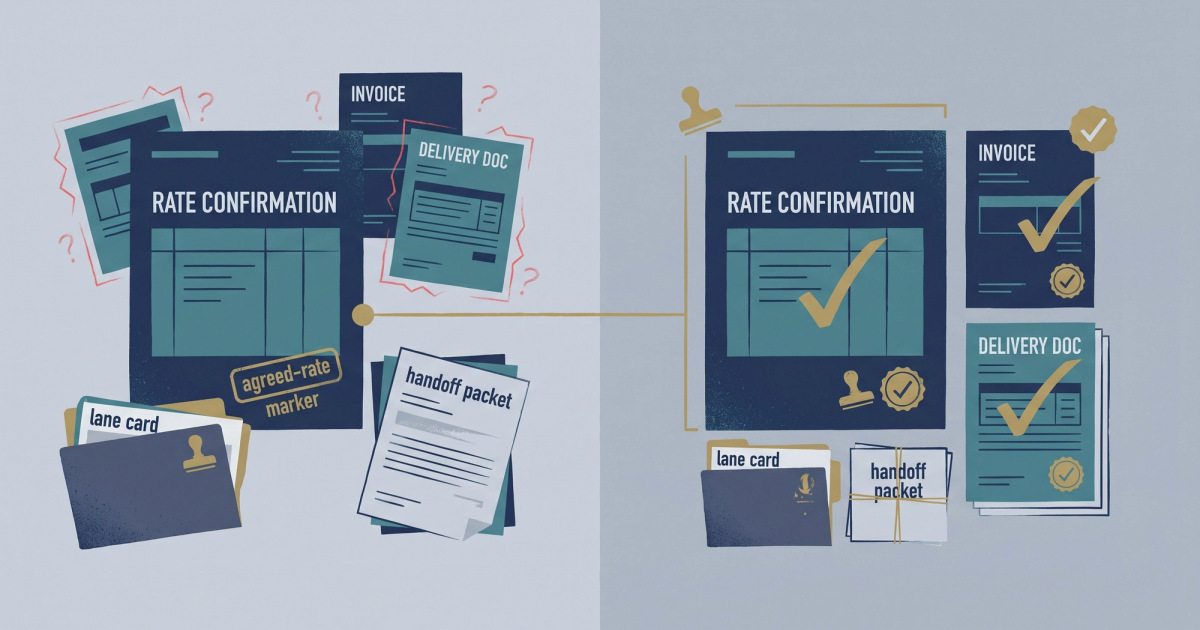
A freight auditor reviews every carrier invoice against the original rate confirmation, bill of lading (BOL), proof of delivery (POD), and any accessorial agreements to confirm that what you're being billed matches what was agreed upon and what actually happened on the load. That's the core job. The invoice reconciliation process involves matching line items (linehaul, fuel surcharge, detention, lumper fees, accessorials) to contract terms, then flagging any discrepancy before payment goes out.
According to Trax Technologies' guide to freight audit, the freight audit process covers pre-audit validation (checking invoice format and required fields), rate verification (matching billed rates to contracted rates), duplicate detection, and GL coding accuracy. That covers the basics. But the basics are where most billing discrepancies hide.
Why "basic" doesn't mean "easy"
The challenge isn't understanding what needs to be checked. It's doing it consistently across hundreds or thousands of invoices per month without missing the $47 fuel surcharge miscalculation buried in load 387. Manual carrier invoice review breaks down at scale. A billing coordinator can realistically audit 15 to 20 invoices per hour with full rate con matching. At 500 loads per month, that's 25 to 33 hours of dedicated audit time, every month, just to keep pace. This is why the freight audit and payment market is projected to grow by $651.2 million from 2026 to 2030, according to Technavio's market forecast. Brokers and shippers are hitting the ceiling of what manual processes can handle.
The Billing Gaps That Cost SMB Brokers the Most Money
Not all freight billing discrepancies are created equal. Some are honest mistakes. Some are patterns. Here are the categories where SMB brokers lose the most money, and where many freight audit and payment companies fail to dig deep enough.
Detention padding
Detention charges are the single most disputed accessorial in brokerage operations. The problem: carriers self-report arrival and departure times, and those timestamps don't always match facility check-in records or TMS data. A carrier billing 4 hours of detention when the actual wait was 2 hours and 15 minutes generates an overbill on every affected load. Across a 500-load monthly operation, even a small percentage of padded detention invoices adds up fast. The real question to ask any audit provider: do they cross-reference carrier-reported detention times against facility timestamps, GPS data, or TMS check-in/check-out records? If their audit process relies solely on the carrier's invoice, they'll miss this entirely.
Fuel surcharge miscalculations
Fuel surcharges are calculated using the Department of Energy (DOE) weekly diesel index. The correct calculation depends on which week's index applies, which fuel surcharge schedule is in the contract, and what the base rate or mileage triggers are. Carriers applying the wrong DOE index week, using a different surcharge table than what's on the rate con, or calculating against incorrect mileage is the single most common accessorial error in freight billing. We'll walk through a specific scenario in the examples section, but here's the summary: a $47 per-load fuel surcharge error on a 300-load monthly operation bleeds $14,100 per month, or $169,200 per year.
Duplicate accessorial charges
Duplicate lumper fees are more common than most brokers realize. It happens when the carrier includes a lumper charge on their invoice and the receiver (or a third-party lumper service) also bills for the same unload at the same stop. Without matching both invoices to the same BOL and stop number, the duplicate sails through. The same logic applies to TONU and dry run charges billed without a matching dispatch record. If your audit provider doesn't cross-reference carrier invoices against TMS dispatch logs and rate confirmations, they're not catching these. For a deeper look at which errors slip through and why, this breakdown of what freight audits cost when you skip them covers the cumulative margin impact.
Layover charges billed without qualifying detention
Most carrier tariffs and rate confirmations require a minimum detention window (typically 24 hours) before a layover charge kicks in. Carriers sometimes bill layover without satisfying that threshold. A $400 layover on a load that sat 19 hours should be $0 under standard terms. Catching this requires not just reviewing the layover line item, but checking the preceding detention calculation, which means your audit process needs to treat related accessorials as a chain, not isolated charges.
How to Audit Freight Bills: A Step-by-Step Process You Can Use Right Now
Whether you're evaluating freight audit and payment companies or building an internal process, you need to know what a thorough audit looks like. Here's a step-by-step invoice reconciliation process you can apply to every load.
Step 1: Match the invoice to the rate confirmation
Pull the rate con for the load. Compare the linehaul rate on the carrier invoice to the agreed rate. Check that origin, destination, and load number match. Any mismatch here is your first flag. This sounds obvious, but on a 300-load month, even a 1% mismatch rate means 3 invoices with the wrong linehaul, and those errors average $50 to $200 each.
Step 2: Verify the fuel surcharge calculation
Confirm which DOE index week the fuel surcharge is based on. Match it to the pickup date on the BOL. Verify the surcharge percentage or per-mile rate against the fuel surcharge schedule referenced in the rate con. Recalculate the total. If the numbers don't match, flag it.
Step 3: Check every accessorial against supporting documentation
For each accessorial line item (detention, lumper, TONU, layover, dry run), ask: is there a signed document, a facility record, or a TMS entry that supports this charge? A detention charge needs timestamps. A lumper fee needs a receipt. A TONU needs a cancellation record. If the supporting document is missing or contradicts the charge, dispute it. This carrier payment audit checklist walks through the exact fields to check for each accessorial type.
Step 4: Run duplicate detection
Search for identical or near-identical invoices by load number, date, carrier, and dollar amount. Also check for the same charge appearing on invoices from different parties (carrier and lumper service, carrier and receiver). Duplicates are easiest to catch with software but possible to spot manually if you sort invoices by load number and scan for repeated stop-level charges.
Step 5: Validate payment terms and GL coding
Confirm that payment terms match what's in the carrier packet. Check that GL codes are correct for each charge type. Miscoded accessorials create accounting headaches downstream and can mask patterns in overbilling by category. As RateLinx explains in their freight audit guide, accurate GL coding is essential for spend visibility and meaningful audit analytics.
Real Scenarios: What These Errors Look Like in Practice
Theory is one thing. Here's what freight billing discrepancies look like on actual loads, with the math.
Example: Fuel surcharge miscalculation on a 300-load operation
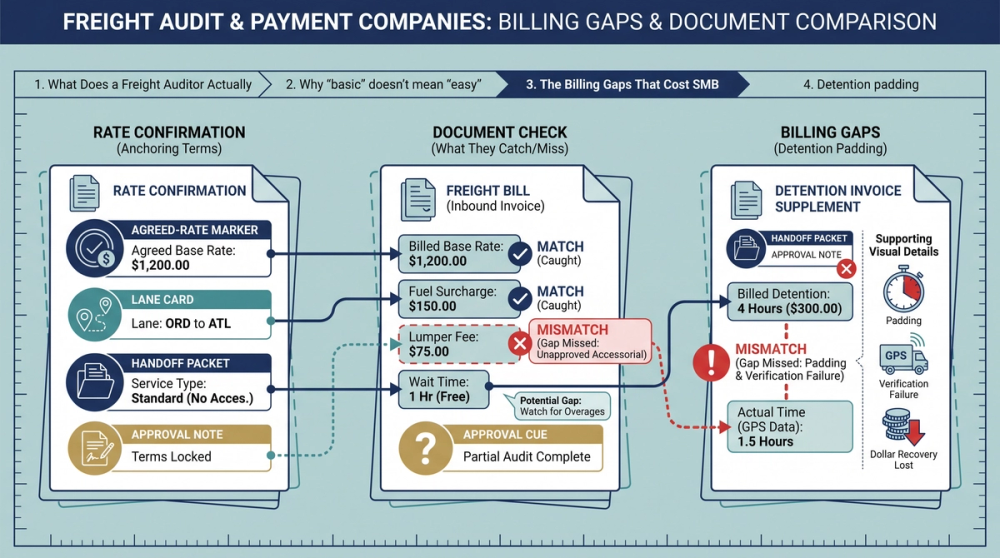
A carrier applies the DOE diesel index from the week prior to pickup instead of the week of pickup. The prior week's index was $0.04/mile higher. On a 1,175-mile average haul, that adds $47 per load. At 300 loads per month: $47 × 300 = $14,100 per month in overbilling, or $169,200 per year. This error is invisible unless you're recalculating the surcharge against the correct DOE week for every invoice. Most manual audit processes skip this step because it's tedious. A freight audit company that doesn't automate DOE index matching will miss it too.
Example: TONU billed on a load that was never tendered
A carrier submits a $250 TONU (Truck Order Not Used) charge for a load they claim was cancelled after dispatch. When the broker cross-references the BOL and TMS timestamps, there's no dispatch record for that carrier on that load. The load was covered by a different carrier entirely. Without matching the TONU invoice to a confirmed dispatch record in the TMS, this $250 charge gets paid. Multiply this across a year of sporadic false TONUs and the exposure grows quickly.
Example: Duplicate lumper fee on the same stop
A carrier invoices a $185 lumper fee for unloading at a distribution center. Separately, the lumper service at the same facility also invoices the broker $185 for the same stop, same date, same load number. Both invoices get processed because they come from different vendors. The result: $185 paid twice. If your freight audit provider doesn't match invoices by stop-level detail (not just by carrier), duplicates from different billing parties slip through.
Example: Layover billed without qualifying detention
A carrier bills a $400 layover charge, claiming the driver was stuck overnight at a shipper facility. The rate con specifies that layover applies only after 24 hours of continuous detention. Facility check-in records show the driver arrived at 2:00 PM and departed at 9:00 AM the next day: 19 hours total. That's 5 hours short of the layover threshold. The correct charge: $0. Catching this requires reading the layover trigger in the rate con and comparing it to actual timestamps, not just confirming that a layover line item exists.
Laneproof's reconciliation engine checks each of these fields automatically, flagging variances between carrier invoices, rate confirmations, and TMS records before payment goes out. That means fuel surcharge mismatches, unsupported TONUs, and duplicate stop-level charges get caught in seconds, not hours.
How to Evaluate a Freight Audit and Payment Company Before You Sign Anything
Here's where most content on this topic fails you. Every article ranks vendors by feature lists. None of them tell you what to actually test before handing over your invoice data. Use these criteria.
Ask what error categories they audit
Not "we audit invoices." Specifically: do they check fuel surcharge calculations against the DOE index? Do they match detention to facility timestamps? Do they catch duplicate charges across different billing parties? If a provider can't name the specific error types they catch, they're running a surface-level audit. According to CTSI-Global's freight audit service description, a thorough FAP provider should be eliminating billing errors, managing contract compliance, and providing spend analytics. If your provider only does the first one, you're leaving money on the table.
Demand recovery benchmarks, in writing
GEODIS reports recovering up to 5% of transportation spend for clients through freight audit and payment services, according to Mordor Intelligence's market analysis. That's a useful benchmark. Before signing, ask the provider: what's your average recovery rate as a percentage of audited spend? What's the median, not just the mean? Get the number in writing with a performance guarantee or a trial period. If they won't commit to a measurable outcome, that's your first red flag.
Understand the pricing model before calculating ROI
A freight audit company that charges 30% of recovered savings sounds cheap until you run the numbers. On $40,000 in annual recoveries, that's $12,000 paid to the provider, leaving you $28,000. A flat-fee tool at $300/month costs $3,600/year, netting you $36,400 from the same $40,000 in recoveries. That's $8,400 more in your pocket. The percentage-of-savings model also creates a perverse incentive: the provider benefits from your billing errors continuing to exist, because their revenue depends on having something to recover. Flat-fee or per-transaction pricing aligns incentives better. For more on what freight audit providers actually deliver relative to their cost, this comparison of what you get for the money breaks it down by pricing model.
Check TMS and ERP integration depth
An audit provider that requires you to export CSVs, email invoice PDFs, or manually enter data into their portal is adding work, not removing it. Ask: does the provider integrate directly with your TMS? Can it pull rate cons, dispatch records, and BOLs automatically? Does it push audit results and payment status back into your system? If the integration is one-directional or manual, you'll spend time feeding the tool instead of the tool feeding you answers.
Red flags that should stop you from signing
- The provider can't explain their audit methodology beyond "we review invoices for accuracy."
- No trial period, no pilot, no performance guarantee of any kind.
- They require long-term contracts (12+ months) before you've seen a single recovery report.
- Their reporting only shows recovered dollars, not the error categories, frequencies, or carrier patterns behind them.
- They don't audit accessorials at the stop level, only at the invoice level.
In-House Auditing vs. Outsourcing: The Honest Tradeoffs
The decision between building an internal freight audit process and hiring a freight audit and payment company isn't binary. Here's the honest comparison.
When in-house auditing makes sense
If you're running under 200 loads per month and you have a billing coordinator with carrier invoice review experience, in-house auditing can work. The labor math: 200 loads at roughly 3 to 4 minutes per audit equals 10 to 13 hours per month. That's manageable. The advantage of in-house is control. Your team knows your carrier base, your rate con quirks, and which carriers consistently overbill on detention. The disadvantage: it doesn't scale. At 400 loads per month, that same process requires 20 to 27 hours of audit time. Your billing coordinator is now spending a third of their month on invoice reconciliation instead of dispute resolution, carrier onboarding, or payment processing.
When outsourcing pays for itself
Outsourcing makes financial sense when the cost of missed billing errors exceeds the cost of the provider. For a broker running 500 loads per month, consider: a billing coordinator spending 4 hours per week on manual reconciliation at $35/hour loses over $7,000 annually in labor cost alone, before counting the disputes they miss because they're buried in data entry. If an outside freight audit catches even 2% of your total freight spend in overbilling, the ROI math is straightforward. At $1,800 average per load and 500 loads monthly, that's $1,800 × 500 × 0.02 = $18,000 per month in recoveries. Even a provider charging 30% of recoveries would return $12,600 per month net.
The hybrid approach
Many SMB brokers are landing on a middle path: using automated tools that flag invoice discrepancies to handle the high-volume matching (linehaul, fuel surcharge, duplicate detection), while keeping a human in the loop for judgment calls on detention disputes, layover validation, and carrier relationship management. This approach gets you the speed and consistency of automation without losing the institutional knowledge that only your ops team has. It also means your billing coordinator's time shifts from data entry to dispute resolution, where their expertise actually matters.
Understanding what freight audit and payment roles actually catch helps you decide which tasks to keep in-house and which to hand off.
Regulatory context: why this matters beyond margins
Freight brokers operate under FMCSA financial responsibility and regulatory requirements that include maintaining a minimum $75,000 security bond under MAP-21 provisions. Consistent overbilling that goes undetected doesn't just erode margins. It strains the cash flow that supports your bond, your carrier payment terms, and your ability to cover claims. FMCSA compliance isn't optional, and poor billing hygiene can create downstream financial exposure that extends well beyond the individual invoice.
Frequently Asked Questions About Freight Audit and Payment Companies
What does a freight auditor do?
A freight auditor reviews carrier invoices against rate confirmations, BOLs, PODs, and accessorial agreements to confirm billing accuracy before payment. They check linehaul rates, fuel surcharges, detention charges, lumper fees, and other accessorials. The goal is to catch overbilling, duplicate charges, and unsupported accessorials before money leaves your account.
How do you audit freight bills?
Start by matching every invoice to its rate con. Verify the linehaul rate, recalculate the fuel surcharge against the correct DOE index week, check each accessorial against supporting documentation (timestamps, receipts, dispatch records), run duplicate detection by load number and stop, and validate GL coding. The five-step process described above covers the complete workflow.
Which company is best for freight auditing?
There's no single best provider for every broker. According to Gartner's freight audit and payment provider reviews, the top-rated companies vary based on load volume, mode mix, and integration requirements. The right choice depends on whether you need full-service outsourcing or targeted automation, what error categories matter most in your operation, and whether the pricing model (percentage of savings vs. flat fee) aligns with your volume.
How much can freight audit save my brokerage?
Recovery rates vary, but industry benchmarks suggest up to 5% of total transportation spend, per Mordor Intelligence's analysis of FAP market data. For an SMB broker spending $900,000 per month on carrier payments, that ceiling is $45,000 per month. Realistic recoveries for a well-run brokerage with some existing controls are typically lower, in the 1% to 3% range, but still represent significant margin recovery.
Do freight audit and payment companies work for small brokerages?
Yes, but the ROI depends on volume and current error rates. A brokerage running 100 loads per month may not generate enough recoveries to justify a provider charging a percentage of savings. Flat-fee or per-transaction pricing models tend to work better at lower volumes. The break-even calculation is simple: multiply your average load value by your monthly volume by an estimated 2% error rate, then compare that to the provider's cost.
Where to Go from Here
Freight audit and payment companies exist because carrier billing errors are consistent, predictable, and expensive. The providers worth hiring are the ones that catch the specific error categories that match your operation: fuel surcharge miscalculations, detention padding, duplicate accessorials, and unsupported charges like TONUs and layovers. Before you sign with any provider, test them against the criteria in this article. Ask for recovery benchmarks in writing. Run the pricing math on their model versus alternatives. And if you're not sure whether to outsource or build internally, start with the five-step audit process above and track how many hours it takes and how many errors you find.
If you want to see how automated invoice matching handles these exact error categories on your own load data, check what it costs and what's included.
Sources
- Regulations | FMCSA — U.S. Department of Transportation
- Best Freight Audit and Payment Providers Reviews 2026 — Gartner
- Freight Audit And Payment Market Size & Growth to 2030 — Mordor Intelligence
- Freight Audit And Payment Market Size 2026-2030 — Technavio
- The Ultimate Guide to Freight Audit — Trax Technologies
- Freight Audit, Billing and Payments: A Guide — RateLinx
- Freight Audit & Payment Solutions — CTSI-Global
- Top 15 Companies in Global Freight Audit and Payment Market — Spherical Insights