Carrier Invoice Audit Software: What It Should Catch Before You Pay
Researched and written with AI assistance. Reviewed by the Laneproof team.
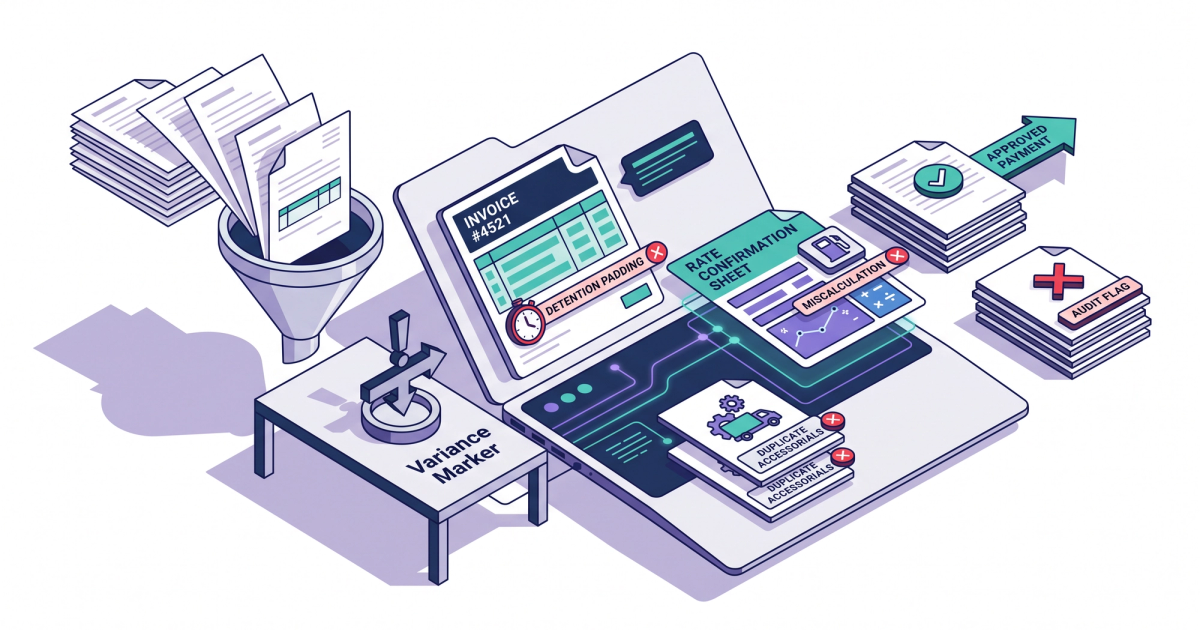
Carrier invoice audit software automatically compares carrier invoices against rate confirmations, BOLs, and shipment data to flag billing errors before you approve payment. The process works in three steps: (1) the software ingests carrier invoices and matches each line item to the corresponding rate con, (2) it flags variances in linehaul, detention, fuel surcharges, and accessorial charges, and (3) it surfaces disputed items with supporting documentation so you can resolve them before cutting a check. According to Traxtech's freight invoice audit analysis, at least 20% of all freight invoices contain errors, including duplicates, incorrect billing, and process mistakes. For a freight broker running 300 loads a month, that means roughly 60 invoices per month could be hitting your AP queue with inflated numbers. The question isn't whether you need audit software. It's whether the tool you're evaluating actually catches the errors that cost you money.
This article walks through the six most common carrier billing errors that erode broker margins, explains how each one works in dollar terms, and gives you a list of questions to ask any vendor before you spend a dollar.
What Carrier Invoice Audit Software Actually Does (In Plain Terms)
Most brokers already know the pain of reconciling invoices manually. A billing coordinator pulls the carrier invoice PDF, opens the TMS, finds the matching rate confirmation, and starts checking line items one by one. Linehaul matches? Check. Fuel surcharge calculated correctly? Maybe. Detention hours line up with the POD? Who has time to verify that on every single load?
Carrier invoice audit software replaces that manual cross-referencing with automated matching. According to Trimble's freight audit documentation, modern audit platforms can automate up to 99% of the audit and pay process, requiring human intervention only on invoices where discrepancies exist. For a broker, this means your team stops spending hours reviewing clean invoices and starts spending minutes resolving the ones that actually have problems.
The core matching process
A good freight audit tool does three things automatically:
- Rate con matching: It compares every line item on the carrier invoice against the agreed rate confirmation. Linehaul, fuel surcharge percentage, accessorial rates, and payment terms all get checked against what was contracted.
- Document cross-referencing: It pulls data from the BOL, POD, and check-call logs to verify factual claims. If a carrier bills 4 hours of detention, the software checks the actual timestamp data to confirm or dispute that number.
- Variance flagging: When a line item doesn't match, the software flags it with the specific dollar amount of the variance and the supporting documentation, so your team can resolve the dispute with evidence rather than guesswork.
What it doesn't do (and shouldn't claim to)
No software eliminates all billing disputes. Carriers sometimes have legitimate reasons for charges that weren't on the original rate con. What audit software does is make sure you never pay an inflated or duplicated charge by accident. It shifts your team from reviewing every invoice to reviewing only the ones that need attention. That distinction matters because it directly affects how much labor you're spending on back-office reconciliation versus operations that grow revenue.
The Billing Errors That Hit Broker Margins the Hardest
Not all invoice errors are created equal. Some are rounding differences of a few dollars. Others are systematic overcharges that, if left unchecked across hundreds of loads per month, cost you five figures annually.
According to Transportation Insight's analysis of freight billing, between 3% and 6% of carrier invoices contain billing errors, with accessorial charges being the most common category. Portcast's research on automated freight audit puts the potential savings from invoice audits at 2% to 8% of total freight spend.
Here are the six error types that show up most often and cost the most when they slip through.
1. Detention time padding
Carriers bill detention when loading or unloading takes longer than the agreed free time (usually 2 hours). The problem: some invoices round up or add hours that don't match what actually happened at the dock. When the POD shows a 1-hour stop but the invoice bills 3 hours of detention at $75/hour, that's $150 per load that came out of your margin for no reason.
2. Fuel surcharge miscalculations
Fuel surcharges are supposed to be calculated on a specific base rate, usually the contracted linehaul. But some carrier invoices calculate the surcharge on the gross invoice total or on a higher linehaul figure than what the rate con specifies. On a single load, the difference might be $20 to $30. Across 300 loads a month, it adds up to thousands.
3. Duplicate accessorial charges
A lumper fee appears on the main invoice and again as a separate accessorial line item. A liftgate charge gets billed twice, once in the linehaul and once as an add-on. These duplicates are easy to miss when you're reconciling 40 or more loads per week by flipping between PDFs and TMS screens. For more on which line items carriers inflate most frequently, see this breakdown of the line items that get padded.
4. TONU charges on picked-up loads
A Truck Order Not Used (TONU) charge is legitimate when a carrier dispatches a truck and the load cancels. It is not legitimate when the load was actually picked up, which the signed BOL proves. This error type is less common but high-dollar, often $200 to $350 per occurrence, and it requires cross-referencing the invoice against shipment status data that billing coordinators rarely have time to check manually.
5. Layover charges inside the appointment window
Layover fees apply when a carrier is forced to wait overnight due to scheduling issues outside their control. But when the carrier's own check-call log shows delivery was attempted inside the appointment window, the layover charge doesn't hold up. Without timestamped data at your fingertips, disputing this charge can drag on for days.
6. Linehaul rate discrepancies
The simplest error, and sometimes the most costly. The rate confirmation says $1,850. The invoice says $1,925. A $75 difference on one load is annoying. On a pattern of loads from the same carrier over a quarter, it's a margin leak that compounds quietly.
How Good Audit Software Matches Invoices Against the Rate Con
The rate confirmation is the single most important document in carrier invoice auditing. It's the contract. Every line item on the carrier's invoice should trace back to what was agreed on the rate con. If it doesn't match, it's either an error or an unapproved charge that needs justification.
Field-by-field matching
Good invoice reconciliation software doesn't just compare totals. It matches individual fields:
- Linehaul rate: Does the invoiced linehaul match the rate con to the penny?
- Fuel surcharge base and percentage: Is the FSC calculated on the correct base rate using the correct percentage from the rate con?
- Accessorial rates: Are detention, lumper, liftgate, and other accessorial fees billed at the rates specified in the rate con or carrier packet?
- Stop counts and locations: Does the invoice bill for stops that match the BOL?
- Payment terms: Is the payment timeline consistent with what was agreed?
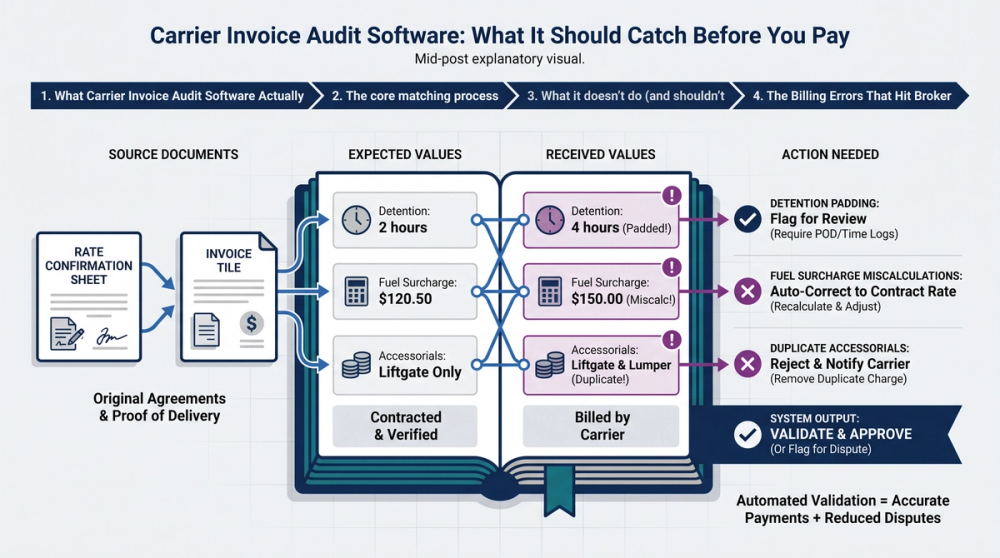
According to ShipperGuide's overview of freight audit software, the core function of any audit tool is validating that invoiced amounts match contracted rates, and that the services billed were actually performed. The difference between a basic tool and a useful one is how granularly it performs that validation.
What happens when a variance gets flagged
When the software finds a mismatch, the workflow matters just as much as the detection. A tool that flags an error but dumps it into a spreadsheet for manual follow-up hasn't saved you much time. What you want is a system that surfaces the variance with the supporting documentation (rate con, BOL, POD, timestamps) attached, so your billing coordinator can send a dispute to the carrier within minutes, not hours. Tools that automatically flag invoice discrepancies and pair them with the right documents cut the dispute cycle from days to hours.
Detention and Accessorial Charges: Where the Padding Hides
If you've been in freight brokerage for more than a year, you already know that detention and accessorial charges are where margins go to die. These are the line items carriers have the most discretion over, and they're the hardest to verify without supporting data.
Why detention is the most disputed charge in freight
Detention charges require proof of time spent waiting. That proof usually lives in the POD, driver check-in logs, or facility timestamps. When a carrier submits an invoice with 4 hours of detention at $75/hour, the broker needs to verify two things: (1) did the driver actually wait that long, and (2) does the wait time exceed the free time specified in the rate con? Without software pulling that data together, your billing coordinator is opening the invoice PDF in one tab, the TMS in another, and hunting for the POD in a third. That process takes 10 to 15 minutes per load, and it still might miss the discrepancy.
A freight audit tool that ingests POD timestamps and cross-references them against invoiced detention hours catches the padding automatically. The billing coordinator only sees the loads where the numbers don't match.
Accessorials that appear twice (or shouldn't appear at all)
Lumper fees, liftgate charges, pallet exchanges, and inside delivery fees are all common accessorials. The issue isn't that carriers bill them. It's that the same charge sometimes appears in multiple places on the same invoice, or gets billed on a load where the service wasn't performed. If you want a full checklist of what to review on every carrier invoice, this carrier invoice audit checklist covers the specific fields to check before approving payment.
Fuel Surcharge Miscalculations Are More Common Than You Think
Fuel surcharges seem straightforward: take the contracted FSC percentage and apply it to the linehaul rate. In practice, this is where small errors create consistent margin leakage across dozens or hundreds of loads.
The base rate problem
The most common fuel surcharge error is calculating the percentage on the wrong base. The rate confirmation might specify a linehaul of $1,850 with a 15% fuel surcharge. The correct FSC is $277.50. But if the carrier calculates 15% on a gross figure of $2,200 (which might include other charges), the FSC becomes $330. That's a $52.50 overcharge on a single load. Over 300 loads per month, even if this error only hits 5% of your volume, you're looking at $787.50 per month in overpayments on fuel surcharges alone.
Why manual checks miss FSC errors
When a billing coordinator is reviewing invoices, they tend to focus on the big numbers: is the linehaul correct? A $52 variance buried in the fuel surcharge line doesn't jump off the page the way a $200 linehaul discrepancy does. But the fuel surcharge error repeats on every load from that carrier, while the linehaul error might be a one-time mistake. Audit software catches FSC errors by recalculating the surcharge from the contracted base rate and percentage on every single invoice, every single time. No fatigue, no rounding, no missed loads.
Real Dollar Impact: What These Errors Cost Brokers Monthly
Let's put actual numbers to these scenarios so you can benchmark against your own operation.
Example: Detention padding on 12 loads
A carrier invoices an extra 2 hours of detention at $75/hour on loads where the POD shows a 1-hour stop. That's $150 overbilled per load. If this pattern appears on 12 loads per month, you're losing $1,800/month, or $21,600/year, on a single error type from potentially a single carrier.
Example: Fuel surcharge on the wrong base
The rate con specifies a $1,850 linehaul with a 15% fuel surcharge. The carrier calculates the FSC on a gross figure of $2,200 instead. The correct FSC is $277.50. The invoiced FSC is $330. The overcharge is $52.50 per load. If this calculation applies to 15 loads per month from this carrier, that's $787.50 per month in margin lost to a math error.
Example: Duplicate lumper fee across a 40-load week
A $185 lumper fee appears on both the carrier invoice line items and as a separate accessorial line. That's $185 per occurrence. If your billing coordinator, reconciling 40 loads in a week, misses even two of these duplicates per week, that's $370/week or $1,480/month paid twice for the same service.
Example: TONU charged on a picked-up load
A carrier bills a $250 TONU on a load that has a signed BOL proving pickup occurred. This is a charge that should never have been invoiced. If it hits your AP queue and gets approved because nobody cross-referenced the shipment status, that's $250 gone. Across a year, even a handful of these errors per quarter adds $1,000 or more in unjustified payments.
Scenario: The aggregate impact on a 300-load broker
A broker running 300 loads per month at an average linehaul of $900. Based on the 3% to 6% error rate cited by Transportation Insight, even at the low end (3.8% average overbill rate), that's $34.20 in overbilling per affected load. Across 300 loads, with roughly 20% containing errors per Traxtech's analysis, that's approximately 60 invoices with errors, totaling roughly $10,260 in recoverable margin per month, or $123,120 per year, before accounting for the cost of the audit software itself.
A broker running 300 loads per month can recover roughly $10,260 in margin per month by catching common carrier invoice errors. That's $123,120 per year in overbilling that audit software is designed to stop before payment goes out.
The labor cost of doing it manually
Manual reconciliation has a cost too. A billing coordinator spending 11 hours per week cross-referencing carrier invoice PDFs against TMS data at $22/hour equals $12,584 per year in labor. Audit software that reduces that workload by 70% to 80% (consistent with automation rates cited by Trimble) frees up 8 to 9 hours per week for dispute resolution, carrier communication, or work that actually moves loads. Laneproof's reconciliation engine checks each of these fields automatically, flagging variances before payment goes out, so your team focuses on exceptions rather than reviewing every clean invoice.
What to Ask Any Vendor Before You Spend a Dollar
You've probably heard software pitches before. "We'll save you time and money." Fine. Here's how to cut through that and figure out whether a carrier invoice audit software tool actually does what you need.
Questions about detection accuracy
- What specific error types does your software catch? Get a list. If the vendor can't name detention padding, FSC miscalculations, duplicate accessorials, and rate con mismatches specifically, their detection may be too shallow for brokerage operations.
- How do you handle accessorial charges that aren't on the rate con? New charges pop up. The software should flag them for review, not auto-approve or auto-reject.
- What's your false positive rate? A tool that flags 30% of invoices when only 5% have real errors creates more work, not less. Ask for benchmarks.
Questions about integration and onboarding
- How does it connect to my TMS? If the answer is "you export a CSV and upload it," that's not integration. Look for API connections or direct TMS integrations that pull rate cons and shipment data automatically.
- What does onboarding look like for a broker running 200 to 500 loads per month? Enterprise onboarding timelines (8 to 12 weeks) don't work for SMB brokers. Ask for the realistic timeline for your volume.
- Do I need to change my invoicing workflow, or does the software fit into what I already do? The best tools require minimal process changes. Your billing coordinator shouldn't need retraining to use it.
Questions about dispute resolution
- When the software flags an error, what happens next? Detection without resolution workflow is just a fancy spreadsheet. The tool should surface the variance, attach the supporting documents (rate con, POD, timestamps), and give you a way to send the dispute to the carrier directly.
- Can I track dispute status and resolution time? If you can't measure how quickly disputes get resolved, you can't prove the software's value to your own business.
- Does the software learn from resolved disputes? If a carrier consistently overbills detention on loads to a specific facility, the tool should flag that pattern, not just catch each instance in isolation.
Questions about ROI
- Can you show me recovered margin from a broker my size? Generic case studies from enterprise shippers don't prove anything for a 300-load-per-month brokerage. Ask for data from operations similar to yours.
- What's the typical payback period? According to Portcast's research, freight invoice audits recover 2% to 8% of total freight spend. At the low end, a broker spending $270,000/month on carrier costs should recover at least $5,400/month. If the software costs $500/month, the payback is immediate.
- Is there a trial or pilot option? You shouldn't have to commit to an annual contract to prove the tool catches real errors in your invoices.
Frequently Asked Questions About Carrier Invoice Audit Software
How is carrier invoice audit software different from a TMS with billing features?
A TMS handles load management, dispatch, and basic invoicing. Carrier invoice audit software is purpose-built for the reconciliation step: it compares what the carrier billed against what was contracted on the rate confirmation. Most TMS platforms don't automatically cross-reference POD timestamps, recalculate fuel surcharges, or flag duplicate accessorial charges. Audit software fills that gap.
What percentage of carrier invoices actually contain errors?
According to Traxtech, at least 20% of all freight invoices contain some type of error, including duplicates, incorrect billing, and process mistakes. Transportation Insight narrows the range to 3% to 6% of invoices containing billing errors specifically in accessorial and rate categories. The exact rate depends on your carrier mix and how tightly your rate cons are written.
How long does it take to implement carrier invoice audit software?
For SMB freight brokers running 100 to 500 loads per month, implementation should take days, not months. If a vendor quotes an 8-to-12-week onboarding timeline, the product was likely built for enterprise shippers and may not fit your workflow. Ask specifically about API connections to your TMS and how quickly the software can start ingesting your carrier invoices.
Can audit software handle spot rates, or only contracted lanes?
Good carrier invoice audit software handles both. For contracted lanes, it matches against stored rate agreements. For spot loads, it matches against the individual rate confirmation issued for that load. The key is whether the software can ingest the rate con for each load, regardless of how the rate was negotiated.
What kind of ROI should I expect from carrier invoice audit software?
According to Portcast, freight invoice audits typically recover 2% to 8% of total freight spend. For a broker spending $270,000 per month on carrier costs, even the low end (2%) represents $5,400/month in recovered margin. Add the labor savings from reducing manual reconciliation time by 70% to 80%, and most brokers see positive ROI within the first month.
Stop Paying for Errors That Software Should Catch
Every carrier invoice that passes through your AP queue without being checked against the rate con is a chance for margin to leak. Detention padding, fuel surcharge miscalculations, duplicate accessorials, and TONU charges on picked-up loads are not rare events. They happen on a measurable percentage of invoices, every month, and they cost real dollars.
The fix isn't hiring more billing coordinators. It's putting a system between the carrier invoice and the payment that automatically catches what humans miss when they're reviewing their 30th PDF of the day. If you're evaluating carrier invoice audit software, use the questions above to test whether the tool catches the specific errors that hit your operation. And if you want to see how automated rate con matching works on your own invoices, Laneproof's reconciliation tool lets you test it on real data before you commit.
Sources
- Freight Audit Software Automates Invoicing & More — Trimble Transportation
- Freight Audit And Payment: Protecting Profit In Soft Rates — Transportation Insight
- Freight Invoice Audit: 4 Key Components — Traxtech
- Cutting Costs and Errors: How Automated Freight Audit and Payment Software Is Changing Logistics — Portcast
- Freight Audit Software: What to Look For — ShipperGuide Blog
Full guide: Carrier Invoice Mistakes That Are Costing You Real Money
Related: How to Catch Carrier Billing Errors Automatically Before You Pay
Related: 5 Freight Billing Errors That Are Costing You Real Money