5 Freight Billing Errors That Are Costing You Real Money
Researched and written with AI assistance. Reviewed by the Laneproof team.

A single billing error on a carrier invoice can cost you $57. Or $112.50. Or $1,450 if a duplicate linehaul charge slips through. Multiply any of those across a few hundred loads a month, and you're watching margin evaporate on loads you already moved. According to industry data from IOFM 2025, 22% of freight invoices contain errors requiring manual correction, and each one costs an average of $53.50 to resolve. That means billing errors aren't just an accounting nuisance. They're a line item eating your profit. This guide covers the five freight-specific billing errors that hit brokers hardest: detention miscalculations, lumper fee gaps, fuel surcharge rounding, duplicate linehaul charges, and accessorial overcharges. For each one, you'll get the exact math on what it costs per load, how it scales across your monthly volume, and what documentation you need to dispute it.
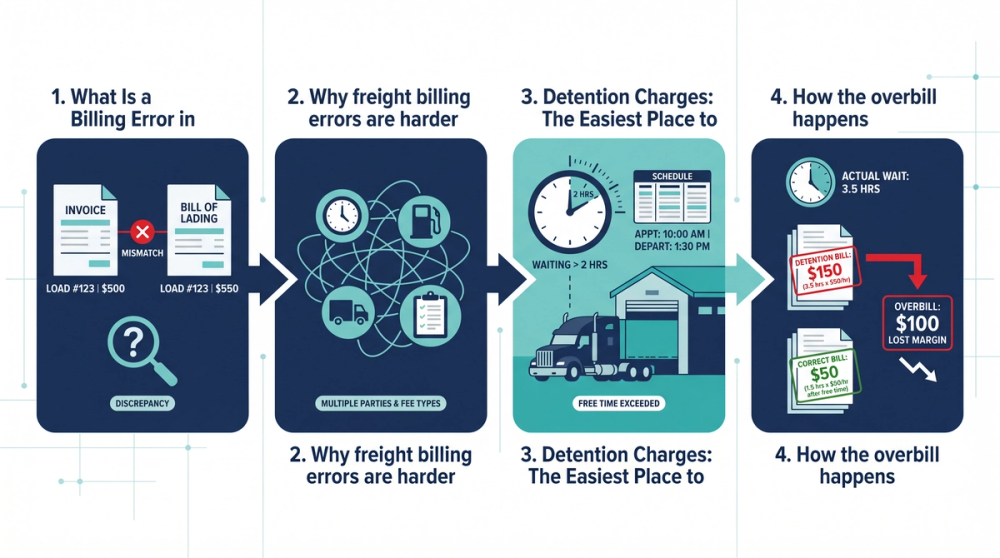
What Is a Billing Error in Freight, and Why It Hits Different Than Other Industries
A billing error in freight is any charge on a carrier invoice that doesn't match the rate confirmation, BOL, or agreed terms of the load. That includes wrong linehaul rates, inflated detention hours, undocumented lumper fees, miscalculated fuel surcharges, and accessorial charges that were never authorized or never actually occurred.
In most industries, billing errors are a back-office problem. In freight, they're an ops problem. Every invoice you process ties back to a rate con, a set of delivery documents, and a chain of timestamps that either confirm or contradict what the carrier is billing. The difference is that nobody has time to check every line on every invoice against every document. So errors compound.
According to American Shipper data cited by Hyland, an overwhelming 80% of carrier invoices contain some kind of discrepancy, and 15% to 20% require significant manual intervention to resolve. That's not a rounding error. That's a structural problem in how carriers bill and how brokers reconcile.
Why freight billing errors are harder to catch
The core issue is volume plus complexity. A single load can generate a rate confirmation, a BOL, a POD, a lumper receipt, a detention log, and an invoice, each from a different source, in a different format, sometimes arriving days apart. When your billing coordinator is processing 50 or 100 of these a week, the math is simple: some errors will get paid. Industry estimates suggest 5% to 15% of all freight invoices contain errors, and those errors accumulate into thousands of dollars monthly for a mid-size brokerage.
The five errors below are the ones we see most often. They aren't obscure edge cases. They show up on everyday loads, every week, and they're all preventable if you know what to look for.
Detention Charges: The Easiest Place to Get Overbilled
Detention is the most disputed line item in freight billing, and for good reason. The carrier's version of how long a driver waited rarely matches the facility's version or the timestamps on the BOL. And when you're paying $50 to $100 per hour for detention, even a one-hour discrepancy adds up fast.
How the overbill happens
Most rate confirmations specify free time (typically 2 hours at pickup and delivery) before detention charges start. The carrier invoices detention from the moment the driver arrives, not from when free time expires. Or the carrier rounds 2.5 billable hours up to 3.5. Or the carrier's check-in time doesn't match the facility's dock log.
The FMCSA addresses billing error correction procedures under its Collection of Charges regulations (Subpart H), which outline responsibilities for both shippers and carriers in resolving billing discrepancies. But in practice, the burden of catching the error falls on the broker.
Example: detention overbill on a single load
Scenario: Your rate con allows 2 free hours at delivery. The carrier invoices for 3.5 hours of detention at $75/hour. That's $262.50 billed. But your POD timestamp shows the driver checked in at 10:15 AM and left at 1:45 PM, a total of 3.5 hours on site. Subtracting the 2 free hours, you owe for 1.5 hours, which is $112.50. The carrier billed for 3.5 hours of detention (not 3.5 hours on site minus free time), which means you're being overbilled $112.50 on that single load.
Now scale it. If your brokerage handles 200 loads per month and 15% of those loads have a detention dispute, that's 30 loads. At $112.50 per overbill, you're looking at $3,375 per month in unchecked detention overcharges. That's $40,500 per year walking out the door. For a deeper look at how carriers miscalculate detention and how to catch it, read how to catch carrier overbilling on detention charges.
What to check on every detention invoice
- Compare carrier's reported arrival time against facility check-in log or BOL timestamp
- Confirm free time allowance matches the rate confirmation exactly
- Verify the hourly detention rate matches the rate con (not a carrier default rate)
- Check that detention hours are calculated from the end of free time, not from arrival
Lumper Fees With No Receipt Are a Blank Check
Lumper fees are one of the least documented charges in freight. A carrier drops at a facility, pays a lumper crew to unload, and invoices you for the cost. The problem: too many of these invoices arrive with no receipt from the lumper company, no cash advance documentation, and a dollar amount that doesn't match the lumper allowance on the rate con.
How the gap opens up
The rate con might include a $150 lumper allowance. The carrier invoices $185. The difference of $35 might seem small, but without a third-party lumper receipt confirming the actual charge, you have no way to verify whether the driver paid $185, $150, or $120. You're trusting a number on an invoice with no backup documentation.
This is not a rare situation. As of 2026-02-01, average hourly earnings in truck transportation were $31.94/hr according to BLS Current Employment Statistics (series CEU4348400008). Lumper fees often run $150 to $350 per stop. When the per-stop cost is that high relative to what drivers earn, the incentive to pad or misreport the amount is real.
Example: lumper fee with no documentation
Scenario: Your rate con includes a $150 lumper allowance. The carrier's freight invoice shows a $185 lumper charge with no receipt attached, no lumper company name, and no Comchek or cash advance record. That's a $35 gap per load. If you process this without documentation, it's unrecoverable. Over 40 loads a month with similar gaps, that's $1,400/month you're paying out on unverified charges.
The fix is simple in principle: require a lumper receipt on every invoice that includes a lumper charge. In practice, enforcing that policy across dozens of carriers takes discipline. For a breakdown of the most common lumper fee mistakes and how to set up receipt requirements in your carrier packets, see lumper fee billing errors that cost brokers thousands.
Documentation requirements for lumper fees
- Third-party lumper company receipt with date, facility, and dollar amount
- Comchek or cash advance record if the broker funded the lumper
- Rate con showing the agreed lumper allowance for comparison
- Reject any lumper charge that exceeds the rate con allowance without a matching receipt
Fuel Surcharge Rounding Is Small Per Load and Huge Across a Month
Fuel surcharge errors don't look like much on a single invoice. A dollar or two here, three dollars there. But fuel surcharges appear on nearly every load, which means even tiny rounding discrepancies multiply across your entire volume.
Where the rounding error comes from
Most fuel surcharges are calculated as a per-mile rate tied to a DOE fuel index. The agreed FSC rate might be 18.4 cents per mile. On a 412-mile lane, the correct charge is $75.81 (412 × $0.184). But the carrier rounds the per-mile rate to 19 cents, or rounds the total up to $78.00. The difference is $2.19 per load.
As of 2026-03-01, the Producer Price Index for truck transportation of freight stood at 159.5 (BLS PPI series WPU3012), reflecting ongoing cost pressures that make every dollar of margin matter. Fuel surcharge overcharges compound those pressures.
Example: FSC rounding across 800 loads
Scenario: Your agreed FSC is 18.4 cents per mile on a 412-mile lane. Correct charge: $75.81. Carrier invoices: $78.00. Difference: $2.19 per load. If you move 800 loads per month and even half of them carry a similar rounding discrepancy, that's 400 loads × $2.19 = $876/month. If the full 800 loads are affected, it's $1,752/month in freight overbilling, or $21,024 per year.
The frustrating part is that $2.19 per invoice never triggers a manual review. It's too small to flag by eye. But it's exactly the kind of error that automated rate-versus-invoice matching catches instantly.
How to verify fuel surcharge calculations
- Pull the FSC rate from the rate confirmation (not from the carrier's invoice)
- Multiply the agreed per-mile FSC rate by the actual loaded miles on the BOL
- Compare the result to the carrier's invoiced FSC, checking for rounding to the nearest dollar
- Flag any FSC variance over $1.00 for review against the DOE index week the load moved
Duplicate Linehaul Charges and Rate Con Mismatches
Duplicate charges are the most expensive billing errors in freight because the entire linehaul gets billed twice. They're also the most embarrassing to miss, because they usually only surface during monthly reconciliation, weeks after the duplicate payment has already gone out.
How duplicate linehaul charges happen
The most common cause is a TMS resubmit. The carrier's billing system or your TMS generates a duplicate invoice after an edit, a correction, or a failed electronic submission. The invoice number might differ by one digit, or the resubmitted version might come in as a "corrected" invoice that doesn't reference the original. Your billing coordinator processes both.
According to Trimble freight audit data, freight billing inaccuracies are a persistent drain on transportation spend, and duplicate charges are among the costliest when they slip through audit processes. A single duplicate on a $1,450 linehaul charge is a $1,450 loss, not a variance or a rounding issue.
Example: duplicate linehaul caught 45 days late
Scenario: A carrier submits an invoice for a $1,450 linehaul on a 650-mile load. Three days later, the carrier's billing system resubmits the same charge under a new invoice number after a TMS error. Both invoices are processed and paid. The duplicate isn't caught until the monthly reconciliation cycle, 45 days after the original payment. You've now paid $2,900 for a $1,450 load, and recovering the overpayment means filing a dispute with a carrier who may take 30 to 60 days to issue a credit.
Rate con mismatch: a different kind of linehaul error
Not all linehaul overcharges are duplicates. Some are simple rate con mismatches where the carrier invoices a different per-mile rate than what was confirmed.
Scenario: Your rate confirmation confirms $2.10/mile on a 380-mile load, for a linehaul of $798. The carrier invoices at $2.25/mile, totaling $855. That's a $57 overcharge. When you follow up, the carrier references a verbal rate discussed before the rate con was signed. The rate con governs. The $57 is an overcharge, and you can dispute it with the signed rate confirmation as your primary document.
For more on which documents win freight billing disputes (and how to use them), see the documents that win billing disputes every time.
Preventing duplicate and mismatch errors
- Set up invoice deduplication rules in your TMS by carrier, load number, and dollar amount
- Flag any invoice where the linehaul total deviates more than $5 from the rate confirmation
- Never accept a "corrected" invoice without confirming the original was voided or credited
- Match every linehaul charge to the signed rate confirmation before payment, not after
Accessorial Overcharges That Slip Through Because Nobody Checks the BOL

Accessorial charges are the wild card of carrier invoices. Detention and lumper fees are at least expected on certain loads. But TONU charges, layover fees, dry run charges, and drayage add-ons can appear on invoices for loads where the event in question never happened.
According to rail freight billing data from IntelliTrans, approximately 27% of all accessorial fees levied on shipments are incorrect. While that statistic comes from rail freight, the pattern is consistent across modes: accessorial charges are the least audited and most frequently wrong line items on a freight invoice.
TONU charges for loads that were never dispatched
A TONU (truck ordered, not used) charge is legitimate when a carrier dispatches a driver to a load and the load cancels. It compensates the carrier for wasted capacity. But TONUs also appear on invoices for loads where no truck was ever assigned, no driver was dispatched, and no capacity was committed. These are phantom charges that get paid because nobody checks the TMS dispatch log.
Scenario: A carrier invoices a $250 TONU on a load that was canceled before any truck was assigned. The carrier's invoice shows a TONU with no driver name, no truck number, and no dispatch confirmation. You pull the TMS dispatch log: no carrier was ever tendered on the load. The $250 charge is disputed and reversed using the timestamped dispatch log as documentation.
Other accessorial overcharges to watch for
- Layover charges where the BOL shows no overnight delay between pickup and delivery
- Dry run fees where the facility confirms the driver never arrived
- Liftgate charges on loads delivered to a dock-height facility (check the delivery address and facility profile)
- Redelivery fees where the original delivery was completed on the first attempt per the POD
The common thread: every one of these can be verified or disputed using documents you already have. The rate con, the BOL, the POD, the dispatch log. The problem isn't that you lack proof. It's that checking every accessorial against every document takes time your team doesn't have. For a full breakdown of the most common billing mistakes and how they compound, see 7 freight billing mistakes draining your margins.
80% of carrier invoices contain some kind of discrepancy, and 15% to 20% require significant manual intervention to resolve. The question isn't whether billing errors are on your invoices. It's how many you're catching.
Frequently Asked Questions About Freight Billing Errors
What is considered a billing error in freight?
A billing error in freight is any charge on a carrier invoice that doesn't match the agreed terms on the rate confirmation, the supporting documents (BOL, POD, lumper receipts), or the actual events of the load. This includes incorrect linehaul rates, inflated detention hours, undocumented lumper fees, miscalculated fuel surcharges, duplicate charges, and accessorial fees for events that didn't occur. If the invoice amount can't be verified by the rate con and delivery documents, it's a billing error.
What are some common billing errors in freight?
The five most common freight billing errors are: detention charge miscalculations (billing from arrival instead of after free time expires), lumper fees without receipts, fuel surcharge rounding (small per load but significant across volume), duplicate linehaul charges from TMS resubmits, and accessorial overcharges like phantom TONU fees or layover charges for loads with no overnight delay. According to IOFM 2025 data, 22% of freight invoices contain errors, and each costs $53.50 on average to correct.
What finds common billing errors on freight invoices?
The most reliable method is matching every line item on the carrier invoice against the rate confirmation and load documents. For detention, compare timestamps. For fuel surcharges, recalculate using the agreed per-mile rate and actual miles. For linehaul, match the total to the rate con. For accessorials, verify the event occurred using the BOL, POD, or dispatch log. Manual reconciliation works but takes hours per week. Automated invoice-to-rate-con matching tools can flag discrepancies in seconds.
Which of the following is a common cause of billing errors in freight?
The most common causes are manual data entry mistakes (typing the wrong rate or mileage into an invoice), TMS resubmit errors that create duplicate charges, carriers using verbal rates instead of the signed rate confirmation, detention time calculated from arrival rather than after free time, and lumper fees submitted without third-party receipts. Per Hyland's analysis of American Shipper data, 80% of carrier invoices contain some discrepancy, meaning billing errors are more the norm than the exception.
How do I dispute a freight billing error with a carrier?
Start with the rate confirmation. It's the single most important document in any freight billing dispute because it establishes the agreed terms. Pair it with the BOL (for pickup and delivery details), the POD (for timestamps and signatures), and any lumper receipts or dispatch logs that are relevant. Present the specific discrepancy in dollar terms: "Rate con shows $2.10/mile on 380 miles = $798. Your invoice shows $855. Please credit the $57 difference." Clear, documented disputes get resolved faster than vague complaints. For more detail, see documents that win billing disputes every time.
Sources
- Collection of Charges (Subpart H) — FMCSA
- Freight audit insights: the truth about freight spend — Trimble Transportation
- Why Freight Billing Errors Still Drain 3PL Profits — Debales AI
- Why Freight Invoice Errors Keep Costing You — ICC Logistics
- Freight Billing Errors: 5 Most Expensive Mistakes — ZDS
- Driving Millions of Dollars in Rail Freight Billing Errors Back into Shippers' Pockets — IntelliTrans
- The fragile state of freight billing processes and audits — Hyland
Stop Paying for Errors You Can Catch
Every freight billing error in this guide has two things in common: it's preventable, and it's provable. You already have the rate con, the BOL, the POD, and the dispatch logs. The challenge is matching them against every carrier invoice, on every load, every week. That's the part that takes your billing coordinator hours.
The five errors covered here (detention miscalculations, undocumented lumper fees, fuel surcharge rounding, duplicate linehaul charges, and accessorial overcharges) represent the highest-frequency, highest-dollar invoice discrepancies in freight brokerage. Catching even two or three of these consistently can recover thousands per month.
If your team processes more than 50 invoices a week, tools that automatically match invoices against rate confirmations can flag these discrepancies before payment goes out, not 45 days later during reconciliation. The math on billing errors only works in your favor if you catch them first.
Full guide: Carrier Invoice Mistakes That Are Costing You Real Money
Related: Carrier Invoice Audit Software: What It Should Catch Before You Pay
Related: How to Catch Carrier Billing Errors Automatically Before You Pay