Carrier Invoice Mistakes That Are Costing You Real Money
Researched and written with AI assistance. Reviewed by the Laneproof team.

A single detention charge billed wrong, a fuel surcharge calculated on the wrong base, a lumper fee that shows up twice: carrier invoice mistakes like these add up to real money leaving your operation every month. According to ICC Logistics' analysis of freight invoice error rates, between 5% and 15% of all freight invoices contain errors. If your brokerage moves 500 loads a month at an average of $2,000 per load, even a 5% error rate affecting just 2% of total spend means $20,000 a month in potential overbills. This isn't a rounding error. It's margin walking out the door. This guide breaks down, charge by charge, exactly where carrier billing errors cluster, how to audit them line by line, and how to build a dispute process that catches patterns before they compound.
How to Resolve Invoice Discrepancies Before They Eat Your Margin
You resolve invoice discrepancies by matching every line item on the carrier's invoice against the original rate confirmation, the BOL, and the POD, then flagging anything that doesn't match before you approve payment. Here's the process in six steps:
- Step 1: Pull the rate con. Before you look at any charge on the invoice, open the rate confirmation that the carrier signed. This is your single source of truth for linehaul, accessorial terms, detention free time, and cancellation windows.
- Step 2: Match the linehaul. Compare the invoice linehaul to the rate con linehaul. If they don't match to the penny, flag it immediately. Even a $15 difference across 200 loads is $3,000.
- Step 3: Check every accessorial against its authorization. Was the detention pre-approved? Does the lumper fee have a receipt? Is the TONU within the cancellation terms? Every accessorial needs a paper trail.
- Step 4: Verify the fuel surcharge calculation. Confirm the FSC percentage is correct for the invoice date and that it's applied to the base linehaul only, not to the linehaul plus accessorials.
- Step 5: Cross-reference supporting documents. Match detention times against the BOL and POD timestamps. Confirm lumper receipts against what the receiver actually charged. Check weight tickets against the freight class billed.
- Step 6: Document and communicate. For any discrepancy, note the specific charge, the expected amount per the rate con, the billed amount, and the dollar difference. Send this to the carrier within 48 hours of invoice receipt with supporting documentation attached.
This six-step process isn't optional if you want to protect your margins. According to Supply Chain Brain's benchmarking analysis, invoice rejection rates should not exceed 4% of all invoices received, with 2% considered best practice in well-managed freight operations. If your rejection rate is above 4%, it likely means your carriers are submitting sloppy invoices, and you need tighter pre-qualification standards. If it's near zero, it probably means you're not catching errors.
The key mindset shift: you're not auditing invoices to be adversarial with your carriers. You're auditing because the rate confirmation is a contract, and both sides agreed to it. When you catch overbilling on detention charges or flag a rate con mismatch, you're enforcing the agreement, not picking a fight.
The Charges Where Carrier Billing Errors Actually Cluster
Not all charges on a carrier invoice carry the same risk of error. In practice, billing mistakes concentrate in a handful of charge types. Knowing where to focus your audit time saves hours per week and catches the most expensive errors first.
Detention Charges
Detention is the single most disputed charge type in freight brokerage, and for good reason. Carriers frequently bill detention starting from arrival time rather than after the free time window expires. If the rate con specifies a 2-hour free period and the carrier bills $75/hour starting at hour one, you're overpaying by $150 per load. On 40 loads a month where this happens, that's $6,000 billed, but only $3,000 is legitimate. The other $3,000 is overbill. Always cross-check detention invoices against POD and BOL timestamps. If the carrier can't provide a signed detention log showing actual arrival and departure times, the charge doesn't have the documentation to support it. For a deeper breakdown of how this plays out, see our guide on how carriers overbill on detention and how to fight back.
TONU (Truck Ordered Not Used)
TONU charges are legitimate when a shipper cancels a load after a carrier has dispatched a truck. But they're not always legitimate. The most common billing error here is a carrier charging a TONU when the cancellation fell within the window specified in the rate confirmation. Many rate cons include language like: "Cancellations made more than 4 hours prior to scheduled pickup will not incur a TONU charge." If the shipper cancelled 6 hours before pickup and the carrier still bills a $250 TONU, that's a clear dispute. Pull the rate con, check the cancellation clause, and check the timestamp of when the cancellation was communicated (email, TMS note, or text message). A $250 TONU that shouldn't have been billed is $250 straight off your margin.
Fuel Surcharges
Fuel surcharge errors are sneaky because the percentages look right at first glance. The problem is what the percentage is applied to. The standard practice is to calculate the FSC on the base linehaul only. Some carriers calculate it on the gross invoice amount, including accessorials. On a $2,200 invoice where $400 is accessorials and $1,800 is linehaul, at a 4.5% FSC, the correct charge is $81 (4.5% of $1,800). Calculated on the full $2,200, it's $99. That's an $18 overbill per load. At a 6% FSC, the difference widens to $24 per load. Move 200 loads a month with that carrier and you're looking at $3,600 to $4,800 per month in inflated fuel surcharges.
Lumper Fees
Lumper fee disputes often come down to one thing: double billing. The carrier invoices a lumper fee of $185. But the broker already confirmed direct payment to the lumper service at the receiver's facility. Now you're paying the lumper fee twice. This happens more often than you'd expect, especially on high-volume lanes where the billing coordinator processes dozens of invoices per day and doesn't cross-check each lumper charge against the payment confirmation from the receiver. The fix is simple but requires discipline: maintain a log of every direct lumper payment, and match it against every carrier invoice that includes a lumper line item.
Accessorial Overcharges
Layover, inside delivery, liftgate, residential delivery: these charges are often added to invoices without proper documentation or authorization. A layover charge of $350 might appear on an invoice when the driver was held fewer than 18 hours, which is below most carrier thresholds for a valid layover claim. Without a signed detention log or facility confirmation, there's no evidence the layover actually met the contractual threshold. Per Freight Caviar's analysis of paperwork errors in freight brokerage, individual invoicing and documentation mistakes cost between $11 and $77 per incident. That range might sound small until you multiply it across hundreds of loads a month.
What a Line-by-Line Carrier Invoice Audit Looks Like in Practice
Talking about auditing invoices is one thing. Actually doing it, load by load, is another. Here's what a practical audit process looks like for a brokerage handling 300 to 500 loads per month.
The Documents You Need Open Before You Start
For every invoice you audit, you need four documents pulled up side by side:
- The carrier invoice (the document you're checking)
- The rate confirmation (what the carrier agreed to)
- The BOL (what was actually picked up, including weight and piece count)
- The POD (delivery confirmation, timestamps, and any notes from the receiver)
If you're missing any of these, stop. You can't audit an invoice without the rate con and you can't verify detention or accessorials without the BOL and POD. If your carrier packet is incomplete, that's a separate problem to fix upstream.
The Audit Checklist, Charge by Charge
Work through the invoice in this order:
- Linehaul: Does the invoiced linehaul match the rate confirmation exactly? If not, what's the variance? Flag anything over $1.
- Fuel surcharge: Is the FSC percentage correct for the shipment date? Is it applied to base linehaul only? Pull the DOE diesel index for the week to verify if needed.
- Detention: Is the charge per the rate con's hourly rate? Does the billing start after the free time period? Is a signed detention log attached?
- Lumper fees: Is there a receipt? Was the lumper already paid directly by the broker or shipper? Check against your lumper payment log.
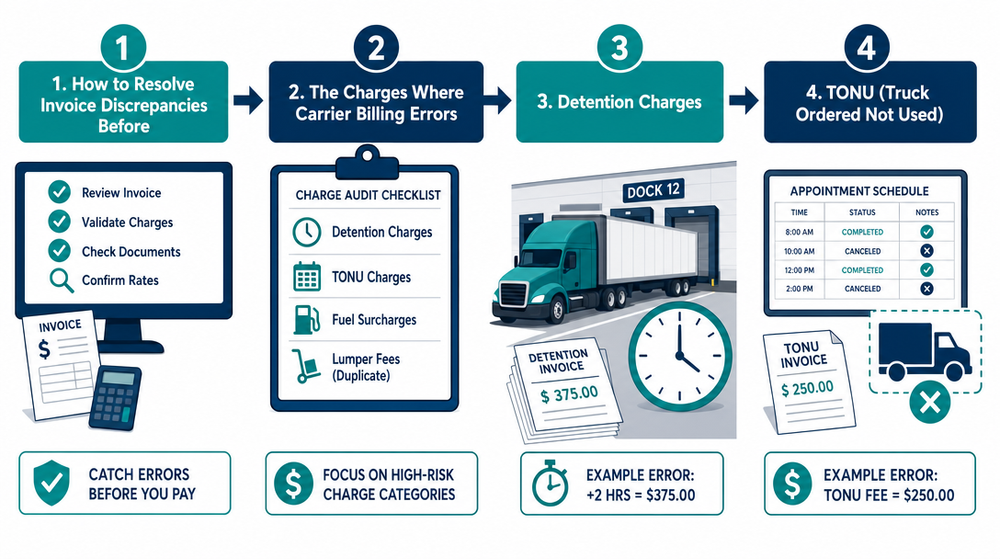
- TONU: Was the load actually cancelled? Was it within the cancellation window? Check the rate con's TONU clause and the cancellation timestamp.
- Other accessorials (layover, liftgate, inside delivery): Was each charge pre-authorized? Does the rate con allow for it? Is there supporting documentation?
- Freight class (LTL): Does the billed class match the rate con? If the carrier reclassified, is there a weight inspection certificate?
This checklist takes 5 to 8 minutes per invoice when done manually. At 400 invoices per month, that's roughly 33 to 53 hours of audit work. This is exactly why most brokerages either skip the audit entirely or sample only a fraction of invoices. According to Trimble's freight audit analysis, sampling gaps and data silos are two of the biggest reasons invoice errors go undetected, because teams audit 10% of invoices and assume the other 90% are fine.
For a ready-to-use version of this workflow, our carrier invoice audit checklist breaks it down into a printable format.
Carrier-Specific Mistake Patterns You Need to Know
Different carrier types make different kinds of mistakes. Once you know the pattern, you can audit smarter, not harder.
LTL Carriers: Freight Class Reclassification
LTL carriers are the most common source of freight class disputes. Here's how it works: you book a shipment at class 70 based on the commodity and density in the rate con. The carrier's terminal inspects the freight, decides the density warrants class 85, and invoices at the higher class. That reclassification can add $140 to $210 to a single invoice depending on the origin-destination lane. The problem isn't always that the carrier is wrong. Sometimes the shipper provided inaccurate dimensions or weight. But the burden is on the carrier to provide a weight inspection certificate and dimensional measurements to justify the reclassification. If they can't produce that documentation, you have grounds to dispute.
Small and Mid-Size Asset Carriers: Manual Billing Errors
Owner-operators and small fleets (1 to 20 trucks) often handle billing manually or through basic accounting software. This leads to honest mistakes: transposing digits, applying the wrong rate from a different lane, or billing for services that were discussed but never confirmed on the rate confirmation. These aren't fraud. They're the result of one person handling dispatch, driving, and invoicing. As of 2026-02-01, average hourly earnings in truck transportation were $31.94/hr (BLS), which means many small carriers can't afford dedicated billing staff. The fix for brokers is straightforward: always send a clear, detailed rate confirmation and always audit against it. Don't assume the carrier's invoice matches just because you've moved 50 loads with them.
Large National Carriers: System-Generated Overcharges
Large carriers with automated billing systems tend to produce a different kind of error. Their systems apply default rates, accessorial schedules, and fuel surcharge tables that may not reflect the negotiated rate on your specific rate con. The invoice looks clean and professional, but the numbers are pulled from a general tariff, not from your contract. This is especially common with fuel surcharges (applied at the carrier's standard percentage rather than the negotiated one) and accessorial rates (liftgate billed at $125 when the rate con specifies $85). Because these invoices look polished and arrive on time, they get less scrutiny. That's a mistake.
According to Hyland's analysis citing American Shipper data, up to 80% of carrier freight invoices contain some form of discrepancy, with 15% to 20% resulting in actual overpayments. The point isn't that every carrier is trying to overbill you. It's that billing systems, whether manual or automated, produce errors at a rate that makes auditing non-optional.
Real Examples: What Carrier Invoice Mistakes Look Like in Dollars
Let's put specific numbers on this. Below are six scenarios drawn from common freight brokerage operations. Each one shows the math, the mistake, and the exact thing to check.
Example 1: Detention Overbill from Ignoring Free Time
Scenario: A carrier invoices detention at $75/hour for 4 hours on a load where the rate con specifies a 2-hour free period. What the carrier billed: 4 hours × $75 = $300 What you actually owe: 2 billable hours × $75 = $150 Overbill per load: $150 Monthly impact (40 loads): $6,000 billed, $3,000 legitimate, $3,000 overbill What to check: Pull the rate con and confirm the free time provision. Cross-reference POD timestamps to verify actual arrival and departure. Require a signed detention log.
Example 2: TONU Charged Inside the Cancellation Window
Scenario: A carrier bills a $250 TONU on a load that was cancelled 6 hours before the scheduled pickup. The rate con states: "Cancellations made more than 4 hours prior to scheduled pickup will not incur a TONU charge." What the carrier billed: $250 TONU What you actually owe: $0 Overbill: $250 What to check: Open the rate con and find the TONU/cancellation clause. Pull the email, TMS log entry, or text message showing when the cancellation was communicated. If the timestamp is more than 4 hours prior to pickup, the charge is not valid per the signed agreement.
Example 3: Fuel Surcharge Calculated on Gross Invoice
Scenario: A carrier invoices a $2,200 load. The linehaul is $1,800 and accessorials total $400. The FSC is 4.5%. Correct FSC (on base linehaul): 4.5% × $1,800 = $81.00 Carrier's FSC (on gross): 4.5% × $2,200 = $99.00 Overbill per load: $18.00 At 6% FSC: Correct = $108.00, Billed = $132.00, Overbill = $24.00 Monthly impact (200 loads at 4.5%): $3,600 in inflated fuel surcharges What to check: Verify the FSC base in the rate con. Most rate confirmations specify "FSC applied to linehaul" or "FSC on base rate." If the carrier is calculating on the total, dispute every invoice.
Example 4: Duplicate Lumper Fee
Scenario: The broker paid a lumper service $185 directly at the receiver facility. The carrier also includes a $185 lumper fee on the invoice. What the carrier billed: $185 lumper What you already paid: $185 directly Duplicate charge: $185 What to check: Match every lumper line item on a carrier invoice against your direct lumper payment log. If the broker paid the lumper directly (confirmed by a Comcheck, Relay payment, or facility receipt), the carrier invoice should not include it.
Example 5: LTL Freight Class Reclassification
Scenario: Rate con quotes class 70. The LTL carrier reclassifies to class 85 based on a density inspection at the origin terminal. Rate con class 70 rate: $680 Invoiced class 85 rate: $860 Overbill (if reclassification is unjustified): $180 What to check: Request the carrier's weight inspection certificate and dimensional measurements. Compare the actual density to the NMFC class breakpoints. If the carrier can't produce documentation justifying the reclassification, dispute the charge.
Example 6: Layover Charge Without Supporting Documentation
Scenario: A carrier adds a $350 layover charge to an invoice. The driver was held at the facility for 14 hours. The carrier's standard layover threshold is 18 hours, and no signed detention log was attached. What the carrier billed: $350 layover What you actually owe: $0 (below threshold, no documentation) Overbill: $350 What to check: Confirm the layover threshold in the rate con or carrier packet. If the hold time falls below the threshold, the charge isn't valid. Even if it meets the threshold, require a signed detention log as supporting documentation. No log, no payment.
An acceptable carrier invoice error rate is under 1.5% of total freight spend. Anything above 3% signals a systemic audit gap worth addressing with a dedicated weekly review process.
How to Document and Track Disputes So You Can Spot the Pattern
Catching one overbill is good. Building a system that catches the pattern is better. Most brokerages handle disputes reactively: they find a bad charge, email the carrier, and move on. They never track whether the same carrier makes the same mistake on 15 invoices in a row. Here's how to build a dispute tracking system that actually works.
What to Log for Every Dispute
Every time you flag a discrepancy, record the following:
- Load number and carrier name

- Charge type (detention, TONU, FSC, lumper, accessorial, linehaul)
- Expected amount (per the rate con)
- Invoiced amount (what the carrier billed)
- Variance (dollar difference)
- Dispute date (when you sent the dispute to the carrier)
- Resolution date and outcome (credit issued, charge adjusted, dispute denied)
- Supporting docs attached (rate con, BOL, POD, detention log, lumper receipt)
A shared spreadsheet works for brokerages under 200 loads per month. Above that, you need a system that ties the dispute to the load record in your TMS.
Spotting Repeat Offenders
Review your dispute log monthly. Sort by carrier name and charge type. You're looking for patterns like:
- Carrier X has billed detention incorrectly on 8 of 35 loads this month
- Carrier Y applies FSC to gross invoice on every load, not just occasionally
- Carrier Z adds a layover charge without documentation on any load where the driver waits more than 10 hours
When you see a pattern, it's time for a direct conversation. Share the data with the carrier. Show them the specific loads, the rate con terms, and the dollar impact. Most carriers will correct their billing process once they see the pattern documented. If they don't, that's a carrier relationship decision.
Falsification of records in the trucking industry is a documented enforcement concern. The FMCSA's guidance on falsification under 49 CFR 390.35 makes clear that knowingly falsifying documentation carries regulatory consequences. While most carrier invoice mistakes aren't intentional fraud, the line between chronic negligence and willful misrepresentation matters, especially when the same carrier produces the same error month after month after you've documented it. Keep your dispute records thorough. They protect you.
Assigning Process Ownership
An audit process without a named owner doesn't get done. Assign invoice auditing to a specific person or role. In most brokerages under 30 employees, this falls on the billing coordinator. Larger operations might split it between billing and operations. What matters is that one person is accountable for completing the weekly audit, logging disputes, and escalating patterns to management. Define a cadence: all carrier invoices received Monday through Friday get audited by the following Tuesday. Disputes get sent to carriers within 48 hours of the audit. Unresolved disputes get escalated at the 14-day mark. For a detailed walkthrough of the reconciliation process, see our guide on invoice reconciliation for freight brokers.
Frequently Asked Questions About Carrier Invoice Mistakes
What happens if a carrier invoice amount is wrong?
If a carrier invoice amount is wrong, you have the right (and the responsibility) to dispute it before payment. Pull the rate confirmation, identify the specific line item that doesn't match, document the discrepancy with the expected versus invoiced amount, and send the dispute to the carrier with supporting documents. Most carrier agreements include a dispute period, typically 30 to 90 days from invoice receipt. If you pay the invoice without disputing, recovering the overpayment becomes significantly harder.
What are the most common carrier invoice mistakes to avoid?
The most common carrier invoice mistakes fall into six categories: detention billed from arrival instead of after free time, TONU charges inside the cancellation window, fuel surcharges calculated on gross rather than base linehaul, duplicate lumper fees, unapproved accessorial charges (layover, liftgate, inside delivery), and LTL freight class reclassification without supporting documentation. Detention and fuel surcharge errors tend to have the highest dollar impact per occurrence, while lumper duplicates and accessorial overcharges are the most frequent by volume.
How often should I audit carrier invoices?
Every invoice, every time. Sampling, where you audit 10% or 20% of invoices, leaves the majority of your freight spend unchecked. Per Trimble's freight audit analysis, sampling gaps are one of the primary reasons freight invoice errors go undetected. If you can't audit 100% manually, prioritize carriers with the highest load volume and the highest historical dispute rate, then work toward full coverage with automation.
What's an acceptable carrier invoice error rate?
An acceptable carrier invoice error rate is under 1.5% of total freight spend. Anything above 3% signals a systemic audit gap that warrants a dedicated weekly review process and potentially a carrier performance conversation. Per Supply Chain Brain, invoice rejection rates should not exceed 4% of total invoices received, with 2% considered best practice. If your numbers are higher, the problem is likely upstream in your carrier onboarding or rate confirmation process.
Should I dispute small carrier invoice errors or just absorb them?
Dispute them. A $15 fuel surcharge error on one load is trivial. That same error on 200 loads a month with the same carrier is $3,000. More importantly, absorbing small errors trains your carriers (and your own team) to treat invoice accuracy as optional. Track every discrepancy, no matter the size. The pattern data is often more valuable than the individual recovery, because it tells you which carriers need corrective action and which charge types need tighter controls in your rate confirmations.
Stop Paying for Billing Mistakes You Can Catch
Carrier invoice mistakes aren't random. They cluster in detention, TONU, fuel surcharges, lumper fees, and accessorial charges. They follow carrier-specific patterns. And they compound silently when nobody is auditing. The playbook is straightforward: match every invoice line to the rate confirmation, check every accessorial against its documentation, log every dispute, and review the data monthly to catch repeat patterns. The math is simple. If you're moving 300 loads a month and overbilling runs at even 2% of freight spend, that's thousands of dollars per month in margin you're handing back.
If your team processes more than 50 invoices a week and the manual audit is eating hours you don't have, tools that automatically match invoices against rate confirmations can catch the discrepancies covered in this guide in seconds instead of minutes per load.
Sources
- FMCSA Falsification Guidance (49 CFR 390.35) — FMCSA
- Freight Audit Insights: The Truth About Freight Spend — Trimble Transportation
- Why Freight Invoice Errors Keep Costing You — ICC Logistics
- The Fragile State of Freight Billing Processes and Audits — Hyland (citing American Shipper)
- How to Ensure That Freight Bills Are Correct and Paid Quickly — Supply Chain Brain
- The Price Tag of Paperwork Mishaps in Freight Brokerage — Freight Caviar
- BLS Current Employment Statistics, series CEU4348400008 — U.S. Bureau of Labor Statistics
Related: Carrier Invoice Audit Software: What It Should Catch Before You Pay
Related: How to Catch Carrier Billing Errors Automatically Before You Pay
Related: Freight Billing Mistakes That Are Costing You Real Money