Invoice Reconciliation Meaning: What It Actually Means in Freight
Researched and written with AI assistance. Reviewed by the Laneproof team.
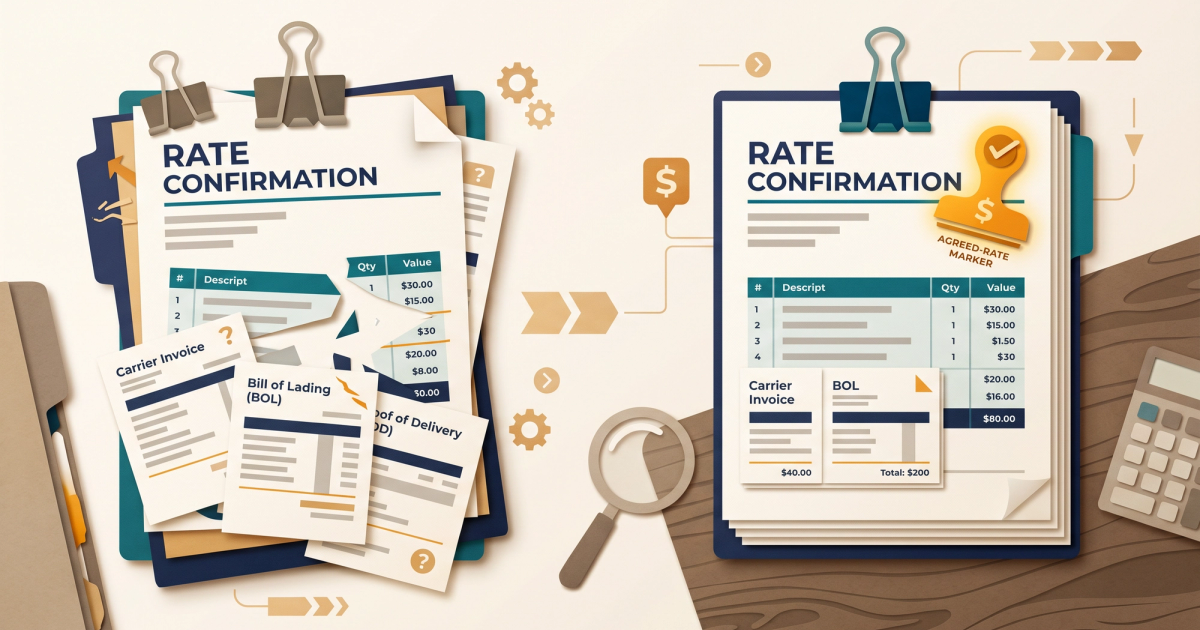
A brokerage moving 300 loads per month at an average linehaul of $1,800 can lose over $24,000 a year to carrier invoice discrepancies that never get reviewed. That's not a theoretical risk. It's what happens when nobody compares the freight invoice to the rate con line by line. The invoice reconciliation meaning most people find online is a generic accounting definition: match the invoice to the PO and the receiving report. In freight, that definition is almost useless. You're not matching a purchase order to a packing slip. You're comparing a carrier invoice against a rate confirmation, a BOL, a POD, and sometimes a lumper receipt, all while checking whether detention hours, fuel surcharges, and accessorial charges match what was actually agreed to. This article breaks down what reconciliation means in operational freight terms, gives you a repeatable audit process, and shows you exactly where the money leaks.
What Invoice Reconciliation Actually Means in Freight (Not Accounting)
If you search "invoice reconciliation meaning," you'll get definitions built for accounts payable departments at retail companies. Stripe defines invoice reconciliation as an accounting process that compares invoices with purchase orders, receiving reports, and other documentation to confirm accuracy. That's correct in a general sense. But it misses everything that makes freight billing complicated.
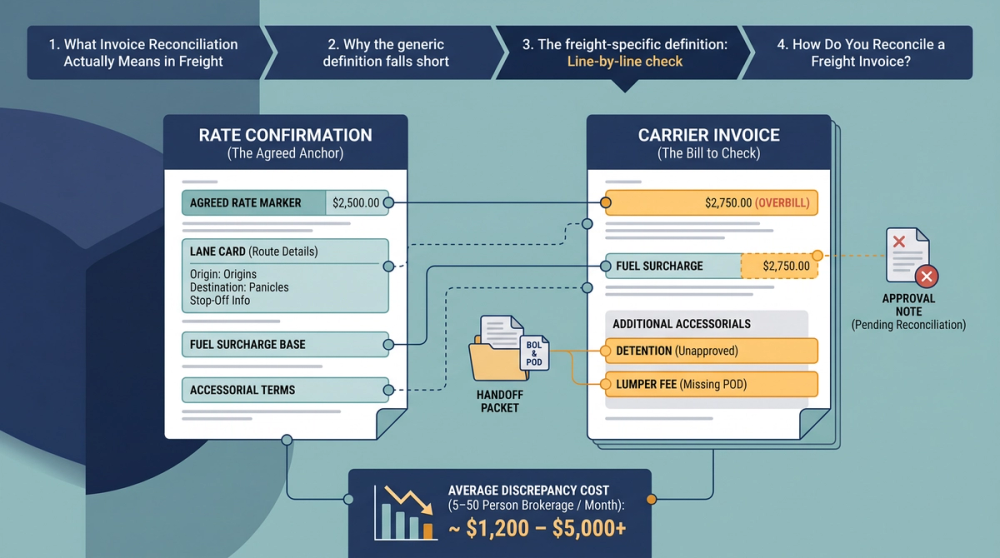
In freight, reconciliation means comparing what a carrier billed against what was contractually agreed and what actually happened on the load. Owlery AI's freight-specific glossary captures this well: it defines the process as checking the carrier's invoice against the rate confirmation, the shipment details, and the actual delivery outcome. That three-way comparison is the core of the process.
Why the generic definition falls short
A standard three-way match in accounts payable compares a purchase order, a goods receipt, and an invoice. The numbers are static. You ordered 500 units at $4.12 each. Did you receive 500 units? Does the invoice say $2,060? Done.
Freight doesn't work that way. The rate confirmation locks in a linehaul rate and maybe a fuel surcharge percentage, but the final carrier invoice can include charges that didn't exist when the load was booked: detention time that may or may not match the free time window, lumper fees that may or may not have receipts, TONU charges at rates that may or may not reflect the rate con, and accessorial fees that were never discussed. As SupplyHoop's logistics glossary explains, freight invoice reconciliation involves comparing carrier or 3PL invoices against internal system data to identify discrepancies before they become losses.
The freight-specific definition
Here's a working definition for anyone in freight operations: Invoice reconciliation is the process of comparing every line item on a carrier invoice against the rate confirmation, BOL, POD, and any supporting documentation to confirm that the billed amount matches what was agreed and what actually happened on the load. That includes linehaul, fuel surcharge, detention, lumper fees, TONU, layover, and any other accessorial charges. If a charge appears on the invoice but not on the rate con, it needs documentation or it gets disputed.
How Do You Reconcile a Freight Invoice? A Line-by-Line Process
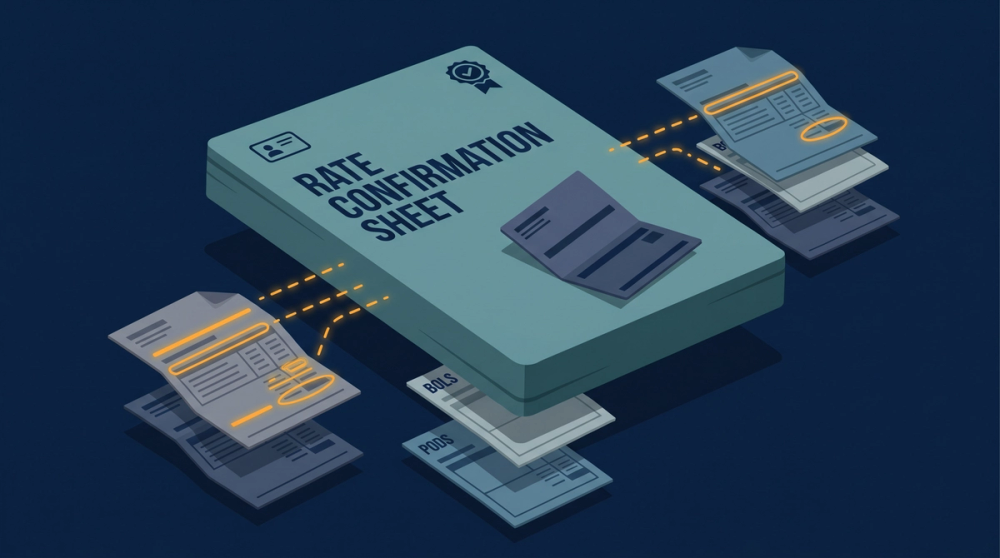
Reconciling a freight invoice is not a single comparison. As CloudSquid outlines in their freight bill reconciliation guide, the process requires checking three sources that almost never agree perfectly: the carrier invoice, the TMS shipment record, and the contracted rate. Here's a step-by-step process a billing coordinator can follow on every load.
Step 1: Pull the rate confirmation
Before you look at the carrier invoice, open the rate con for that load. This is your source of truth. It should show the agreed linehaul rate, fuel surcharge terms (percentage and basis), free time for detention, per-hour detention rate after free time, and any pre-approved accessorial charges. If your rate con is missing any of these details, that's a problem in itself, but it's a separate conversation about freight billing reconciliation and the line items carriers inflate most.
Step 2: Match linehaul and fuel surcharge first
These two line items represent 85% or more of the invoice total on most loads. Compare the linehaul on the carrier invoice to the rate con. They should be identical. Then check the fuel surcharge. Confirm the percentage matches the rate con, and confirm the basis it's calculated on. Some carriers calculate FSC on the gross linehaul; others calculate on the net rate. This distinction matters. On a $2,500 linehaul with an 18% fuel surcharge, calculating on gross instead of net can create a $45 overbill on a single load. Across hundreds of invoices per month, that adds up fast.
Step 3: Review every accessorial charge individually
After linehaul and fuel, check detention, lumper fees, TONU, layover, and any other accessorial charge on the invoice. For each one, ask three questions:
- Is this charge on the rate con? If not, it needs separate documentation or approval before you pay it.
- Does the rate match? Detention billed at $75/hour when the rate con says $50/hour is a clear discrepancy.
- Is there supporting documentation? Lumper fees without receipts, detention without facility sign-in/sign-out times, and TONU charges without dispatch records are all disputable.
Step 4: Cross-reference the BOL and POD
The BOL confirms what was shipped. The POD confirms what was delivered. Together, they verify that the load described on the carrier invoice is the load that actually moved. For LTL shipments especially, check the freight class on the BOL against what the carrier invoiced. Reclassification fees are one of the most common billing discrepancies in LTL.
Step 5: Flag, dispute, or approve
For each invoice, the outcome is one of three things: approve for payment as invoiced, flag for a partial dispute (one or more line items need adjustment), or reject entirely (the invoice doesn't match the load). Document every dispute with the specific line item, the rate con amount, and the invoiced amount. This creates an audit trail that makes resolution faster and protects you if the same issue comes up again. If you need a printable version of this process, the carrier invoice audit checklist covers every line item to check.
Rate Con vs. Carrier Invoice: Where the Numbers Stop Matching
Most billing coordinators know the rate confirmation is the baseline. The challenge is that carrier invoices diverge from the rate con in predictable, recurring ways. Knowing where to look saves time.
Linehaul discrepancies
Pure linehaul overbills are the easiest to catch but they still happen. A rate con that says $1,800 and a carrier invoice that says $1,875 is a straightforward dispute. The more common version: the carrier invoices the correct linehaul but adds a "fuel surcharge" or "equipment fee" that wasn't on the rate con, effectively increasing the linehaul by another name.
Fuel surcharge basis errors
This is one of the most frequently missed discrepancies. The rate con might specify an 18% fuel surcharge on the net linehaul rate. The carrier calculates 18% on the gross total instead. On a $2,500 linehaul, that's a $45 difference per load. It looks right at a glance (the percentage matches), but the basis is wrong. Multiply that across 200 loads a month and you're looking at $9,000 in annual overbilling from a single calculation error.
Detention rate and free time mismatches
Detention is one of the most disputed charges in freight. The dispute usually isn't about whether detention happened. It's about the rate and the free time window. If the rate con specifies a 2-hour free window and $50/hour after that, but the carrier invoices $75/hour starting at hour one, you have two separate discrepancies on a single line item. We'll walk through a specific example below.
TONU and dry run charges
TONU (Truck Order Not Used) charges are often booked at one rate and invoiced at another. The rate con might specify a $125 TONU fee, but the carrier invoice shows $150. This $25 gap seems small in isolation. But TONU events aren't rare. In high-demand dry van lanes, they can occur on roughly 8 to 12 percent of loads, which means a brokerage handling 300 loads per month could see 24 to 36 TONU events, and the small discrepancies compound.
What Accessorial and Fuel Surcharge Disputes Are Costing Your Brokerage Per Month
The cost of freight billing discrepancies isn't abstract. Here are concrete scenarios that show how individual overbills translate to monthly and annual losses.
Example: Detention overbill on a single load
A carrier bills detention at $75/hour for 4 hours. The rate con shows a 2-hour free window and $50/hour after that. The carrier invoices $300 ($75 x 4 hours). The correct charge is $100 ($50 x 2 billable hours, after the 2-hour free window). That's a $200 discrepancy on one load. If your brokerage sees detention charges on even 15% of 300 monthly loads (45 loads), and even half of those have a rate or free-time mismatch, you're looking at roughly $4,500/month in disputed detention alone.
Example: Lumper fee with no supporting receipt
A carrier invoice includes a $185 lumper fee. There's no supporting receipt attached and no notation on the BOL. Without documentation, you can't verify whether the fee was actually incurred, whether the amount is accurate, or whether it should be billed back to the shipper. If nobody catches it, the brokerage absorbs $185. That's not an overbill in the traditional sense. It's an unverified charge that becomes a margin leak because nobody flagged it.
Example: Fuel surcharge basis error at scale
A $2,500 linehaul with an 18% fuel surcharge should generate a $450 FSC charge when calculated on the correct net rate. The carrier calculates on a slightly higher gross figure, billing $495 instead. That's a $45 overbill per load. On 200 loads per month with the same carrier, that's $9,000/month or $108,000/year. This is one of the highest-dollar discrepancies in freight billing and one of the hardest to catch visually because the percentage looks correct.
A brokerage moving 300 loads/month at an average $1,800 linehaul, with a 3.8% overbilling rate, loses roughly $2,052/month ($24,624/year) to unreviewed carrier invoice discrepancies.
The labor cost of manual reconciliation
Beyond the overbills themselves, there's the cost of the person doing the checking. A billing coordinator spending 3.5 hours per week on manual reconciliation at a loaded labor cost of $28/hour spends $98/week, or $5,096/year, on the process. And that's before accounting for the errors that still slip through because a human reviewing invoices for 3.5 hours can't catch every fuel surcharge basis error or every TONU rate mismatch.
LTL vs. FTL Invoice Reconciliation: Why the Process Is Different
The basic principle of reconciliation is the same for both LTL and FTL: compare what was billed to what was agreed. But the details of the process diverge significantly, and treating them the same leads to missed discrepancies on both sides.
FTL reconciliation: rate con is king
For full truckload shipments, the rate confirmation is the primary reference document. The linehaul is a flat rate. Fuel surcharge terms are spelled out. Accessorial allowances (detention, lumper, layover) are either on the rate con or they're not. The reconciliation process is relatively straightforward: match the invoice to the rate con, check accessorials for documentation, and approve or dispute.
The main risk in FTL reconciliation is accessorial inflation. Carriers don't typically change the linehaul rate after booking (that would be obvious). Instead, the discrepancies show up in detention hours, TONU rates, and charges that weren't discussed at booking. The freight invoice reconciliation process guide covers the FTL workflow in more detail.
LTL reconciliation: freight class is the wild card
LTL billing is more complex because pricing depends on freight class, weight, dimensions, and lane, all of which can be recalculated by the carrier after pickup. The most common LTL billing discrepancy is freight class reclassification.
Scenario: An LTL shipment is quoted at $340 based on class 65. The carrier inspects the freight, reclassifies it as class 70, and invoices at $550 plus a reclassification fee of $210. The total cost is now $550, a 62% overrun on a single shipment. To dispute this, you need the BOL (which should show the correct freight class) and potentially photos or product specs that support your classification. Without that documentation, the carrier's reclassification stands.
LTL reconciliation also requires checking for duplicate charges. Because LTL shipments consolidate with other freight, carriers sometimes apply accessorial charges (liftgate, residential delivery, limited access) that were already included in the quote. Each charge needs to be verified against the original quote and the BOL.
How Do You Resolve a Carrier Invoice Dispute Without Losing the Relationship
Catching a discrepancy is one thing. Resolving it without damaging a carrier relationship is another. Carriers are your business partners. How you handle disputes affects whether they pick up your next load.
Lead with documentation, not accusations
When you dispute a line item, send the carrier the rate con, the specific line item in question, and the dollar amount of the discrepancy. "Your invoice shows detention at $75/hour for 4 hours ($300). The rate con specifies a 2-hour free window at $50/hour, making the correct charge $100. Attached is the rate con for reference." That's a factual communication. It gives the carrier everything they need to review and respond. Compare that to: "You overbilled us on detention again." The first approach gets resolved faster and doesn't burn the relationship.
Set up a dispute window in your payment terms
Your carrier packet should specify a dispute resolution window. Something like: "All invoice discrepancies will be communicated within 5 business days of invoice receipt. Carriers have 3 business days to respond with supporting documentation or accept the adjusted amount." This sets expectations upfront and removes ambiguity. Carriers know the rules. You know the timeline. Avantiico's guide on freight invoice audits reinforces this approach, noting that cross-checking rates, accessorial fees, and shipment data against delivery records and agreements is a standard audit practice that protects both parties.
Track dispute patterns by carrier
If the same carrier consistently overbills on detention or inflates TONU charges, that's not a billing error. That's a pattern. Track the frequency and dollar amount of disputes by carrier over time. This data helps you make decisions: renegotiate terms with that carrier, tighten rate con language, or move volume to carriers with cleaner billing. It also gives you leverage in conversations. "We've disputed 14 detention charges with your team in the last 90 days, totaling $2,800. Let's fix the root cause." That's a conversation based on data, not emotion.
Example: TONU discrepancy caught and resolved
Scenario: A carrier invoices a TONU charge of $150 on a load where the rate con specifies $125. The billing coordinator catches the $25 discrepancy during line-item review and sends the carrier a dispute email with the rate con attached. The carrier acknowledges the error and reissues at $125 within 24 hours. That $25 seems small. But if this occurs on 30 TONU events over a quarter, it's $750 recovered from a single recurring discrepancy type. The only reason it was caught: someone compared the exact line item on the invoice to the exact line item on the rate con.
Frequently Asked Questions About Invoice Reconciliation in Freight
What does reconciliation invoice mean?
In freight, a reconciliation invoice (or more precisely, invoice reconciliation) means comparing every line item on a carrier's freight invoice against the rate confirmation, BOL, POD, and any supporting documentation to verify that billed amounts match agreed rates and actual load outcomes. SAP's documentation defines it broadly as identifying and managing discrepancies between invoices and purchase orders or contracts. In freight, those "contracts" are rate confirmations, and the discrepancies are typically in accessorial charges, fuel surcharges, and detention fees.
What is the difference between an invoice and invoice reconciliation?
An invoice is a document a carrier sends requesting payment for services provided on a load. Invoice reconciliation is the process of verifying that invoice against the agreed terms (rate con), the shipment record (BOL/POD), and the TMS data to confirm accuracy. The invoice is the claim. Reconciliation is the audit. One is a document; the other is a process for checking that document.
What are the four types of reconciliation?
In accounting, the four types are generally bank reconciliation, customer reconciliation, vendor reconciliation, and intercompany reconciliation. In freight operations, the relevant type is vendor (carrier) reconciliation, but it's more nuanced because it involves rate confirmations rather than standard purchase orders, variable charges (detention, lumper, fuel) that change load by load, and supporting documents (BOLs, PODs, lumper receipts) that are unique to logistics.
How long should freight invoice reconciliation take per load?
For a clean FTL load with no accessorial charges, manual reconciliation should take 2 to 4 minutes: check linehaul, check fuel surcharge, verify the BOL/POD, approve. For loads with detention, lumper fees, or other accessorials, it can take 8 to 15 minutes per invoice because each charge requires separate documentation review. A brokerage processing 300 loads/month with 30% requiring accessorial review could spend 25 to 40 hours per month on reconciliation.
Can you reconcile freight invoices without a TMS?
Yes, but it's slower. Without a TMS, you're comparing paper or PDF rate cons against carrier invoices manually. You'll need a spreadsheet or tracking system to log each invoice, the discrepancy (if any), the dispute status, and the resolution. The process works. It just takes more time and creates more room for human error, especially on accessorial charges where the math isn't straightforward. As UNIS describes in their freight payment reconciliation glossary entry, the process covers verification between shippers and carriers to identify discrepancies, regardless of whether it's done manually or through software.
Build a Reconciliation Process That Catches the Money Before It's Gone
Invoice reconciliation in freight is not an accounting abstraction. It's the operational process that stands between your brokerage and thousands of dollars in annual margin erosion from carrier overbills, unverified accessorials, and fuel surcharge miscalculations. The core of it is simple: compare the carrier invoice to the rate con, line by line, on every load. Check the math on fuel surcharges. Verify detention hours and rates. Demand documentation for lumper fees. Track TONU charges to the penny.
Whether you do this manually or with software, the process is non-negotiable. What changes is how much time it takes and how many discrepancies slip through. For a deeper walkthrough of how brokers specifically should approach this, read the full guide on invoice reconciliation for freight brokers and how to stop paying carrier overbills. If your team processes more than 50 invoices a week and you want to automatically flag invoice discrepancies against rate cons, that's exactly what Laneproof was built to do.
Sources
- Invoice reconciliation: What businesses should know — Stripe
- Overview of Invoice Reconciliation — SAP
- What is Invoice Reconciliation? — Owlery AI
- Invoice Reconciliation in Logistics — SupplyHoop
- Freight Bill Reconciliation: How to Catch Carrier Errors — CloudSquid
- How Freight Invoice Audits Help You Catch Costly Carrier Errors — Avantiico
- Freight Payment Reconciliation — UNIS