How to Catch Carrier Billing Errors Automatically Before You Pay
Researched and written with AI assistance. Reviewed by the Laneproof team.

Automated invoice auditing tools catch carrier billing errors by comparing every freight invoice against the original rate confirmation, BOL, and POD at the moment of receipt. The specific error types they flag include:
- Linehaul rate variances between the invoice and rate con
- Unauthorized accessorial charges (lumper fees, inside delivery, detention)
- Fuel surcharge miscalculations applied to inflated base rates
- Duplicate invoices submitted under the same PRO number
- TONU charges on loads with confirmed delivery documentation
A broker moving 500 loads per month at an average linehaul of $1,800 who doesn't catch carrier billing errors automatically is likely bleeding cash. According to TransImpact's freight audit data, most shippers recover between 3% and 7% of their total freight spend through audit-driven error detection. At a 3.8% overbill rate on $900,000 in monthly freight spend, that's $34,200 per month walking out the door. That's $410,400 per year. Not in theory. In actual payments to carriers for charges that don't match the rate confirmation.
This article doesn't rehash a list of common billing errors you already know about. Instead, it shows you the exact detection logic that automated matching uses at the moment a carrier invoice hits your system. You'll see how each error type gets flagged, how fast it happens compared to manual review, and how to estimate what missed errors are costing your operation every month.
Manual Invoice Review Misses More Than You Think. Here's What the Numbers Say
Your billing coordinator is good at their job. But when they're reviewing 100 to 150 freight invoices per week against rate confirmations, BOLs, and accessorial agreements, things slip through. Not because they're careless, but because the volume makes perfection impossible.
According to STB Freight's audit analysis, up to 20% of freight invoices contain errors, and most of those errors favor the carrier. That's not a rounding error. On a desk handling 500 loads per month, that's potentially 100 invoices with discrepancies that need to be caught, challenged, and corrected before payment goes out.
Turing IT Labs' freight payment research puts the number even higher, citing that 20% to 30% of freight invoices contain discrepancies, with carriers sometimes issuing multiple bills for the same shipment. When your billing coordinator is manually cross-referencing each invoice against the rate con, they're spending 6 to 9 hours per week on reconciliation alone. As of 2026-04-01, average hourly earnings in truck transportation were $32.41/hr (BLS), but even at a billing coordinator rate of $22/hour, that's $132 to $198 per week in labor cost. And that's before counting the errors that still get paid.
Why Manual Review Has a Built-in Blind Spot
The problem isn't effort. It's sequence. Manual review is reactive: a billing coordinator opens an invoice, pulls up the rate con, compares fields one at a time, checks for accessorials, then moves to the next invoice. If a carrier submits a duplicate invoice 18 days later in a different billing cycle, the coordinator has no efficient way to cross-reference it against every previous submission. If a fuel surcharge is calculated on an inflated base rate, the coordinator has to manually recalculate the FSC to spot the discrepancy. Each of these checks adds minutes per invoice, and at scale, minutes become hours.
According to NuvoCargo's analysis of freight billing errors, companies without systematic invoice auditing lose 3% to 5% of annual freight spend to billing errors that would be caught automatically. The key phrase there: "would be caught automatically." The errors aren't invisible. They're just too numerous and too varied for a human reviewer to catch consistently across hundreds of invoices per week. For a deeper look at the most common types, see our breakdown of freight billing errors that cost real money.
The Six Carrier Billing Error Types That Catch Brokers Off Guard
Most freight brokers know about obvious overbilling. Carrier sends an invoice for $2,200, the rate con says $1,800, you reject it. That's not what costs you money. The errors that actually erode your margins are subtler, often embedded in accessorial charges, surcharge calculations, or timing discrepancies that don't jump out on a quick visual scan.
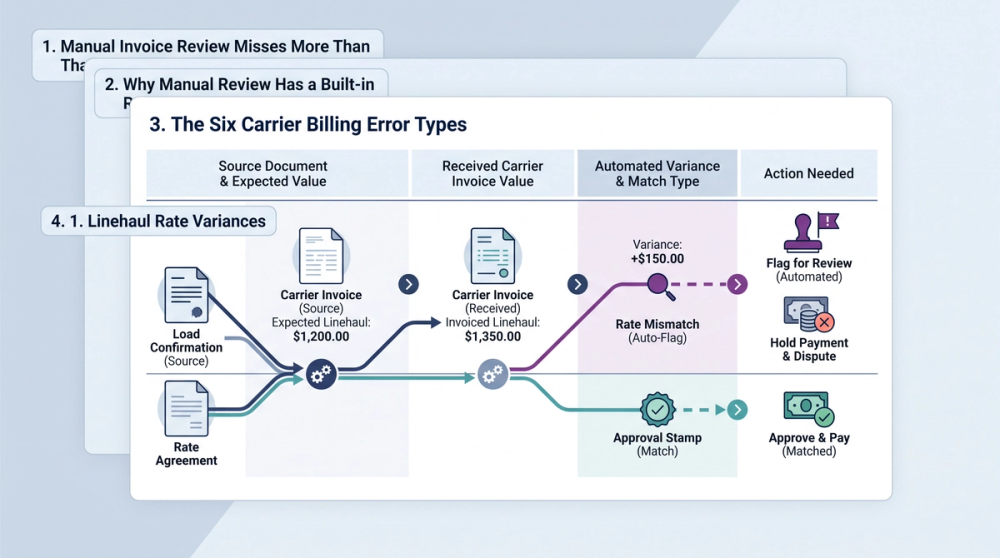
1. Linehaul Rate Variances
The carrier invoice shows a linehaul rate that differs from the rate confirmation. Sometimes it's blatant ($50 to $100 higher), sometimes it's a few dollars. On high-volume lanes, even small variances compound. A $15 overcharge per load across 500 loads per month is $7,500 per month that your manual review might dismiss as rounding.
2. Unauthorized Accessorial Charges
Inside delivery billed at $175 on a rate con that specifies curbside only. Lumper fees submitted without pre-authorization. Layover charges on loads that moved within the agreed pickup window. Each of these requires the reviewer to check the original rate con for what was actually agreed to, and many billing coordinators don't have time to verify every accessorial code on every invoice.
3. Detention Overcharges
Detention billed at 4 hours when the BOL timestamp shows a 2-hour dock window. This is one of the most common carrier billing errors in the industry, and it requires cross-referencing the invoice against facility timestamps. The FMCSA has pushed for greater transparency in detention billing, but enforcement at the invoice level still falls on the broker. Our detailed guide on catching carrier overbilling on detention charges walks through the specific timestamps to check.
4. Fuel Surcharge Miscalculations
This one is sneaky. The carrier calculates the fuel surcharge percentage correctly but applies it to an inflated base rate. If the rate con shows a $1,400 linehaul but the carrier uses $1,568 as the base (12% higher), the FSC compounds the overcharge. On a 28% fuel surcharge, that's an extra $47.04 per load that doesn't show up as a linehaul variance because the linehaul field might technically match.
5. Duplicate Invoice Submissions
A carrier submits an invoice, it gets paid. Eighteen days later, the same PRO number shows up in a new batch. If your billing coordinator is reviewing that week's invoices in isolation, there's no flag. The duplicate gets processed. According to Turing IT Labs, carriers sometimes issue multiple bills for the same shipment, whether by error or intent.
6. TONU Charges on Delivered Loads
A truck-not-used charge of $200 hits your invoice queue for a load that has a confirmed POD in the TMS. This happens more often than you'd expect, especially when carrier billing departments operate independently from dispatch. The TONU was probably generated when the load was initially reassigned, but the cancellation was never processed on the carrier's billing side.
How Automated Matching Actually Works: What Gets Checked Against What
Most articles about automated freight auditing describe the concept in vague terms: "software compares invoices to contracts." That's not useful to a broker trying to decide if automation will actually catch the errors their team is missing. Here's the specific detection logic, field by field.
The Three-Document Match
Automated matching starts with three core documents for every load: the rate confirmation, the carrier invoice (also called the freight invoice), and the proof of delivery (POD). Some systems also pull in the BOL and any accessorial agreements. Each document feeds specific data points into the matching engine.
Rate confirmation provides: agreed linehaul rate, authorized accessorials, fuel surcharge formula, pickup and delivery locations, load number or reference number, special instructions (lumper pre-authorization, appointment times, equipment type).
Carrier invoice provides: billed linehaul rate, itemized accessorial charges, fuel surcharge amount, PRO number, invoice date, total amount due.
POD provides: delivery confirmation, delivery timestamp, receiver signature, any noted exceptions or shortages.
Field-Level Matching Logic
The automation engine runs a series of checks the moment a carrier invoice is uploaded or received via EDI. Here's what gets compared:
- Linehaul rate: Invoice amount vs. rate con amount. Any variance outside a defined tolerance (typically $0 for exact-match brokers, or $5 to $10 for those who allow minor rounding) triggers a flag.
- Accessorial codes: Each accessorial line item on the invoice is checked against the list of authorized accessorials on the rate con. If inside delivery appears on the invoice but only curbside delivery appears on the rate con, it's flagged.
- Fuel surcharge calculation: The system recalculates the FSC using the rate con's base rate and the agreed surcharge schedule, then compares it to the invoiced FSC. If the carrier used a different base rate, the delta is flagged.
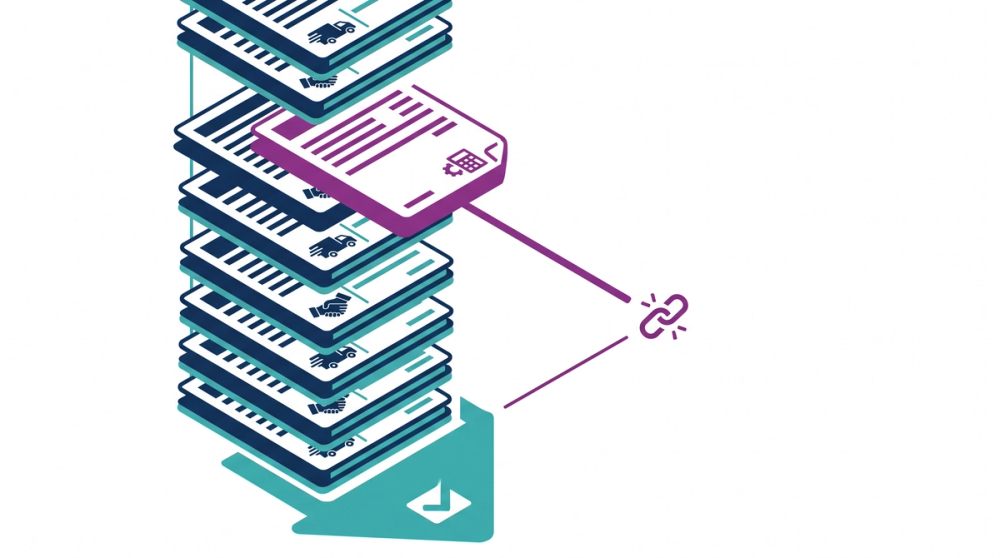
- PRO number deduplication: Every incoming PRO number is checked against all previously received invoices. If a match is found, the duplicate is flagged immediately, regardless of which billing cycle it falls in.
- TONU cross-reference: If a TONU charge appears on an invoice, the system checks the TMS for a confirmed POD on the same load number. If a POD exists, the TONU is flagged as contradictory.
- Detention time validation: Invoice detention hours are compared against facility timestamps from the BOL or TMS check-in/check-out records. Any hours billed beyond documented time are flagged.
This is the kind of invoice vs. rate confirmation reconciliation that takes a billing coordinator 4 to 6 minutes per invoice manually. Automated matching runs the entire check in seconds.
What Happens After a Flag
Flagged invoices don't automatically get rejected. They get routed to a review queue with the specific discrepancy highlighted: which field mismatched, what the rate con says, what the invoice says, and the dollar amount of the variance. This gives your billing coordinator or ops manager exactly what they need to approve, dispute, or escalate without having to re-pull the original documents. The ARDEM analysis of AI-powered freight audit describes this as the shift from "finding errors" to "deciding on errors," where automation handles detection and humans handle judgment calls.
How Fast Does Automation Catch an Error Compared to Doing It Manually?
Speed matters for two reasons. First, faster detection means you can dispute before the carrier's payment terms expire. Second, faster detection means your billing coordinator spends less time on reconciliation and more time on exceptions that actually need human judgment.
Manual Review Benchmark
A billing coordinator reviewing 100 invoices per week against rate confirmations manually averages 6 to 9 hours per week. That's 3.6 to 5.4 minutes per invoice for a full check. At $22/hour, the labor cost is $132 to $198 per week, or $6,864 to $10,296 per year. And that's just the labor. Per KD Logistics' analysis, a typical freight audit catches 3% to 6% of invoices with errors, yet programs consistently miss additional recoverable loss. The errors your coordinator doesn't catch still get paid.
Automated Review Benchmark
Automated matching processes an incoming freight invoice in seconds, not minutes. The same 100-invoice batch that takes a coordinator 6 to 9 hours is fully matched, flagged, and sorted into "clean" and "review needed" queues within minutes. Your coordinator then only reviews the flagged invoices, which typically represent 10% to 20% of the total volume. That drops the human review workload from 6 to 9 hours per week down to 1 to 2 hours, focused entirely on invoices with confirmed discrepancies.
For a broker running 500 loads per month, the math shifts dramatically. Instead of a billing coordinator spending 30 to 45 hours per month on reconciliation, they spend 5 to 10 hours per month reviewing only the exceptions. The rest of the invoices clear automatically because they match the rate confirmation. Our carrier payment audit checklist covers the specific fields to verify on each flagged invoice.
Real Examples: What Automated Detection Catches That Manual Review Misses
Let's walk through specific scenarios with dollar amounts. These are the kinds of errors that show up in carrier invoices regularly, and each one illustrates a different piece of the automated matching logic.
Example: Detention Overcharge Flagged in Seconds
A carrier invoices 4 hours of detention at $75/hour ($300 total). The BOL timestamp shows the driver arrived at 09:15 and the facility check-out time was 11:20. That's 2 hours and 5 minutes, not 4 hours. Automated matching pulls the facility timestamps, calculates actual dwell time (2.08 hours), and flags the 1.92-hour overage. The delta: $144. Your billing coordinator sees the flag, confirms the timestamps, and sends the dispute. Total time for the coordinator: 2 minutes. Manual review of this same invoice, including pulling up the BOL and calculating times, takes 5 to 8 minutes, assuming the coordinator thinks to check.
Example: Unauthorized Lumper Fee Caught Before Check Run
A carrier invoices a $250 lumper fee on a grocery delivery load. The rate con specifies that lumper reimbursement requires pre-authorization with a reference number from the broker's ops team. The invoice includes no authorization reference. Automated matching checks the lumper line item against the rate con's lumper clause, finds no matching authorization code, and flags it. If the lumper was authorized but the reference was simply missing from the invoice, your coordinator can add the reference and clear it. If it was never authorized, you just saved $250 on that load.
Example: Fuel Surcharge on an Inflated Base Rate
Rate con shows a linehaul of $1,400. Carrier invoice shows the linehaul as $1,400 (correct), but the fuel surcharge is calculated on a base of $1,568, which is 12% higher. At a 28% fuel surcharge, the correct FSC is $392 ($1,400 × 0.28). The invoiced FSC is $439.04 ($1,568 × 0.28). Overcharge: $47.04. This error doesn't trigger a linehaul variance flag because the linehaul field matches. Manual review almost never catches it because the coordinator would have to independently recalculate the FSC. Automated matching recalculates every FSC against the rate con base rate and flags any delta.
Example: Duplicate Invoice 18 Days Apart
A carrier submits an invoice with PRO number 8847291 on March 3. It gets paid on March 10. On March 21, the same PRO number appears in a new invoice batch. A billing coordinator reviewing the March 21 batch has no practical way to cross-reference every PRO number against every invoice from previous cycles. Automated PRO number matching flags it instantly on receipt. The duplicate is routed to the exception queue with a note showing the original invoice date and payment date. Potential double-pay avoided: $1,800 (the full load cost).
Example: TONU on a Delivered Load
A carrier invoices a $200 TONU charge on load #4412. Your TMS shows a confirmed POD for load #4412, signed by the receiver at destination. The load was delivered. The TONU was generated by the carrier's billing system when the load was briefly reassigned during dispatch, but the cancellation of the TONU was never processed. Automated cross-referencing checks every TONU invoice against POD records in the TMS and flags the contradiction. Your coordinator sees: "TONU invoiced on load with confirmed delivery. POD on file." Dispute takes 30 seconds.
Laneproof's reconciliation engine checks each of these fields automatically, flagging variances before payment goes out. Every example above represents a real pattern that shows up in carrier invoices regularly.
How to Set Up Automated Invoice Auditing in Your Existing TMS Workflow
You don't need to replace your TMS to add automated invoice matching. Most automation tools work alongside your existing system by connecting to the data your TMS already stores: rate confirmations, load details, PODs, and carrier information.
Step 1: Map Your Document Inputs
Identify where your rate confirmations, BOLs, PODs, and carrier invoices currently live. If rate cons are generated in your TMS, they're already structured data. If carrier invoices arrive via email as PDFs, they need to be parsed (extracted into structured data) before matching can run. Most automated systems handle this parsing step, using OCR or AI-based extraction to pull key fields from PDF invoices.
Step 2: Define Your Tolerance Thresholds
Not every variance requires human review. Decide which thresholds matter for your operation:
- Linehaul variance: $0 (exact match) or allow a $5 to $10 tolerance for rounding
- Accessorial authorization: binary (authorized or not)
- Fuel surcharge delta: flag anything over $2 to $5
- Detention time delta: flag anything over 15 to 30 minutes
- Duplicate PRO: always flag, zero tolerance
Step 3: Connect Your Invoice Intake to the Matching Engine
Whether invoices arrive via EDI, email, or carrier portal, route them through the matching engine before they reach accounts payable. This is the critical step: matching must happen before payment, not after. If your current process sends invoices directly to AP, insert the automated check as a gate between intake and payment approval. Clean invoices pass through. Flagged invoices go to a review queue.
Step 4: Route Exceptions to the Right Person
Not all flagged invoices require the same person. Linehaul variances might go to the broker who covered the load. Accessorial disputes might go to ops. Duplicate invoices might go directly to AP. Set up routing rules based on the type of discrepancy so each exception gets to the person who can resolve it fastest. For a complete checklist of what to verify on each flagged invoice, see our carrier invoice audit checklist.
Step 5: Track Your Catch Rate
Once automated matching is running, track two metrics: the percentage of invoices flagged with discrepancies, and the total dollar amount of variances caught per month. According to Shipware's freight audit best practices, scheduled auditing catches issues early enough to recover overcharges before they become embedded in carrier payment patterns. Your catch rate also gives you data to bring to carrier performance reviews, which is where persistent overbilling patterns get addressed at the source.
The Monthly Cost of Not Automating: A Quick Calculation
Here's the math for a mid-size brokerage running 500 loads per month at an average linehaul of $1,800.
Total monthly freight spend: 500 loads × $1,800 = $900,000
Estimated overbill rate without automated audit: 3.8% (based on TransImpact's freight audit recovery data citing 3% to 7% recovery rates)
Monthly overbilling exposure: $900,000 × 3.8% = $34,200
Annual overbilling exposure: $34,200 × 12 = $410,400
Manual reconciliation labor cost: 30 to 45 hours/month × $22/hour = $660 to $990/month
Total annual cost (overbilling + labor): $410,400 + $7,920 to $11,880 = $418,320 to $422,280
A broker moving 500 loads per month is exposed to over $410,000 per year in undetected carrier billing errors. Even catching half of those errors through automation pays for itself many times over.
As of 2026-04-01, the Producer Price Index for truck transportation of freight stood at 174.6 (BLS PPI series WPU3012), reflecting continued upward pressure on freight costs. Higher rates per load mean higher dollar amounts at stake in every billing error. A 3.8% overbill rate on a $2,200 average linehaul (not uncommon on refrigerated or specialized loads) pushes the annual exposure past $500,000.
Frequently Asked Questions About Carrier Billing Errors and Automated Detection
What finds common billing errors before a claim is sent to the insurance carrier?
In freight, automated invoice auditing tools catch billing errors before payment is approved by matching every carrier invoice against the rate confirmation, BOL, and POD. These tools flag linehaul variances, unauthorized accessorials, fuel surcharge miscalculations, duplicate PRO numbers, and contradictory TONU charges. The detection happens at invoice receipt, not during a post-payment audit, so errors are caught before any money changes hands. The term "insurance carrier" applies to a different industry context (medical/insurance billing), but the principle is the same: systematic pre-payment verification catches errors that manual review misses.
What are the most common causes of carrier billing errors in freight?
The most common causes are data entry mistakes on the carrier's side (wrong rate, wrong accessorial code), carrier billing systems that don't sync with dispatch updates (generating TONU charges on delivered loads), fuel surcharge tables applied to incorrect base rates, and duplicate invoice submissions across billing cycles. According to STB Freight, up to 20% of freight invoices contain errors, with most favoring the carrier. This isn't always intentional. Carrier billing departments often operate separately from dispatch, leading to outdated or incorrect data flowing into invoices.
Why does my carrier keep sending invoices with billing problems?
Recurring billing problems from a carrier usually point to a systemic issue in their invoicing process, not a one-time mistake. Common causes include outdated rate tables in their billing system, accessorial defaults that auto-add charges regardless of the rate con, and lack of integration between their dispatch and accounting systems. If you're seeing the same type of error from the same carrier repeatedly, flag it in a carrier performance review with specific data: dates, load numbers, dollar amounts. Carriers who see documented patterns are more likely to fix the root cause.
How much does automated freight invoice auditing actually save?
Savings depend on your volume and current error rate. According to TransImpact, most shippers recover 3% to 7% of total freight spend through audit-driven error detection. For a broker spending $500,000 per month on carrier payments, that's $15,000 to $35,000 per month in recovered overcharges. Add the labor savings from reducing manual reconciliation hours by 60% to 80%, and the total ROI typically pays for the auditing tool within the first month of operation.
Can automated invoice auditing work with my existing TMS?
Yes. Most automated matching tools are designed to sit alongside your TMS, not replace it. They pull rate con data and load details from your TMS, receive carrier invoices via email, EDI, or API, and push flagged exceptions back into your workflow. The key requirement is that your rate confirmations exist as structured data in your TMS (which they almost always do). Carrier invoices in PDF format get parsed during intake. No TMS migration is required.
Stop Paying for Errors Your Team Can't See Fast Enough
Carrier billing errors aren't going away. Carriers process thousands of invoices through their own systems, and a meaningful percentage of those invoices contain discrepancies that favor the carrier. Your billing coordinator can catch some of them, but not all of them, and not fast enough to stop every bad payment before it clears.
Automated matching changes the economics. Instead of paying a coordinator to manually check every invoice field, you let detection logic handle the comparison at the moment of receipt and only involve a human when something doesn't match. Your team spends less time on data entry and more time on the judgment calls that actually need experience.
If you're moving 200 or more loads per month and your current process involves manually comparing carrier invoices to rate confirmations, you're leaving money on the table. See how Laneproof's automated reconciliation works and find out what your operation is actually paying in undetected billing errors.
Sources
- Freight Audit & Pay | Catch Errors Before You Pay — TransImpact
- How to Optimize Freight Payments and Eliminate Billing Errors — Turing IT Labs
- Freight Audit: Recover Overcharges & Prevent Billing Errors — STB Freight
- Freight Invoice Errors and Hidden Costs — NuvoCargo
- Agentic AI-powered Automation in Freight Audit and Payment — ARDEM
- Why Freight Audit Misses Recoverable Loss — KD Logistics
- 5 Freight Audit and Payment Best Practices — Shipware
- Federal Motor Carrier Safety Administration — FMCSA
Full guide: Carrier Invoice Mistakes That Are Costing You Real Money
Related: Carrier Invoice Audit Software: What It Should Catch Before You Pay