Carrier Invoice Audit Checklist: Catch Overbilling Fast
Researched and written with AI assistance. Reviewed by the Laneproof team.
A broker running 50 loads per week who misses an average $47 overbill per load loses roughly $122,200 per year in unrecovered charges. That is not a rounding error. It is the difference between a profitable quarter and a flat one. The carrier invoice audit is supposed to catch these problems, but most small brokerages either skip it, do it inconsistently, or stop at detection without actually recovering the money. According to American Shipper data cited by Hyland, an estimated 80% of carrier invoices contain some kind of discrepancy. Between 15% and 20% of those contain errors significant enough to result in overcharges. This guide is not another definition piece. It is a working checklist: what to audit, how to dispute what you find, and how to track what you actually recover.
What Is a Carrier Invoice Audit? (And What Is a Freight Invoice Audit?)
A carrier invoice audit is the process of comparing every line item on a carrier's bill against the original rate confirmation, BOL, POD, and any supporting documentation to verify the charges are correct. A freight invoice audit is the broader term covering all freight-related invoices (carrier, drayage, intermodal, parcel) but the mechanics are the same: match what was agreed to against what was billed, flag anything that does not match, and dispute or recover the difference.
For brokers specifically, the carrier invoice audit sits between load delivery and customer billing. If you pay a carrier overbill without catching it, that cost either eats your margin or gets passed through to your shipper (which eventually costs you the account). The audit is not optional overhead. It is margin protection.
Why Small Brokerages Get Hit Hardest
Enterprise shippers with $50M+ in annual freight spend typically outsource auditing to third-party payment processors. According to Armstrong & Associates data cited by Supply Chain Brain, the global freight audit and payment market was valued at $3.1 billion in 2019, and per Technavio's market analysis, that market is expected to grow by USD $651.2 million from 2026 to 2030 at a CAGR of 11.2%. Large shippers are investing heavily in audit infrastructure. Small brokerages running 100 to 5,000 loads per month usually are not. They rely on a billing coordinator with a spreadsheet, or worse, the ops manager doing it between load calls. That gap is where money disappears.
The Line Items Carriers Overbill Most, and What It's Costing You
Not all invoice discrepancies are created equal. Some are honest mistakes from manual data entry. Others are patterns. If you are going to spend time auditing, focus on the line items that move the needle. Here is where we see the most frequent and most expensive overbilling, based on the types of charges that freight audit best practices consistently flag for pre-audit comparison.
Detention and Layover Charges
Detention is the single most disputed accessorial in brokerage billing. Carriers bill detention based on time at the shipper or receiver facility, but the supporting documentation often tells a different story. Common problems include: detention billed from appointment time rather than actual arrival, hours rounded up aggressively (a 2-hour stop billed as 4 hours), and detention charged when free time was never exceeded. A single detention overcharge of 2 extra hours at $75/hour is $150. Across 200 loads per month with even a 10% detention dispute rate, that is $3,000 per month in potential overcharges on detention alone. For a deeper look at which line items get inflated most frequently, see the full breakdown of billing reconciliation line items carriers inflate.
Lumper Fees
Lumper fees are supposed to be pre-approved or listed on the rate confirmation. When they are not, carriers sometimes add them to the invoice after the fact. A $250 lumper fee that was never on the rate con is pure margin loss if you pay it without questioning it. The issue is not that lumper fees do not happen. They do. The issue is whether the rate con explicitly authorizes them, whether there is a receipt, and whether the amount matches what was approved.
Fuel Surcharges at the Wrong Rate
Fuel surcharges are typically calculated based on a published index (DOE national average) and tied to mileage bands. When a carrier applies the wrong mileage band or uses a different index date, the surcharge shifts. A 1.2% overcharge on a fuel surcharge sounds small until you run the math across volume. On a $2,000 average linehaul, 1.2% is $24 per load. Across 500 loads per month, that is $12,000 per month or roughly $3,600 per quarter in overcharges from fuel surcharge miscalculation alone.
TONU and Dry Run Charges
Truck Order Not Used (TONU) charges are legitimate when a load is canceled after a carrier has dispatched. But carriers sometimes bill a TONU on a load that was rescheduled, not canceled. The distinction matters. If the rate con language says "TONU applies upon cancellation" and the load was moved to a new pickup date (not canceled), the charge should not apply. TONU fees typically range from $150 to $350, and disputing them requires clear documentation of what actually happened versus what the carrier claims.
Your Step-by-Step Carrier Invoice Audit Checklist
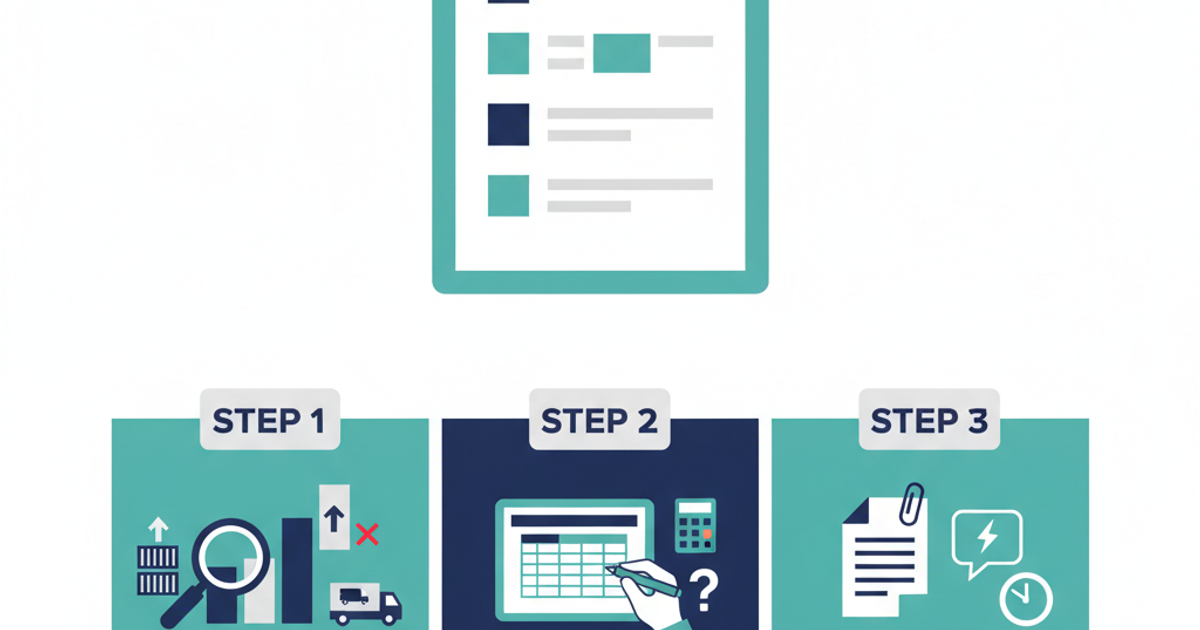
Here is the actual workflow. Print this, tape it next to the monitor, or build it into your SOP. Every invoice that comes in should pass through these checks before payment is approved.
Step 1: Match the Invoice to the Rate Confirmation
Pull the rate con for the load number on the invoice. Compare the linehaul rate, any pre-approved accessorials, fuel surcharge terms, and payment terms. If the rate con says $1,850 all-in and the invoice says $2,100, you have an immediate discrepancy of $250 to investigate. Do not approve any invoice where the total does not match the rate con without reviewing every added charge individually. This is where most invoice matching errors originate, and catching them here prevents downstream disputes.
Step 2: Verify Every Accessorial Against Documentation
For each accessorial charge on the invoice (detention, lumper, fuel surcharge, TONU, layover), answer three questions:
- Is this charge authorized on the rate con? If the rate con does not mention detention or lumper fees, the carrier needs to provide separate pre-approval documentation.
- Does the supporting documentation match the billed amount? For detention, check the BOL and POD timestamps. For lumper fees, check the receipt. For fuel surcharges, check the index date and mileage band.
- Is the calculation correct? Detention at $75/hour for 2 hours is $150, not $225. Fuel surcharge at 22% on a $1,800 linehaul is $396, not $432. Check the math.
Step 3: Cross-Reference the BOL and POD
The BOL and POD are your ground truth. They show actual pickup and delivery times, actual weight, piece counts, and any notes about exceptions at the facility. If a carrier bills for 4 hours of detention but the POD shows the driver checked in at 10:00 AM and departed at 12:15 PM, the actual detention (after standard 2-hour free time) is 15 minutes, not 2 additional hours. The BOL and POD override what the carrier claims unless those documents are missing or illegible, which is itself a red flag.
Step 4: Check Duplicate Invoice Numbers
Duplicate billing is more common than most brokers realize, especially with carriers who bill from multiple systems or have factoring companies involved. Before approving any invoice, search your records for the same load number, same date, or same amount from the same carrier. A simple duplicate check takes 30 seconds and can save hundreds of dollars per occurrence.
Step 5: Log Every Discrepancy Before You Dispute
Do not email the carrier the moment you find a problem. First, log the discrepancy in a tracking sheet or system with: the load number, carrier name, invoice number, the specific line item in question, the billed amount, the correct amount per your documentation, the dollar difference, and the date you flagged it. This log becomes your recovery tracker and your leverage. When a carrier sees you have documented 15 overcharges in 60 days, the conversation changes.
What to Do After You Find a Discrepancy: The Dispute Workflow
Finding the discrepancy is half the job. Recovering the money is the other half. Most content about carrier invoice audits stops at detection. Here is what actually happens next.
Document First, Then Contact
Before reaching out to the carrier, assemble your dispute package. This includes: a copy of the original rate con, the BOL and POD with timestamps highlighted, a screenshot or excerpt of the invoice showing the disputed charge, and a brief written summary of the discrepancy with the correct amount calculated. For more on building a complete dispute workflow, see how to stop paying carrier overbills through better reconciliation.
Send a Clear, Professional Dispute Email
Here is the exact language structure that gets results:
"Subject: Invoice Dispute — [Load #] — [Carrier Name] Hi [Carrier Contact], We've completed our review of invoice [#] for load [#] and identified a discrepancy on the following line item: • Billed: [Charge description] — $[Amount] • Rate con authorization: [What the rate con says] • Supporting documentation: [BOL/POD reference] • Correct amount per our records: $[Amount] Please review and issue a corrected invoice within 7 business days. Documentation is attached. Thank you, [Your name]"
This format works because it is specific, includes the evidence, and sets a clear timeline. Carriers who receive vague disputes ("your invoice seems wrong") deprioritize them. Carriers who receive a detailed dispute with attached documentation typically respond faster.
Dispute Resolution Timelines: What to Expect
In our experience, carriers who receive well-documented disputes typically respond within 7 to 14 business days with a corrected invoice or a counter-explanation. When documentation is incomplete or the dispute is vague, resolution commonly stretches past 30 days and often requires escalation to the carrier's billing supervisor or accounts receivable manager. The documentation quality directly affects the timeline. Disputes backed by a rate con, BOL, and POD with timestamps tend to close 2x faster than disputes sent with only an email explanation. According to Cass Information Systems' analysis of freight audit risks, one of the top dangers in freight audit and payment is failing to resolve disputes quickly enough, which leads to write-offs and lost recovery.
Escalation Path When Carriers Push Back
If a carrier does not respond within 14 days or rejects the dispute without new evidence:
- Day 15: Send a follow-up email with the original dispute attached, referencing the original date sent and the lack of response.
- Day 21: Escalate to the carrier's billing manager or owner. Include a summary of all open disputes with that carrier, not just this one.
- Day 30: Place the disputed amount on hold and offset against future payments if your carrier agreement allows it. Notify the carrier in writing.
- Day 45+: If the amount is significant ($500+), consider whether this carrier relationship is worth maintaining. Track dispute success rate per carrier as a quality metric.
Real Examples: What Overbilling Looks Like on Your Desk
Theory is easy. Here is what these discrepancies look like in practice with the math attached.
Example 1: Detention Billed at 4 Hours, POD Shows 2
Scenario: A carrier bills $300 in detention (4 hours at $75/hour) on load #4821. Your rate con includes 2 hours free time with detention at $75/hour after that. You pull the POD: driver arrived at 8:00 AM, departed at 12:05 PM. Total facility time is 4 hours and 5 minutes. Subtract the 2-hour free time window: actual billable detention is 2 hours and 5 minutes. At $75/hour, the correct charge is $150 (rounding down per standard practice). The carrier billed $300. The discrepancy is $150. You document the POD timestamps, attach the rate con showing the free time provision, and send the dispute. Corrected invoice received in 9 days.
Example 2: Lumper Fee Not on the Rate Con
Scenario: Carrier submits invoice for load #5103 with a $250 lumper fee. Your rate con says "$1,650 all-in, no accessorials authorized." There is no pre-approval email or call log for a lumper. The carrier provides a lumper receipt, but the receipt alone does not override what the rate con says. Your dispute email states: "Per the rate confirmation executed on [date], the agreed rate is $1,650 all-in with no accessorials authorized. No pre-approval for lumper services was requested or granted. Please issue a corrected invoice for $1,650." This is a clear-cut dispute. The rate con language protects you. If the rate con had said "lumper fees reimbursed with receipt," you would owe it. The exact wording on your rate con is the deciding factor.
Example 3: TONU Billed on a Rescheduled Load
Scenario: Load #5287 was originally scheduled for Monday pickup. On Friday, the shipper moved it to Wednesday. The carrier bills a $250 TONU. Your rate con states: "TONU of $250 applies if load is canceled after dispatch." The load was not canceled. It was rescheduled. The carrier's truck was not dispatched to the original pickup and turned away. The shipper notified the carrier 3 days before the original pickup. Your dispute: "This load was rescheduled, not canceled. Per the rate con, TONU applies upon cancellation after dispatch. The carrier was notified of the new pickup date prior to dispatch. Please remove the $250 TONU charge and reissue." If the rate con had said "TONU applies if load is canceled or rescheduled after confirmation," the carrier would have a case. Language matters.
Example 4: Fuel Surcharge at the Wrong Mileage Band
Scenario: Your rate con specifies a fuel surcharge of 22% on linehaul, tied to the DOE national average for the week of pickup. The linehaul is $2,000. Correct fuel surcharge: $440. The carrier bills fuel surcharge at 24.4%, which is $488. Difference per load: $48. Across 500 loads per month at this carrier, that is $24,000 per month. Even if only 15% of loads have the wrong surcharge applied, that is $3,600 per month. You dispute by referencing the DOE published rate for the pickup week, the rate con surcharge percentage, and the correct calculation.
Example 5: The Labor Cost of Manual Reconciliation
Scenario: Your billing coordinator spends 6 hours per week manually matching carrier invoices to rate cons, pulling BOLs and PODs from email attachments and your TMS, and flagging discrepancies in a spreadsheet. At a fully loaded cost of $28/hour (including benefits and overhead), that is $168 per week or $8,736 per year in labor cost for reconciliation alone. That does not include the time spent on dispute emails, follow-ups, or tracking recovery. If that coordinator could cut reconciliation time in half by using a structured process (or a tool that automates invoice-to-rate-con matching), the savings are $4,368 per year in labor before you even count the overbills caught.
In-House vs. Outsourced vs. Software: Which Audit Approach Actually Works for Small Ops?
You have three options for running your carrier invoice audit. Each has trade-offs depending on your volume, team size, and budget.
In-House Manual Audit
This is what most small brokerages do: a billing coordinator or ops manager manually comparing invoices to rate cons. It works when you are running fewer than 100 loads per month and have a disciplined team. The problem is that it does not scale. As load volume increases, manual audits either slow down (delayed payments, carrier complaints) or get skipped (overbills get paid). The quality of the audit depends entirely on the person doing it, and turnover in billing coordinator roles means you are constantly retraining. According to FreightWaves' analysis of the evolution of freight audit and payment, the industry is shifting from basic invoice validation to strategic data use, but most small operations are still stuck at the basic validation stage.
Outsourced Freight Audit and Payment
Third-party freight audit and payment companies handle the entire process for you. They receive invoices, audit them against contracted rates, pay carriers on your behalf, and report discrepancies. This works well for mid-size to large shippers, but it has limitations for small brokers:
- Cost: Most outsourced providers charge per transaction or a percentage of freight spend. At low volumes, the per-invoice cost can exceed the savings.
- Control: You hand off your carrier relationships and payment timing. Some carriers dislike being paid through third parties.
- Customization: Outsourced providers audit against standardized rules. Your specific rate con language, accessorial agreements, and carrier-specific terms may not get the attention they need.

Outsourcing makes sense if you are processing 2,000+ loads per month and do not have internal audit staff. Below that volume, the economics often do not work.
Software-Assisted Audit
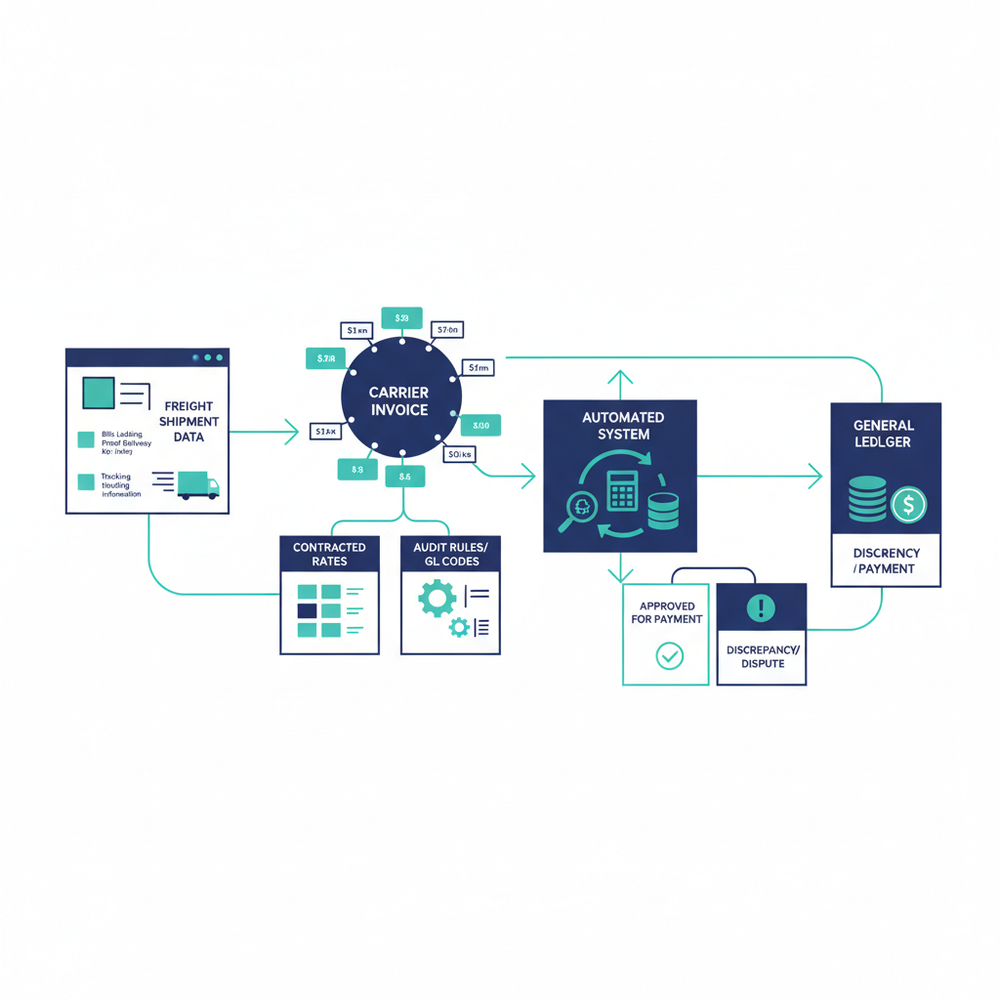
Software tools sit between fully manual and fully outsourced. They automate the extraction and comparison steps (pulling line items from invoices, matching them against rate con data, flagging variances) while keeping the human in the loop for dispute decisions. This approach works well for brokers in the 200 to 2,000 loads-per-month range because it reduces the labor hours per invoice while keeping you in control of carrier relationships and payment timing. The key requirement: the software needs to read your actual rate con documents, not just structured TMS data. Rate cons come in PDFs, emails, and scanned images. If the tool cannot extract data from those formats accurately, it creates more work than it saves. For a detailed look at how the reconciliation process itself should work, regardless of which approach you choose, see the freight invoice reconciliation process guide.
How to Decide
Here is a rough framework:
- Under 100 loads/month: In-house manual audit with a structured checklist (this article). Invest in the process, not the tool.
- 100 to 2,000 loads/month: Software-assisted audit. The labor savings justify the cost, and you keep control.
- Over 2,000 loads/month: Evaluate outsourced providers or a combination of software plus a dedicated audit team.
Audit Frequency: How Often Should You Be Doing This?
The answer is every invoice, every time. No exceptions. But since that is the ideal and not always the reality, here is the minimum:
- Every invoice over $2,500: Full audit against rate con, BOL, and POD.
- Every invoice with accessorial charges: Any invoice that includes detention, lumper, TONU, layover, or fuel surcharge adjustments gets a full review regardless of the total amount.
- Random sample of "clean" invoices: Even invoices that appear to match should be spot-checked. Audit at least 10% of invoices that do not have obvious variances.
- Carrier-specific deep dives monthly: Pick your top 5 carriers by volume each month and audit 100% of their invoices. Rotate carriers quarterly.
This approach balances thoroughness with time constraints. It also lets you build per-carrier quality scores over time. Carriers who consistently overbill get flagged for 100% audit. Carriers with clean histories get sampled. According to NVision Global's freight audit best practices, key validation steps include carrier detail verification, rate checking, and accessorial cross-verification on every shipment.
Frequently Asked Questions About Carrier Invoice Audits
What is a carrier audit?
A carrier audit is the review of a motor carrier's invoices, documentation, and charges against the contracted rates and service terms. For freight brokers, this means comparing every line item on a carrier's invoice to the rate confirmation, BOL, and POD to verify accuracy. The goal is to catch overbilling, duplicate charges, and unauthorized accessorials before payment is made.
What is an invoice audit?
An invoice audit is the systematic review of any vendor invoice to confirm that billed amounts match contracted terms and delivered services. In freight, this specifically covers linehaul rates, fuel surcharges, accessorial charges (detention, lumper, TONU, layover), and payment terms. An effective invoice audit catches discrepancies before they become paid losses.
What are the 5 C's of audit findings?
The 5 C's of audit findings are Condition (what you found), Criteria (what the standard or contract says it should be), Cause (why the discrepancy happened), Consequence (the financial impact), and Corrective Action (what needs to change). In a carrier invoice audit, this translates to: the carrier billed $300 in detention (condition), the rate con authorizes $150 based on documented facility time (criteria), the carrier used estimated rather than actual timestamps (cause), the overpayment is $150 per load (consequence), and the carrier must reissue a corrected invoice and use POD timestamps going forward (corrective action).
How long does a typical carrier invoice dispute take to resolve?
Well-documented disputes with attached rate cons, BOLs, and PODs with highlighted timestamps typically resolve in 7 to 14 business days. Vague or undocumented disputes regularly stretch past 30 days and often require escalation to carrier management. The single biggest factor in resolution speed is documentation quality. Attaching the evidence upfront eliminates back-and-forth requests for information.
Should I audit every carrier invoice or just the ones that look wrong?
Audit every invoice with accessorial charges, period. For straightforward linehaul-only invoices, audit 100% if you have the capacity and at minimum 10% as a random sample. Carriers who know you audit consistently tend to bill more accurately over time. Carriers who know you only check large invoices will test the boundaries on smaller ones.
Conclusion: Build the Habit, Then Build the System
The carrier invoice audit is not a project. It is a recurring operational discipline. Start with the checklist in this guide: match every invoice to the rate con, verify every accessorial against documentation, log every discrepancy before you dispute, and track your recovery rate per carrier. That process alone, done consistently, will catch the overcharges that are costing your brokerage thousands per year. The math is simple. A 50-load-per-week broker missing an average $47 overbill per load is leaving $122,200 on the table annually. Even catching half of that changes your margin picture.
As your volume grows past the point where manual reconciliation is sustainable, tools that automatically compare carrier invoices against rate confirmations and flag discrepancies can cut reconciliation time significantly while maintaining audit quality. But the tool is only as good as the process behind it. Get the process right first.
Sources
- The fragile state of freight billing processes and audits — Hyland (citing American Shipper data)
- Why Should You Audit Your Freight Bills? — Supply Chain Brain (citing Armstrong & Associates)
- Freight Audit And Payment Market Size 2026-2030 — Technavio
- Freight Invoice Audit: 4 Key Components — Trax Technologies
- 5 Top Dangers in Freight Invoice Audit and Payment — Cass Information Systems
- From invoice processing to strategic advantage — FreightWaves
- 7 Key Freight Audit and Payment Best Practices — NVision Global
Full guide: Freight Audit for SMB Brokers: What It Costs to Skip It
Related: Freight Audit and Payment Jobs: What These Roles Actually Catch
Related: Your Freight Audit Report Is Missing These Line Items
Related: What Freight Audit and Payment Companies Actually Catch (And Miss)
Related: Orca Freight Audit Reviewed: What SMB Brokers Actually Get