Freight Billing Reconciliation: Line Items Carriers Inflate Most
Researched and written with AI assistance. Reviewed by the Laneproof team.
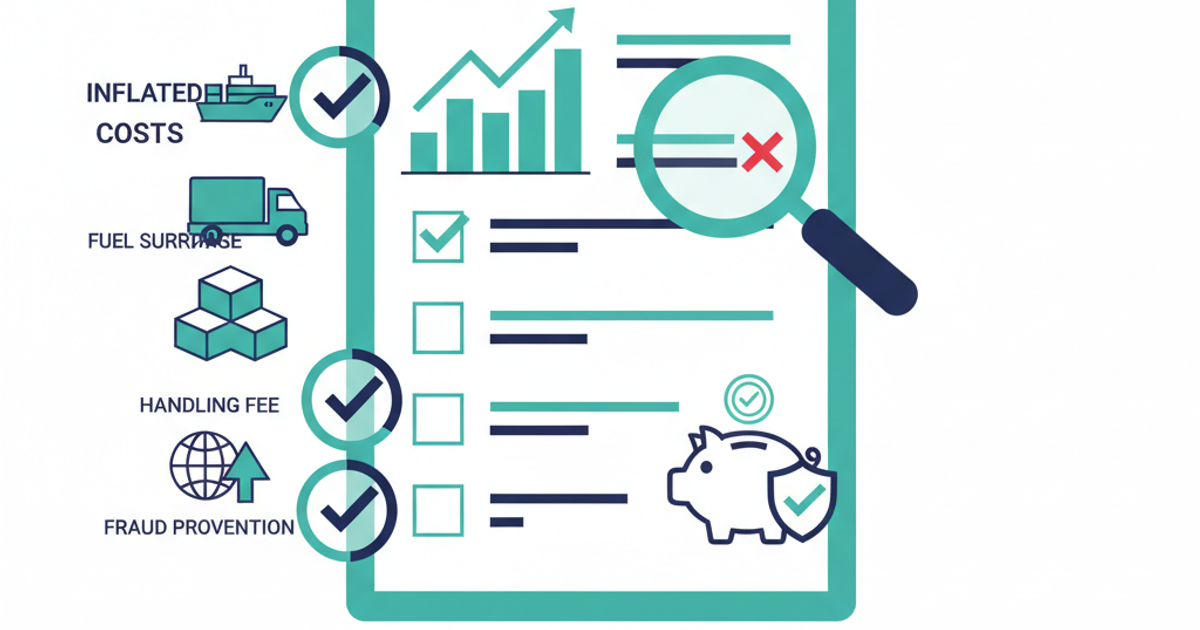
A broker running 500 loads per month with an average invoice of $1,500 and an overbilling rate of 3.8% is losing roughly $28,500 every month before a single dispute gets filed. That's $342,000 a year walking out the door on line items nobody checked. Freight billing reconciliation is the process that catches those losses, but most brokerages either skip it entirely or run a version so shallow it only catches the obvious mismatches. The real money hides in specific line items that carriers inflate repeatedly: detention, fuel surcharges, lumper fees, TONUs, layovers, and dry runs. This guide names those line items, shows the average dollar exposure on each, and gives you a checklist your billing coordinator can run in under 15 minutes per invoice.
What Is Freight Billing Reconciliation?
Freight billing reconciliation is the process of comparing a carrier's invoice, line by line, against the signed rate confirmation, BOL, POD, and any supporting documents to verify that every charge is accurate, authorized, and documented before payment is released. The goal is to catch overbilling, unauthorized accessorials, and math errors before they become margin losses.
According to UNIS's freight payment reconciliation overview, this process sits at the intersection of shipper, broker, and carrier relationships, and discrepancies identified during reconciliation are the primary trigger for freight invoice disputes. If you're a broker, you're the one in the middle. You pay the carrier, you bill the shipper, and every dollar that slips through reconciliation comes directly off your margin.
The regulatory baseline for this process matters too. Under 49 CFR Part 377, carriers must present freight bills within 7 days of receiving the shipment. That timeline creates a narrow window where errors get locked in if your team isn't checking invoices against rate cons the moment they arrive. Wait a week, and you're already behind.
Why Brokers Lose More Than Shippers or Carriers
Shippers with enterprise TMS platforms often have automated three-way matching built into their AP workflow. Large carriers have dedicated billing departments that double-check outbound invoices. Brokers, especially those with 5 to 50 employees, sit in the gap. Your billing coordinator might be juggling 200 invoices a week alongside carrier packets, POD collection, and customer billing. That's the environment where a $200 linehaul mismatch or a $185 undocumented lumper fee slides through without a second look.
If you want a deeper walkthrough of how brokers specifically get hit by overbilling patterns, the guide on stopping carrier overbills through invoice reconciliation covers the structural reasons why broker margins are the most exposed.
The Line Items Carriers Inflate Most, and How Much It Costs You
Not all overbilling is intentional. Some of it is sloppy data entry on the carrier side. Some of it is a driver logging detention time wrong. But regardless of intent, the result is the same: you pay more than you agreed to. According to Pando.ai's analysis of the freight audit industry, an estimated 5 to 10% of annual freight spend is lost to erroneous invoices. For a brokerage spending $500,000 a year on carrier payments, that's $25,000 to $50,000 in billing errors.
But that range is too broad to act on. You need to know which line items to check first. Here are the six that show up most frequently in carrier invoice disputes, ranked by how often they appear and how much they cost per occurrence.
1. Detention Charges
Detention is the single most inflated line item in carrier invoicing. Carriers bill based on driver-reported time, but that time often conflicts with facility timestamps on the POD or lumper receipt. The typical dispute: a carrier invoices 4 hours of detention at $75/hr ($300 total), but the POD timestamp shows the truck was released after 1.5 hours. That's a recoverable overbill of $187.50 on one load. Multiply that across even 10 loads a month, and you're looking at nearly $1,900 in monthly exposure on detention alone.
The fix is straightforward. Match every detention charge against the POD arrival and departure timestamps. If the carrier didn't provide timestamps, request them before approving payment. No timestamps, no detention.
2. Fuel Surcharge Mismatches
Fuel surcharges should be locked at the rate con. If your rate confirmation specifies an FSC of 18% of linehaul, that's the number. Period. But carriers frequently bill a higher percentage, sometimes referencing a different fuel index week or simply rounding up.
On a $2,200 linehaul, the difference between 18% and 23% FSC is $110 per load. A brokerage moving 200 loads per month at that discrepancy rate is exposed to $22,000 in monthly overbilling on fuel surcharges alone. This is one of the easiest errors to catch if your team is doing a rate confirmation match on every invoice, and one of the most expensive to miss if they aren't.
3. Lumper Fees Without Receipts
Lumper fees are uniquely vulnerable to inflation because they originate at the delivery facility, away from the broker's visibility. A carrier invoices a $185 lumper fee with no lumper receipt attached. Industry estimates indicate that roughly 1 in 4 lumper charges submitted without documentation are either inflated or fabricated. The fix: require a lumper receipt for every lumper charge. No receipt, no reimbursement. Make this policy clear in your carrier packet.
4. TONU Billed on a Load That Moved
This one sounds absurd, but it happens more than you'd expect. A carrier invoices a $250 TONU (truck ordered, not used) charge, but your TMS shows the load was delivered and a signed POD exists. That's a full $250 recoverable with one document pull. These errors typically stem from the carrier's billing department working off a dispatch log that was updated after the driver was rerouted, but before the final delivery status synced. If your team isn't cross-referencing TONUs against delivery confirmations, these charges clear payment unchallenged.
5. Layover Charges on Next-Day Pickups
A carrier bills $350 for a layover, claiming the driver had to wait overnight for a pickup appointment. But your load notes show the shipper offered a same-day appointment that the carrier declined or missed. Layover disputes are harder to win than detention disputes because they depend on communication records, not just timestamps. You need the email, the TMS note, or the dispatcher's call log showing the shipper offered a same-day option. Without timestamped carrier communication, this charge sticks.
6. Dry Run Fees Without Documented Refusal
A carrier bills a $175 dry run fee, claiming they arrived at the shipper and were turned away. But the shipper has no record of a delivery attempt. Without a timestamped driver log, geofence ping, or photo, this charge is nearly impossible to dispute after payment clears. Dry run fees are low dollar amounts individually, but they add up fast on high-volume lanes. The documentation standard should be the same as detention: no proof, no pay.
How to Do Billing Reconciliation: A Step-by-Step Field Workflow
Most guides on freight billing reconciliation describe the concept but skip the operational detail. Here's a workflow your billing coordinator can actually follow, designed for brokerages processing 100 to 1,000 invoices per month without enterprise TMS automation.
Step 1: Pull the Rate Con Before Opening the Invoice
Before you even look at the carrier's invoice, pull the signed rate confirmation for that load. This is your source of truth. Every linehaul rate, fuel surcharge percentage, and pre-authorized accessorial should be on this document. If your rate con is vague on accessorials (for example, it says "detention per carrier's policy"), you've already lost negotiating power. Fix your rate cons going forward by specifying dollar caps on every accessorial category.
Step 2: Match Linehaul First, Then Surcharges
Start with the linehaul rate. Does the invoiced amount match the rate con? This is the most basic check, yet nVision Global's analysis of freight invoice errors demonstrates that even a 2% overbilling rate on a $500,000 annual freight spend results in $10,000 in unnecessary costs. A $200 linehaul discrepancy (carrier invoices $1,850, rate con shows $1,650) is only caught if someone pulls the rate con and compares it line by line. After linehaul, check the fuel surcharge percentage and calculate the dollar amount yourself. Don't trust the carrier's math.
Step 3: Verify Every Accessorial Against Supporting Documents
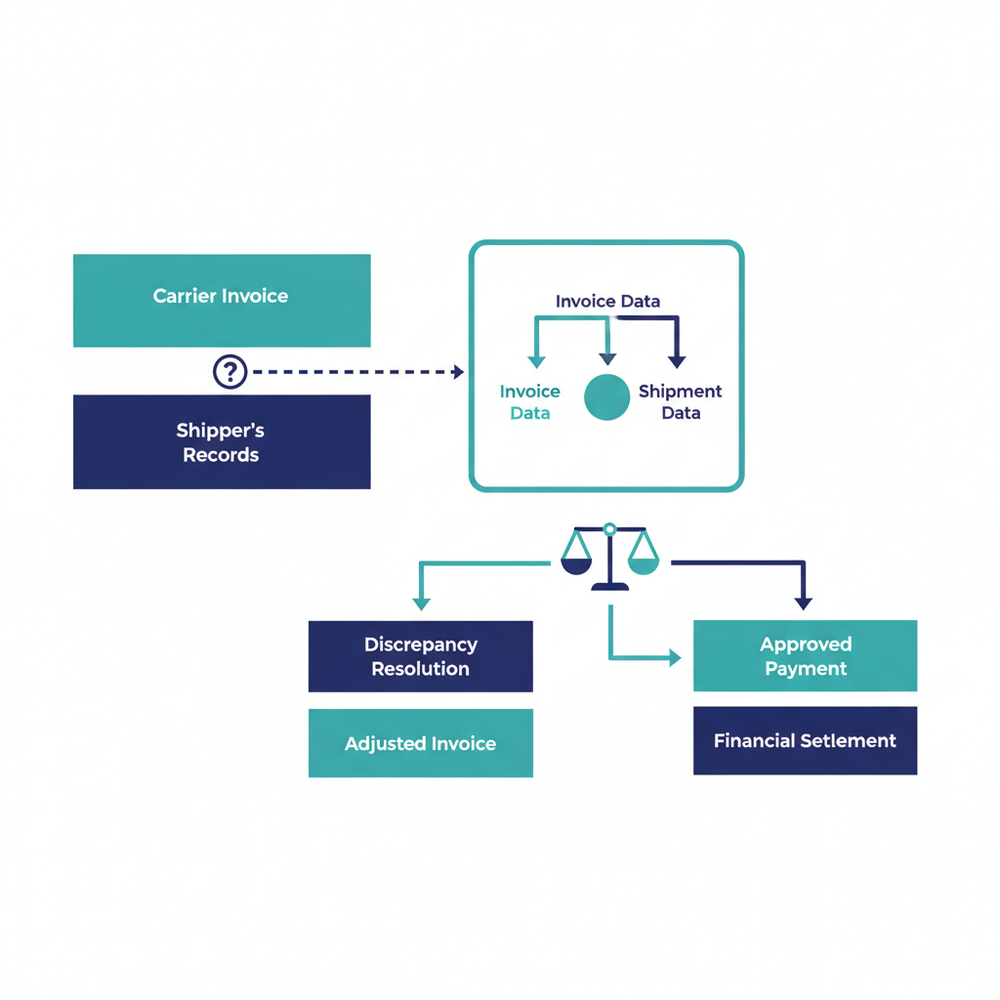
For each accessorial line item (detention, lumper, layover, TONU, dry run), ask two questions. First: is this charge authorized on the rate con or in a written agreement? Second: does supporting documentation exist? If the answer to either question is no, flag the charge for dispute before payment. For a detailed breakdown of where invoice matching goes wrong on accessorials specifically, see the guide on where carrier bills go wrong in invoice matching.
Step 4: Cross-Reference Against the BOL and POD
The BOL confirms what was supposed to happen. The POD confirms what did happen. Comparing both against the invoice catches charges that contradict the actual load execution. A TONU billed on a delivered load. Detention billed at a facility where the POD shows a 30-minute turnaround. Additional stop charges when the BOL shows a single origin and destination. This step takes 2 to 3 minutes per load and catches roughly 40% of the errors that make it past the rate con comparison.
Step 5: Document the Dispute and Send It With Evidence
When you find a discrepancy, don't call the carrier and argue. Write it down. Your dispute communication should include: the load number, the line item in question, the invoiced amount, the correct amount per your documentation, and the specific document that proves the discrepancy (rate con page, POD timestamp, lumper receipt, etc.). Carriers resolve documented disputes faster than verbal ones. Email is better than a phone call because it creates a record.
What the 5-Step Reconciliation Process Actually Looks Like on a Real Load
The five steps above work in theory. Here's what they look like when applied to actual loads with real numbers.
Example: Detention Overbilling on a Midwest Grocery Delivery
Scenario: Carrier invoices $300 in detention (4 hours at $75/hr) on a delivery to a grocery DC in Indianapolis. Your billing coordinator pulls the POD. The arrival timestamp reads 08:15 and the departure timestamp reads 09:45. That's 1.5 hours, not 4.
Calculation: Authorized detention at 1.5 hours = $112.50. Invoiced amount = $300. Recoverable overbill = $187.50.
Resolution: Billing coordinator emails the carrier with the POD timestamps and a corrected invoice amount. Carrier revises the invoice within 48 hours. Total time spent: 6 minutes.
Example: Fuel Surcharge Mismatch Compounding Across 200 Loads
Scenario: Rate con specifies FSC at 18% of linehaul. Carrier invoices FSC at 23%. Linehaul is $2,200.
Calculation: Correct FSC = $2,200 × 0.18 = $396. Invoiced FSC = $2,200 × 0.23 = $506. Per-load discrepancy = $110. Across 200 loads/month = $22,000 in monthly exposure.
Resolution: This error was caught on load #3 of the month when a billing coordinator noticed the FSC dollar amount looked high. She pulled the rate con, ran the math, and flagged the carrier. The carrier acknowledged the error, attributing it to an outdated fuel table in their billing system. All 3 invoices were corrected. Had this gone unchecked for the full month, the brokerage would have overpaid by $22,000.
Example: TONU Billed on a Delivered Load
Scenario: Carrier invoices a $250 TONU. Dispatcher checks TMS and finds a signed POD for the same load number. The load was picked up, delivered, and confirmed.
Calculation: Full $250 is recoverable. The load moved. A TONU doesn't apply.
Resolution: Dispatcher forwards the POD to the carrier's billing contact with a note: "Load [number] shows delivered per attached POD. Please remove the TONU charge and resubmit." Carrier corrects the invoice the same day. This error likely originated from a dispatch cancellation that was later reversed, but the billing system picked up the initial cancellation status.
Example: Linehaul Rate Mismatch Caught by Rate Con Pull
Scenario: Carrier invoices $1,850 linehaul. Billing coordinator pulls the signed rate con and sees $1,650.
Calculation: $200 discrepancy. Straightforward overbill.
Resolution: Rate con is attached to the dispute email. Carrier acknowledges the error and re-invoices at $1,650. Without the rate con pull, this $200 would have cleared payment and never been questioned. According to Metaport's analysis of manual freight reconciliation, up to 20% of freight invoices contain some form of billing error. Linehaul mismatches like this are among the simplest to catch and the easiest to lose when teams skip the rate con comparison step.
Mistakes That Let Overbilling Slip Through to Payment
Catching overbilling isn't just about knowing what to look for. It's about not making the process mistakes that let errors through even when your team knows better.
Paying Invoices in Batches Without Individual Review
When your billing coordinator processes 50 invoices at once on a Friday afternoon, the incentive is speed, not accuracy. Batch payment without individual line-item review is the number one reason accessorial overbilling goes unchallenged. Even a quick 3-minute scan per invoice (linehaul match, FSC calculation, accessorial documentation check) catches the majority of errors. As Truckstop's freight invoice bookkeeping guide notes, one of the clearest signs your brokerage billing process is failing is when invoices move from inbox to payment without a reconciliation step in between.
Accepting Carrier Invoices Without Supporting Documents

If a carrier sends you an invoice with a $185 lumper fee and no lumper receipt, and you pay it, you've set a precedent. That carrier now knows they can submit accessorial charges without documentation and get paid. Your carrier packet should specify documentation requirements for every accessorial type: lumper receipts, detention timestamps, TONU confirmation from dispatch, driver logs for dry runs. Enforce it consistently, or the policy means nothing.
Not Tracking Dispute Rates by Carrier
Some carriers overbill more than others. If you aren't tracking which carriers generate the most disputes, you can't adjust your workflow or your carrier selection accordingly. A simple spreadsheet with carrier name, load count, dispute count, and recovered dollars gives you a quarterly view of which relationships cost you the most in billing errors. When a carrier's dispute rate exceeds 10% of invoices, that's a conversation worth having. When it exceeds 20%, it's a pattern that affects whether you keep booking them.
Waiting Too Long to Dispute
The longer you wait to dispute a charge, the harder it is to recover. Carrier billing departments have their own processing cycles, and once a payment clears, getting a credit applied takes three to five times longer than correcting an invoice before payment. According to Transportation Insight's analysis of the freight audit process, one of the hidden values of freight auditing is that proactive error identification prevents disputes from escalating into drawn-out recovery processes. Aim to reconcile every invoice within 48 hours of receipt. The closer to real-time you get, the higher your recovery rate.
The Compound Cost of Skipping Reconciliation
Here's the math that should make this a priority for every brokerage owner. Take 500 loads per month at an average carrier invoice of $1,500. Apply the 3.8% overbilling rate. That's $28,500 per month in overbilling exposure. Per Debales.ai's analysis of freight invoice error costs, a typical mid-market 3PL with $500K to $10M in annual freight spend loses $30,000 to $300,000 annually to undetected or unrecovered billing errors. If you're processing more than 200 loads a month and not reconciling invoices, you're statistically guaranteed to be losing money you could recover.
A broker running 500 loads/month with 3.8% overbilling on a $1,500 average invoice loses roughly $28,500/month, or $342,000/year, before a single dispute is filed.
For a breakdown of the most common billing mistakes that create this exposure, see the full guide on freight billing mistakes that drain brokerage margins.
Frequently Asked Questions About Freight Billing Reconciliation
What is a freight reconciliation?
Freight reconciliation is the process of comparing a carrier's invoice against the signed rate confirmation, BOL, and POD to verify that every line item (linehaul, fuel surcharge, accessorials) matches the agreed-upon terms and is supported by documentation. The business outcome is catching overbilling before payment, protecting your margin, and maintaining accurate financial records. Per UNIS's definition of freight payment reconciliation, this process is how shippers and brokers identify discrepancies between contracted rates and billed amounts.
What are the 5 steps of the reconciliation process?
For freight billing specifically, the five steps are: (1) pull the signed rate confirmation before reviewing the invoice, (2) match linehaul and fuel surcharge against the rate con, (3) verify each accessorial charge against supporting documentation (POD timestamps, lumper receipts, driver logs), (4) cross-reference the invoice against the BOL and POD to confirm load execution matches what was billed, and (5) document any discrepancies and submit a formal dispute with attached evidence. This workflow takes 10 to 15 minutes per invoice when your documents are organized.
How do I dispute a carrier invoice charge?
Put it in writing. Email the carrier's billing contact with the load number, the specific line item you're disputing, the invoiced amount, the correct amount based on your documentation, and the document that proves the discrepancy (rate con, POD, lumper receipt). Avoid phone disputes because they don't create a paper trail. Most carriers resolve documented disputes within 48 to 72 hours. If the carrier pushes back, escalate to their operations manager with the same evidence package.
What is the journal entry for freight in?
When you receive a carrier invoice for freight services, the typical journal entry debits a freight expense or cost of goods sold account and credits accounts payable. If reconciliation reveals a discrepancy (for example, a $200 linehaul overbill), you adjust the debit to reflect only the verified amount and either reduce accounts payable or create a receivable for the disputed amount. Your accounting software should reflect the reconciled amount, not the invoiced amount, as the cost basis for that load.
How often should I reconcile freight invoices?
Every invoice, every time, before payment. If that's not feasible given your volume, prioritize invoices that include accessorial charges, invoices from carriers with a history of billing errors, and invoices above a dollar threshold you set (for example, any invoice over $2,000). At minimum, reconcile within 48 hours of invoice receipt. The longer an invoice sits unreviewed, the harder it becomes to dispute charges and recover overpayments.
Stop Paying for Charges You Didn't Agree To
Freight billing reconciliation isn't complicated. It's a comparison exercise: what did the rate con say, what does the invoice say, and do the supporting documents back it up? The hard part isn't the process. It's doing it consistently on every load when your team is handling hundreds of invoices a week.
Start with the six line items covered in this guide: detention, fuel surcharges, lumper fees, TONUs, layovers, and dry runs. These are the charges that get inflated most often and cost the most when they slip through. Print the five-step workflow, hand it to your billing coordinator, and track your dispute rate for 30 days. You'll see the dollar recovery in the first week.
If your team processes more than 50 invoices a week and the manual comparison is eating hours you don't have, tools that automatically match invoices against rate confirmations can catch the discrepancies covered in this guide without adding headcount. But whether you automate or stay manual, the principle is the same: check every line item before you pay it.
Sources
- 49 CFR Part 377 — Payment of Transportation Charges — Electronic Code of Federal Regulations
- Freight Payment Reconciliation — UNIS
- The Freight Audit Industry: Navigating Complexity and Key Insights — Pando.ai
- The True Cost of Freight Invoice Errors — nVision Global
- Manual Freight Reconciliation: Hidden Costs and How to Automate — Metaport
- Freight Invoice Errors Cost $200K+: How to Stop Them — Debales.ai
- The Hidden Value Inside a Modern Freight Audit Process — Transportation Insight
- Freight Invoice Bookkeeping: 5 Signs Your Brokerage Is Falling Behind — Truckstop.com
Related: Automated Freight Billing Software: Errors It Catches That You're Missing
Related: Best Invoice Reconciliation Tools for Freight Brokers (2026)
Related: The Invoice Reconciliation Process Freight Brokers Actually Use
Full guide: Freight Invoice Reconciliation Process: Stop Losing Hours