Automated Freight Audit Tools: What They Catch That You Miss
Researched and written with AI assistance. Reviewed by the Laneproof team.

Automated freight audit tools are software systems that compare carrier invoices against rate confirmations, BOLs, PODs, and shipment timestamps to flag billing discrepancies before payment goes out. They catch detention overcharges, lumper fee double-billing, fuel surcharge miscalculations, unauthorized accessorials, and TONU disputes, typically in seconds rather than the hours manual review requires. For a broker running 800 loads per month with a 3.8% carrier overbill rate on an average $1,800 linehaul, the gap between catching those errors and missing them is roughly $54,720 per month.
That number is not hypothetical. It is the kind of math that plays out every billing cycle for mid-size freight brokers who rely on a billing coordinator and a spreadsheet to reconcile carrier invoices. This article maps the specific billing error types automated freight audit tools catch, the exact dollar amounts per load type, why manual reconciliation misses them, and what to look for if you are evaluating a tool for a 100 to 5,000 load per month operation.
What Automated Freight Audit Tools Actually Do (In One Paragraph)
An automated freight audit tool ingests carrier invoices (PDF, EDI, email, or API), extracts line items, and matches each charge against the rate con, BOL, POD, and any supporting documentation like lumper receipts or detention logs. When a charge does not match, the tool flags it as an exception, categorizes the discrepancy type (detention, accessorial, fuel surcharge, etc.), and either routes it for review or blocks payment until the carrier submits supporting proof. According to Trimble's freight audit platform documentation, core automation features include automated invoice bookings, real-time exception reporting, and compliance tracking. The key difference from manual review: the tool checks every field on every invoice, every time. No skipped loads. No "I'll circle back to that one later."
This matters because the freight audit and payment market is growing fast. According to Technavio's market size report, the freight audit and payment market is expected to grow by USD $651.2 million from 2026 to 2030, expanding at a CAGR of 11.2%. That growth is not driven by enterprise shippers alone. Mid-size brokerages handling 100 to 5,000 loads per month are adopting these tools because the cost of not catching errors has become too visible to ignore.
The Billing Errors Manual Review Keeps Missing
If you have a billing coordinator reconciling invoices against rate cons in a spreadsheet, they are probably catching the obvious stuff: wrong linehaul rate, duplicate invoice numbers, invoices for loads that do not exist. That is the easy 20%. The remaining 80% of carrier invoice errors live in the details that a human scanning 40 to 60 invoices per day simply cannot cross-reference consistently.
Detention and Layover Overcharges
Carriers bill detention based on their records, not yours. When a carrier invoices 4 hours of detention at $75 per hour but the BOD (bill of delivery) timestamp shows the driver was on-site for 2.5 hours, that is $112.50 overbilled on a single load. A billing coordinator would need to pull up the BOD, cross-reference the timestamp against the carrier's invoice, and verify the rate con's detention terms. On 200 loads per month, even a 10% detention dispute rate means 20 loads require this level of review. Most coordinators do not have the time. The overcharges go through.
Layover charges present the same problem. Carriers bill layover fees without attaching supporting documentation (check-call logs, shipper delay confirmation, etc.). An automated tool flags the missing documentation and blocks payment until the carrier submits proof. Manual review either catches it late or not at all.
Lumper Fee Double-Billing
This is one of the most common freight billing discrepancies on grocery and retail loads. The rate con specifies that lumper fees are shipper-paid. The carrier's invoice includes a lumper charge anyway, averaging $185 per occurrence. A billing coordinator who does not re-read the rate con's accessorial terms on every invoice will pay it. Multiply $185 across even 15 loads per month and that is $2,775 in pure overpayment. If you want a deeper look at which line items to check first, this breakdown of transportation audit priorities covers the highest-impact categories.
Fuel Surcharge Miscalculations
Fuel surcharges should be calculated using the DOE (Department of Energy) national average diesel price index for the week the load shipped. Carriers sometimes apply the prior week's index, or use a regional rate instead of the national average, or calculate on the wrong mileage band. The difference is typically $40 to $90 per load depending on distance. A coordinator would need to look up the correct DOE index for the shipment date, verify the mileage, and recalculate. Few do this on every load.
TONU Billed on Completed Loads
A truck-not-used (TONU) charge is legitimate when a carrier dispatches a truck and the load cancels. It is not legitimate when there is a signed BOL proving the pickup occurred. Automated tools cross-reference TONU invoices against BOL records instantly. When a TONU charge appears on a load with a signed BOL and POD, the tool flags it with timestamp proof, recovering $250 to $400 per dispute. Manual review might catch this if the coordinator happens to check, but the default assumption is that a TONU invoice means the load did not move.
Here Is What Those Errors Cost Per Load Type
Below are three concrete scenarios showing how carrier invoice errors compound across a mid-size brokerage operation. These are not edge cases. They represent the most common billing discrepancies that automated freight audit tools catch.
Example: Detention Overbilling at Scale
A broker handles 200 dry van loads per month with an average linehaul of $1,800. Detention is billed on roughly 30% of loads (60 loads). The carrier bills 4 hours at $75 per hour on each. Actual BOD timestamps show an average of 2.5 hours. That is 1.5 hours overbilled per load at $75/hr, equaling $112.50 per load. Across 60 loads: $6,750 per month in detention overcharges. Over a year: $81,000. An automated tool catches every one of these by matching the carrier's detention hours against BOD timestamps. A billing coordinator catching even half of them would be exceptional.
Example: Lumper Fee Double-Billing on Retail Loads
Same broker, but now on their reefer book. They run 120 grocery and retail loads per month. Roughly 12% of carriers include a lumper charge on their invoice even though the rate con specifies it as shipper-paid. That is about 14 loads per month at an average of $185 per lumper charge. Monthly cost: $2,590. Annual cost: $31,080. The automated tool matches the rate con's accessorial terms against every line item on the carrier invoice. If the rate con says "lumper: shipper-paid," any lumper charge on the carrier invoice gets flagged instantly.
Example: Fuel Surcharge Miscalculation Across Mileage Bands
A broker's 800 loads per month include a mix of short-haul (under 500 miles) and long-haul (over 1,000 miles). On long-haul loads, a carrier applying the prior week's DOE index when diesel prices dropped $0.04 per gallon means the fuel surcharge is overstated by roughly $40 to $90 per load, depending on mileage. If 15% of loads have this issue (120 loads) and the average overcharge is $65: monthly cost is $7,800. Annual: $93,600. According to Portcast's analysis of freight audit automation, AI-driven freight audit software automates invoice validation and discrepancy detection for exactly these types of calculation errors.
The Full Accessorial Creep Picture
Stack those three error types together for a broker running 800 loads per month at an average $1,800 linehaul with a 3.8% overbill rate across all accessorial categories. The total monthly exposure: approximately $54,720. Not all of that is recoverable (some charges are legitimate but incorrectly documented), but even catching 60% represents $32,832 per month back on the margin line. That is the gap between a freight audit process and no freight audit process.
How Rate Con Matching Catches What Your Eyes Skip
Rate con matching is the core engine behind every effective freight audit tool. Here is what happens when an automated system processes a carrier invoice versus what happens when a human does it.
What an Automated Tool Checks on Every Invoice
- Linehaul rate against the signed rate confirmation, including any negotiated discounts or volume adjustments
- Fuel surcharge recalculated using the correct DOE index for the shipment date and the agreed-upon mileage band
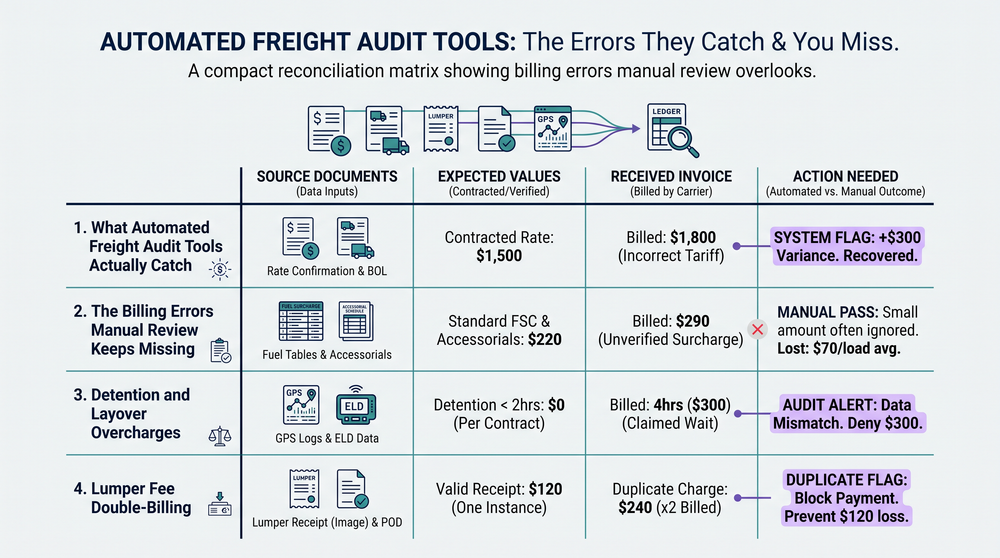
- Detention hours matched against BOD/POD timestamps, check-call logs, and geofence data when available
- Accessorial charges compared line-by-line against the rate con's accessorial terms (lumper, TONU, layover, per-stop fees)
- Multi-stop fees verified against the original rate con. If the rate con lists 2 stops and the carrier bills for 3, the unauthorized stop charge ($60 to $120 per stop) gets flagged
- Supporting documentation verified as present: signed BOL, POD, lumper receipt, detention log. Missing docs trigger a hold
According to SafetyCulture's freight audit guide, automated audit tools also provide pattern detection and carrier performance insights, meaning they can identify carriers who consistently overbill on specific charge types. That is something no spreadsheet will ever surface.
What a Human Checks (Realistically)
A billing coordinator processing 40 to 60 invoices per day will typically verify linehaul rate, check for duplicate invoice numbers, and spot-check one or two accessorial charges when something looks off. Fuel surcharge recalculation? Almost never. Detention timestamp verification? Only on loads where the carrier's hours look extreme. Multi-stop fee verification? Only if they remember the load had multiple stops. The math on labor alone makes the case. A billing coordinator spending 11 hours per week on invoice matching at $28 per hour equals $16,016 per year just for reconciliation. That does not include the cost of the errors they miss.
If you are still running manual reconciliation and want a faster way to check your exposure, this carrier payment audit checklist covers the minimum fields to verify on every invoice.
In-House Audit vs Automated Tool: What the Real Tradeoff Looks Like
You have heard the pitch: "Automate your freight audit and save money." You are probably skeptical. Fair. Here is the actual tradeoff, broken down for a brokerage running 400 to 1,200 loads per month.
Cost Comparison
In-house manual audit: One billing coordinator at $28/hr spending 11 hours per week on reconciliation ($16,016/year in labor) plus the unrecovered billing errors that pass through. If your overbill rate is 3.8% on $1,800 average linehaul across 800 loads, you are losing up to $54,720/month in carrier overcharges. Even if manual review catches 40% of those, the remaining 60% ($32,832/month) leaks straight through.
Automated freight audit tool: Pricing varies, but most tools for mid-market brokers charge either a per-invoice fee ($1.50 to $4.00 per invoice) or a monthly subscription ($500 to $2,500/month depending on volume). At 800 loads per month and $3 per invoice, that is $2,400/month. If the tool catches even 70% of the $54,720 monthly overbill exposure, it recovers $38,304/month, netting $35,904/month after the tool's cost.
Implementation and Switching Complexity
This is the part most vendors skip. Implementation for a mid-market brokerage typically takes 2 to 6 weeks depending on your TMS integration and document format standardization. The main bottlenecks are: getting carrier invoices flowing into the system (email parsing, EDI setup, or API connection), mapping your rate con fields to the tool's matching logic, and training your team on exception handling workflows.
According to Transporeon's step-by-step freight audit automation guide, the process typically involves connecting your TMS and ERP systems, defining audit rules and thresholds, and building exception routing workflows. For brokers already using a TMS with decent data hygiene, the heavy lift is usually the first two weeks. After that, you are running invoices through the system and refining exception rules based on what flags.
If you are considering switching from an existing tool, ask these questions before signing anything:
- Can I export my historical audit data and exception categories?
- What is the onboarding timeline for my load volume (be specific about your monthly count)?
- Does the tool support my carrier invoice formats (PDF, EDI 210, email)?
- How are disputes routed back to carriers, and does the system track resolution status?
- What happens to invoices the tool cannot parse? (The answer should be "exception queue," not "they go through")
Compliance and Carrier Relationship Considerations
Automated freight audit is not just about catching overcharges. It also creates an auditable paper trail for FMCSA compliance and carrier disputes. When a carrier challenges a payment deduction, you need timestamp-backed proof, not a billing coordinator's memory. As of 05/30/2026, JB Hunt Transport Inc (USDOT 264184), one of the largest truckload carriers, carries an operating status of AUTHORIZED FOR Property, HHG (SAFERWEB). Even carriers of that scale have billing discrepancies. As of 02/20/2003, JB Hunt's FMCSA safety rating was Satisfactory (SAFERWEB), but safety ratings and billing accuracy are separate operational functions. The point: every carrier, regardless of size or rating, produces invoices that need verification.
An automated system gives you the documentation to dispute confidently and maintain the carrier relationship. "Your invoice showed 4 hours of detention, but here is the BOD timestamp showing 2.5 hours" is a very different conversation than "We think you overbilled us."
What to Look for When Evaluating a Tool for Your Operation
Not every automated freight audit tool is built for a 100 to 5,000 load per month brokerage. Enterprise tools from providers listed on Gartner's freight audit and payment provider reviews are often priced and scoped for shippers moving 10,000 or more loads per month. Here is what actually matters for your size.
Must-Have Features for Mid-Market Brokers

- Rate con ingestion and matching: The tool must parse your rate confirmations and match every line item against the carrier invoice. If it only checks linehaul, it is missing the accessorial charges where most errors live.
- Document verification (BOL, POD, lumper receipts): The tool should flag invoices where supporting documents are missing, not just where numbers do not match.
- Exception routing and dispute tracking: When a discrepancy is found, the tool should categorize it, route it to the right person, and track carrier response and resolution.
- TMS integration: If the tool requires manual data entry to function, you have replaced one manual process with another. API or EDI integration with your TMS is not optional.
- Carrier performance reporting: You need to see which carriers overbill most frequently and on which charge types. This drives better carrier selection and contract negotiation.
According to CT Global's analysis of AI in freight audit, AI models in freight audit can analyze shipment history to forecast where costs are likely to rise, helping finance and logistics teams improve budget accuracy. That forecasting layer is a nice-to-have. The matching, flagging, and dispute tracking layers are the non-negotiables.
For a deeper look at the cost of skipping this step entirely, this analysis of what freight audit costs SMB brokers breaks down the real exposure.
Data Security and Governance
Your carrier invoices, rate cons, and BOLs contain sensitive operational and financial data. Any tool you evaluate should be able to answer: Where is data stored? Who has access? Is data encrypted in transit and at rest? Can you delete your data if you leave the platform? These are not theoretical concerns. A billing dispute that escalates to litigation will require you to produce audit records. If those records live in a system you cannot control or export from, you have a problem.
Laneproof's reconciliation engine checks each of these fields automatically, flagging variances before payment goes out. If you are evaluating tools for your operation, see how automated document matching works in practice.
Frequently Asked Questions About Freight Audit Automation
How long does it take to implement an automated freight audit tool?
For a mid-market brokerage running 100 to 5,000 loads per month, typical implementation takes 2 to 6 weeks. The main variables are your TMS integration method (API, EDI, or email parsing), the consistency of your carrier invoice formats, and how many custom audit rules you need configured. According to Transporeon's automation guide, connecting your TMS and defining audit rules are the two highest-effort steps.
What percentage of carrier invoices typically have errors?
Based on Laneproof analysis of invoice data across mid-size brokerage clients, the carrier overbill rate on accessorial charges averages approximately 3.8%. The error rate on linehaul is lower (under 1%), but accessorial overcharges on detention, lumper fees, fuel surcharges, and per-stop fees account for the bulk of recoverable dollars. On a brokerage running 800 loads per month at $1,800 average linehaul, a 3.8% overbill rate across all charges represents roughly $54,720 per month in exposure.
Will automating freight audit damage my carrier relationships?
The opposite tends to happen. When you dispute a charge with timestamp-backed documentation ("BOD shows 2.5 hours, not 4"), carriers resolve faster and with less friction than when disputes are based on memory or gut feeling. Consistent, data-backed auditing also trains carriers to submit cleaner invoices over time, reducing disputes on both sides.
Can I use an automated freight audit tool if my carriers send PDF invoices by email?
Yes. Most modern freight audit tools include OCR (optical character recognition) or AI-based document extraction that parses PDF invoices from email. The accuracy varies by tool and by how standardized your carriers' invoice formats are. Ask any vendor you are evaluating what their extraction accuracy rate is on carrier PDFs, and ask them to run a test batch on your actual invoices before you commit.
What is the difference between freight audit software and a freight audit service?
Freight audit software is a tool your team operates, with automated matching and exception routing built in. A freight audit service is a third party that handles the entire audit process on your behalf, typically for a per-invoice or percentage-of-savings fee. For brokerages running 100 to 5,000 loads per month, software gives you more control and lower per-invoice cost, while a service may require less internal overhead. The right choice depends on whether you have someone on your team who can manage exceptions and carrier disputes, or whether you need that handled externally.
Stop Paying for Errors You Can Catch
The billing errors described in this article are not rare events. They happen on a measurable percentage of carrier invoices every billing cycle. Detention overbilling, lumper double-charges, fuel surcharge miscalculations, unauthorized multi-stop fees, and TONU charges on completed loads are the specific categories where mid-size brokerages lose the most money. Manual reconciliation catches some of them. Automated freight audit tools catch nearly all of them, on every invoice, every time.
If you are running 100 to 5,000 loads per month and your billing coordinator is spending 11 or more hours per week on invoice matching, the ROI math is straightforward. The tool costs less than the errors it catches. Start by benchmarking your current overbill rate using a freight bill audit process that takes 10 minutes per load, then evaluate whether your volume justifies a dedicated tool. If you want to see what automated reconciliation looks like on your actual documents, check current plans and pricing.
Sources
- Trimble Freight Audit Software Automates Invoicing & More — Trimble Transportation
- Freight Audit and Payment Market Size 2026–2030 — Technavio
- Cutting Costs and Errors: How Automated Freight Audit and Payment Software Is Changing Logistics — Portcast
- Freight Audit: A Comprehensive Guide — SafetyCulture
- AI in Freight Audit: What's Real and What's Hype? — CT Global Freight Audit
- Automate Your Freight Audit Process: Step-by-Step Guide — Transporeon
- Best Freight Audit and Payment Providers Reviews 2026 — Gartner
Full guide: TMS Limitations Every Freight Ops Team Hits (But Nobody Talks About)
Related: Beyond TMS: Where Your Billing Workflow Actually Breaks Down
Related: TMS Gaps Are Costing You Per Load: Where the Money Goes