TMS Gaps Are Costing You Per Load: Where the Money Goes
Researched and written with AI assistance. Reviewed by the Laneproof team.

In freight logistics, TMS gaps are the missing capabilities in transportation management software that let carrier invoice errors pass through unchallenged. They're not bugs. They're fields that don't exist, cross-checks that never run, and data points your system records but never compares. For a freight broker running 500 loads a month at an average linehaul of $1,800, even a small overbill rate turns into five figures of monthly margin loss. This post breaks down the specific TMS gaps that cause invoice reconciliation to eat hours of your week, estimates what each gap costs per load, and lays out what a catch process (manual or automated) should look like for accessorials, detention, and lumper fees.
What 'TMS Gaps' Actually Means in Freight (Not the Medical Kind)
If you searched "TMS gaps" and got a page full of results about transcranial magnetic stimulation therapy, you're not alone. Every top result right now is about brain stimulation treatment frequency and relapse rates. This post is about a completely different problem: the functional holes in your freight TMS that cost you real money on every load.
A TMS (transportation management system) handles load creation, dispatch, carrier assignment, tracking, and basic invoicing. According to Tai Software's overview of essential TMS features for brokers, the TMS market was projected to grow at a CAGR of 14.5% between 2020 and 2025, reflecting widespread recognition that brokerages need these systems. But adoption doesn't mean completeness. Most freight brokers operating between 100 and 5,000 loads per month hit a ceiling where their TMS handles the top of the workflow (booking and dispatch) but leaves the bottom (billing, reconciliation, and dispute resolution) full of holes.
The Gaps That Actually Matter to Your Margin
TMS gaps in freight fall into a few categories:
- Missing data fields: Your TMS records appointment times but has no field for actual driver arrival or departure, making detention charges unverifiable.
- No cross-referencing logic: A carrier submits a lumper fee, and the TMS posts it without checking whether the rate con says "shipper-paid lumper."
- No document matching: A dry run fee posts even though a signed BOL exists in the system, because the TMS doesn't check for delivery confirmation before allowing that accessorial type.
- Static surcharge handling: The TMS accepts a carrier's fuel surcharge without comparing it to the agreed DAT or DOE index rate on the rate con.
These aren't edge cases. They're the normal operating conditions for most mid-market TMS platforms. As QAD's analysis of TMS execution gaps puts it, transportation execution issues account for a significant share of freight cost variance even when planning is sound. The gap isn't in how you book loads. It's in what happens between the POD and the payment.
The Accessorial Black Hole: What Your TMS Logs vs. What Carriers Bill
Accessorial charges are where TMS gaps do the most damage. Your system might have a dropdown for accessorial types, but that's not the same as having logic that validates whether those charges match the terms on the rate con. The result: carriers bill accessorials, your billing coordinator checks them manually (or doesn't), and money walks out the door.
What Gets Logged vs. What Gets Checked
Most TMS platforms log accessorial charges as line items on the carrier invoice. What they don't do is compare those line items against the rate confirmation agreement. This means a carrier can submit a $250 TONU charge on a load where the driver never arrived within the cancellation window, and the TMS has no field to log driver check-in time. Without that data point, you can't dispute the charge with anything more than an email and a guess.
According to Bluegistics' breakdown of pre-TMS pain points in transportation, the lack of centralized data matching is one of the primary operational gaps that TMS adoption is supposed to fix. But for accessorials specifically, most platforms stop short. They record the charge. They don't validate it.
The Rate Con Is the Contract. Your TMS Ignores It.
The rate confirmation is the agreement between you and the carrier. It specifies linehaul, fuel surcharge method, included accessorials, and exclusions. When a carrier submits an invoice with a line item that contradicts the rate con, your TMS should flag it before it posts. In practice, most don't. The rate con lives as a PDF attachment. The invoice lives as a data entry. The two never talk to each other. This is one of the most common rate agreement gaps carriers use to overbill on every load, and it happens because your TMS treats the rate con as a document, not as a set of enforceable billing rules.
Detention and Lumper Fees: Why Your TMS Can't Catch These on Its Own
Detention and lumper fees are two of the highest-dollar accessorials in freight, and they're also two of the hardest for a TMS to verify. The reason is simple: verification requires document-level data that most TMS platforms don't extract, compare, or flag.
Detention: The Timestamp Problem
Here's a scenario every ops manager has seen. A carrier bills detention at $75/hour starting at hour 2. Your TMS records the shipper's appointment time, but it doesn't capture the driver's actual arrival time or departure time. That leaves a window (often 30 to 45 minutes) where detention is billed but unverifiable. Without a timestamped POD or a facility check-in log imported into the system, you're paying for time you can't confirm.
Scenario: Detention billing with a 45-minute unverifiable window. The carrier bills 3 hours of detention at $75/hour ($225 total). Your TMS shows an appointment time of 8:00 AM but no actual arrival timestamp. The POD shows a departure time of 11:45 AM. Without the arrival time, you can confirm the driver was there but not when they arrived. If the driver arrived at 8:45 AM instead of 8:00 AM, actual billable detention is only 2 hours ($150), not 3. That $75 difference, multiplied across 500 loads a month even if only 10% have detention, is $3,750/month you can't dispute.
Lumper Fees: The Cross-Check That Never Happens
Lumper fee handling is a textbook case of a TMS gap that costs money on individual loads. The rate con might specify "shipper-paid lumper" or "lumper included," but when the carrier submits an invoice with a $185 lumper fee, the TMS posts it as a line item. There's no automated cross-check against the rate con terms.
Scenario: Lumper fee submitted on a shipper-paid-lumper load. A carrier submits $185 for a lumper fee. The rate con clearly states the shipper pays lumper at destination. Your billing coordinator is reviewing 40 invoices that afternoon and doesn't catch it. The $185 posts. This happens once or twice a week across a 500-load operation, and you're looking at $1,480 to $2,960 per month in lumper fees you shouldn't be paying.
This is where brokerage operations break down for small freight brokers: the volume of invoices exceeds the capacity of manual review, and the TMS doesn't pick up the slack.
How Much Are These Gaps Costing You Per Load?
Let's put numbers on this. The goal here isn't to estimate an abstract loss. It's to show you how each specific TMS gap translates into dollars per load and dollars per month.
The Big Picture: Overbill Rate on Linehaul
Consider a brokerage running 500 loads per month with an average linehaul of $1,800. Even a conservative carrier overbill rate of 3.8% (applied across accessorials, detention, fuel surcharge discrepancies, and disputed fees) means roughly $68.40 per load in unbilled or unchallenged discrepancies. Over 500 loads, that's approximately $34,200 per month in margin leakage.
That number isn't a single line item. It's the sum of small misses across multiple gap types:
- Fuel surcharge discrepancy: $38 per load when a carrier applies their own FSC table instead of the agreed DAT or DOE index. The TMS accepts the invoice without comparing against the contracted surcharge rate. Over 500 loads (assuming 20% have a surcharge discrepancy), that's $3,800/month.
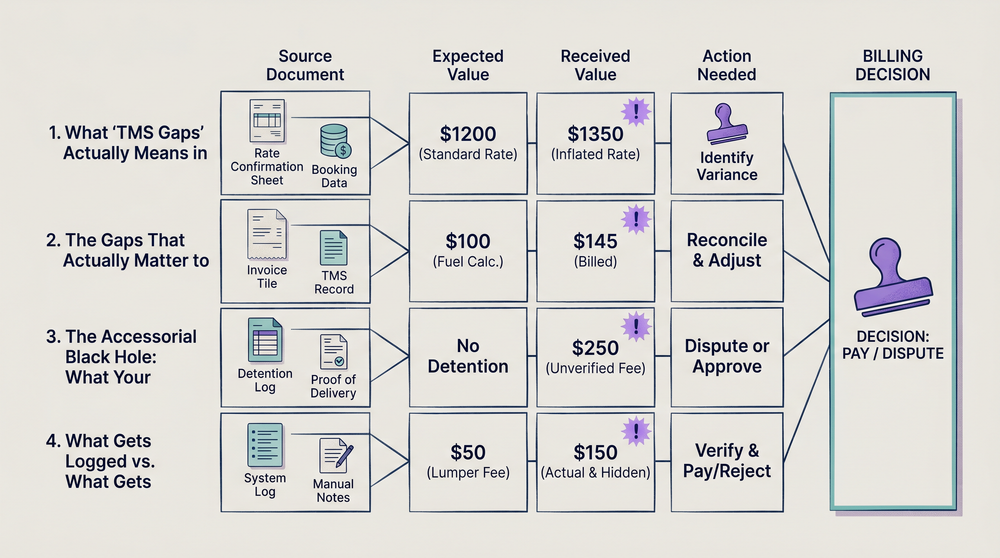
- Unverifiable detention: $75 per occurrence on loads where the timestamp gap prevents dispute. At 10% of loads, that's $3,750/month.
- Duplicate or invalid lumper fees: $185 per occurrence on loads where the rate con specifies shipper-paid. At 1-2% of loads, that's $925 to $1,850/month.
- Invalid TONU charges: $250 per occurrence on loads where the TMS has no driver check-in timestamp. Even at 1% of loads, that's $1,250/month.
- Dry run fees billed on delivered loads: $150 per occurrence on loads that have a signed BOL. The TMS has no flag to check whether delivery confirmation exists before allowing the accessorial to post.
The Hidden Labor Cost
The dollar losses above are just the invoice discrepancies. There's also the cost of the manual process itself. A billing coordinator spending 11 hours per week manually cross-referencing carrier invoices against rate cons in a spreadsheet, at $22/hour, is costing you $242/week. That's roughly $12,584 per year in labor dedicated entirely to work the TMS should be doing, or at least supporting.
According to DashDoc's analysis of hidden expenses in trucking operations without proper TMS support, a U.S.-based shipper using a modern TMS achieved $2.2 million in logistics cost avoidance in a single year. For a small brokerage, the scale is different but the principle is the same: every hour spent on manual reconciliation is an hour not spent on load coverage, carrier negotiation, or customer service.
A billing coordinator spending 11 hours per week on manual invoice reconciliation costs roughly $12,584 per year in labor alone, before you count the discrepancies they miss.
What a Freight Billing Workflow Looks Like When You Patch the Gaps
Knowing the gaps exist is step one. Step two is building a catch process, whether manual or automated, that closes them. Here's what a freight billing workflow should include to prevent the losses described above.
Step 1: Rate Con Extraction and Rule Creation
Before you can compare a carrier invoice to a rate con, the terms on the rate con need to be structured data, not just a PDF sitting in your TMS. That means extracting key fields: linehaul rate, fuel surcharge method and index, included accessorials, lumper responsibility, detention free time, and cancellation/TONU terms. For a manual process, this means a billing coordinator fills out a checklist for each rate con. For an automated process, this means OCR or document extraction pulls those fields into a structured record tied to the load.
Step 2: Invoice Matching Against Rate Con Terms
Every carrier invoice line item should be compared against the extracted rate con terms before it posts. The checks are specific:
- Linehaul: Does the invoiced linehaul match the rate con? Flag any variance over $1.
- Fuel surcharge: Does the invoiced FSC match the agreed index and calculation method? If the rate con says "DOE national average, carrier's published table," compare the carrier's submitted surcharge against that index for the shipment week.
- Accessorials: Is each invoiced accessorial allowed under the rate con? If the rate con says "shipper-paid lumper," reject a carrier-submitted lumper fee.
- Detention: Does the invoiced detention time match verifiable timestamps? Compare carrier-submitted detention hours against POD timestamps, facility check-in logs, or driver app data.
- TONU/Dry run: Does the charge match the load status? If a signed BOL exists, a dry run fee shouldn't post. If the driver didn't check in within the cancellation window, a TONU should be flagged for review.
Step 3: Exception Handling and Dispute Documentation
When a discrepancy is flagged, the workflow needs to produce a dispute-ready package: the rate con terms, the carrier invoice, the supporting document (POD, BOL, timestamp log), and the specific variance in dollars. Without this, disputes become email arguments with no resolution. With it, you have a documented case that can be resolved in one exchange.
According to DAT's documentation on TMS capabilities for freight brokers, a well-configured TMS should centralize document management and reporting. But even DAT acknowledges that most brokerages need additional tools or workflows for the reconciliation layer, especially when dealing with accessorials and disputed charges.
Step 4: Batch Reconciliation Review
For brokerages running 100+ loads per month, reconciliation should happen in batches, not one invoice at a time. Group invoices by carrier, flag the ones with exceptions, and review exceptions first. Clean invoices (where every line item matches the rate con) should approve automatically or with a single click. This approach cuts the 11-hour weekly reconciliation time significantly because you're only spending manual attention on the loads that need it.
As Transfix notes in their guide on signs it's time to replace your TMS, if your team is spending more time working around the system than working in it, the system isn't serving you. Reconciliation is the most common place where that workaround behavior shows up.
Concrete Examples: TMS Gaps in Action
Let's walk through three more scenarios to make this tangible. Each one describes a real gap, the dollar impact, and what the catch process should be.
Example 1: Fuel Surcharge Discrepancy at Scale
Setup: A broker runs 500 loads/month. The rate con on 60% of loads (300 loads) specifies fuel surcharge based on the DOE national average diesel price, using the carrier's published FSC table. The remaining 40% have fuel surcharge built into the linehaul rate.

The gap: The TMS accepts the carrier's invoiced fuel surcharge as a line item but does not compare it against the DOE index for that shipment week or the carrier's published table. On 100 of the 300 applicable loads (33%), the carrier applies a slightly higher FSC, resulting in a $38/load discrepancy.
The cost: 100 loads × $38 = $3,800/month or $45,600/year.
The fix: The billing workflow should pull the DOE index for each shipment week, apply the carrier's published FSC table, and compare the result against the invoiced surcharge. Any variance over $2 gets flagged for review.
Example 2: TONU Charged Without Driver Check-In Data
Setup: A broker cancels a load after the carrier was tendered but before the driver arrives at pickup. The carrier invoices a $250 TONU (truck ordered, not used) fee.
The gap: The TMS has no field to log the driver's check-in time at the pickup location. The cancellation happened before the agreed pickup window, which under the rate con terms means no TONU is owed. But without a timestamp showing the driver hadn't yet arrived, the broker has no data to dispute the charge.
The cost: $250 per occurrence. If this happens on 5 loads per month, that's $1,250/month.
The fix: Log driver check-in times from the carrier's ELD or tracking app. If no check-in exists at the time of cancellation, the TONU charge should be automatically flagged as "unverifiable" and routed to dispute.
Example 3: Dry Run Fee on a Delivered Load
Setup: A carrier submits a $150 dry run fee on a load. A dry run means the driver arrived at the delivery location and was unable to deliver, so they left without unloading.
The gap: The load has a signed BOL in the TMS, proving delivery was completed. But the TMS has no logic to check whether a delivery confirmation document exists before allowing a dry run accessorial to post. The billing coordinator is reviewing 40+ invoices and doesn't catch the contradiction.
The cost: $150 per occurrence. Even once or twice a month, that's $1,800 to $3,600/year on a charge that's provably invalid.
The fix: Before any dry run accessorial posts, the system should check for the presence of a signed BOL or POD. If one exists, the charge is blocked and flagged for review. This is a binary check. Delivery confirmed or not. No interpretation needed.
Frequently Asked Questions About TMS Gaps in Freight Operations
What are TMS gaps in freight logistics?
In freight logistics, TMS gaps are missing features, data fields, or automated checks in your transportation management system that allow carrier invoice errors to go undetected. Common examples include the inability to cross-reference carrier invoices against rate con terms, missing timestamp fields for detention verification, and no automated flag when an accessorial contradicts the load's billing terms. These gaps are distinct from the medical "TMS" (transcranial magnetic stimulation) that dominates search results.
How much do TMS gaps cost a mid-size freight broker?
The cost depends on load volume and the types of gaps present. For a broker running 500 loads per month at an $1,800 average linehaul, uncaught discrepancies across fuel surcharges, detention, lumper fees, TONUs, and dry run charges can total $34,200 per month or more. Add the labor cost of manual reconciliation (roughly $12,584/year for one billing coordinator spending 11 hours/week), and the total annual impact can exceed $400,000.
Can my TMS handle invoice reconciliation on its own?
Most freight TMS platforms handle load booking, dispatch, and basic invoicing well. But few have built-in logic to compare every carrier invoice line item against the specific terms on the rate confirmation. According to DAT's TMS documentation, even well-configured systems often need additional tools or manual processes for the reconciliation layer. The TMS records the data. Closing the gap means adding the cross-check logic, either through a manual checklist or an automated audit tool.
What's the difference between a TMS gap and a TMS limitation?
A TMS limitation is something the software wasn't designed to do (like managing warehouse operations). A TMS gap is something it should do for your freight billing workflow but doesn't. The gap between recording an appointment time and recording the driver's actual arrival time is a gap, not a limitation. The data exists (on the POD, the ELD, the facility log), but the TMS doesn't capture or use it. Closing these gaps doesn't require replacing your TMS. It requires adding a layer that does the comparison work.
What should I do if my TMS doesn't catch carrier invoice errors?
Start with the highest-dollar gaps first: fuel surcharge discrepancies, detention verification, and lumper fee cross-checks. Build a manual checklist that your billing coordinator runs against every invoice. Track which carriers submit the most discrepancies and prioritize those for review. If manual review is already consuming more than 8 hours per week, you're past the point where a spreadsheet process scales, and it's time to look at automated document extraction and matching tools that sit on top of your existing TMS.
Sources
- Switching Your TMS: Why DAT Broker TMS is the Smart Choice — DAT
- When Shipping Costs Rise, the TMS Gap is Execution — QAD
- Pain Points in Transportation Before TMS Implementation — Bluegistics
- The Real Cost of Not Having a TMS: Hidden Expenses — DashDoc
- TMS Features That Are Essential For Freight Brokers — Tai Software
- How Do I Know It's Time to Replace My TMS? — Transfix
Close the Gaps Before They Close Your Margin
Every TMS gap described in this post is a specific, identifiable hole in your billing workflow. Fuel surcharge comparisons that never run. Detention timestamps that don't exist. Lumper fees that post without checking the rate con. Dry run charges on delivered loads. These aren't abstract problems. They're line items on carrier invoices that your team either catches manually or pays without question.
Start by mapping which gaps exist in your current workflow. Check your last 50 carrier invoices against the rate cons and count the discrepancies. If the number is higher than you expected (it usually is), you have a baseline. If your billing coordinator is already spending double-digit hours per week on manual reconciliation, tools that automatically flag invoice discrepancies against rate con terms can take the per-invoice review time from minutes to seconds and catch the errors that manual review misses at volume.
Full guide: TMS Limitations Every Freight Ops Team Hits (But Nobody Talks About)
Related: Automated Freight Audit Tools: What They Catch That You Miss
Related: Beyond TMS: Where Your Billing Workflow Actually Breaks Down