TMS Limitations Every Freight Ops Team Hits (But Nobody Talks About)
Researched and written with AI assistance. Reviewed by the Laneproof team.

A transportation management system handles dispatch, load tracking, and document storage. What it does not do is catch the $75/hour detention charge that should have been $50, the lumper fee with no BOL confirmation, or the fuel surcharge calculated on gross linehaul instead of net. These are the TMS limitations that quietly drain freight margins while your ops team patches the gaps with spreadsheets every week. According to a Descartes buyer's guide for freight broker TMS platforms, brokers can handle 25 to 40 percent more loads per rep with a dedicated TMS. But handling more loads means nothing if carrier overbilling scales right along with volume. This post names the exact billing and reconciliation failures your TMS glosses over, puts dollar amounts on each one, and shows you what to check in your own back office to stop absorbing charges you never agreed to.
Your TMS Was Not Built to Catch Carrier Overbilling
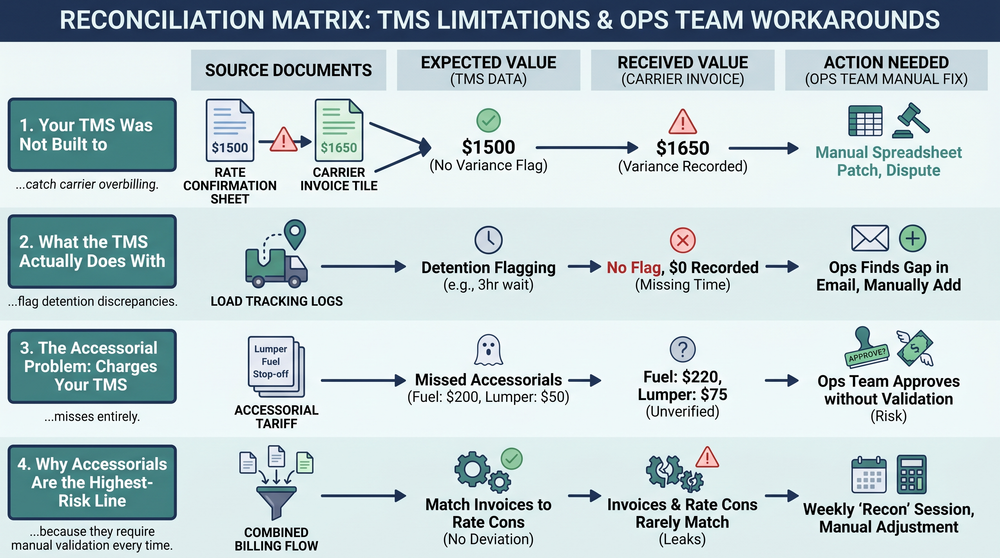
Here is the uncomfortable truth about most TMS platforms: they were designed to move freight, not to audit the bills that come after. Load tendering, dispatch, tracking, document storage. That is the core feature set. Invoice reconciliation, if it exists at all, is usually limited to confirming that a carrier invoice was received for a given load number. It does not check whether the amounts on that invoice match the rate confirmation. It does not flag accessorial charges that were never agreed to. It does not compare detention hours against facility appointment data.
This is not a niche complaint. According to a DAT guide on buying a broker TMS, one of the most common mistakes brokers make is assuming a TMS will serve every department's needs out of the box. Accounting, operations, and dispatch all interact with the same load data differently, but the TMS treats invoicing as an afterthought, a line item to record rather than a number to verify.
What the TMS Actually Does With a Carrier Invoice
When a carrier submits an invoice, your TMS typically does one of three things: it attaches the document to the load record, it populates a payable field with the invoice total, or it routes the invoice to a payment queue. In all three cases, the system is recording the carrier's number as fact. It is not comparing that number against your rate con. It is not checking whether accessorial charges were authorized. It is not verifying that the linehaul rate matches what was agreed. The result is a workflow that looks automated on the surface but requires your billing coordinator to manually verify every charge underneath.
For a freight broker running 200 to 500 loads per month, that means hundreds of invoices flowing through your TMS with zero automated validation. Your team either trusts the carrier's math or spends hours each week doing the math themselves. Most operations land somewhere in between: they trust the math on most loads and spot-check when they can. That is where the money disappears.
The Accessorial Problem: Charges Your TMS Logs But Never Questions
Accessorial charges are where TMS workflow gaps cause the most damage. Detention, lumper fees, layover, TONU, dry runs, fuel surcharges. These are all legitimate costs when they are real and when they match what was agreed. The problem is that your TMS treats every accessorial line item identically: it logs the charge and moves on.
There is no built-in logic in most TMS platforms to ask: Was this detention rate in the rate con? Was a lumper actually used at this facility? Does this TONU make sense given that a signed POD exists for this load? These are questions that require cross-referencing multiple documents (the rate con, the BOL, the POD, facility appointment records) and comparing them against the invoice. Your TMS stores all of these documents. It just never compares them.
Why Accessorials Are the Highest-Risk Line Items
Accessorials are inherently variable. Unlike linehaul, which is agreed upon in the rate con before the load moves, accessorials often get added after the fact. A driver hits detention. A lumper is needed at delivery. Weather causes a layover. These charges get submitted on the carrier invoice days or weeks after the load delivers, and by then, your ops team has moved on to the next 50 loads.
The variability is exactly what makes accessorials easy to overbill on. A carrier can submit a detention charge at $75/hour when your rate con caps it at $50. They can add a lumper fee on a load where no lumper service is documented on the BOL. They can calculate a fuel surcharge on gross linehaul when the rate con specifies net. Each of these discrepancies is small enough to slip past a busy billing coordinator but large enough to add up to thousands per month. If your team is already stretched thin on manual reconciliation alongside a TMS, these charges will get paid without question.
No Rate Con Cross-Check Means You Are Trusting the Carrier to Bill You Right
The rate confirmation is the contract. It specifies the linehaul rate, the fuel surcharge terms, the detention cap, and any pre-approved accessorials. Every carrier invoice should be compared against the rate con, line by line, before payment is issued. In practice, almost no TMS does this automatically.
Most TMS platforms store the rate con as a document attachment. It sits in the load file as a PDF or image. The invoice amount sits in a separate data field. These two pieces of information exist in the same system but are never connected. Your TMS knows the load is associated with a rate con, and it knows the carrier submitted an invoice for a certain amount. It does not know whether those two numbers match.
The Cost of Missing the Cross-Check
Consider a simple fuel surcharge miscalculation. Your rate con specifies a 28 percent fuel surcharge on net linehaul. The carrier calculates 28 percent on gross linehaul instead. On a $2,200 linehaul, that is a $616 charge versus a correct $560 charge. The difference is $56 per load. That looks trivial on a single invoice. But run 200 loads per month with the same carrier billing practice, and you are looking at $11,200 in annual overcharges from one line item on one type of charge.
Now multiply that across detention discrepancies, unauthorized lumper fees, and linehaul rounding differences. The total quickly reaches five figures annually for a mid-size brokerage. And the TMS never raises a flag because it was never designed to. This is one of the places where small freight brokers quietly lose money month after month without realizing the cumulative impact.
Rate Con Data Is Trapped in Documents
The root cause is that rate con terms live inside unstructured documents. Your TMS stores the PDF but does not extract the detention cap, the FSC formula, or the accessorial limits into structured data fields that can be compared against invoice line items. Until that extraction happens, whether manually by your billing coordinator or through document automation tools that pull data from BOLs and rate cons, the rate con is just a file sitting in a folder. It is not a control mechanism. It is not protecting your margin.
Detention and Lumper Fees Fall Through the Cracks Every Single Time
Detention and lumper fees are the two most commonly overbilled accessorials in freight operations. They are also the two that your TMS is least equipped to verify.
Detention charges require knowing three things: when the driver arrived at the facility, when loading or unloading began, and what the agreed detention rate and free time were per the rate con. Your TMS may have check-call data or ELD integration showing arrival times. But it rarely connects that timestamp data to the rate con's detention terms and then compares both against the carrier's invoice. The data exists in three different places within the system, and the system never brings them together.
Scenario: Detention Overbilling at Scale
Example: A carrier consistently bills detention at $75/hour. Your rate con with that carrier caps detention at $50/hour with two hours of free time. On loads where detention applies (let us say 40 out of 200 loads per month), the carrier bills an average of two extra hours at the inflated rate. That is $50 per load in overcharges ($25/hour overage times 2 hours). Across 40 loads, that is $2,000 per month, or $24,000 per year. Your TMS records every one of those detention charges without comparing them to the rate con cap.
Scenario: The Phantom Lumper Fee
Example: A carrier submits an invoice for a load that includes a $325 lumper fee. The BOL for that load shows no lumper service was used at delivery. Your TMS has both the invoice and the BOL attached to the load record. But it does not cross-reference them. The $325 charge enters the payment queue, gets approved in a batch, and is paid. Your billing coordinator might catch it during a monthly audit, three weeks after payment has already gone out. By then, recovering the overpayment requires a dispute process that takes more time than most small teams have.
Lumper fees are particularly vulnerable because they are often paid at the facility by the driver and then reimbursed through the carrier invoice. The chain of documentation (lumper receipt to BOL notation to carrier invoice) has multiple handoff points where discrepancies can enter. Your TMS tracks none of these handoffs.
Regulatory Risk Compounds the Problem
TMS-integrated compliance tools can also create unexpected exposure. When FMCSA revoked TMS One's ELD device compliance status, carriers using those devices had up to 60 days to find replacements. The incident underscores a broader point: when your TMS or its integrated tools fail, the downstream impact on documentation, compliance records, and billing verification can be significant. If your detention verification depends on ELD data routed through your TMS, and that data source becomes unreliable, your already-thin audit trail disappears entirely.
Why Your Ops Team Is Still Using Spreadsheets Alongside a TMS
If your billing coordinator maintains a spreadsheet to track carrier invoice discrepancies, you are not alone. The spreadsheet exists because the TMS does not do what your team needs it to do for reconciliation. Specifically, the TMS does not flag mismatches between the invoice and the rate con, does not surface unauthorized accessorials, and does not connect document data (BOL notations, POD signatures, appointment logs) to the billing workflow.
According to an analysis of common TMS implementation challenges, data migration issues and integration gaps are among the top reasons TMS deployments fail to deliver expected results. When the TMS cannot pull structured data from rate cons and invoices, your team builds the bridge manually. That bridge is a spreadsheet.
The Time Cost Is Real
Example: A billing coordinator at a brokerage running 300 loads per month spends 6 to 9 hours per week manually matching carrier invoices to rate cons. They open the rate con PDF, note the linehaul and accessorial terms, open the carrier invoice, compare each line item, and log any discrepancies in a spreadsheet for follow-up. That is 26 to 39 hours per month dedicated to a task that the TMS should, in theory, handle. At a fully loaded labor cost of $25/hour, that is $650 to $975 per month in manual reconciliation labor. For a small brokerage, that is the equivalent of losing a part-time employee to a process gap.
Spreadsheets Do Not Scale
The spreadsheet workaround has a ceiling. At 100 loads per month, one person can keep up. At 300, it starts slipping. At 500 or more, it breaks entirely. Discrepancies get missed, disputes get filed late, and overbilled amounts get absorbed into the cost of doing business. A Bluegistics analysis of TMS trends for 2026 identifies siloed architecture as a major limitation of traditional TMS platforms, noting that closed systems prevent collaborative data sharing across supply chain partners. Your spreadsheet is a symptom of that silo. It exists because your TMS cannot talk to your documents in a way that produces actionable billing data.
More Scenarios Your TMS Misses
Example: TONU on a Delivered Load. A carrier submits a Truck Ordered Not Used charge on a load. Your TMS also has a signed POD for that same load, confirming delivery was completed. The TMS stores both documents but does not compare them. If the TONU is submitted in a batch with 30 other invoices, your billing coordinator may not catch it until weeks later during a manual review cycle. By then, the TONU may have already been paid.
Example: Dry Run With No Documentation. A carrier invoices for a dry run, claiming the facility was closed at arrival. No supporting documentation (photos, facility contact confirmation, check-call data) accompanies the invoice. Your TMS accepts the invoice and queues it for payment with no exception raised. There is no rule in the system that requires supporting docs for dry run charges. The charge gets paid because nobody told the TMS to question it.
Example: Layover Fee on a Rescheduled Load. A carrier bills a layover fee because they had to wait overnight for a delivery appointment. What the invoice does not show is that the shipper rescheduled the appointment, which means the layover was not caused by the carrier's early arrival. Your TMS has the original appointment time, the rescheduled time, and the carrier invoice, all in separate parts of the system. It never links the appointment change log to the invoice review workflow. The layover fee gets paid at face value.
What These TMS Limitations Actually Cost Per Month
Let us put the numbers together for a mid-size brokerage running 200 loads per month.
- Detention overbilling: $50/load overage on 40 loads = $2,000/month
- Fuel surcharge miscalculation: $56/load on 200 loads = $11,200/year ($933/month)
- Unverified lumper fees: Even 5 phantom charges at $325 = $1,625/month
- Manual reconciliation labor: 6 to 9 hours/week at $25/hour = $650 to $975/month

- Missed TONU/dry run disputes: Variable, but 2 to 3 per month at $250 to $500 each = $500 to $1,500/month
Conservative total: $5,700 to $7,000 per month in absorbed overcharges and wasted labor. That is $68,000 to $84,000 per year leaking out of a single mid-size operation. And every dollar of that falls below the line where your TMS is supposed to provide value.
Your TMS handles load execution. It was never built to protect your margins on the billing side. The gap between those two functions is where freight brokers lose real money every month.
Per a Nuvocargo guide on TMS implementation failure, a TMS implementation should produce measurable improvement in at least two key performance areas within 12 months. If your team is still spending hours on manual invoice review after a year on the platform, that is a clear signal that the system is not covering the workflow you need it to cover.
Frequently Asked Questions About TMS Limitations in Freight Operations
What are the biggest downsides of TMS software for freight brokers?
The biggest downside is the gap between what a TMS promises and what it actually automates on the billing side. Most platforms excel at dispatch and load tracking but treat invoice reconciliation as a manual process. According to DAT's guide on broker TMS selection, brokers frequently underestimate how much cross-departmental work the TMS will leave unaddressed. For billing and accounting teams, this means rate con matching, accessorial verification, and detention flagging all remain manual tasks.
Why does my ops team still use spreadsheets if we already have a TMS?
Because your TMS stores documents without comparing them. The rate con, carrier invoice, BOL, and POD all live in the same load file, but the system does not cross-reference them to flag discrepancies. Your spreadsheet fills that gap. It is where your billing coordinator tracks which invoices matched, which had overcharges, and which disputes are outstanding. The spreadsheet is not a failure of discipline. It is a symptom of a TMS that was not built for invoice-level reconciliation.
Do freight brokers have to rely on a TMS forever?
No, and the question itself reveals a common frustration. A TMS is a tool, not a permanent commitment. Many brokerages supplement their TMS with specialized tools for document automation, invoice auditing, or carrier payment verification. The key is recognizing which functions your TMS handles well (dispatch, tracking, capacity management) and which it does not (billing reconciliation, accessorial validation, rate con cross-checking). Fill the gaps with purpose-built tools rather than expecting a single platform to do everything.
How can I tell if my TMS implementation has failed?
According to Nuvocargo's guide on TMS implementation failure, if your TMS has not produced measurable improvement in at least two key performance areas within 12 months, the implementation has likely fallen short. For freight billing specifically, ask: Has our average invoice processing time decreased? Are we catching more carrier billing errors before payment? Has the number of post-payment disputes gone down? If the answer to all three is no, your TMS is not covering the billing workflow.
What is the controversy around TMS adoption in freight?
The core controversy is that the TMS market is growing rapidly (the global TMS market was valued at $18.56 billion in 2025 and is projected to reach $68.36 billion by 2033, per Grand View Research), while the platforms themselves still leave major operational gaps unaddressed. Brokers and carriers invest significant time and money in TMS implementation only to find that billing verification, the function most directly tied to margin protection, is still a manual process. The controversy is not whether TMS platforms are useful. They clearly are. It is whether they justify their cost when the most margin-sensitive workflows remain outside their scope.
Stop Absorbing the Costs Your TMS Misses
Your TMS is good at what it was built for: moving loads from booking to delivery. The problem is everything that happens after delivery, when carrier invoices arrive with inflated detention, unauthorized lumper fees, and fuel surcharges calculated on the wrong base. Those charges flow through your TMS unchecked because the system was never designed to check them.
Start with an audit of your last 30 days of carrier invoices. Pull the rate cons. Compare detention rates, FSC calculations, and accessorial charges line by line. If you find discrepancies on more than 10 percent of loads, you have a pattern that manual review will not fix at scale. If your team processes more than 50 invoices a week, automated freight document tools that flag invoice discrepancies can catch the overbilling covered in this guide before payment goes out, not three weeks after.
Sources
- FMCSA Removes TMS One ELD Device Compliance — Trucking Info
- A Freight Broker's TMS Buyer's Guide — Descartes
- 5 Tips to Buying a Broker TMS — DAT
- 5 Most Common Challenges in TMS Implementation — UniqTMS
- Signs Your TMS Implementation Has Failed — Nuvocargo
- TMS Trends 2026: The Future of SaaS for Transportation — Bluegistics
- Transportation Management System Market Report, 2033 — Grand View Research
Related: Automated Freight Audit Tools: What They Catch That You Miss
Related: Beyond TMS: Where Your Billing Workflow Actually Breaks Down
Related: TMS Gaps Are Costing You Per Load: Where the Money Goes