Beyond TMS: Where Your Billing Workflow Actually Breaks Down
Researched and written with AI assistance. Reviewed by the Laneproof team.

A 500-load/month freight broker paying an average of $18 in uncaught detention overbilling per load loses $9,000 every month. That is $108,000 a year in charges that were never cross-checked against the rate con. The TMS logged the load. It tracked the status updates. It even generated the invoice. But it did not catch the overcharge, because that is not what a TMS is built to do. The conversation about going beyond TMS is not about replacing your transportation management system. It is about seeing clearly where its job ends and where your money starts leaking. This post maps those gaps with specific dollar amounts, so you can calculate exactly what your back-office freight operations are costing you right now.
What Your TMS Actually Does, and Where It Stops
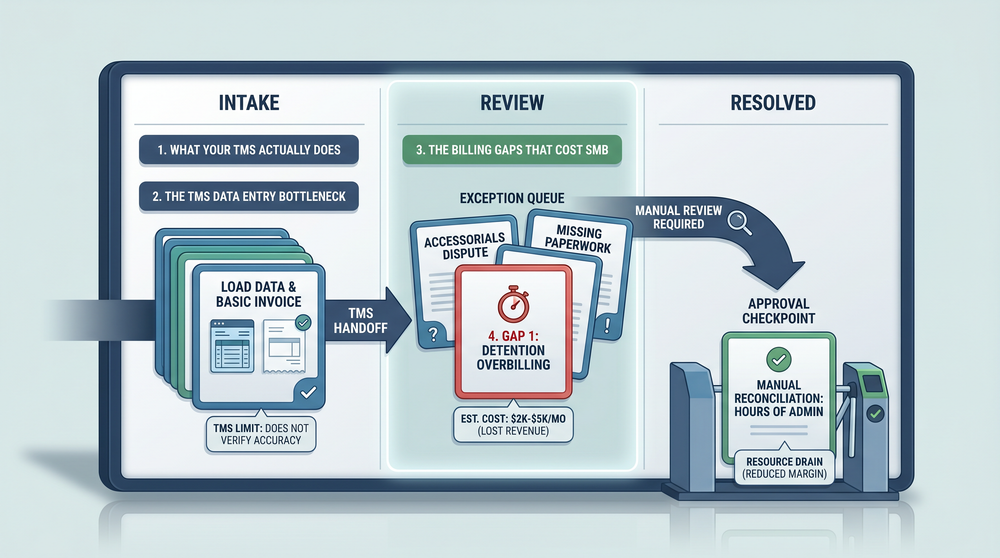
A TMS is the operational backbone of a freight brokerage or carrier. It handles load tendering, carrier assignment, rate management, shipment tracking, and basic document storage. According to a DAT guide on buying a broker TMS, the core value of a TMS lies in centralizing load lifecycle management: finding carriers, booking loads, tracking status, and generating invoices. That is a lot. But it is also a very specific job.
Here is what a TMS typically handles well:
- Load creation and tender management
- Carrier selection and rate confirmation generation
- Shipment tracking and status updates
- Basic invoicing (generating bills based on load data)
- Document storage (BOLs, PODs, carrier packets)
Here is what a TMS does not do, or does poorly, in nearly every platform on the market:
- Line-item reconciliation of carrier invoices against rate cons
- Automated detection of detention, lumper, or accessorial overbilling
- Cross-referencing fuel surcharge calculations against DOE index rates
- Flagging TONU or dry run charges that lack documented proof of tender
- Matching BOL appointment windows to layover charge claims
The TMS is a load management tool. It is not a billing accuracy tool. That distinction costs SMB brokers and carriers thousands of dollars every month. The 2025 Buyer's Guide to Freight Brokerage Software from Axis TMS describes how modern platforms have added real-time load management and carrier portals, but even these advanced features focus on operational throughput, not post-delivery invoice verification.
The TMS Data Entry Bottleneck
Even the data that does flow through your TMS often gets there manually. A dispatcher spending 4 hours per week keying carrier invoices into a TMS at a $25/hr all-in cost burns $5,200/year on data entry that produces zero margin. That is not a technology problem. It is a workflow design problem. Your TMS expects clean, structured input. Carrier invoices arrive as PDFs, scanned images, or email attachments with inconsistent formatting. Someone has to bridge that gap, and in most 5–50 person operations, that someone is your most experienced (and most expensive) ops person. If your team is still entering BOL data by hand, the TMS is not saving you time on billing. It is just giving you a more organized place to store the errors.
The Billing Gaps That Cost SMB Brokers $2,000–$8,000 a Month
The freight management software market grew from $19.41 billion in 2025 to $21.64 billion in 2026, an 11.5% year-over-year increase according to Research and Markets data reported by CX TMS. Brokers and carriers are spending more on software every year. And yet the billing gaps persist, because the software category itself was never designed to close them.
Let's walk through the specific gaps and what they cost a mid-sized operation.
Gap 1: Detention Overbilling
Carriers bill detention based on their own records. Your TMS timestamps when a load was tendered and when it was marked delivered, but it does not compare the carrier's claimed wait time against the facility appointment window on the BOL. On a 500-load/month operation, an average of $18 in uncaught detention overbilling per load means $9,000/month walking out the door. Over a year, that is $108,000 in charges that were never verified against the original rate con terms.
Gap 2: Fuel Surcharge Miscalculations
Your rate con specifies a fuel surcharge based on the DOE national average diesel index. But the carrier applies their own FSC table instead. On a $2,200 linehaul, the difference between a 22% FSC (per DOE index) and a 28% FSC (per the carrier's internal table) is $132 overcharged. Even a more conservative scenario, where the carrier's rate is just 2 percentage points higher than the agreed DOE-based rate, produces a $44 overcharge per load. On 100 affected loads per month, that is $4,400/month your TMS never flagged.
Gap 3: Lumper Fee Double-Billing
Grocery and retail freight is especially vulnerable. The shipper pays the lumper fee directly at the receiver. The carrier also invoices a $250 lumper charge. Without BOL-to-invoice matching that checks whether the lumper was already covered, this double-bill passes through unchallenged on at least 1 in 12 loads. For a broker handling 300 loads/month on grocery lanes, that is 25 loads with duplicate lumper charges: $6,250/month.
Gap 4: TONU and Dry Run Charges Without Proof
Truck not used (TONU) and dry run charges average $150 to $350 per incident. Carriers submit these on roughly 2% to 4% of loads in high-volume lanes. On 500 loads/month, that is 10 to 20 TONU charges, often billed without documented proof of tender. If half of those are unsubstantiated, you are paying $750 to $3,500/month for loads that may not have been legitimately dispatched.
Gap 5: Unauthorized Layover Charges
Layover charges of $250 to $400/day show up on carrier invoices with no cross-reference to the original appointment window on the BOL. Your TMS timestamps the load but does not flag whether the layover was authorized by your ops team or matched the shipper's delivery schedule. On even 5 disputed layover charges per month, that is $1,250 to $2,000 in unverified charges.
Add it all up for a 500-load/month broker: detention ($9,000) plus fuel surcharge ($4,400) plus lumper doubles ($6,250) plus TONU ($2,125 midpoint) plus layover ($1,625 midpoint) equals $23,400/month. Even if your operation is smaller or catches some of these manually, the range of $2,000 to $8,000/month in leaked billing for a typical SMB freight broker is conservative. These are the numbers that explain where small freight brokers lose money.
Manual Invoice Review: Why Carrier Packets Still Require Human Eyes
If your TMS could catch all of this, you would not need this article. The reason it cannot comes down to document complexity. A carrier invoice is not a structured data feed. It is a PDF (or worse, a scanned image) with line items that vary in format from carrier to carrier. Your billing coordinator is doing the real reconciliation work: pulling up the rate con, comparing the linehaul, checking each accessorial, verifying the FSC calculation, and making sure the POD matches.
The True Cost of Manual Reconciliation
A mid-sized carrier or brokerage processing 300 invoices/month and spending 6 hours/week on dispute resolution at a loaded labor cost of $30/hr spends $720/month, or $8,640/year, just managing back-and-forth on accessorial disputes they cannot quickly prove. That does not include the initial review time. It does not include the hours spent hunting for the original BOL or rate con in your TMS document storage. And it does not include the margin erosion when your team decides a $44 overcharge is not worth 20 minutes of their time to dispute. Multiply that decision by 100 loads and you have just absorbed $4,400 in costs because proving the discrepancy was harder than paying it.
Why 'Good Enough' Matching Fails
Some TMS platforms offer basic invoice matching: they compare the total billed amount to the expected amount from the load record. If the numbers are close, the invoice passes. The problem is that carrier invoices can be correct on the total but wrong on the components. A carrier might undercharge linehaul by $50 and overcharge detention by $75, netting a $25 difference that falls within the 'close enough' tolerance. Your TMS approves it. You just lost $75 on detention that should have been $0. Line-item reconciliation, comparing each charge category on the invoice against the corresponding terms on the rate con, is what catches these. And that is a level of document analysis your TMS was never designed for.
What Is the Best TMS for Trucking Companies? (And What None of Them Cover)
This is one of the most searched questions in freight tech. The honest answer: it depends on your operation size, load volume, and whether you are a broker, asset carrier, or hybrid. But here is what matters for this conversation: the best TMS for your operation still will not close the billing gaps described above.
Top TMS Providers for SMB Freight Operations
According to Ark TMS's 2026 roundup of TMS platforms for freight brokers, the most commonly cited platforms for SMB brokers include Tai TMS, Rose Rocket, Aljex (now part of Trimble), McLeod Software, Turvo, and Ascend TMS. Each has strengths in specific areas:
- Tai TMS: Strong carrier management and CRM integration, popular with brokerages under 50 employees
- Rose Rocket: Modern interface, good for asset carriers and brokers who want real-time visibility
- McLeod Software: Enterprise-grade, widely used by larger operations (500+ loads/month)
- Ascend TMS: Free tier available, common entry point for brokerages just starting out
- Turvo: Collaboration-focused, designed for multi-party visibility across broker-carrier-shipper networks
Per Intek Logistics' 2026 TMS evaluation guide, modern TMS evaluation increasingly centers on AI integration, managed freight programs, and total cost of ownership rather than feature checklists alone. That is a shift in the right direction. But even the most advanced TMS platforms treat invoicing as an output function (generating bills), not a verification function (auditing incoming carrier charges against contractual terms).
How Much Does a TMS System Cost?
TMS pricing varies widely based on deployment model and operation size:
- Cloud-based SaaS for SMB brokers: $75 to $300/user/month. Most common for 5–50 person operations.
- Per-load pricing models: $1 to $5/load, offered by platforms like Tai TMS and Ascend TMS.
- Enterprise on-premise solutions: $50,000 to $500,000+ in implementation costs, plus annual maintenance. Typically McLeod, MercuryGate, or Oracle TMS.
- Free tiers: Ascend TMS offers a free version with limited features, suitable for very small brokerages.
The global transportation management system market was valued at $18.70 billion in 2025 and is projected to reach $21.30 billion in 2026, according to Fortune Business Insights' market analysis. Brokers are spending significant budget on TMS tools. The question is whether that spend covers the full freight billing workflow or just the load management portion.
Is Uber Freight a TMS System?
Uber Freight is a digital freight brokerage, not a TMS. It connects shippers with carriers through a marketplace model. Uber Freight operates as a broker itself, handling the carrier sourcing, pricing, and load matching on behalf of shippers. A broker using their own TMS would not use Uber Freight as a software tool. They would encounter Uber Freight as a competitor in the brokerage market. If you are a carrier, you might book loads through Uber Freight's platform, but it does not replace your need for a TMS to manage your own operations, invoicing, and dispatching.
How Much Does a TMS Cost, Who Are the Largest Providers, and Is Uber Freight One of Them?
To address these questions together, because they come up in every TMS buying conversation: the largest TMS providers by market share include Oracle Transportation Management, SAP Transportation Management, Blue Yonder (formerly JDA), MercuryGate, and Trimble. These are enterprise platforms. For SMB freight brokers, the relevant players are the ones listed above: Tai, Rose Rocket, McLeod, Ascend, Turvo, and a handful of others.
Who Are the Largest TMS Providers?
At the enterprise level, Oracle and SAP dominate. Their TMS solutions serve shippers with $100M+ in annual freight spend. In the mid-market, MercuryGate and Trimble (including their Aljex acquisition) serve both brokers and 3PLs. For SMB brokers (the 5–50 employee range this article focuses on), the leaders are cloud-native platforms designed specifically for brokerage workflows. The Vektor TMS buying guide emphasizes that broker TMS selection should prioritize operational continuity during implementation and alignment with your specific load volume and carrier network, not just feature lists.
Why Provider Size Does Not Solve Billing Gaps
Here is the core point: whether you use Oracle's $500,000 enterprise TMS or Ascend's free tier, the billing verification gap is the same. Neither platform was designed to pull data off a carrier's PDF invoice, compare each line item against your rate con terms, check the fuel surcharge against the DOE index for that week, and flag discrepancies for your billing coordinator. That is a document intelligence problem, not a load management problem. Your TMS handles the load. The gap is in the invoice.
What a Complete Back-Office Freight Billing Workflow Actually Looks Like
If your TMS covers load management and your billing team covers manual reconciliation, what fills the middle? Here is the workflow map for an operation that actually catches the $2,000 to $8,000/month in billing leakage:
Step 1: Document intake. Carrier invoices, BOLs, PODs, and rate cons are received from multiple sources (email, carrier portals, TMS uploads). They arrive in inconsistent formats.
Step 2: Data extraction. Each document's line items are extracted into structured data. This means converting a PDF's "Detention: $375" into a data field your system can compare against the rate con's detention terms.
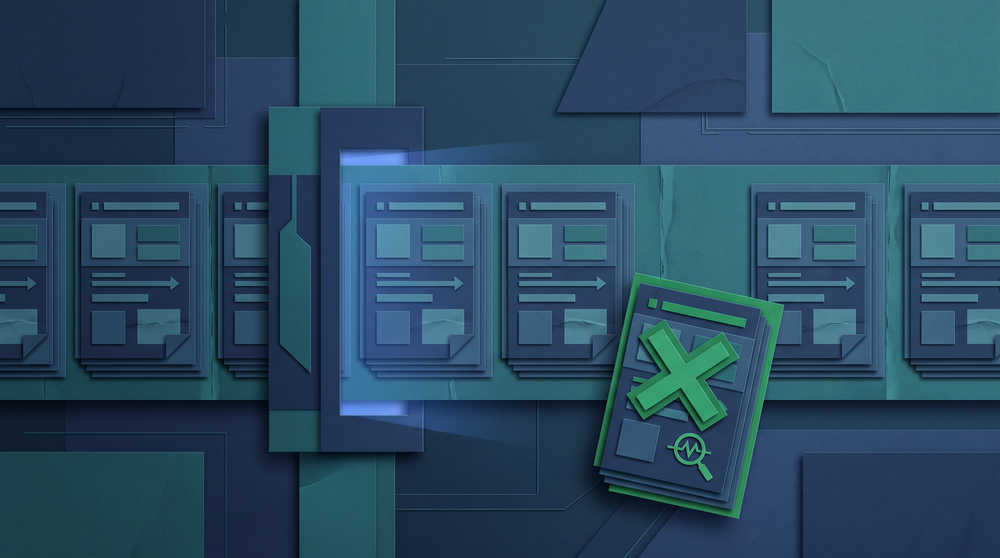
Step 3: Document matching. The carrier invoice is matched to the correct load by PRO number, BOL number, or load ID. The rate con for that load is pulled. The POD is pulled.
Step 4: Line-item reconciliation. Each charge on the carrier invoice is compared against the corresponding term on the rate con. Linehaul vs. agreed linehaul. FSC percentage vs. DOE index. Detention hours vs. BOL appointment window. Lumper charge vs. shipper payment records.
Step 5: Discrepancy flagging. Any charge that does not match is flagged with the specific variance: "Carrier billed $616 FSC (28%). Rate con specifies DOE-based FSC of $484 (22%). Variance: $132."
Step 6: Dispute documentation. The flagged discrepancy is packaged with the supporting documents (rate con, BOL, POD) so your billing coordinator can send a dispute with proof attached, not just a phone call saying "this looks wrong."
Step 7: Approval or adjustment. Clean invoices are approved for payment. Disputed invoices are held until resolution.
Your TMS covers parts of Steps 1 and 3 (document storage and basic load matching). Steps 2, 4, 5, and 6 are where the money leaks. Those are the steps that require either significant manual labor or purpose-built document automation.
Real-World Examples: What These Gaps Cost in Practice
Let's put specific numbers to three common scenarios.
Example: Fuel Surcharge Miscalculation on 100 Loads
A broker moves 100 loads/month with an average linehaul of $2,200. The rate con specifies fuel surcharge based on the DOE national average diesel index, which at the time of billing translates to a 22% FSC ($484 per load). The carrier applies their own internal FSC table at 28% ($616 per load). The overcharge per load is $132. But let's use the more conservative scenario where the carrier's rate is only 2 percentage points above the agreed rate, producing a $44 overcharge per load. On 100 loads, that is $4,400/month. Over a year, $52,800. The TMS recorded the load and generated the broker's outbound invoice to the shipper. It did not compare the carrier's inbound FSC rate against the DOE index specified on the rate con.
Example: Lumper Double-Billing on Grocery Freight
A broker handles 240 loads/month on grocery and retail lanes. The shipper pays lumper fees directly at the receiver on many of these loads. The carrier also invoices a $250 lumper charge. Without BOL-to-invoice matching that cross-references shipper payment records, this double-bill passes through on approximately 1 in 12 loads. That is 20 loads/month with duplicate $250 charges: $5,000/month, or $60,000/year. The fix requires matching three documents: the carrier invoice, the BOL (showing delivery to a lumper-equipped facility), and the shipper's payment confirmation. Your TMS stores all three but does not compare them.
Example: Dispute Resolution Labor Costs
A mid-sized operation processes 300 carrier invoices/month. The billing coordinator spends 6 hours/week on dispute resolution: pulling up rate cons, recalculating charges, drafting dispute emails, and following up. At a loaded labor cost of $30/hr, that is $720/month or $8,640/year. But here is the hidden cost: for every dispute that takes more than 15 minutes to document, the team is incentivized to just pay it. If the overcharge is under $50, it is often cheaper to absorb than to fight. Across 300 invoices, those small leaks add up to thousands per month. The problem is not that your people are lazy. The problem is that proving the discrepancy requires manual document comparison that is slow and tedious. Speed up the proof, and you change the math on which disputes are worth pursuing.
Frequently Asked Questions
What billing tasks does a TMS not handle?
A TMS manages the load lifecycle: tendering, tracking, and basic invoicing. It does not perform line-item reconciliation of incoming carrier invoices against rate con terms. It does not automatically verify fuel surcharge calculations against the DOE index, detect lumper fee double-billing, or flag TONU charges that lack proof of tender. These tasks require document-level comparison that falls outside standard TMS functionality.
How much does a TMS cost for a small freight broker?
Cloud-based TMS platforms for SMB brokers typically cost $75 to $300 per user per month. Some platforms offer per-load pricing at $1 to $5 per load. Free tiers exist (Ascend TMS, for example) but come with feature limitations. Enterprise solutions from Oracle or SAP can run $50,000 to $500,000+ in implementation costs. For a 5–50 person brokerage, expect to budget $500 to $3,000/month for a capable cloud TMS.
Who are the largest TMS providers?
At the enterprise level, Oracle Transportation Management and SAP Transportation Management lead by market share. In the mid-market, MercuryGate and Trimble are widely used. For SMB freight brokers, the most common platforms include Tai TMS, Rose Rocket, McLeod Software, Ascend TMS, and Turvo. The right choice depends on your load volume, whether you are asset-based or a pure brokerage, and how much you want to spend per month.
Is Uber Freight a TMS?
No. Uber Freight is a digital freight brokerage that connects shippers with carriers through a marketplace. It competes with freight brokers rather than serving as a software tool for them. Carriers may book loads through Uber Freight's app, but it does not replace a TMS for managing operations, dispatching, or invoicing. If you are a broker, Uber Freight is a competitor, not a tool.
What does carrier invoice matching actually involve?
Carrier invoice matching means comparing every line item on a carrier's invoice (linehaul, fuel surcharge, detention, lumper fees, accessorials) against the agreed terms on the rate con and the supporting documents (BOL, POD). True matching goes beyond comparing totals. It checks each charge category individually, because a carrier can be correct on the total while overcharging on one line item and undercharging on another. This level of reconciliation is what catches the billing gaps that TMS platforms miss.
What Comes After You Understand the Gaps
Your TMS is doing its job. It was built to manage loads, and it does that. The billing gaps described here are not a TMS failure. They are a category gap. The freight industry built excellent tools for moving freight and mediocre tools for verifying what carriers charge for moving it.
If your operation processes more than 200 invoices a month, the math is clear. Manual reconciliation is expensive, slow, and incentivizes your team to let small overcharges slide. Those small overcharges compound into $2,000 to $8,000/month for a typical SMB broker.
The fix is not a better TMS. It is a layer that sits between your carrier's invoices and your TMS, one that extracts, matches, and flags discrepancies before your billing coordinator ever touches the file. If that sounds like the workflow gap your team deals with every week, tools that automatically flag invoice discrepancies exist specifically for this problem. You can also see what that costs before committing to a conversation.
Sources
- 5 Tips to Buying a Broker TMS — DAT
- The 2025 Buyer's Guide to Freight Brokerage Software — Axis TMS
- The Freight Management Software Market Hits $21.6 Billion — CX TMS (citing Research and Markets)
- Transportation Management System Market Size, Share — Fortune Business Insights
- 2026 Best Transportation Management System (TMS) — Intek Logistics
- Best TMS for Freight Brokers in 2026 — Ark TMS
- Broker TMS Buying Guide — Vektor TMS
Full guide: TMS Limitations Every Freight Ops Team Hits (But Nobody Talks About)
Related: Automated Freight Audit Tools: What They Catch That You Miss
Related: TMS Gaps Are Costing You Per Load: Where the Money Goes