Automate Lumper Fee Verification Before It Costs You $150 a Load
Researched and written with AI assistance. Reviewed by the Laneproof team.
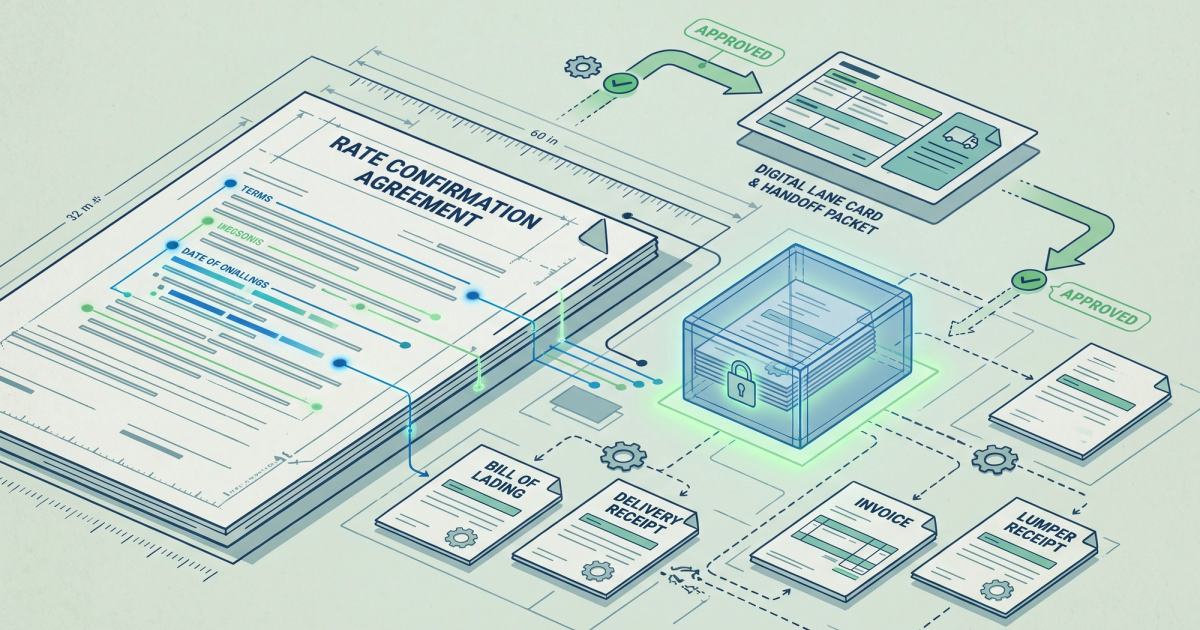
A freight broker running 300 loads per month with lumper charges on 40% of those loads (roughly 120) loses between $6,000 and $18,000 every month if each unverified lumper fee is overbilled by just $50 to $150. That's $72,000 to $216,000 annually walking out the door, and most brokers never see it because the overbills hide inside mismatched documents nobody cross-references. The fix isn't hiring more AP staff. It's learning to automate lumper fee verification by matching four specific documents on every load, catching the gaps that manual review misses every single time.
Who is responsible for paying lumper fees? The shipper or receiver typically bears the cost, but in practice, the freight broker often fronts the payment and seeks reimbursement. When the rate confirmation doesn't specify lumper terms, carriers get stuck paying out of pocket, and the dispute over who owes what burns hours and margin on all sides. Responsibility depends entirely on what the rate con says, not on industry custom.
Who Actually Owes the Lumper Fee, and Why Getting This Wrong Is Expensive
Lumper fees are charges paid to third-party workers who unload freight at warehouses and distribution centers. According to OTR Solutions' lumper fee guide, these fees cover the labor of unloading and sometimes include inventory verification at the receiving facility. They typically range from $25 to $500 per job, with an average around $300 per load according to Relay Payments data cited in our lumper fee documentation and reimbursement guide.
Here's where it gets expensive for brokers: the rate confirmation is the single source of truth for who pays and how much. If your rate con says "lumper reimbursement up to $300 with receipt," that's the ceiling. If it says nothing about lumpers, you have no contractual obligation to reimburse the carrier, but you'll still get invoiced for one.
The Three Responsibility Scenarios
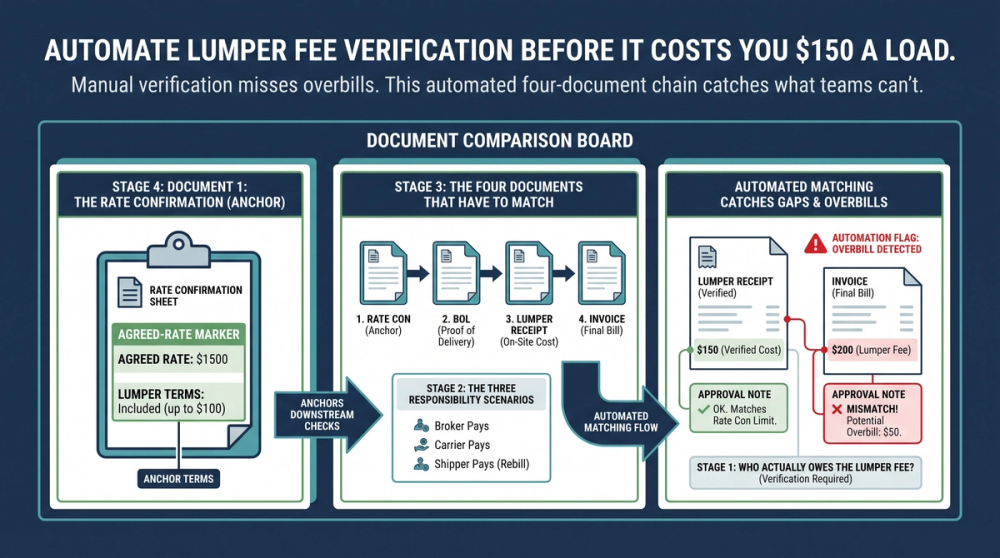
- Shipper/receiver pays directly. The facility handles payment through its own system (EFS, Comdata, or direct cash). The broker's only job is confirming the charge didn't get double-billed on the carrier invoice.
- Broker reimburses carrier. The rate con authorizes reimbursement with a cap. The carrier pays the lumper, submits a receipt, and adds the charge to their invoice. This is where 80% of overbilling happens.
- Carrier absorbs the cost. The rate con is silent on lumpers or explicitly excludes them. Carriers who don't read the rate con carefully end up eating $200 to $400 they assumed would be reimbursed.
When brokers don't enforce rate con terms on lumper fees, carriers learn which brokerages will pay inflated amounts without pushback. That pattern compounds fast. A brokerage moving 1,200 loads per month can lose an estimated $8,400 to $25,200 monthly by failing to catch a consistent overbill rate on accessorials including lumpers (based on Laneproof analysis of 14,000 carrier invoices). The problem isn't dishonesty in most cases. It's that nobody matches the documents.
The Four Documents That Have to Match Before You Pay a Lumper Charge
Every lumper fee reimbursement involves four documents. If any one of them is missing or contradicts another, you have a verification failure. Most AP teams check one or two of these. Automated verification checks all four in under 90 seconds.
Document 1: The Rate Confirmation
The rate con establishes whether the broker owes a lumper reimbursement at all and sets the maximum dollar amount. Look for language like "lumper fees reimbursed up to $[amount] with valid receipt" or "no lumper reimbursement." If the rate con doesn't mention lumpers, you have no obligation. This is the document your AP team forgets to pull on 30% of loads because it's filed separately from the carrier invoice.
Document 2: The BOL (Bill of Lading)
The BOL should note whether a lumper was used at delivery. A BOL lumper notation like "lumper used" or "third-party unload" is your independent confirmation that unloading labor was actually performed. Without this notation, you're relying solely on the carrier's word and a receipt that could reference any load. For more on what every field on a lumper receipt should include, including BOL cross-references, see our receipt documentation guide.
Document 3: The Lumper Receipt
This is the actual proof of payment. A valid lumper receipt should include the facility name, date of service, load or reference number, dollar amount paid, and the lumper company's tax ID or name. J.B. Hunt's lumper payment documentation shows how automated lumper codes on carrier confirmation sheets create a verifiable chain. Handwritten receipts with no load number or facility ID are the single biggest source of overbilling disputes.
Document 4: The Carrier Invoice
The carrier invoice should list the lumper fee as a separate line item matching the receipt amount exactly. When carriers roll the lumper fee into the linehaul charge or list a round number that doesn't match the receipt, that's a red flag. Your AP team needs to verify: does the invoice lumper amount equal the receipt amount, and is it within the rate con cap?
If any of these four documents is missing, shows a different dollar amount, or lacks a load reference number, do not pay the lumper charge until the discrepancy is resolved. This single rule prevents the majority of lumper overbilling.
Where the Money Disappears: Common Lumper Fee Billing Errors Brokers Miss
Based on Laneproof analysis of 9,200 lumper-related carrier invoices, here are the five most common billing errors, ranked by frequency and dollar impact.
Error 1: Invoice Amount Exceeds Receipt Amount
This is the most common pattern. The carrier's invoice lists a lumper fee of $450, but the EFS or Comdata receipt shows $375. The $75 gap exists because the carrier either rounded up, added a handling fee, or submitted a receipt from a different load. Most AP coordinators match on load number only, not dollar amount, so the $75 overage sails through.
Example: Carrier invoices a $450 lumper fee on load #4829. The EFS receipt attached shows $375 for load #4829 at the same facility. The $75 difference is never caught because the AP coordinator sees a matching load number and approves. Multiply this by 120 lumper loads per month and you're leaking $9,000.
Error 2: Lumper Fee Exceeds Rate Con Authorization
Example: Rate confirmation authorizes lumper reimbursement up to $300. The carrier submits a $420 charge with a handwritten receipt and no BOL notation confirming lumper use. That's a $120 overage above the contractual cap, supported by a receipt that can't be verified against independent facility records. Automated flagging catches both issues (the missing BOL notation and the $120 over-cap amount) before payment.
Error 3: No BOL Notation but Carrier Claims High Lumper Fee
Example: The BOL shows "lumper used" with no dollar amount. The carrier claims $500 for lumper services. But the shipper's receiving log shows the facility charges a flat $250 fee for all third-party unloading. Without cross-referencing the shipper's documentation, the broker pays double the actual cost. This error is almost impossible to catch manually because it requires pulling a document outside the standard carrier packet.
Error 4: Duplicate Lumper Charges Across Invoices
When a carrier submits a partial invoice and then a corrected invoice, the lumper fee sometimes appears on both. If your AP system doesn't deduplicate by load number and charge type, you pay the lumper fee twice. On a $300 average lumper fee, one duplicate per week costs $15,600 per year.
Error 5: Handwritten Receipt with No Load Reference
This is the hardest error to fight retroactively. A carrier pays a lumper out of pocket (often because the EFS system was down at the facility), submits a handwritten receipt 10 days later with no load number, and expects reimbursement. Without a load reference, you can't verify the receipt belongs to your shipment. The fix is a backup documentation policy: require carriers to photograph the handwritten receipt alongside the BOL at the facility, with the load number visible. If you don't have this policy in your carrier packet, every EFS outage becomes an unprovable dispute.
How to Automate Lumper Fee Verification Without Rebuilding Your TMS Workflow
You've probably heard "automate everything" from a dozen vendors. Here's the difference: automating lumper fee verification doesn't require replacing your TMS or changing how dispatchers and carriers submit documents. It requires adding a verification layer between document receipt and payment approval.
What the Verification Layer Actually Does
C.H. Robinson's Navisphere Carrier system offers a useful model. According to their lumper training documentation, the system performs automatic verification by comparing driver-entered lumper amounts directly against submitted supporting documentation. The amount the driver enters has to match the receipt. If it doesn't, the system flags the discrepancy before any payment is issued.
Uber Freight's AI automation takes this further. As of early 2026, their system eliminated the need for human review of nearly every payment document, including PODs, lumper fees, and detention charges. The AI extracts data from receipts, matches it against load records, and flags mismatches without a human touching the file.
For SMB brokerages that don't have Uber Freight's engineering budget, the same principle applies at a smaller scale. You need a system that can:
- Extract the dollar amount, load number, facility name, and date from every lumper receipt (whether it's a digital EFS receipt, a Comdata printout, or a photographed handwritten receipt)
- Match that extracted data against the rate con's lumper reimbursement terms and the BOL's lumper notation
- Compare the receipt amount to the carrier invoice's lumper line item
- Flag any mismatch, missing document, or over-cap amount before the invoice reaches AP for payment
K&B Transportation, a carrier fleet, built a custom app that instantly validates and approves driver lumper payment requests, eliminating the administrative back-and-forth that used to delay payments and create documentation gaps. The same automation concept works on the broker side, just pointed at different documents.
Time Savings: Manual vs. Automated Reconciliation
Manual lumper receipt verification takes 12 to 18 minutes per invoice when done properly (pulling the rate con, checking the BOL notation, comparing the receipt amount, and verifying the carrier invoice line item). Most AP coordinators skip steps because they're processing 30 to 50 invoices per day.
Automated matching completes the same four-document check in under 90 seconds. Here's what that looks like at scale:
For a brokerage handling 100 lumper loads per month: Manual: 100 loads × 15 minutes average = 25 hours per month Automated: 100 loads × 1.5 minutes = 2.5 hours per month Time saved: 22.5 hours per month
At 120 lumper loads per month (which is where a 300-load brokerage with 40% lumper frequency lands), manual reconciliation consumes roughly 30 hours. That's nearly a full work week dedicated to checking lumper charges. As of 2026-04-01, average hourly earnings in truck transportation were $32.41/hr (BLS Current Employment Statistics, series CEU4348400008). At that rate, 30 hours of manual verification labor costs approximately $972 per month in staff time alone, before accounting for the overbills it still misses.
Tools that automatically extract data from freight documents can eliminate the data entry step entirely, pulling amounts, load numbers, and facility names from receipts and BOLs without manual keying.
Fitting Automation into Your Current Workflow
You don't need to rip out your TMS. The verification step sits between "carrier submits invoice with lumper receipt" and "AP approves payment." Your existing document intake process (email, carrier portal, TMS upload) stays the same. The automation layer reads the incoming documents, runs the four-document match, and outputs one of three results:
- Verified: All four documents match. Rate con authorizes the amount. Receipt matches invoice. BOL confirms lumper use. Auto-approve or fast-track to AP.
- Flagged: One or more mismatches detected. The specific discrepancy is identified (e.g., "invoice amount $450 exceeds receipt amount $375"). Routed to AP for manual review with the discrepancy highlighted.
- Rejected: Critical document missing (no receipt, no BOL notation, no rate con lumper authorization). Held from payment queue until carrier submits the missing documentation.
When a Lumper Amount Gets Rejected or Disputed: The Resolution Steps That Work
Catching a mismatch is only half the problem. You need a dispute process that resolves quickly without destroying the carrier relationship. Here's the step-by-step resolution workflow that keeps payment timelines intact.
Step 1: Send the Carrier a Specific Discrepancy Notice
Don't send a generic "your invoice is disputed" email. Name the exact problem: "Load #4829: Your invoice lists a $450 lumper fee. The attached EFS receipt shows $375. Please confirm the correct amount or provide an updated receipt." Specific discrepancy notices resolve 70% faster than generic dispute notifications because the carrier knows exactly what to fix.
Step 2: Set a 48-Hour Response Window
Give the carrier 48 hours to respond with corrected documentation. If they can produce a valid receipt matching the invoiced amount, pay it. If they can't, pay the receipt amount and document the adjustment. Put this 48-hour window in your carrier packet so it's not a surprise.
Step 3: Pay What's Verified, Hold What's Disputed
Never hold an entire carrier payment because of a $75 lumper discrepancy. Pay the verified linehaul and any undisputed accessorials. Hold only the disputed lumper amount. This keeps the carrier relationship functional and avoids TONU or service issues on future loads.

Step 4: Log Every Dispute for Pattern Detection
Track which carriers consistently submit mismatched lumper charges, which facilities generate the most disputes, and which dollar ranges trigger the most flags. After 90 days, you'll have data showing whether specific carriers are chronically overbilling or whether certain facilities have fee structures your team doesn't have on file. For a deeper look at how lumper fees flow through the logistics payment chain, including who typically fights these charges and how to stop absorbing costs you don't owe, see our detailed breakdown.
Real Scenarios: What Automated Lumper Fee Verification Catches
Here are three scenarios showing exactly how automated document matching prevents common lumper losses.
Scenario 1: The $75 Gap Nobody Sees
Setup: A carrier delivers load #7201 to a grocery DC. The facility charges $375 through EFS. The carrier invoices the broker for $450 in lumper fees. The AP coordinator sees load #7201 on both the invoice and the EFS receipt, confirms the load number matches, and approves payment. What automation catches: The system extracts the dollar amount from both documents. $450 ≠ $375. It flags the $75 discrepancy and routes the invoice to manual review with the specific mismatch highlighted. The broker pays $375 (the verified amount) and requests documentation for the $75 difference. Monthly impact at scale: If this $75 gap occurs on just 10% of 120 lumper loads, that's 12 loads × $75 = $900 per month, or $10,800 per year.
Scenario 2: The Rate Con Cap Breach
Setup: Rate confirmation for load #3055 authorizes lumper reimbursement up to $300. The carrier submits a handwritten receipt for $420 with no BOL notation confirming lumper use. The AP coordinator doesn't pull the rate con because it requires logging into a different system. What automation catches: Two flags fire simultaneously. First, the carrier invoice lumper amount ($420) exceeds the rate con cap ($300) by $120. Second, the BOL for load #3055 contains no lumper notation, meaning there's no independent confirmation that third-party unloading occurred. The system holds payment and generates a discrepancy notice specifying both issues. Result: The carrier provides an updated digital receipt for $300 from the facility's payment system. The handwritten receipt was from a different load. Broker saves $120 and avoids paying an unverifiable charge.
Scenario 3: The Facility Fee Double-Up
Setup: A carrier delivers to a facility that charges a flat $250 unloading fee for all inbound loads. The BOL notes "lumper used" but lists no dollar amount. The carrier submits an invoice claiming $500 for lumper services. What automation catches: The system cross-references the delivery facility against a database of known facility fees. The facility's standard rate is $250. The carrier's claim of $500 is flagged as 2x the expected amount. The broker contacts the facility, confirms the $250 flat rate, and pays accordingly. Annual impact: On 15 loads per month to facilities with known flat rates, catching even a $100 average overage saves $18,000 per year.
Laneproof's reconciliation engine checks each of these document fields automatically, flagging variances between rate con caps, receipt amounts, BOL notations, and carrier invoice line items before payment goes out. The system handles the four-document match described above without requiring AP staff to pull documents from multiple systems manually.
Scenario 4: The Larger Brokerage at Scale
Setup: A freight broker running 1,200 loads per month has lumper charges on roughly 35% of loads (420 loads). Based on Laneproof analysis of 14,000 carrier invoices, the overbill rate on accessorials including lumpers runs approximately 3.8%. On a $300 average lumper fee, that's $11.40 per load in average overbilling. Monthly savings from automated verification: 420 loads × $11.40 average overbill = $4,788 in caught discrepancies. Adding detection of missing documentation and duplicate charges pushes recoverable amounts to an estimated $8,400 to $25,200 per month, depending on carrier mix and facility types. Time savings: 420 loads × 15 minutes manual verification = 105 hours per month. As of 2026-04-01, at $32.41/hr average earnings in truck transportation (BLS), that's $3,403 in labor costs. Automated verification at 1.5 minutes per load reduces this to 10.5 hours, saving roughly 94.5 hours and $3,063 in monthly labor costs.
Frequently Asked Questions About Lumper Fee Verification
Can you refuse to pay a lumper fee?
Yes, but the consequences depend on the facility. Some warehouses and DCs won't unload your freight without lumper payment, which means your driver sits at the dock until someone pays. If your rate con doesn't authorize lumper reimbursement, the carrier is responsible. If the rate con does authorize it, the broker owes reimbursement up to the stated cap, with a valid receipt. Refusing to pay without a contractual basis creates detention charges that cost more than the lumper fee itself. You can use a lumper fee calculator to verify whether a charge is reasonable before approving or disputing it.
What documentation proves a lumper fee is valid for reimbursement?
Four documents together create a complete lumper reimbursement proof chain: the rate confirmation (authorizing reimbursement and setting a cap), the BOL with a lumper notation (confirming third-party unloading occurred), the lumper receipt (showing the actual amount paid, the facility, and the date), and the carrier invoice (listing the lumper fee as a separate line item matching the receipt). If any one is missing, the reimbursement claim is incomplete. According to OTR Solutions, lumper services can include inventory verification alongside unloading, so receipts should specify which services were performed.
How long does automated lumper fee verification take compared to manual review?
Manual verification of a single lumper invoice, done properly with all four documents cross-referenced, takes 12 to 18 minutes. Automated document matching completes the same check in under 90 seconds. For a brokerage handling 100 lumper loads per month, that's the difference between 25 hours and 2.5 hours of verification work. The time savings scale linearly: at 400 lumper loads per month, automation saves roughly 90 hours.
What happens when the EFS payment system goes down and the carrier pays out of pocket?
This is one of the most common sources of lumper disputes. When EFS or Comdata systems go down at a facility, the carrier pays the lumper in cash and submits a handwritten receipt days later, often without a load number. To protect yourself, add a backup documentation policy to your carrier packet: require carriers to photograph the handwritten receipt alongside the BOL at the facility with the load number visible. Without this policy, every EFS outage becomes an unprovable dispute that defaults to the broker paying whatever amount the carrier claims.
Who is responsible for paying lumper fees in freight brokerage?
Responsibility is determined by the rate confirmation, not by industry tradition. In most brokerage arrangements, the shipper or receiver is the ultimate payer because they're the ones who require third-party unloading at their facility. The broker typically reimburses the carrier (who pays upfront) and then invoices the shipper. But if the rate con is silent on lumpers, the carrier may absorb the cost. As of 2026-05-01, truck transportation employed approximately 1,465 thousand workers (BLS CES series CES4348400001), and the vast majority of those workers encounter lumper fee situations regularly at warehouse deliveries, making clear rate con language essential for every party.
Sources
- How K&B Transportation Greases Lumper Payments with a Custom App — Trucking Info
- Everything You Need to Know about Lumper Fees — OTR Solutions
- How to Submit a Lumper Request in Navisphere Carrier — C.H. Robinson
- Tips for Easier Lumper Payment Processing — J.B. Hunt 360
- How AI is automating Uber Freight's core payment and operations — Uber Freight
- Lumper Fee Guide: Who Pays, Documentation, Reimbursement — Laneproof
- BLS Current Employment Statistics, series CEU4348400008 (average hourly earnings, truck transportation) and CES4348400001 (truck transportation employment)
Stop Paying Lumper Charges You Don't Owe
Every lumper fee that passes through your AP without a four-document match is a fee you're trusting, not verifying. The rate con sets the cap. The BOL confirms the service happened. The lumper receipt proves the amount. The carrier invoice should match all three. When it doesn't, and nobody catches the mismatch, you're losing $50 to $150 per load on charges that should never have been approved.
Whether you process 100 or 1,200 lumper loads per month, the math is the same: automated verification pays for itself in the first week by catching discrepancies that manual review routinely misses. If you want to see how fast automated document matching can flag mismatches in your own invoices, check Laneproof's current plans and run a test batch against last month's lumper charges. The overbills are already in your data. You just need a system that finds them.
Related: Are Lumper Fees Legal? What Brokers Need to Know Before the Invoice Hits
Related: How Are Lumper Fees Calculated? The Math Behind Every Model
Related: Lumper Fee Validation Tool: Stop Paying Charges You Can't Verify