Lumper Fee Validation Tool: Stop Paying Charges You Can't Verify
Researched and written with AI assistance. Reviewed by the Laneproof team.

A broker running 300 loads per month with a 12% lumper frequency and an average of $80 in unverified overcharges per affected load is losing $2,880 every month. That's $34,560 per year walking out the door because nobody spent five minutes checking receipts. A lumper fee validation tool catches those overcharges before payment goes out, not after your margin is already gone. According to OTR Solutions' lumper fee guide, lumper fees are one of the most frequently disputed accessorial charges between brokers and carriers. The problem isn't that the charges are always wrong. The problem is that most brokers have no repeatable process to confirm they're right.
Most Brokers Pay Lumper Fees Without Actually Checking Them
Lumper fees typically range from $25 to $500 per load, with the most common band falling between $150 and $400 depending on freight type, volume, and facility, according to this 2026 lumper fee cost and rules guide from OTrucking. That's a massive spread. And inside that spread, inflated and unsupported charges hide in plain sight.
Here's what actually happens on most brokerage desks: a carrier submits an invoice with a lumper line item. The dispatcher or billing coordinator sees a receipt attached, assumes it's legitimate, and approves the reimbursement. Nobody checks whether the facility name matches the delivery location. Nobody confirms the rate con had a lumper notation. Nobody verifies that the receipt itemizes worker count or per-worker rate. The charge gets paid because disputing it takes more time than the team has.
This is how $75 overages become invisible. If your rate con says "lumper NTE $150" and the carrier invoices $225, that $75 delta is small enough to slip through. Multiply it across 40 loads per month and you're bleeding $3,000 monthly on a single accessorial you thought was under control.
The root cause isn't negligence. It's the absence of a structured validation process. Most TMS platforms track lumper charges as a line item but don't validate them against the rate con, the BOL, or the receipt itself. That gap between "recorded" and "verified" is where your margin disappears. If you need a primer on what a lumper fee actually covers and who pays in different scenarios, start there and come back. This article assumes you already know the basics and need the operational checklist to stop paying charges you can't verify.
What a Lumper Fee Validation Tool Actually Checks (And Manual Review Misses)
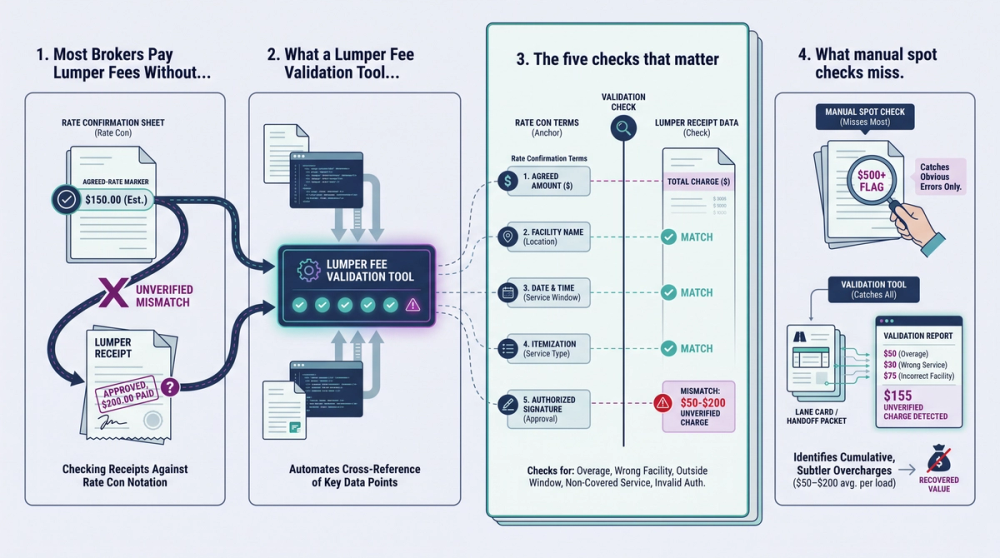
A lumper fee validation tool automates the document cross-checks that your billing team doesn't have time to do on every load. It pulls data from the rate con, the BOL, the lumper receipt, and the carrier invoice, then flags mismatches before the payment is approved.
The five checks that matter
Manual review typically catches the obvious problems: a missing receipt, a charge on a load that wasn't delivered. But the charges that actually cost you money are the ones that look plausible on the surface. A validation tool checks for:
- Rate con match: Does the invoice amount match the lumper notation on the rate con? If the rate con says "NTE $150" and the invoice says $225, the tool flags the $75 overage instantly.
- Facility verification: Does the facility name on the lumper receipt match the delivery location on the BOL? Receipts from unrelated facilities or receipts with no facility name at all are flagged.
- Receipt completeness: Does the receipt include date, time, worker count, per-worker rate, total, and a driver signature? According to Truckstop.com's accessorial charges guide, brokers are expected to verify lumper charges using receipts submitted by drivers before passing the cost to shippers.
- Load type cross-check: Was this a live unload or a drop-and-hook? Lumper fees on drop-and-hook loads should not exist. The tool checks the BOL appointment type and flags any lumper charge on a non-live-unload delivery.
- Threshold comparison: Does the charge fall within the expected range for the facility type? A $400 lumper fee at a grocery DC where the typical range is $100 to $200 triggers an automatic review.
What manual spot checks miss
Even a diligent billing coordinator reviewing every lumper invoice by hand will miss patterns that only emerge across volume. A carrier that consistently bills $50 above the rate con NTE across dozens of loads looks fine on any individual invoice. It's only when you aggregate the data that you see the pattern. Validation tools built for extracting and matching data from freight documents surface these patterns automatically. Manual review catches errors. Structured validation catches strategies.
The 6-Point Document Stack You Need Before Approving Any Lumper Charge
Before you approve any lumper fee reimbursement, you need six documents or data points on file. If any one is missing, hold payment and request it from the carrier. This is your minimum verification stack.
1. Rate confirmation with lumper notation
The rate con should specify whether lumper fees are included, excluded, or reimbursable up to a stated cap ("NTE $200"). If the rate con is silent on lumper fees, you have a decision to make before approving anything. We'll cover that scenario below.
2. Bill of lading with delivery details
The BOL confirms the delivery location, the appointment type (live unload vs. drop-and-hook), and the commodity. You need this to verify that a lumper charge is even plausible for the load.
3. Itemized lumper receipt
This is where most validation fails. An itemized lumper receipt must include the facility name, service date, time in/out, number of workers, per-worker rate, total charge, and driver signature. A handwritten total on a blank piece of paper is not a receipt.
4. Comcheck, EFS, or Relay payment confirmation
According to TrueNorth's guide on getting paid faster by freight brokers, drivers must submit lumper receipts within 24 to 48 hours to ensure timely reimbursement. If the reimbursement was processed via Comcheck or EFS, the payment confirmation should show the payee, amount, and date. An unspecified payee is a red flag.
5. Shipper pre-authorization (when applicable)
Some shipper contracts require pre-authorization for lumper charges above a certain threshold. If your shipper relationship includes this clause, you need written authorization on file before approving the carrier reimbursement. Without it, you may eat the cost.
6. Carrier invoice with lumper line item
The carrier invoice should break out the lumper fee as a separate line item, not roll it into the linehaul. When lumper charges are buried in a single total, you lose the ability to validate them against your rate con notation or the receipt itself.
If any of these six documents is missing, your validation is incomplete. Hold payment. Request the document. The carrier that pushes back hardest on documentation requests is often the carrier that benefits most from you not checking.
How Are Lumper Fees Calculated, and When Do the Numbers Stop Making Sense?
Lumper fees are calculated based on the number of workers assigned to unload, the time required, and the type of freight. Most facilities use a flat rate per load or a per-worker hourly rate. According to LumperHQ's cost calculator guide, the key variables are freight type (palletized vs. floor-loaded), commodity weight, and the facility's own pricing schedule.
Typical cost bands by facility type
These are approximate ranges based on industry reporting and Laneproof analysis of common facility categories. Charges outside these bands warrant immediate documentation review:
- Grocery distribution center: $100 to $200 per load
- Big-box retailer DC: $150 to $300 per load
- Food-grade warehouse: $175 to $350 per load
For context on the labor cost side, as of 2026-04-01, average hourly earnings in truck transportation were $32.41/hr (BLS Current Employment Statistics, series CEU4348400008). That number applies to trucking employees, not third-party lumper workers, but it provides a useful benchmark. When a lumper receipt claims four workers for three hours at $40/hr each ($480 total) at a standard grocery DC, the math doesn't align with the facility type or typical labor costs.
Red flags in lumper fee calculations
Watch for these patterns that indicate inflated or fabricated charges:
- Round-number charges with no breakdown (e.g., "$300" with no worker count or hourly rate)
- Charges significantly above the facility-type range with no explanation for complexity
- Multiple loads at the same facility with wildly different lumper amounts
- Lumper fees on commodity types that are always palletized and rarely require manual unloading
The question isn't whether lumper fees are legitimate. They often are. The question is whether the specific amount on the specific receipt for the specific load matches what actually happened at the dock. That's what validation is for.
Who Is Responsible for Lumper Fees, and What Happens When the Rate Con Is Silent?
The entity responsible for paying lumper fees depends on what the rate confirmation says. In most broker-carrier relationships, the rate con spells out whether lumper fees are the broker's responsibility (reimbursable to the carrier) or the carrier's responsibility (included in the linehaul). The FMCSA requires that carriers not be coerced into paying for loading or unloading services, but the practical allocation is almost always a contractual matter between broker and carrier.
When the rate con has a lumper notation
If the rate con says "lumper reimbursable NTE $200," the process is clear: the carrier pays at the dock, submits an itemized receipt, and the broker reimburses up to the stated cap. Any amount above the cap requires separate authorization or gets denied. This is the scenario where validation is most straightforward, because you have a documented threshold to compare against.
When the rate con is silent
This is where disputes get expensive. If the rate con doesn't mention lumper fees at all, carriers may assume the broker will reimburse. Brokers may assume the linehaul covers it. Both sides have a plausible argument, and the dispute costs more in time than the charge is worth, so the broker often just pays. For a deeper breakdown of how lumper fee responsibility works in different logistics scenarios, including what to do when the rate con is silent, that guide walks through the contract language.
The fix is operational, not legal. Every rate con should explicitly address lumper fees: included, excluded, or reimbursable with a cap. If your rate con template doesn't have a lumper field, add one today. The five minutes it takes to update your template will save you hours of disputes per month.
How to Dispute a Lumper Fee Charge That Does Not Match Your Documentation
Disputing a lumper charge is not about confrontation. It's about documentation. When your validation process flags a mismatch, follow this sequence:
Step 1: Identify the specific discrepancy
Name exactly what doesn't match. "The lumper receipt shows $225 but the rate con NTE is $150" is a dispute. "This seems high" is not. Specificity makes the difference between a resolved dispute and an ignored email.
Step 2: Pull the full document stack
Gather all six documents from the validation checklist above. You need the rate con, BOL, lumper receipt, payment confirmation, shipper pre-authorization (if applicable), and the carrier invoice. Missing documents weaken your position. Complete documentation wins disputes.
Step 3: Send a written request with evidence attached
Email the carrier with the specific discrepancy, the supporting documents, and a clear request: "Please provide an itemized receipt matching the delivery on BOL #12345 or adjust the invoice to the rate con NTE of $150." Give them 48 hours to respond. Most carriers resolve discrepancies quickly when they see you have documentation ready.
Step 4: Deduct or hold if unresolved
If the carrier cannot provide supporting documentation within the stated timeframe, deduct the disputed amount from the carrier payment per your broker-carrier agreement. Document the deduction and your reasoning. This protects you if the dispute escalates.
The key to winning disputes is having a process that runs on every load, not just the ones that look suspicious. When carriers know you validate every lumper charge, the inflated ones stop showing up.

Real Scenarios: What Validated vs. Unvalidated Lumper Fees Look Like
These examples show the difference between brokers who validate and brokers who don't. Every dollar amount here reflects patterns based on Laneproof analysis of common brokerage billing workflows.
Example 1: The receipt nobody questioned
A carrier submits a $175 lumper receipt with no facility name, no timestamp, and no worker count. The dispatcher approves it because they assume the driver wouldn't fabricate a charge. No rate con check. No BOL cross-reference. The $175 goes through. With a validation tool, this receipt would be flagged instantly for missing three of six required fields. The carrier would be asked for a compliant receipt before payment, and the charge would either be substantiated or withdrawn.
Example 2: The $75 overage that added up to $3,000/month
A rate con notation says "lumper NTE $150." The carrier invoices $225. On a single load, the $75 difference looks like a rounding issue or an unusually heavy load. Nobody disputes it. But this carrier moves 40 loads per month on this lane, and the overage is consistent. That's $3,000 per month, $36,000 per year, in charges above the contracted cap. A validation tool flags every invoice where the lumper line item exceeds the rate con NTE, on every load, every time. The $75 gets caught on load one, not load 40.
Example 3: The drop-and-hook lumper charge
A carrier submits a $125 lumper fee on a load that was scheduled as a drop-and-hook at a distribution center. No live unload occurred. The trailer was dropped, the driver left, and a third-party crew unloaded later. Lumper fees apply to live unloads where a driver is present and waiting. By cross-checking the BOL appointment type against the lumper charge, this $125 is flagged and recovered. A billing coordinator reviewing 50 invoices per day would likely miss the appointment-type mismatch. Laneproof's reconciliation engine checks each of these fields automatically, flagging variances before payment goes out.
Example 4: The monthly recovery math
A broker running 300 loads per month has a 12% lumper frequency, meaning roughly 36 loads per month involve a lumper charge. If structured validation catches an average of $80 in unverified or inflated charges per affected load, that's $2,880 per month recovered. Over a year, that's $34,560 in margin that would have been lost to unvalidated charges. With manual spot-checking (maybe reviewing 1 in 10 lumper invoices), the recovery is close to zero, because the spot checks catch the obvious misses but not the systematic overcharges.
Side-by-side: valid vs. invalid lumper receipt
Here's what separates a receipt that passes validation from one that doesn't:
Valid receipt: Facility name (ABC Grocery DC, Memphis TN), service date (03/15/2026), time in/out (0645/0830), worker count (3), per-worker rate ($50), total ($150), driver signature present.
Invalid receipt: Handwritten "$300" on a blank page, no facility header, no date, no worker breakdown, no signature. This is not a receipt. It's a number on paper. Your validation process should reject it immediately.
Frequently Asked Questions
How are lumper fees calculated?
Lumper fees are calculated based on the number of workers, the time required, and the freight type. Most facilities charge either a flat rate per load or a per-worker hourly rate. According to LumperHQ's cost calculator, key variables include whether the load is palletized or floor-loaded, the commodity weight, and the facility's own pricing schedule. Typical charges range from $25 to $500, with most falling between $150 and $400 per OTrucking's 2026 guide.
Can you refuse to pay a lumper fee?
Technically, a driver can refuse lumper services and unload the freight themselves, but most facilities don't allow this for liability and efficiency reasons. From a broker's perspective, you can refuse to reimburse a lumper fee that lacks proper documentation or exceeds the rate con NTE. You cannot refuse to reimburse a properly documented charge that falls within the agreed terms. The key is having your lumper fee documentation requirements clearly stated in the rate con and carrier packet before the load moves.
Who is responsible for lumper fees?
Responsibility depends on the rate confirmation and the broker-carrier agreement. In most arrangements, the carrier pays the lumper at the dock and the broker reimburses based on a submitted receipt, up to any stated cap. The FMCSA prohibits coercing carriers into paying for loading/unloading services without reimbursement. If the rate con is silent on lumper fees, responsibility becomes a dispute, which is why every rate con should explicitly address this charge.
What makes a lumper receipt invalid for reimbursement?
A lumper receipt is invalid for reimbursement if it's missing any of the core fields: facility name, service date, time in/out, worker count, per-worker rate, total amount, or driver signature. Per Truckstop.com's accessorial charges guidance, brokers are expected to verify receipts before passing costs to shippers. A receipt with only a handwritten total and no itemization does not meet this standard.
How quickly should carriers submit lumper receipts?
Best practice is within 24 to 48 hours of delivery. According to TrueNorth's broker payment guide, receipts submitted beyond this window risk delayed or denied reimbursement. Including a receipt submission deadline in your carrier packet sets expectations upfront and reduces disputes later.
Sources
- Federal Motor Carrier Safety Administration — FMCSA
- Lumper Fees Explained: Costs & Rules (2026) — OTrucking
- Everything You Need to Know about Lumper Fees — OTR Solutions
- Accessorial charges brokers need to know — Truckstop.com
- A Step-by-Step Guide Using LumperHQ's Cost Calculator — LumperHQ
- How to Get Paid Faster and Securely by Freight Brokers — TrueNorth
Stop Approving What You Haven't Verified
Every lumper fee you approve without checking is a bet that the carrier, the driver, and the facility all reported honestly. Some of them did. Some of them didn't. And you have no way to tell the difference without a structured validation process running on every load.
The six-point document stack, the cost-band comparisons, and the dispute workflow in this guide give you a repeatable process to catch inflated and unsupported lumper charges before they hit your margin. For a broker moving 300 loads a month, that process is worth over $34,000 a year in recovered charges, based on the math above.
If you're spending hours per week on manual invoice reconciliation and still missing overcharges, consider tools that automatically extract and match freight document data against your rate con terms. Five minutes of automated validation per load is worth more than five hours of spot-checking per week. Check current pricing and plans to see what structured validation looks like at your load volume.