How Are Lumper Fees Calculated? The Math Behind Every Model
Researched and written with AI assistance. Reviewed by the Laneproof team.
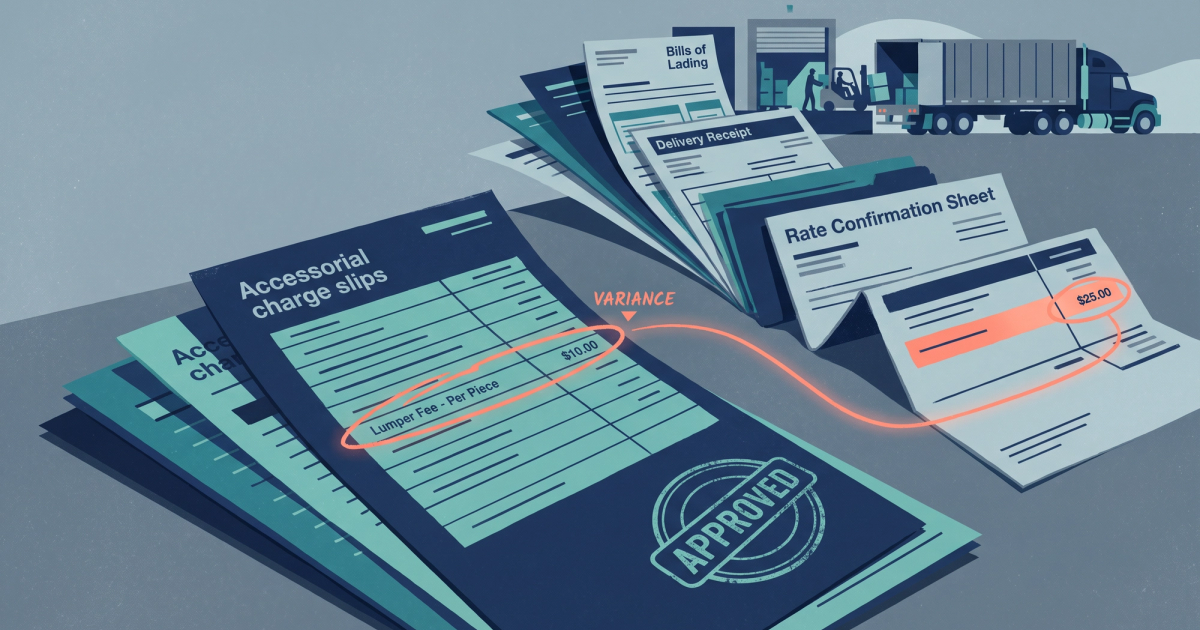
A freight broker running 80 loads a month to distribution centers with mandatory lumpers, at an average of $250 per load, faces $20,000 in monthly accessorial exposure. That is $240,000 a year in costs that rarely appear as a line item on the rate con and almost never get audited at the invoice level. So how are lumper fees calculated? The answer depends on which of four pricing models the warehouse uses: per-piece, weight-based, hourly, or flat-rate. Each model produces a different total for the exact same load. According to Relay Payments, lumper fees typically range from $25 to $500 per load, driven primarily by hours worked and cargo complexity. The problem is not that the fees exist. The problem is that most brokers cannot verify whether the number on the carrier invoice matches what the warehouse actually charged.
How Lumper Fees Are Calculated: The Short Answer (With Numbers)
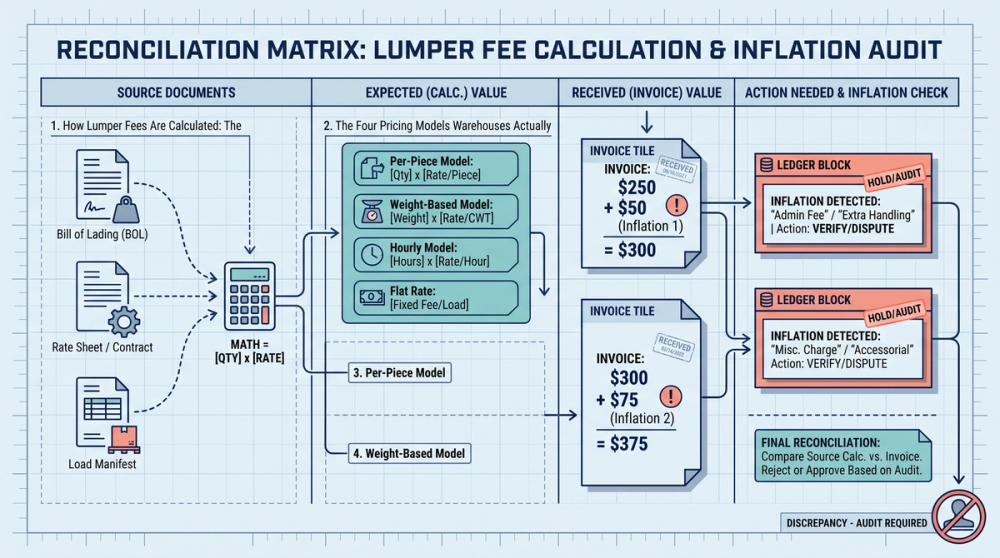
A lumper fee is the charge for third-party labor that loads or unloads freight at a warehouse or distribution center. There is no universal formula. As ShipEx Logistics notes, lumper costs are determined on a job-specific basis considering the unique requirements of each assignment. But every lumper fee calculation comes down to one of four models:
- Per-piece model: Total pieces multiplied by a per-piece rate. Example: 1,200 pieces × $0.18 = $216.
- Weight-based model: Total shipment weight multiplied by a per-pound rate. Example: 42,000 lbs × $0.008 = $336.
- Hourly model: Number of lumpers × hours worked × hourly rate. Example: 3 lumpers × 4 hours × $22/hr = $264.
- Flat-rate model: A fixed dollar amount quoted by the warehouse regardless of load specifics. Example: $300 flat.
According to RoadSync, the average lumper fee sits around $300. But that average hides enormous variation. A 500-piece pallet load and a 2,400-piece floor-loaded shipment going to the same facility will produce wildly different charges under per-piece and hourly models. The model the warehouse uses, not just the load itself, determines your cost.
For context on the labor costs underpinning these fees: as of 2026-04-01, average hourly earnings in truck transportation were $32.41/hr (BLS Current Employment Statistics, series CEU4348400008). Lumper services typically price below this rate because the labor is less specialized, but the BLS figure gives you a ceiling for what hourly-model charges should look like.
The Four Pricing Models Warehouses Actually Use
Every warehouse or third-party lumper service provider uses one of these four models. Some large DCs switch models depending on the commodity. Knowing which model applies to your load is the first step to verifying whether the fee on the carrier invoice is accurate.
Per-Piece Model
This is common at grocery and beverage DCs. The warehouse sets a rate per case, carton, or unit, then multiplies by the total piece count on the BOL. The formula is straightforward:
Lumper fee = Total pieces × Rate per piece
Rates typically range from $0.10 to $0.30 per piece depending on freight type and handling difficulty. Fragile or oddly shaped items (glass bottles, aerosol cans) push rates toward the higher end. Dry goods on standard pallets sit at the lower end.
The risk for brokers: piece counts on the BOL and piece counts on the lumper receipt don't always match. A BOL showing 1,200 pieces and a lumper receipt showing 1,350 pieces means someone is wrong, and you are paying for the difference.
Weight-Based Model
Some warehouses, especially those handling bulk commodities or mixed pallets, charge per pound of total shipment weight. The formula:
Lumper fee = Total weight (lbs) × Rate per pound
Rates range from $0.005 to $0.012 per pound. The catch: some warehouses round up to the nearest 500 or 1,000 pounds. On a 42,000-lb shipment, rounding up to 44,500 lbs at $0.008/lb turns a $336 fee into $356. That $20 difference is small enough to skip past manual review but large enough to matter across hundreds of loads.
According to LumperHQ's cost calculator methodology, weight-based models factor in total shipment weight as one of the primary inputs, but the final charge can also be adjusted based on facility-specific requirements.
Hourly Model
The hourly model charges for the number of lumpers assigned to a load multiplied by the hours they work. The formula:
Lumper fee = Number of lumpers × Hours worked × Hourly rate
Hourly rates for lumper labor generally fall between $18 and $28 per hour per worker. This model creates the most billing disputes because hours are subjective. A 4-hour unload billed as 5 hours adds $66 (3 lumpers × 1 hour × $22/hr) to the invoice. Without a timestamped receipt from the warehouse showing actual start and end times, the broker has no basis to dispute.
This is the model where documentation matters most. If your carrier sends an invoice with an hourly-model lumper charge but no lumper fee receipt showing timestamps, treat that as a red flag.
Flat-Rate Model
Flat-rate lumper fees are set by the warehouse and do not change based on piece count, weight, or hours. A facility quotes $300 for any load coming through the door. This model is simple but not always fair.
Flat rates benefit the broker on heavy, complex loads. A 2,400-piece floor-loaded shipment that would cost $432 under a per-piece model at $0.18/piece only costs $300 flat. But on a lighter load (600 pieces, 18,000 lbs), you are overpaying relative to what a per-piece or weight-based model would charge.
The key question: does the warehouse quote flat rates, or does the carrier claim it is a flat rate without providing the warehouse's actual receipt? If you are seeing $300 flat on every invoice from a carrier delivering to multiple DCs, that consistency is suspicious. Different warehouses rarely charge the same flat rate.
A Real Load, Four Different Bills: Side-by-Side Comparison
Let's take one load and run it through all four models so you can see how the same shipment produces four different totals.
Base scenario: 1,200-piece dry goods shipment, 42,000 lbs, delivered to a mid-size distribution center in the Southeast. Three lumpers assigned. Unload takes 4 hours.
Example: Per-Piece Calculation
1,200 pieces × $0.18/piece = $216
This is the lowest total for this particular load because 1,200 pieces is moderate and the per-piece rate for dry goods sits at the lower end of the range. If the warehouse bumps the rate to $0.22/piece (common for mixed SKU loads), the fee jumps to $264. That is $48 more with no change in paperwork, no extra labor, and no notification to the broker. It happens when the lumper service reclassifies the freight type at the dock.
Example: Weight-Based Calculation
42,000 lbs × $0.008/lb = $336
This is $120 more than the per-piece model for the same load. Some warehouses round up to the nearest 500 lbs, making the billable weight 42,500 lbs ($340). Others round to the nearest 1,000 lbs: 43,000 lbs ($344). In the worst case, a carrier submits an invoice using 44,500 lbs (perhaps pulling from a scale ticket that includes the tractor weight), and the fee becomes $356. That $20 overcharge takes 4 minutes to catch by comparing the BOL weight to the invoice weight.
Example: Hourly Calculation
3 lumpers × 4 hours × $22/hr = $264
Now watch what happens when the invoice shows 5 hours instead of 4: 3 × 5 × $22 = $330. That is $66 more. The only document that proves the actual time is a timestamped lumper fee receipt from the warehouse. If the carrier does not provide it, you are trusting their math. On 80 loads a month, even a 30-minute average inflation per load adds up to $2,640 in annual overcharges at this rate.
Example: Flat-Rate Calculation
Warehouse quotes $300 flat, regardless of the 1,200 pieces or 42,000 lbs.
For this load, the flat rate falls between the per-piece low ($216) and the weight-based high ($336). It benefits the broker on heavier or more complex loads. It hurts on lighter loads. A 600-piece, 18,000-lb shipment to the same warehouse would cost $108 under per-piece or $144 under weight-based, but the flat rate is still $300.
The pricing model determines the cost more than the load itself. The same 42,000-lb shipment produces lumper fees ranging from $216 to $336 depending solely on the warehouse's billing method.
Three Ways Lumper Fees Get Inflated on Carrier Invoices
Knowing how lumper fees are calculated is only half the job. You also need to know how they get inflated between the warehouse and your desk. These are the three most common tactics, and every one of them relies on brokers not checking the documentation. For a deeper look at who bears the cost and your rights as a broker, see our guide on who pays lumper fees and how to stop eating the cost.
Tactic 1: Double-Billing With a Different Line Item Name
The carrier invoice shows a $216 lumper fee on one line and a $95 "unloading assistance" accessorial on another. Both charges are for the same service: getting the freight off the trailer. The lumper fee is the warehouse's third-party labor charge. The "unloading assistance" is the carrier's version of the same work. On a single invoice, that is $311 for what should be $216.
How to catch it: any time you see both a lumper charge and an unloading or handling accessorial on the same invoice, compare the lumper receipt to the carrier's accessorial description. If the lumper receipt covers the full unload, the accessorial is a duplicate. This is one of the most common forms of lumper charge disputes between brokers and carriers.
Tactic 2: Inflated Amount With No Signed Receipt
The carrier submits a lumper fee of $375. The actual warehouse charge was $300. There is no signed lumper receipt attached to the invoice. The carrier verbally claims the fee but provides no documentation. The broker, processing 200 invoices this week, pays it.
The fix is simple but requires discipline: require a signed lumper fee receipt for every load where a lumper charge appears. No receipt, no reimbursement. This policy alone, applied consistently, stops $50 to $75 in per-load inflation. According to OTR Solutions, lumper fees are individualized and job-specific, which means there is no way to verify the charge without the receipt from the facility.
Tactic 3: Lumper Fee on an All-In Rate Con
The rate con states the carrier rate as "all-in" or "inclusive of all accessorials." The carrier delivers the load, pays the lumper at the warehouse, then invoices the broker for the lumper fee separately on top of the agreed rate. The broker pays both because the rate con language was vague.
This one is on the broker. If your rate con says "all-in" but does not explicitly list lumper fees as included, you will end up in a gray area. Best practice: your rate con should have a line item for lumper reimbursement ("lumper: pass-through with receipt") or explicitly state "lumper included in linehaul rate." Ambiguity always costs money. Our breakdown of how lumper fees appear on rate cons and who pays covers the exact language that protects your margin.
What a Lumper Fee Receipt and BOL Notation Should Look Like
Documentation is the only thing that turns a billing dispute into a billing correction. Here is what clean lumper documentation includes.
The Lumper Receipt
A valid lumper fee receipt should contain:
- Warehouse or lumper service provider name and address
- Date and time of service (start and end times for hourly models)
- Load reference number or BOL number
- Pricing model used (per piece, per pound, hourly, or flat)
- Itemized calculation (e.g., 1,200 pieces × $0.18 = $216)
- Total amount charged

- Signature of the driver or warehouse representative
If any of these elements are missing, the receipt does not give you enough information to verify the charge. Particularly for hourly models, the absence of start and end times makes it impossible to audit the hours billed.
It is worth noting that FMCSA regulations prohibit coercing drivers into using lumper services. If a driver reports being forced to use a specific lumper service at a facility, and the associated receipt lacks transparency, that is both a compliance and a billing concern.
BOL Lumper Notation
The BOL should include a lumper notation when lumper services are used at delivery. This notation typically appears in the remarks or accessorial section and should state:
- Whether lumper services were used (yes/no)
- The total lumper fee charged
- The name of the lumper service provider
When the BOL notation matches the lumper receipt and both match the carrier invoice, you have a clean audit trail. When they don't match, you have the documentation to dispute the difference in minutes rather than days.
Carrier Invoice Requirements
The carrier invoice should list the lumper fee as a separate line item, not bundled into linehaul, and should reference the attached lumper receipt. The invoice amount for the lumper should match the receipt amount exactly. Any difference between the receipt total and the invoiced lumper fee is either a markup (which should be disclosed in the carrier packet) or an error that needs correction.
As of 2026-04-01, the Producer Price Index for truck transportation of freight stood at 174.6 (BLS PPI series WPU3012), reflecting continued pressure on carrier margins. This environment makes it more common for carriers to look for margin recovery through accessorial line items, including lumper fee markups.
Budgeting Example: The Cost of Not Tracking
Scenario: You are a freight broker running 80 loads per month to DCs with mandatory lumper services. Average lumper fee: $250 per load. Your rate cons have no lumper line item. That is $20,000 per month in untracked accessorial exposure, or $240,000 per year. If even 8% of those charges are inflated by $50 per load (the conservative estimate from the tactics above), you are losing $1,600 per month, or $19,200 per year.
Track it. Require receipts. Compare BOL weights and piece counts to invoiced amounts. The math is not complicated. The discipline is what separates brokers who protect margin from brokers who wonder where it went.
Frequently Asked Questions About Lumper Fees
How much is the average lumper fee?
According to RoadSync, the average lumper fee is approximately $300 per load. However, fees range widely from $25 to $500 depending on the pricing model used, freight type, load size, and facility requirements. A 1,200-piece dry goods shipment might cost $216 under a per-piece model but $336 under a weight-based model at the same warehouse.
Can you refuse to pay a lumper fee?
Drivers cannot be coerced into using lumper services. The FMCSA explicitly prohibits coercion of drivers into employing loading or unloading assistance. However, many warehouses and DCs require third-party lumper services as a condition of receiving freight. In practice, refusing the lumper often means the load does not get unloaded, which creates detention charges. The better approach is to negotiate lumper reimbursement terms upfront in the rate con rather than fighting the charge at the dock.
Who typically pays the lumper fee?
In most broker-carrier arrangements, the broker or shipper reimburses the lumper fee. The driver pays the lumper at the warehouse (often via a comcheck or payment code from the broker), and the carrier invoices the broker for reimbursement. The key is that the rate con should specify who pays and whether the lumper is included in the linehaul rate or billed as a separate accessorial. For a full breakdown, see our guide on lumper fee reimbursement and documentation requirements.
How do I avoid lumper fee overcharges?
You cannot always avoid lumper fees, but you can avoid overpaying. Require a signed lumper fee receipt for every load. Compare the receipt amount to the invoiced amount. Check the BOL weight or piece count against the lumper calculation. Flag any invoice that includes both a lumper charge and a separate unloading accessorial. Build lumper reimbursement language into your rate cons. These five steps catch the majority of inflation before it hits your margin.
How do lumper fees appear on a carrier invoice?
A properly documented lumper fee appears as a separate line item on the carrier invoice, referencing the attached lumper receipt from the warehouse. The invoiced amount should match the receipt exactly. If the lumper fee is bundled into the linehaul charge, hidden in a generic accessorial line, or listed without an attached receipt, you do not have enough information to verify the charge. Treat missing receipts as a hard stop in your payment process.
Stop Guessing, Start Checking
Lumper fees are not mysterious. They follow one of four pricing models, and each model has a simple formula. The problem is not the math. It is the gap between what the warehouse charges and what ends up on the carrier invoice, combined with the fact that most broker teams do not have time to compare BOL weights, piece counts, and receipts across hundreds of loads per month.
Start with the basics: require lumper receipts, add lumper reimbursement language to your rate cons, and spot-check 10% of your invoices against BOL data. Those three changes will catch the most common inflation tactics covered in this guide. If your team processes more than 50 invoices a week and the manual comparison is eating hours, automated document extraction tools can pull the numbers from BOLs, receipts, and invoices so your team can focus on the mismatches instead of the data entry.
The $20,000-a-month question is not whether lumper fees are legitimate. Most of them are. The question is whether the number on the invoice matches the number on the receipt. Check the math. Protect the margin.
Sources
- May drivers be coerced into employing loading or unloading assistance (lumpers)? — FMCSA
- A Step-by-Step Guide Using LumperHQ's Cost Calculator — LumperHQ
- Everything You Need to Know about Lumper Fees — OTR Solutions
- What is a lumper and lumper payment? — Relay Payments
- Freight FAQs: What is a Lumper? — RoadSync
- Understanding Lumper Fees in the Trucking Industry — ShipEx Logistics
Related: Are Lumper Fees Legal? What Brokers Need to Know Before the Invoice Hits
Related: Automate Lumper Fee Verification Before It Costs You $150 a Load
Related: Lumper Fee Validation Tool: Stop Paying Charges You Can't Verify