Lumper Fee in Logistics: Who Pays, Who Fights It, How to Stop Eating the Cost
Researched and written with AI assistance. Reviewed by the Laneproof team.

A lumper fee in logistics is a charge for third-party labor used to load or unload freight at a warehouse or distribution center, and it typically ranges from $25 to $500 per load depending on freight type, trailer size, and hours of labor required. If you're a freight broker, you already know the definition. What you probably don't know is exactly how much that fee is costing you when documentation falls apart. A broker running 300 loads per month who absorbs an average of $85 per disputed lumper charge is losing over $25,000 per year in unrecovered accessorials. That's not a rounding error. That's margin disappearing load by load because nobody wrote the right language into the rate con, nobody collected a lumper receipt, and nobody flagged the charge before the carrier invoice got paid.
This guide skips the trucking 101 overview. Instead, it walks through how lumper fees actually show up on invoices, why brokers end up paying charges that belong to someone else, and what specific steps you can take to stop it.
What a Lumper Fee Actually Is (and Why the Definition Doesn't Help You)
You can find a clean definition of a lumper fee on a dozen logistics blogs. Here's the short version: a lumper is a third-party worker (or crew) hired to physically unload a trailer at a receiving facility, and the lumper fee is what that service costs. According to TAWI's 2024 industry analysis, a single truck unload can cost as little as $50 for a partial load and up to $250 or more for a full trailer. RoadSync's freight FAQ puts the average lumper fee at around $300, with a range of $100 to $500.
The definition is not where brokers lose money. The problem is operational: who authorized the fee, who has the receipt, and who agreed to pay for it before the truck left the shipper. When none of those questions have documented answers, the charge lands on the broker's desk by default.
The Legal Baseline You Should Know
The Motor Carrier Act of 1980 made it illegal to coerce a driver into unwanted loading or unloading and require payment for it. This is codified under 49 U.S.C. 14103 and enforced by the FMCSA. In practice, this means a receiver cannot force a carrier's driver to pay for lumper services against their will. But it does not mean the service is free. Someone pays, and the question of who is entirely a function of what your rate confirmation says and what paperwork you collected.
Why Definitions Fall Short in the Real World
Most content about lumper fees stops at the definition. That's a problem, because the definition doesn't tell you what to do when a carrier submits an invoice with a $375 line item labeled "unloading labor" and there's no BOL notation, no third-party lumper receipt, and no pre-authorization on file. The definition doesn't explain why that invoice gets paid anyway, which is usually because the broker's billing coordinator has no documentation to push back with and the payment deadline is looming. For a deeper breakdown of what goes wrong at the documentation level, see common lumper fee billing errors that cost brokers thousands.
Who Pays the Lumper Fee — and Why the Answer Changes Based on Your Paperwork
The short answer to "who pays lumper fees" is: it depends on the agreement between the shipper, broker, and carrier. According to Capstone Logistics, lumper fees are most commonly paid upfront by the carrier or driver and then passed through to the shipper or broker for reimbursement. But "most commonly" is doing heavy lifting in that sentence. In reality, the payment responsibility shifts based on three things: what the rate confirmation says, what the shipper's vendor routing guide requires, and whether anyone documented the charge at the point of delivery.
The Three Payment Scenarios Brokers Face
Scenario 1: Shipper pays directly. Some shippers have standing accounts with lumper service providers at their DCs. The lumper fee never touches the carrier or broker. This is the cleanest setup, but it's not the most common one.
Scenario 2: Carrier pays, broker reimburses. The driver pays the lumper crew at delivery (often via ComChek, EFS, or cash), collects a lumper receipt, and submits it with their carrier invoice. The broker reimburses the carrier and then bills the shipper. This is where documentation gaps create disputes. If the carrier can't produce a valid receipt, the broker has no proof to submit upstream for reimbursement.
Scenario 3: Nobody agreed to pay, and now it's a fight. The rate con says nothing about lumper fees. The carrier pays $300 at a Walmart DC, invoices the broker, and the broker pushes back because the charge wasn't pre-approved. The carrier argues it had no choice. The broker argues there's no contractual obligation. Both are partially right, and the one with weaker documentation loses.
Why Paperwork Decides the Outcome
If your rate con doesn't explicitly address lumper fee reimbursement, you have no contractual leg to stand on when disputing the charge. And if the carrier doesn't have a signed lumper receipt, they have no proof the fee was actually incurred. The party with the weaker paper trail absorbs the cost. For a detailed look at what fields a valid lumper receipt must include, read what a valid lumper receipt must include to win a billing dispute.
How Lumper Fees Show Up on Carrier Invoices and Catch Brokers Off Guard
Lumper fees rarely announce themselves clearly on a carrier invoice. They show up under different labels, at different amounts, and sometimes buried inside a lump-sum accessorial line. If your billing coordinator is processing 50 or more invoices a week, these charges slip through unless someone is specifically looking for them.
Common Invoice Labels That Hide Lumper Charges
- "Unloading labor" with no further description
- "Lumper" or "lumper service" as a one-word line item
- "Accessorial: warehouse unload" with a round-dollar amount
- "Third-party labor" listed under a general accessorial category
- A charge folded into "detention/unloading" as a combined line, making it impossible to separate what's detention and what's lumper
The problem isn't just labeling. It's context. A line item that says "unloading labor — $375" with no BOL notation, no attached lumper receipt, and no pre-authorization record gives your billing team nothing to verify. Was it $375 or $275? Was it a third-party lumper service or the driver themselves? Was the receiver even a facility that uses lumpers? Without answers, the invoice either gets disputed (costing time) or gets paid (costing money).
Example: The $450 Walmart DC Charge With No Paper Trail
Scenario: A carrier delivers a full truckload to a Walmart distribution center. The DC uses a third-party lumper service, and the driver pays $450 via ComChek at the dock. The carrier invoices the broker for the linehaul rate plus a $450 lumper fee. The original rate con made no mention of lumper fees. No lumper receipt was attached to the invoice. No pre-authorization was requested or given.
What happens: The broker wants to dispute the $450, but has no documentation to prove the fee wasn't incurred. The carrier, meanwhile, has the ComChek transaction showing $450 left their account. The broker has two choices: pay the $450 and try to recover it from the shipper (who may or may not reimburse without a receipt), or dispute the charge and risk the carrier relationship. Most brokers pay. That $450 comes straight out of margin.
The Documentation You Need to Win a Lumper Fee Dispute
Winning a lumper fee dispute, whether you're pushing the charge back to a carrier or forwarding it to a shipper, comes down to five documents. If you have all five, you'll recover the charge. If you're missing even one, your odds drop significantly.
The Five-Document Checklist
- Signed lumper receipt: This is the single most important document. It must show the facility name, date, trailer number, number of cases or pallets unloaded, the lumper service company name, the fee amount, and a signature or transaction ID. A receipt that just says "$300 lumper" with no detail is nearly useless in a dispute.
- Rate confirmation with lumper language: Your rate con needs to explicitly state whether lumper fees are the carrier's responsibility, the broker's responsibility, or subject to pre-authorization. Vague language like "accessorials must be pre-approved" is not enough.
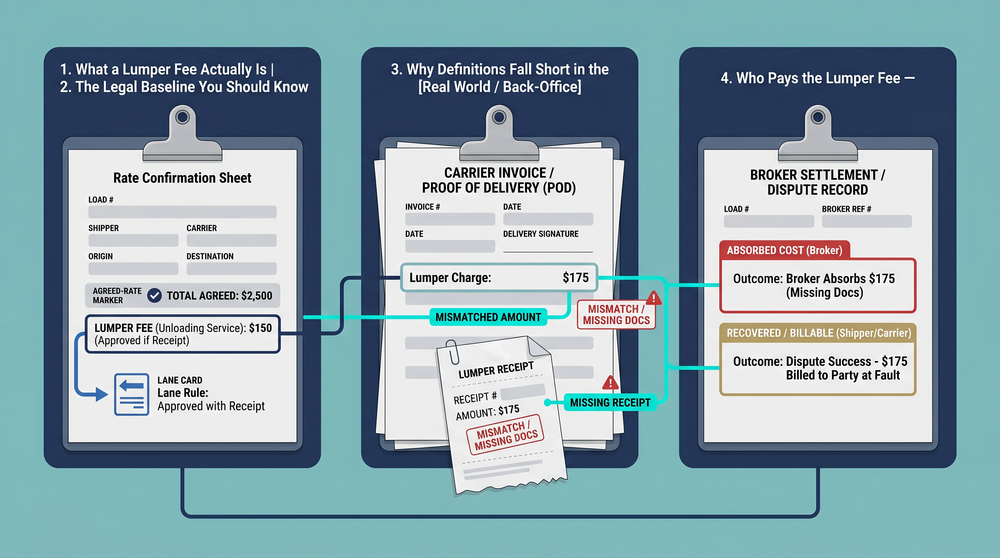
- BOL or POD with unloading notation: The bill of lading or proof of delivery should note that a lumper service was used. Many facilities stamp or note this on the BOL at delivery. If it's not there, ask the carrier to request it.
- Pre-authorization record: An email, text message, or TMS note showing that the broker approved the lumper fee before it was incurred. Without this, the carrier's claim that "you told me it was okay" is hearsay.
- ComChek, EFS, or payment transaction record: Digital payment receipts from ComChek or EFS provide a verified transaction amount, timestamp, and location. These are harder to fabricate than paper receipts and carry more weight in disputes.
What Missing Documentation Costs You: A Calculation
Example: A mid-size brokerage moves 300 loads per month. Of those, roughly 15% involve facilities that use lumper services (45 loads). On about 40% of those loads (18 loads), the lumper fee documentation is incomplete: missing receipts, no pre-authorization, or vague rate con language. The average disputed lumper charge is $85, after accounting for partial recoveries and negotiated reductions.
18 loads × $85 per disputed charge = $1,530 per month in unrecovered lumper costs. Over 12 months, that's $18,360 per year. If the average disputed charge is closer to $120 (common at high-volume DCs where lumper fees run $300 to $500), the annual figure climbs to $25,920. That's not a line item most brokerages are tracking, but it's real margin loss.
For context, as of 2026-04-01, average hourly earnings in truck transportation were $32.41/hr (BLS Current Employment Statistics, series CEU4348400008). A $450 lumper fee represents nearly 14 hours of driver labor at that rate. The cost is not trivial for carriers either, which is why they push it to the broker.
Walmart vs. Amazon: How Lumper Fee Policies Differ at Major Retailers
Not all facilities handle lumper fees the same way, and the differences matter for how you write your rate cons and set carrier expectations.
Walmart Distribution Centers
Walmart DCs are one of the most common places carriers encounter lumper fees. Most Walmart DCs use third-party lumper services, and the fees are typically paid via ComChek at the dock. According to Relay Payments' lumper fee overview, lumper fees can range from $25 to $500, with the cost depending on load size, number of SKUs, and trailer configuration. At Walmart specifically, fees commonly fall between $150 and $500, with full truckloads of mixed SKUs on the higher end. The ComChek transaction creates a digital paper trail, which is useful for reimbursement, but only if the carrier attaches the receipt to their invoice.
Amazon Fulfillment Centers
Amazon FCs operate differently. Many Amazon facilities require drivers to unload their own trailers, particularly for floor-loaded shipments. There is often no third-party lumper option available. This creates a different problem: instead of a lumper fee dispute, brokers face detention disputes or driver refusal situations. A carrier who expected a lumper service at an Amazon FC and finds none may refuse to unload, triggering a potential TONU or layover charge that compounds the situation. The solution is proactive: before booking the load, confirm with the shipper whether the delivery facility uses lumpers, and communicate that clearly to the carrier.
Scenario: Carrier Refuses to Unload, Shipper Is Closed, Broker Is Stuck
Scenario: A carrier arrives at a facility expecting a lumper service. The facility doesn't offer one. The driver refuses to unload the trailer themselves (which, per the FMCSA's guidance on lumper services, is within their rights under 49 U.S.C. 14103, as drivers cannot be coerced into performing unwanted loading or unloading). It's now 4:00 PM on a Friday. The shipper's customer service line is closed. The broker is caught between a potential TONU charge from the carrier, a layover fee if the driver stays overnight, and an angry shipper expecting a delivery confirmation.
What should have happened: The broker should have confirmed unloading requirements with the consignee before dispatching. The rate con should have specified whether the load was live unload (driver-assist), lumper-serviced, or drop-and-hook. A single dispatch call to the facility could have prevented a compounding cost that now includes detention, potential layover, and a damaged carrier relationship.
How to Write Lumper Fee Language Into Your Rate Cons and Carrier Packets
The cheapest way to stop lumper fee disputes is to prevent them with clear rate con language. Most carrier disputes over lumper charges trace back to one of two problems: the rate con said nothing about lumper fees, or it said something so vague that it was unenforceable.
Vague Language vs. Specific Language: A Side-by-Side Comparison
Vague (common but weak): "All accessorials must be pre-approved by the broker."
This sounds protective, but it fails in practice. "Accessorials" is a broad term. A carrier can argue they didn't consider a lumper fee an accessorial because it was a third-party charge, not a service fee. Pre-approval requirements without a defined method (email? phone call? text?) are difficult to enforce.
Specific (enforceable): "Lumper fees are the responsibility of the carrier unless pre-authorized in writing by the broker prior to unloading. Reimbursement for pre-authorized lumper fees is capped at $200 per load unless a higher amount is approved in writing. Carrier must submit a valid lumper receipt (showing facility name, date, trailer number, service provider, and fee amount) attached to the proof of delivery. Acceptable payment documentation includes ComChek or EFS transaction receipts. Invoices for lumper fees submitted without pre-authorization and valid documentation will not be processed."
What to Add to Your Carrier Packet
Your carrier packet (the onboarding document carriers sign before hauling their first load) should reinforce rate con language with a standing policy on lumper fees. Include these elements:
- A clear statement that lumper fees require pre-authorization for any amount over a defined threshold (e.g., $100)
- The required format for lumper receipt submission (photo of receipt, ComChek receipt number, or digital payment confirmation)
- A reimbursement timeline (e.g., lumper fees will be reimbursed within 15 business days of receiving valid documentation)
- A statement that lumper charges submitted without documentation will be deducted from the carrier's invoice
Example: One Sentence That Cut Unrecovered Charges by 60 Percent
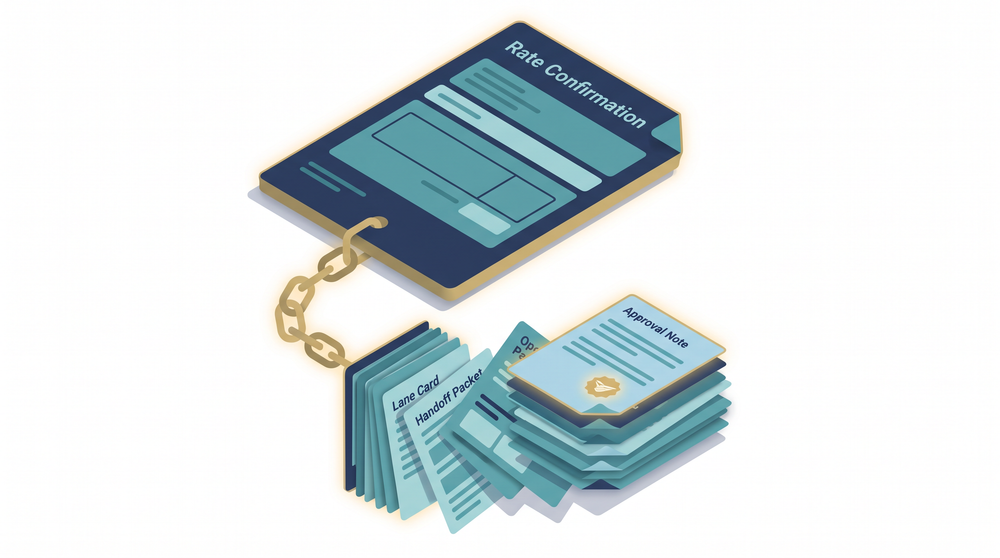
Scenario: A brokerage running roughly 250 loads per month added one sentence to their rate con: "Lumper fees exceeding $100 require written pre-authorization from the broker; unapproved lumper charges will not be reimbursed." Within 90 days, their unrecovered lumper charges dropped by 60 percent. The reason wasn't that lumper fees disappeared. It was that carriers started calling before paying the lumper, which gave the broker the chance to verify the fee, negotiate the amount, and document the authorization. That single sentence shifted the default from "pay now, argue later" to "call first, get approved, get reimbursed."
A single sentence in your rate con requiring pre-authorization for lumper fees over $100 can cut unrecovered charges by 60 percent in 90 days. The fix is not technology. It's language.
For more on structuring your rate con language around all types of lumper charges, liability, and reimbursement workflows, that guide covers the full process from shipper agreement through carrier settlement.
Tracking Lumper Fee Costs Per Load: What to Measure and Why
Most brokerages track linehaul cost per load. Very few track lumper fee cost per load as a separate metric. That's a mistake, because lumper costs aren't consistent. They vary by facility, by region, by commodity, and by time of year. Without per-load tracking, you can't identify which lanes or customers are eating your margin through accessorial charges.
What to Track
- Lumper fee incurred per load: The actual dollar amount charged at delivery
- Lumper fee recovered per load: The amount you successfully billed back to the shipper or deducted from the carrier
- Recovery rate: Recovered ÷ Incurred. If this number is below 90%, you have a documentation or contract language problem.
- Average lumper fee by facility: Track this over 30 to 90 days. If a particular DC consistently charges $400+ while the lane average is $200, you need to renegotiate the shipper rate or add a lumper allowance to the rate con.
- Dispute rate: What percentage of lumper-related invoices require manual review or dispute? If it's above 20%, your rate con language or carrier onboarding is the root cause.
Per-Load Calculations That Reveal Margin Erosion
Example: A lane from Dallas to a Walmart DC in Bentonville pays a $2,800 linehaul rate with a target margin of 15% ($420). The carrier is booked at $2,380, leaving $420 gross margin. A $350 lumper fee that isn't recovered drops the effective margin to $70, or 2.5%. If that lane runs 12 times per month with a 50% lumper recovery rate, the broker is losing $2,100 per month on that single lane's lumper costs alone. As of 2026-04-01, the Producer Price Index for truck transportation of freight stood at 174.6 (BLS PPI series WPU3012), reflecting elevated pricing across the freight market. Margins are already compressed. Unrecovered lumper fees make them worse.
Frequently Asked Questions About Lumper Fees in Freight
Who pays for the lumper fee?
Lumper fees are most commonly paid upfront by the carrier or driver at the point of delivery and then submitted for reimbursement to the broker or shipper. The contractual responsibility depends entirely on what the rate confirmation and carrier packet specify. If neither document addresses lumper fees, the charge typically defaults to the broker, who then attempts to recover it from the shipper. Clear rate con language is the only reliable way to assign payment responsibility. For a full breakdown of payment responsibility, see who pays lumper fees and how to get reimbursed.
Can you refuse to pay a lumper fee?
A driver can refuse to personally unload freight. Under 49 U.S.C. 14103, enforced by the FMCSA, it is illegal to coerce a carrier or driver into performing loading or unloading services against their will. However, refusing to pay for a third-party lumper service at a facility that requires one will likely result in the freight not being unloaded, creating detention charges, delivery failures, or TONU situations. The practical approach is to pre-authorize lumper fees before dispatch, not refuse them at the dock.
What is a lumper in logistics?
A lumper is a third-party worker or crew hired to physically load or unload freight at a warehouse, distribution center, or dock facility. According to Trinity Logistics, lumper services are most commonly found at food distribution centers, grocery warehouses, and high-volume retail facilities. The lumper fee is the charge for that service, and it varies based on load size, commodity type, and facility requirements.
How can brokers avoid lumper fees?
You can't always avoid lumper fees, because many receiving facilities require them. What you can do is prevent them from becoming unrecovered costs. Add specific lumper fee language to your rate cons, require pre-authorization for any lumper charge above a set threshold, mandate that carriers submit valid lumper receipts with their invoices, and track lumper cost per load as a margin metric. The goal isn't to eliminate the fee. It's to make sure it lands on the right party's balance sheet with full documentation.
What should a lumper receipt include to be valid for reimbursement?
A valid lumper receipt should include the facility name and address, the date of service, the trailer number, the number of pallets or cases unloaded, the lumper service company name, the total fee amount, and a transaction ID or signature. ComChek and EFS receipts are preferred because they provide a verified digital record. Paper receipts with only a dollar amount and no facility or date information are difficult to use in disputes.
Stop Treating Lumper Fees as a Cost of Doing Business
Lumper fees are a legitimate logistics cost. Unrecovered lumper fees are not. The difference between the two is documentation, contract language, and a willingness to enforce both. Every broker reading this has paid a lumper charge they shouldn't have, not because the fee wasn't real, but because the paperwork wasn't there to push it where it belonged.
Start with your rate con. Add the specific lumper fee clause covered in this guide. Require pre-authorization above a defined threshold. Mandate valid receipts. Track your recovery rate per load. These are not complex changes, but they require consistency across every load, every carrier, and every invoice.
If your team processes more than 50 carrier invoices a week and lumper receipt verification is eating hours of manual review, automated freight document extraction tools can pull receipt data, match it against rate con terms, and flag discrepancies before invoices get paid. The operational fixes in this guide work. Automation makes them stick.
Sources
- Lumpers | FMCSA — U.S. Department of Transportation
- What Is a Lumper? Costs, Risks & Unloading Alternatives — Capstone Logistics
- Lumper Fees: What are They and Why are They Needed? — Trinity Logistics
- Are Lumper Services Still Cost-Effective for the Logistics Industry? — TAWI
- What is a Lumper and Lumper Payment? — Relay Payments
- Freight FAQs: What is a Lumper? — RoadSync