Are Lumper Fees Legal? What Brokers Need to Know Before the Invoice Hits
Researched and written with AI assistance. Reviewed by the Laneproof team.

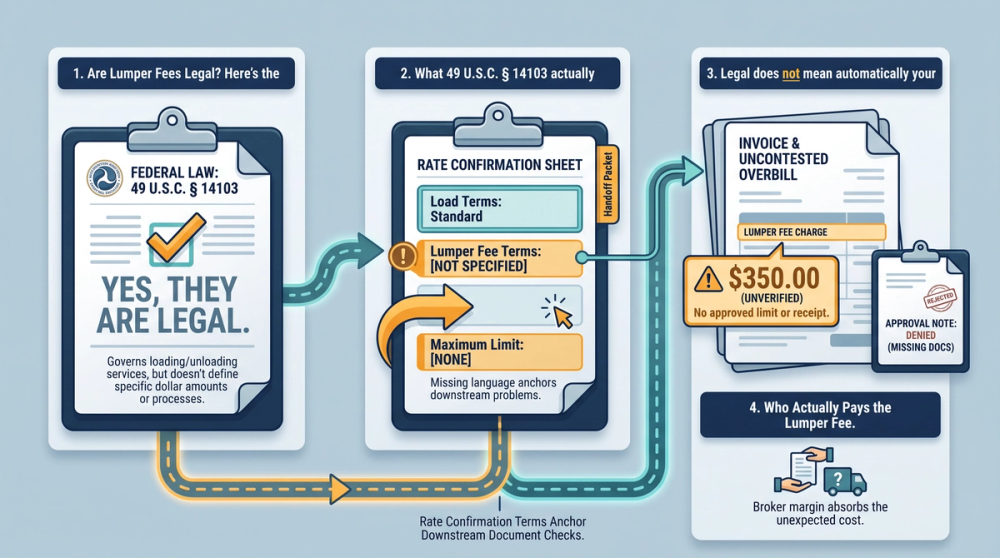
Are lumper fees legal? Yes. Under 49 U.S.C. § 14103, lumper fees are federally legal charges for third-party loading or unloading services at warehouses and distribution centers. What the law prohibits is coercing a driver into paying for those services out of pocket without reimbursement. The shipper or receiver bears legal responsibility for the cost. But here's what costs brokers real money: it's not the legality of the lumper fee itself. It's the $50 to $200 per load that slips through when your rate con says nothing about lumper fees, your carrier submits a vague invoice, and your billing team approves it because there's no documented basis to push back. This article covers the legal framework, the rate con language that protects you, what a valid lumper receipt must include, and exactly how to dispute charges you never agreed to cover.
Are Lumper Fees Legal? Here's the Short Answer
Lumper fees are legal. The practice of using third-party labor to load or unload trailers at distribution centers has existed for decades, and federal law specifically addresses how these fees must be handled. The Motor Carrier Act of 1980 established the legal foundation, now codified at 49 U.S.C. § 14103, that governs lumper arrangements.
The law does two things that matter to freight brokers. First, it confirms that shippers, receivers, and warehouse operators can require the use of lumper services. Second, and this is the part most people skip, it makes it illegal to coerce a driver into paying for lumper services without reimbursement. The FMCSA enforces this rule. If a receiver at a grocery DC tells a driver to pay a lumper $200 and nobody reimburses the driver, that is a federal violation.
For brokers, the legal question isn't whether the lumper fee itself is valid. It's whether the fee was properly authorized, documented, and assigned to the right party. That's where your rate confirmation language and receipt policies determine whether a lumper charge is a legitimate cost or an uncontested overbill sitting on your P&L.
What 49 U.S.C. § 14103 actually says
The statute prohibits anyone from coercing a motor carrier or driver into using the services of a particular person to load or unload cargo, unless the carrier or driver is properly compensated. Per the FMCSA's own guidance, drivers cannot be forced to employ loading or unloading assistance without reimbursement. This means the party requiring the lumper service (usually the receiver) holds financial responsibility. In practice, though, that cost often gets passed from receiver to shipper to broker to carrier and back again, depending on who has the weakest contract language.
Legal does not mean automatically your cost
A lumper fee being legal does not mean it lands on the broker's invoice by default. Who pays depends entirely on the contractual chain: the shipper-broker agreement, the rate confirmation between broker and carrier, and the receiver's dock policy. If your rate con is silent, you're essentially agreeing to sort it out after the fact, which always costs more.
Who Actually Pays the Lumper Fee — and Why the Rate Con Decides It
The short answer to who pays lumper fees: it depends on what's written in the rate con. Federal law assigns the underlying obligation to the party requiring the service (the receiver or shipper), but in practice, the rate confirmation between the broker and carrier is what determines who absorbs the cost on any given load.
According to eCapital's analysis of lumper fee liability, 49 U.S.C. § 14103 protects drivers from being forced to pay lumper fees without reimbursement. But between the broker and carrier, the rate con is the governing document. If your rate con includes an all-in rate with no lumper carve-out, the carrier has a weak claim for reimbursement. If the rate con is silent, the carrier has a much stronger argument, and you have a much weaker position to dispute it.
The three payment scenarios brokers face
Scenario 1: Lumper fee included in the linehaul rate. The broker and carrier agree to an all-in rate that accounts for the possibility of a lumper charge. The carrier absorbs the cost, and no separate reimbursement is expected. This works best on dedicated lanes where lumper exposure is predictable.
Scenario 2: Lumper fee reimbursable per the rate con. The rate con explicitly states that lumper fees are reimbursable with proper documentation. The carrier pays at the dock, submits a valid lumper receipt with the invoice, and the broker reimburses. This is the cleanest arrangement when lumper fees are likely.
Scenario 3: Rate con says nothing about lumper fees. This is where brokers lose money. The carrier arrives at a facility, gets hit with a lumper charge, pays out of pocket, and invoices the broker after delivery. The broker's billing team has no documented policy to approve or deny the charge. According to Trinity Logistics, the party requiring the lumper service holds initial financial responsibility, but without rate con language, your leverage in a dispute disappears.
Why 'all-in' rates don't always protect you
Even when a rate con states an all-in rate, carriers will sometimes submit a separate lumper line item if the actual lumper charge exceeded what they anticipated. If the rate con doesn't explicitly say "no additional accessorials will be reimbursed," you're back in dispute territory. Specificity in rate con language isn't optional. It's the difference between a five-second approval decision and a 20-minute back-and-forth with your carrier's billing department.
What Happens When the Rate Con Is Silent on Lumper Fees
A rate con that says nothing about lumper fees is an open invitation for post-delivery charges you can't efficiently dispute. Here's a scenario that plays out hundreds of times a day across the brokerage industry.
Example: A dry van load delivers into a grocery distribution center in Atlanta. The rate con confirms a $2,400 linehaul with no mention of lumper fees, accessorials, or documentation requirements. At the dock, the receiver requires a lumper service. The driver pays $185 out of pocket. The carrier then invoices the broker for $2,585: the $2,400 linehaul plus $185 lumper reimbursement. No lumper receipt is attached. No pre-authorization was requested. The broker's billing coordinator sees the charge, has no documented basis to dispute it, and approves it to avoid delaying payment and souring the carrier relationship.
That $185 came straight off the broker's margin. On a $2,400 load, that could represent 30% to 50% of the broker's gross profit on the load.
Vague language is almost as bad as silence
A rate con that includes language like "accessorials may apply" offers almost no protection. It doesn't define which accessorials are reimbursable, what documentation is required, or whether pre-approval is needed. Compare these two versions:
Vague version: "Accessorials may apply."
Protective version: "Lumper fees, if applicable, require pre-authorization by broker and must be supported by a signed lumper receipt submitted with the POD before reimbursement is processed."
The second version gives your billing team a clear decision tree. No receipt? No reimbursement. No pre-authorization? No reimbursement. It doesn't eliminate lumper costs, but it eliminates the ambiguity that lets overbills through. For more on what documentation your team should require, see our breakdown of what a valid lumper receipt must include to win a billing dispute.
Side-by-side: rate con language that costs you vs. language that protects you
- Costs you: "Rate is $2,400 to [destination]. Standard terms apply." No lumper mention, no accessorial policy, no documentation requirement.
- Protects you: "Rate is $2,400 to [destination]. Lumper fees are not included in the linehaul rate. If a lumper is required at delivery, carrier must call broker for pre-authorization before payment. Reimbursement requires a signed lumper receipt with facility name, date, load number, itemized charges, and driver signature. Receipts must be submitted with the POD. No reimbursement will be processed without a compliant receipt."
One version takes 10 extra seconds to add to your rate con template. The other costs you $50 to $200 every time a lumper charge shows up without documentation.
What a Legitimate Lumper Receipt Has to Include
A lumper receipt is the single document that proves a lumper service was performed, what it cost, and who received it. Without a valid receipt, a lumper charge on a carrier invoice is just a number with no verification behind it. According to DTS One's overview of lumper fee documentation, drivers who front lumper fees are legally entitled to reimbursement, but that reimbursement should always be tied to proper documentation.
Here's what a legitimate lumper receipt must include for a broker to approve reimbursement:
Lumper receipt checklist
- Facility name and address: The specific DC or warehouse where the lumper service was performed. This lets you verify the delivery location matches the rate con.
- Date of service: Must match the delivery date on the POD. A lumper receipt dated two days after delivery is a red flag.
- Load number or BOL reference: Ties the receipt to a specific shipment. Without this, the receipt could belong to any load.
- Printed name and signature of the lumper service provider: Identifies the third-party company or individual who performed the unloading. Many large DCs use national lumper service providers like Capstone Logistics or staffing agencies.
- Itemized labor description: What work was done: pallet unloading, floor-loaded freight sorting, etc. A receipt that just says "lumper service" with no description is incomplete.
- Dollar amount: The exact charge, broken down if multiple services were performed.
- Driver signature confirming service was received: This is the field most often missing. Without it, you have no proof the driver was present and the service was actually performed.
If your team doesn't have a standard receipt checklist, you're relying on whatever the carrier decides to send. Our guide to lumper fee receipt fields that protect your reimbursement walks through each field in detail and includes a template you can share with carriers.
What to do when the receipt is missing or incomplete
If a carrier submits a lumper charge with no receipt, or with a receipt missing key fields, your first step is simple: request the complete documentation before processing. This isn't adversarial. It's standard billing practice. Carriers who regularly deliver into lumper-heavy facilities usually have these receipts on hand. If a carrier can't produce a receipt, that's information. It may mean the charge is inflated, duplicated, or fabricated.
How Brokers Get Overbilled on Lumper Fees (And What It Costs Per Load)
Lumper fee overbilling doesn't usually look like outright fraud. It looks like a $220 charge on an invoice with no receipt attached, approved by a billing coordinator who processes 80 invoices a day and doesn't have time to call the carrier for documentation. It looks like a lumper charge on a load that was supposed to be a drop-and-hook. It looks like a $350 frozen food lumper fee at a facility where the average is $175.
The math on unchecked lumper exposure
Scenario: A brokerage moves 300 loads per month. Based on typical grocery and retail distribution center delivery patterns, about 12% of those loads (36 loads) involve lumper-eligible facilities. If the broker has no rate con notation regarding lumper fees and no receipt verification policy, an average unchecked overbill of $60 per disputed load adds up fast.
36 loads × $60 average overbill = $2,160 per month in unverified charges approved by default.
That's $25,920 per year. For a mid-size brokerage with tight margins, that's not a rounding error. It's a dispatcher's salary.
As of 2026-04-01, average hourly earnings in truck transportation were $32.41/hr according to BLS Current Employment Statistics (series CEU4348400008). That $25,920 in annual lumper overbills represents roughly 800 labor hours at the industry's average hourly rate. Put differently: you're paying for 20 full work weeks of labor value in charges you never verified.
Average lumper fee ranges by freight type
Not all lumper charges are created equal. The type of freight and the receiving facility's location significantly affect what a legitimate lumper fee should cost. Based on Capstone Logistics' overview of lumper service costs, fees vary by the complexity and labor intensity of the unload. Here are typical ranges brokers should use as benchmarks:
- Grocery and retail DC: $75 to $250 per load
- Frozen food and cold storage: $150 to $350 per load (higher due to time-limited dock access and physical demands)
- Beverage distribution: $100 to $200 per load
Regional variation matters too. Southeast DCs, particularly in Georgia and the Carolinas, tend to average $40 to $60 higher than Midwest facilities for comparable freight types. Knowing these ranges helps your billing team flag outliers instantly. A $300 lumper charge at a standard grocery DC in Ohio should trigger a documentation request.
The drop-and-hook fraud scenario

Scenario: A carrier delivers a dry van load to a receiver and invoices the broker for a $220 lumper charge. The broker's operations notes show the stop was a drop-and-hook. No live unload occurred. No lumper was used. But the broker's billing team has no documentation policy requiring receipts, and the invoice gets approved during a high-volume billing cycle.
This isn't hypothetical. It happens when billing teams lack cross-referencing between dispatch notes and carrier invoices. The fix isn't more staff. It's a policy that requires a lumper receipt matching a confirmed live unload before any lumper line item gets approved.
As of 2026-04-01, the Producer Price Index for truck transportation of freight stood at 174.6 (BLS PPI series WPU3012), reflecting continued cost pressure across the industry. In an environment where every dollar of margin matters, approving unverified lumper charges is one of the most preventable sources of margin leakage for brokers.
Five common lumper overbill patterns to watch for
- No receipt attached: Carrier invoices a lumper charge with zero supporting documentation.
- Receipt doesn't match the load: Facility name, date, or load number on the receipt doesn't align with the BOL or rate con.
- Charge exceeds regional norms: A $325 lumper fee at a standard dry goods facility where the typical range is $75 to $150.
- Lumper charged on a drop-and-hook: No live unload occurred, so no lumper service was performed.
- Duplicate charges: Same lumper receipt submitted on two different invoices, sometimes weeks apart.
Frequently Asked Questions About Lumper Fees
Can you refuse to pay a lumper fee?
A driver can refuse to personally pay a lumper fee. Under 49 U.S.C. § 14103, no one can coerce a driver into paying for loading or unloading services without reimbursement. However, refusing the lumper service itself can result in the receiver refusing to unload the trailer, which creates detention and potential TONU situations. For brokers, the better approach is to establish pre-authorization and receipt requirements so that valid lumper fees get reimbursed quickly and invalid ones get caught before payment.
Who is responsible for paying lumper fees?
Legally, the party requiring the lumper service (usually the receiver or shipper) holds financial responsibility under federal statute. In practice, drivers often pay at the dock and get reimbursed by their carrier. The carrier then invoices the broker, and the broker may bill the shipper. Who ultimately absorbs the cost depends on the rate con language and the shipper-broker contract. If neither document addresses lumper fees, the broker usually ends up paying. For a deeper look at how the payment chain works, see our guide on who pays lumper fees and how to get reimbursed.
How can drivers avoid lumper fees?
Drivers can sometimes avoid lumper fees by offering to unload the freight themselves. Some facilities allow driver-assisted unloading as an alternative to mandatory lumper services. However, many large grocery and retail distribution centers require lumper use as a facility policy, and in those cases the fee is unavoidable. Per OTR Solutions, drivers who front lumper fees out of pocket are entitled to reimbursement from their carrier or the responsible party under federal law.
How much is the average lumper fee?
Average lumper fees range from $75 to $350 depending on freight type, facility location, and the complexity of the unload. Grocery and retail DCs typically charge $75 to $250. Frozen food and cold storage facilities run $150 to $350 due to time-sensitive dock operations. Beverage loads typically fall between $100 and $200. Southeast facilities tend to run $40 to $60 higher than Midwest facilities for comparable freight types.
What should a broker do when a carrier disputes a lumper fee denial?
Start with the rate con. If the rate con includes clear language requiring pre-authorization and receipt documentation for lumper reimbursement, point the carrier to that language. If the carrier has a valid, complete lumper receipt that meets your checklist, pay it. If they don't, request the documentation. Most carrier disputes around lumper fees dissolve once you ask for the receipt. The carriers who can't produce one either didn't incur the charge or don't have a documentation process. Either way, you've protected your margin.
Protect Your Margin Before the Invoice Arrives
Lumper fees are a legitimate cost of moving freight into many distribution centers. The legal question was settled decades ago. The operational question, who pays and how much, is settled by your rate con language, your receipt policy, and your billing team's ability to verify charges before they get approved.
Every load that touches a lumper-eligible facility without clear rate con notation is a load where you're exposed to $50 to $200 in unverified charges. Across hundreds of loads per month, that exposure compounds into tens of thousands of dollars annually.
The fix is straightforward: add lumper language to your rate con template, require pre-authorization, build a receipt checklist, and cross-reference lumper invoices against dispatch notes to catch charges on drop-and-hook loads. If your team processes more than 50 carrier invoices a week, automated document extraction tools can flag missing receipts and mismatched charges before they reach your billing queue.
Sources
- May drivers be coerced into employing loading or unloading assistance (lumpers)? — FMCSA
- Lumper Fees in Trucking: Are They Good or Bad? — CloudTrucks
- What Is A Lumper Fee In Trucking? Lumper Fees Explained — DTS One
- What Is a Lumper Fee in Trucking and Who Pays? — eCapital
- Everything You Need to Know about Lumper Fees — OTR Solutions
- Lumper Fees and Who is Responsible for Paying Them — AW Collects
- Lumper Fees: What are They and Why are They Needed — Trinity Logistics
- What Is a Lumper? Costs, Risks & Unloading Alternatives — Capstone Logistics
Related: Automate Lumper Fee Verification Before It Costs You $150 a Load
Related: How Are Lumper Fees Calculated? The Math Behind Every Model
Related: Lumper Fee Validation Tool: Stop Paying Charges You Can't Verify
Related: Lumper Fee Calculator: Verify Every Charge Before You Pay