Lumper Fee Receipt: Every Field That Protects Your Reimbursement
Researched and written with AI assistance. Reviewed by the Laneproof team.
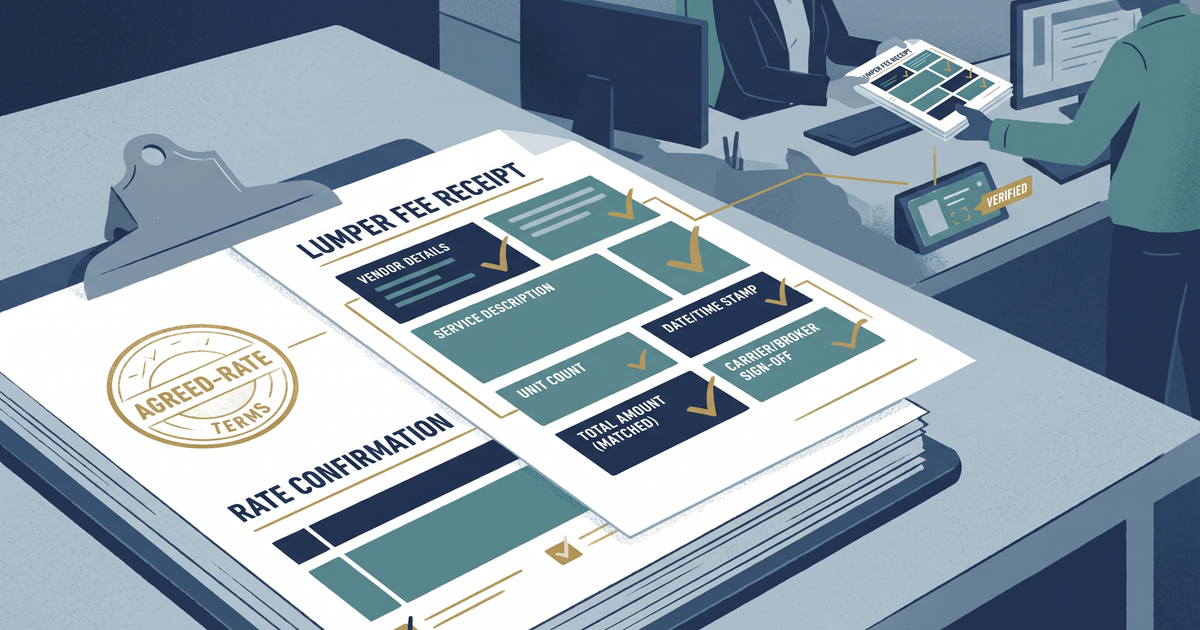
A $275 lumper charge gets submitted to a carrier's accounting team. No facility name. No service date. No breakdown of what work was performed. The result: the driver eats the full $275 out of pocket, the broker gets a complaint call, and the carrier's AP department moves on to the next invoice. That single missing field on a lumper fee receipt turned a routine reimbursement into a total loss. According to Apex Capital Corp, lumper fees typically range from $100 to $500 per job depending on hours worked and freight volume. At those amounts, even one rejected receipt per week adds up to thousands per year. This guide breaks down every field that matters on a lumper receipt, line by line, so you know exactly what to check before you approve, submit, or dispute.
What Is a Lumper Receipt? (The Version That Actually Holds Up in a Dispute)
A lumper receipt is a document issued by a third-party loading or unloading service at a warehouse or distribution center, confirming the work performed and the amount charged. It serves as the primary proof of payment when a driver, carrier, or broker seeks reimbursement for lumper fees. Without it, there is no verifiable record that the charge was legitimate, that the amount was correct, or that the service actually happened.
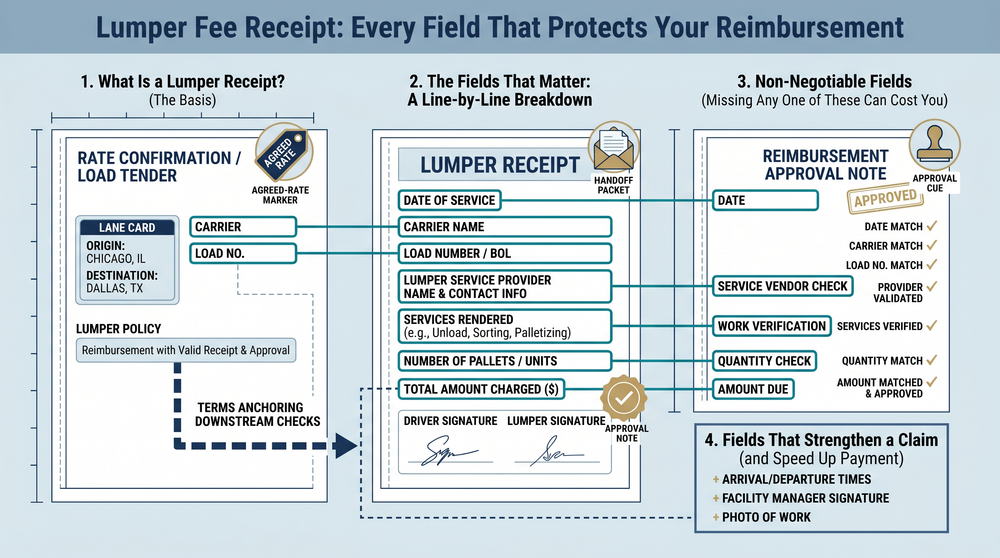
That definition covers the basics. But here is what separates a lumper receipt that holds up in a billing dispute from one that gets tossed: completeness. Per otrucking.com's 2026 guide on lumper fees, a valid lumper receipt should include at minimum the date, facility name, load or shipment reference, services rendered, and total fee charged. Miss any of those, and you are handing the carrier's accounting team a reason to deny the claim.
The legal backdrop matters here too. The Motor Carrier Act of 1980, codified at 49 U.S.C. 14103, made it illegal to coerce drivers into employing lumper services and forcing payment. The FMCSA's official guidance on lumper coercion reinforces that carriers and receivers cannot force a driver to pay for lumper services out of pocket without proper documentation and reimbursement channels. That means the lumper receipt is not just an accounting formality. It is the document that connects a legally protected right to actual dollars recovered.
For freight brokers specifically, the lumper receipt is the line of defense between paying a legitimate charge and getting padded. If you are handling lumper charges across dozens of loads per week, the quality of that documentation directly determines your margin leakage.
The Fields That Matter: A Line-by-Line Breakdown of a Valid Lumper Fee Receipt
Not every lumper receipt looks the same. Some are printed from a digital payment system like Comdata or RoadSync. Others are handwritten on carbon paper at the dock. Regardless of format, the fields below are what make the difference between a receipt that gets reimbursed and one that gets denied. According to Vector's breakdown of lumper receipt requirements, these are the elements every receipt should contain.
Non-Negotiable Fields (Missing Any One of These Risks Denial)
- Date of service: The exact date the unloading or loading occurred. Without this, accounting cannot match the charge to a specific load or delivery window.
- Facility name and address: The warehouse, distribution center, or receiver location where the lumper service was performed. A receipt that just says "warehouse" with no address is unusable.
- Load or shipment reference number: This ties the receipt to a specific BOL, PRO number, or load ID. Without it, the receipt floats with no connection to the shipment it belongs to.
- Description of services rendered: "Unloading" is a start, but specifics matter. Was it pallet breakdown? Floor-loaded trailer? Sorting? The description should match the type of work actually done.
- Total amount charged: The dollar figure, clearly stated. If tax or surcharges are separate, those should be itemized.
- Lumper company name or individual identification: Who performed the work? A company name, an individual's name, or a service badge number. Anonymous receipts are red flags.
Fields That Strengthen a Claim (and Catch Fraud)
- EIN or tax identification number: Especially important for cash-paid lumper services. A receipt without a company EIN from a lumper company claiming to be a legitimate business is worth questioning.
- Time in and time out: Hours worked by the lumper crew. This is critical for spotting inflated charges. If the receipt says 4 hours but the facility appointment window was only 90 minutes, something does not add up.
- Payment method: Cash, Comdata, T-Chek, or check. This helps accounting reconcile the payment against driver advances or reimbursement requests.
- Signature or authorization: A signature from the driver or facility representative confirming the work was completed and the charge accepted.
- Receipt number or transaction ID: Digital receipts from platforms like Comdata's Lumper Pay eReceipt system automatically generate transaction IDs, which makes matching receipts to invoices significantly faster.
As of 2026-04-01, average hourly earnings in truck transportation were $32.41/hr (BLS Current Employment Statistics, series CEU4348400008). When you consider that a billing coordinator spends 15 to 30 minutes per receipt manually verifying these fields, and you are processing hundreds of loads per month, the labor cost of bad documentation adds up fast.
What Gets a Lumper Reimbursement Claim Denied, and How to Fix It Before You Submit
Most reimbursement denials do not come from disputed amounts. They come from incomplete paperwork. Here are the most common reasons a carrier's AP team or a broker's accounting department rejects a lumper reimbursement claim, along with what to do about each one.
Missing or Mismatched Dates
The receipt says March 14, but the BOL shows delivery on March 16. That two-day gap gives accounting a reason to question whether the receipt even belongs to this load. Fix: drivers should confirm the date on the receipt matches the actual delivery date before leaving the facility. If the lumper company pre-dates receipts (this happens more than you would expect), the driver should note the discrepancy and take a timestamped photo of the BOL at the same location.
No Facility Name or a Generic Location
"Warehouse, NJ" is not a facility name. Neither is "DC #4" without the company that operates it. If the receipt does not clearly identify where the service happened, the claim has no anchor. Fix: the driver should ask the lumper company to include the full facility name. If they refuse, write it on the receipt yourself and photograph the facility sign alongside the receipt.
Amount Exceeds Rate Con Authorization
This is where brokers lose real money. If your rate con states "lumper fees not to exceed $200" and the driver submits a $350 receipt without calling for pre-authorization, you have a $150 gap that is extremely difficult to recover. The carrier will argue they paid the charge. The shipper will point to the rate con cap. And the broker is stuck in the middle. Fix: build a pre-authorization step into your workflow. Every driver should call dispatch before paying any lumper fee that exceeds the rate con amount. Document that call with a timestamp. For a deeper look at how these billing errors compound, see common lumper fee billing errors that cost brokers thousands.
Handwritten Receipt with No Company Identifiers
Handwritten receipts are still common, especially at smaller facilities. But a handwritten receipt with no EIN, no company address, and no printed company name is the weakest possible documentation. Fix: if the receipt is handwritten, the driver should ask for a business card from the lumper company, photograph both together, and note the lumper worker's name. Even a phone number on the receipt adds traceability.
Every missing field on a lumper receipt is a dollar amount you may never recover. The time to fix it is at the dock, not at your desk three days later.
Can You Refuse to Pay a Lumper Fee? What Your Rate Con and Broker Agreement Actually Say
This question comes up constantly. The short answer: drivers have the legal right to refuse coerced lumper services, but the practical answer depends on what the rate con says, what the broker-carrier agreement covers, and what the receiver demands.
The Legal Side
Under 49 U.S.C. 14103, as reinforced by FMCSA guidance, a receiver cannot coerce a driver into using and paying for lumper services. The driver has the right to unload the freight themselves. However, many receivers (especially grocery DCs and large retail distribution centers) require third-party unloading for insurance, liability, or union reasons. In practice, refusing the lumper means the freight does not get unloaded, and the driver sits at the dock burning detention time.
The Rate Con Side
Your rate confirmation is the governing document for lumper fee responsibility. If the rate con includes language like "shipper/receiver lumper fees will be reimbursed with valid receipt" or "lumper not to exceed $XXX," then the broker has agreed to cover lumper costs within those terms. If the rate con is silent on lumper fees, the carrier or driver may be responsible. This is why understanding exactly what your rate con lumper notation means is critical before the truck reaches the dock.
Example: The $150 unrecoverable gap. A broker's rate con states "lumper fees not to exceed $200." The driver arrives at a grocery DC and is charged $350 by the lumper company. The driver pays without calling dispatch. The receipt is valid, complete, and properly documented. But the broker can only reimburse $200 per the rate con. The carrier eats $150. If the driver had called dispatch, the broker could have contacted the shipper for pre-authorization on the overage or negotiated with the receiver. That one missed phone call created a $150 loss that nobody can recover.
The Broker Agreement Side
Many broker-carrier agreements include a clause specifying the documentation required for lumper reimbursement: original receipt (or clear photo/scan), submission within 48 to 72 hours of delivery, and matching load reference numbers. If the carrier's driver does not meet these documentation requirements, the broker is within their contractual rights to deny reimbursement. That is not a negotiation tactic. It is the agreement the carrier signed.
When the Receipt Is Lost, Illegible, or Never Issued: How to Recover Without It
Receipts get lost. They get smudged in the rain. They end up crumpled in a door pocket and forgotten. Sometimes the lumper company simply does not issue one. Here is what to do in each scenario.
Scenario: Handwritten Receipt with No EIN or Address, Recovered via BOL Photo
A driver pays $180 cash to a lumper crew at a produce warehouse. The handwritten receipt has a dollar amount and a scrawled signature, but no company name, no EIN, and no facility address. The driver knows the claim will be denied. But the driver also took a timestamped photo of the BOL at the same facility, showing the delivery date, load number, and receiver name. The driver submits the handwritten receipt alongside the timestamped BOL photo and a written statement describing the service. The carrier's accounting team accepts the claim because the BOL photo corroborates the time, place, and load. This is not ideal documentation, but it is recoverable documentation.
Scenario: Digital Receipt from Payment Platform
If the lumper fee was paid via Comdata, T-Chek, or a platform like RoadSync, an electronic receipt exists in the system. These digital receipts (eReceipts) typically contain all required fields automatically: date, time, facility, amount, transaction ID, and payment method. If the paper receipt is lost, request a duplicate from the payment platform. This is one of the strongest arguments for using digital lumper payment systems: the backup is built in.
Scenario: Receipt Was Never Issued
This is the worst case. The driver paid cash for lumper services and received nothing in writing. Under 49 CFR Part 373, motor carriers are required to issue receipts for services rendered in interstate commerce. While this regulation focuses on bills of lading, it establishes the broader documentation standard in freight. If no receipt exists, the driver should immediately document the payment with a written statement including the date, amount, facility, and names of any lumper workers. A photo of the facility entrance with a visible address sign and timestamp adds supporting evidence. File the claim with a note explaining that the lumper company refused to issue a receipt. Some carriers will accept this with corroborating evidence. Many will not. The lesson: never leave a facility without a receipt.
How Brokers Should Be Handling Lumper Fee Documentation in Their Workflow Right Now
If you are a freight broker processing 100 or more loads per month, lumper fee documentation cannot be an afterthought handled by whoever answers the phone. It needs a defined process. Here is what that looks like.
Step 1: Rate Con Clarity Before the Load Moves
Every rate confirmation should state whether lumper fees are covered, who pays, and what the cap is. If the shipper has not confirmed whether the receiver charges lumper fees, call and ask before tendering the load. A rate con that says nothing about lumper fees is a rate con that creates disputes.
Step 2: Pre-Authorization Protocol for Overages
Set a policy: if the lumper fee exceeds the rate con amount by any margin, the driver must call dispatch before paying. Dispatch then contacts the shipper or broker (depending on the chain) for approval. Document the authorization with a timestamped email or TMS note. No pre-authorization, no reimbursement above the cap. Make this clear to every carrier at onboarding.
Step 3: 48-Hour Receipt Submission Requirement
Per OTR Solutions, drivers are typically required to submit lumper receipts to dispatch or accounting within 24 hours to qualify for reimbursement. As a broker, you should set a 48-hour window for carriers to submit receipts after delivery. Here is the exact email language you can use:
Subject: Lumper Receipt Required — Load #[XXXX] — Due within 48 hours Please submit the lumper receipt for Load #[XXXX], delivered [date] to [facility name]. Receipt must include: date, facility name, load reference, services performed, and total amount. Reimbursement requests received after [date + 48 hours] or without required fields will not be processed. Thank you.
This is not aggressive. It is clear. And it protects your reimbursement timeline with the shipper.
Step 4: Receipt Validation Before Payment
Before approving any lumper reimbursement, check the receipt against the required fields listed above. Cross-reference the amount with the rate con. Compare the facility name to the delivery address on the BOL. If the charge seems abnormal for the facility type, flag it.
Example: Inflated lumper fee at a grocery DC. Your average lumper fee for dry goods at standard warehouses runs $150. A receipt comes in from a grocery distribution center for $400. Grocery DCs often charge more due to temperature requirements, pallet breakdown, and sorting. But $400 is still at the high end. Cross-check with the typical lumper fee range of $100 to $500 cited by Apex Capital Corp. If the receipt lacks a detailed service description explaining why the charge is $250 above your norm, request an itemized breakdown before approving.
Step 5: Centralize and Archive Everything
Lumper receipts should be attached to the load file alongside the BOL, POD, and rate con. If they exist only as loose papers in a driver's cab or as email attachments buried in an inbox, they are effectively lost. As of 2026-05-01, the truck transportation sector employed 1,465 thousand workers (BLS CES series CES4348400001), and the sheer volume of documentation flowing through the industry makes centralized archiving a necessity, not a luxury.
Real Examples: Complete vs. Incomplete Lumper Receipts and What They Cost
Let's put numbers to the documentation gaps.
Example: Side-by-Side Receipt Comparison
Complete receipt (approved):
- Date: March 12, 2026
- Facility: Kroger DC #7, 4500 Industrial Blvd, Nashville, TN
- Load reference: BOL #88421
- Services: Full pallet breakdown, floor sort, 3.5 hours
- Amount: $275
- Lumper company: FastFreight Unloading LLC, EIN 47-XXXXXXX
- Payment: Comdata, Transaction #9912847

Incomplete receipt (denied):
- Date: (blank)
- Facility: "Nashville warehouse"
- Load reference: (blank)
- Services: "unloading"
- Amount: $275
- Lumper company: (blank)
- Payment: "cash"
Same dollar amount. Same load. But the second receipt has no date, no specific facility, no load reference, no service detail, and no company identification. The carrier's AP team rejected it in under 30 seconds. The driver lost $275. For a detailed look at which fields most often trigger denials, see what a valid lumper receipt must include to win a billing dispute.
Example: Annual Cost of Documentation Gaps for a Mid-Size Brokerage
Here is the math for a brokerage processing 300 loads per month:
- Loads involving lumper fees: approximately 25% (75 loads/month)
- Average lumper fee: $175
- Dispute rate due to documentation gaps: 12%
- Disputed receipts per month: 9
- Average unrecovered amount per dispute: $175 (full denial) to partial recovery of $100 (net loss of $75 per dispute)
At full denial on 9 disputes: 9 × $175 = $1,575/month, or $18,900/year. At partial recovery (more realistic): 9 × $75 average net loss = $675/month, or roughly $4,000 to $7,000/year depending on the mix of full and partial denials. That range, $4,000 to $7,000 annually, is money that never shows up on a P&L line item because it is buried across hundreds of individual load files. But it is real margin erosion.
Frequently Asked Questions About Lumper Fee Receipts
What is a lumper receipt?
A lumper receipt is a document issued by a third-party unloading or loading service confirming the work performed and the fee charged at a warehouse or distribution center. It serves as the primary proof of payment for reimbursement claims. According to otrucking.com, a valid lumper receipt should include the date, facility name, load reference, services rendered, and total amount charged.
Can you refuse to pay a lumper fee?
Legally, yes. Under 49 U.S.C. 14103, drivers cannot be coerced into paying for lumper services, per FMCSA enforcement guidance. Drivers have the right to unload freight themselves. However, many receivers require third-party unloading for insurance or operational reasons, and refusing the lumper in practice often means the freight does not get unloaded. Check your rate con and broker-carrier agreement for specific lumper fee terms before making that call.
How long does a driver have to submit a lumper receipt for reimbursement?
Most carriers and brokers require lumper receipt submission within 24 to 48 hours of delivery. Per OTR Solutions, drivers are typically expected to submit receipts to dispatch or accounting within 24 hours. Brokers should build a 48-hour submission window into their carrier agreements and enforce it consistently to protect their own reimbursement timelines with shippers.
What if a lumper company refuses to issue a receipt?
If a lumper company refuses to provide a receipt, the driver should document the payment immediately with a written statement including the date, facility name, amount paid, and names of any workers involved. Take timestamped photos of the facility entrance and the BOL. Report the refusal to dispatch. While some carriers will accept a claim with corroborating documentation, a missing receipt makes reimbursement significantly harder. This is also a potential red flag for an unlicensed lumper operation.
Are digital lumper receipts valid for reimbursement?
Yes. Digital receipts (eReceipts) from platforms like Comdata, RoadSync, or T-Chek are fully valid and often preferred by accounting teams because they automatically include all required fields: date, time, facility, amount, and transaction ID. Per Comdata's Lumper Pay eReceipt platform, digital receipts also create an automatic backup, reducing the risk of lost documentation.
Sources
- May drivers be coerced into employing loading or unloading assistance (lumpers)? — FMCSA
- 49 CFR Part 373: Receipts and Bills — eCFR
- Simplify Lumper Fee Payments — RoadSync
- Lumper Receipt: What Is It and What Should Be on It? — Vector
- Everything You Need to Know about Lumper Fees — OTR Solutions
- Lumper Pay eReceipts — Comdata
- Lumper Fees Explained: Costs & Rules (2026) — otrucking.com
- Lumper Fees in Trucking: What Are They and Who Pays Them? — Apex Capital Corp
Stop Losing Reimbursements to Bad Paperwork
The difference between a lumper fee you recover and one you eat comes down to seven or eight fields on a single piece of paper. Every field covered in this guide exists to answer one question: can you prove what was paid, where, when, for what service, and to whom? If the answer to any of those is "not really," the reimbursement is at risk.
Build the receipt validation into your workflow now. Set the 48-hour submission rule. Make rate con lumper notations specific and enforceable. Train your carriers on what a complete receipt looks like. The $4,000 to $7,000 in annual losses from documentation gaps is not inevitable. It is fixable.
If your team processes more than 50 lumper receipts a week and is still manually checking every field against the BOL and rate con, automated document extraction tools can catch the mismatches covered in this guide before they turn into denied claims.