Lumper Fee Calculator: Verify Every Charge Before You Pay
Researched and written with AI assistance. Reviewed by the Laneproof team.

A carrier submits a lumper receipt for $425 on a 42,000 lb dry van load. You pay it. But if you had run the numbers through a lumper fee calculator using the receiver's posted per-pound rate of $0.008/lb, the correct charge was $336. That is an $89 overbill on a single load. According to FreightCenter's lumper fee overview, average lumper fees range from $100 to $500 per stop, and they are commonly paid via cash, fleet checks, or fuel cards. Each of those payment methods makes tracking harder and disputes messier. If your brokerage moves 200 loads a month and even 15% involve lumper charges, unchecked overbilling adds up to thousands in margin loss per quarter. This guide gives you the exact formulas, receipt requirements, rate con language, and dispute scripts to stop paying more than you owe.
How Lumper Fees Are Actually Calculated (Two Methods, One Right Answer)
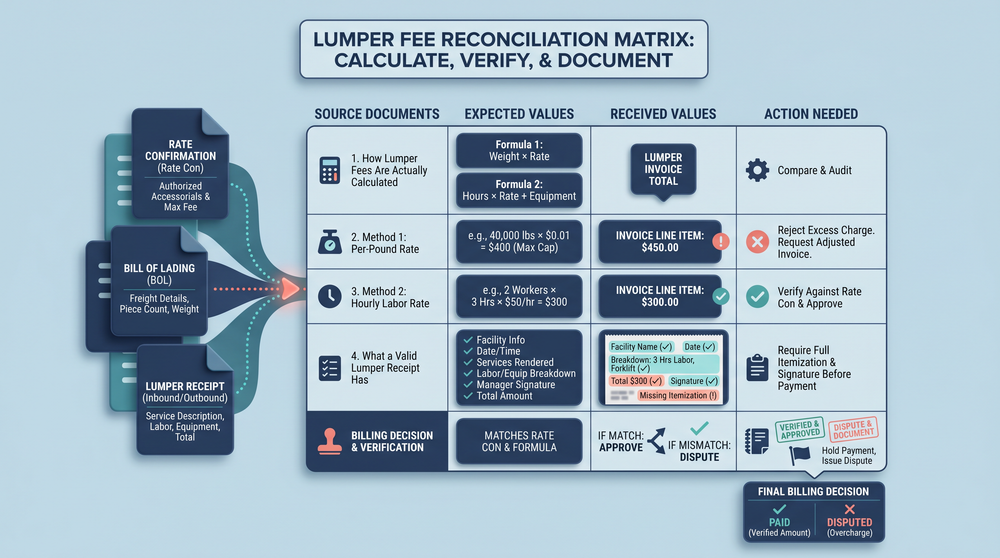
Lumper fees are calculated using one of two methods: a per-pound (or per-ton) rate multiplied by shipment weight, or an hourly labor rate multiplied by crew size and time on dock. Most receivers use one method consistently, but the receipt your carrier submits does not always match. That gap is where overbilling lives.
According to Relay Payments' breakdown of lumper fee calculations, weight-based pricing is the most common structure at large distribution centers. The receiver posts a per-pound or per-ton rate, and the lumper service multiplies it against the total shipment weight. Humano's calculation guide illustrates the formula directly: a $0.05 per pound rate on a 5,000 lb shipment yields a $250 fee. The math is simple. The problem is that carriers often submit receipts with round numbers that do not correspond to any published rate.
Method 1: Per-Pound Rate
This is the formula you should use for any weight-based lumper fee calculator:
Lumper Fee = Shipment Weight (lbs) × Per-Pound Rate
Example: A 42,000 lb dry van load delivered to a grocery DC with a posted lumper rate of $0.008/lb.
42,000 × $0.008 = $336
If the carrier submits a receipt for $425 with no weight or rate breakdown, that is an $89 discrepancy. Most brokers pay it because pulling up the receiver's rate schedule takes time they do not have. But the math takes 10 seconds when you know the rate.
To find the receiver's posted rate, call the facility's receiving office directly, or check the LumperHQ cost calculator, which estimates costs based on container size, piece count, and SKU complexity. Not every facility will publish rates openly, but asking once and recording the answer saves you money on every future load to that location.
Method 2: Hourly Labor Rate
Some facilities, especially smaller receivers or specialty freight handlers, charge lumper fees based on crew hours. The formula:
Lumper Fee = Number of Workers × Hourly Rate × Hours Worked
Example: 4 workers at $22/hour for 3.5 hours.
4 × $22 × 3.5 = $308
Now compare that to a receipt showing 5 workers for 4 hours at the same rate: 5 × $22 × 4 = $440. That is a $132 difference. To verify headcount, request the receiver's dock sign-in log. Most facilities require lumper crews to sign in. If the log shows 4 names and the receipt says 5, you have documented grounds to dispute.
For context on labor costs, as of 2026-04-01, average hourly earnings in truck transportation were $32.41/hr (BLS Current Employment Statistics, series CEU4348400008). Lumper workers typically earn less than this, so any receipt charging $35 or more per worker per hour should get a second look.
What a Valid Lumper Receipt Has to Show, and What Gets Claims Rejected
A lumper receipt is the single document that determines whether your reimbursement claim holds up or gets thrown out. According to OTR Solutions' lumper fee guide, lumper fees are classified as accessorial charges, which means they require the same documentation rigor as any other line item on a carrier invoice. A receipt missing key fields is not just sloppy. It is unverifiable, and unverifiable charges should not be paid.
Required Fields on Every Lumper Receipt
Every lumper receipt your team accepts should include these fields. If any are missing, flag the receipt before approving payment:
- Facility name and address of the receiver where the work was performed
- Date and time the lumper service started and ended
- Number of workers assigned to the unload
- Rate basis (per-pound rate, per-pallet rate, or hourly rate with hours logged)
- Total charge with a line-item breakdown matching the rate basis
- Lumper company name or service provider identification
- Signature or stamp from the facility confirming the service was rendered
For a deeper breakdown of which receipt fields matter most in disputes, see our guide on what a valid lumper receipt must include to win a billing dispute.
Scenario: The Receipt That Would Not Survive a Dispute
A carrier submits a handwritten lumper receipt with a total of $375. Here is what is on it: a date, a handwritten dollar amount, and a signature you cannot read. Here is what is missing:
- No facility name or address
- No worker count
- No rate basis (per-pound, hourly, or per-pallet)
- No lumper company identification
- No time-in/time-out log
This receipt cannot be verified against any formula. You cannot check it against the receiver's posted rate. You cannot cross-reference headcount against a sign-in log. If this carrier disputes your rejection, they have no documentation to support their claim. Conversely, if you pay it without question, you have no way to prove the charge was accurate during a later audit. Reject the receipt, request a replacement with full details, and document the request in writing.
Who Pays the Lumper Fee and What Your Rate Con Should Say Before You Accept the Load
The question of who pays the lumper fee is answered before the truck ever arrives at the dock. It is determined by the rate confirmation, and if the rate con is vague, the broker almost always absorbs the cost. According to OTrucking's 2026 lumper fee guide, lumper fees typically range from $150 to $400 per load and are classified as accessorial charges. That classification means they should be treated like any other accessorial: agreed upon in advance, capped with a ceiling, and documented with a receipt.
Rate Con Language That Protects You vs. Language That Costs You
Here are two real examples of rate con language and what each one means for your margin:
Version A: "Lumper fees included."
This means the carrier's linehaul rate already accounts for the lumper. If the carrier then submits a separate lumper receipt for reimbursement, you are within your rights to deny it. The fee was baked into the rate. But if the actual lumper cost exceeds what the carrier estimated, that is the carrier's problem, not yours. This language gives you the most protection.
Version B: "Lumper fees reimbursable up to $350 with valid receipt."
This is the more common structure. It sets a cap, requires documentation, and gives both parties clarity. If the carrier submits a lumper receipt for $525, you reimburse $350 and the carrier absorbs the $175 overage. But only if the rate con says this explicitly. If it says nothing about lumper fees at all, you are in a gray zone where both sides will argue responsibility.
For a complete breakdown of liability scenarios and contract language, see our guide on who pays lumper charges and how to get reimbursed.
If your rate con does not address lumper fees explicitly, assume you will pay them. Write the language before you tender the load, not after the carrier is at the dock asking for a Comchek.
The Legal Baseline You Need to Know
Under 49 U.S.C. § 14103, which originated from the Motor Carrier Act of 1980, it is illegal to coerce a driver into performing loading or unloading services and then require payment for those services. The FMCSA's official guidance on lumper regulations establishes that receivers can require the use of lumper services, but they cannot force the driver to do the work personally and then charge for it. This distinction matters because it means the receiver controls whether a lumper is used, but the rate con controls who pays.
How to Run the Reimbursement Process Without Chasing Carriers for Two Weeks
Lumper fee reimbursement should be a 48-hour process. In practice, it drags out for weeks because receipts are incomplete, carrier invoices lump the fee into linehaul, and nobody documents the BOL correctly at the dock. Here is the workflow that keeps reimbursement on schedule.
Step 1: Get the BOL Notation Right at the Dock
Before the driver leaves the receiver, the BOL should include a handwritten or stamped notation: "Lumper used, receipt attached." This does two things. First, it creates a time-stamped record that lumper services were rendered at that facility on that date. Second, it ties the lumper receipt to a specific load, which prevents carriers from recycling receipts across multiple invoices.
A BOL with no lumper notation gives you nothing in a dispute. If a carrier submits a lumper receipt three days later and the BOL has no mention of lumper services, you have no way to confirm the charge is connected to that load. Instruct your carriers to get the notation on the BOL every time, and make it a condition of reimbursement.
Step 2: Separate Lumper Reimbursement from Linehaul on the Carrier Invoice
Lumper fees paid by the carrier in cash must be documented as a separate line item from linehaul revenue. This is not just an accounting preference. It affects gross revenue reporting and can create issues during audits if lumper reimbursements inflate the carrier's reported income.
Here is what a properly structured carrier invoice looks like:
- Linehaul: $2,150.00
- Fuel Surcharge: $215.00
- Lumper Fee Reimbursement: $336.00 (receipt #LMP-8842 attached)
- Total Invoice: $2,701.00
When the lumper reimbursement is broken out, your accounting team can categorize it correctly as an accessorial passthrough rather than carrier revenue. If the carrier submits a single-line invoice for $2,701 with no breakdown, you should request a revised invoice before processing payment. For more on common lumper fee billing errors that cost brokers money, including how bundled invoices create audit exposure, see our detailed breakdown.
Step 3: Cross-Reference the Receipt Against Your Calculator
Before approving any lumper reimbursement, run the receipt through the calculation framework above. If the receipt shows a per-pound charge, multiply the rate by the shipment weight on the BOL. If it shows hourly labor, multiply the crew size by rate and hours. Compare the result to the receipt total. If the difference exceeds $25, request documentation from the carrier before paying. That threshold is not arbitrary. On a $300 average lumper fee, $25 represents an 8% variance, which is enough to indicate a calculation error or inflated charge.
Can You Refuse to Pay a Lumper Fee, and What Happens If You Try
Yes, in limited circumstances, but it almost always costs you more than paying. Under FMCSA regulations, a receiver cannot force the driver to unload the freight personally and then charge a fee for it. But the receiver can require that a third-party lumper service handle the unload. If the receiver mandates lumper use, refusing to pay means the freight does not get unloaded. Your driver sits at the dock, detention starts accruing, and the load misses its appointment window.
When Refusal Makes Sense
There are narrow situations where refusing, or at least disputing, is justified:
- The receipt is missing required fields and the lumper service cannot provide a complete one
- The charge exceeds your rate con cap and the carrier did not get pre-approval for the overage
- The receiver's posted rate does not match the receipt amount and the lumper company cannot explain the difference
- The facility has a documented pattern of inflating lumper charges (keep a facility log with historical costs)
The Dispute Script When the Charge Exceeds the Rate Con
When a carrier submits a lumper charge that is $175 over your rate con cap, here is the exact language you can send:
"Per load [LOAD NUMBER], the rate confirmation specifies lumper fee reimbursement up to $350 with a valid receipt. The submitted lumper receipt totals $525. To process reimbursement above the agreed cap, we require: (1) the receiver's posted lumper rate schedule for this facility, (2) a complete lumper receipt showing worker count, hours or weight basis, and facility stamp, and (3) written confirmation from the receiver that the charge is accurate. Without these documents, reimbursement will be processed at the rate con cap of $350. Please submit the above within 48 hours."
This script does three things: it references the specific agreement, names the exact documents needed, and sets a clear deadline. Most carriers will either produce the documentation (proving the charge is valid) or accept the cap (because they cannot prove it is not). Either way, you have a paper trail.
Putting It All Together: Two Full Calculation Examples
Let us walk through two complete scenarios from load acceptance to invoice approval.
Example 1: Per-Pound Overcharge on a Grocery DC Load

Load details: 42,000 lb dry van, Dallas to a grocery distribution center in Memphis. Rate con states: "Lumper fees reimbursable up to $350 with valid receipt."
At the dock: Driver checks in. Receiver requires lumper service. The posted rate at this facility is $0.008/lb.
Your calculation: 42,000 × $0.008 = $336.
Carrier submits: A lumper receipt for $425 with no per-pound breakdown, no worker count, and a handwritten total.
Your response: Reject the receipt. Request a revised receipt showing the weight-based calculation. The correct charge is $336, which falls within the $350 rate con cap. If the carrier cannot produce a proper receipt, reimburse $336 based on your own calculation using the facility's posted rate, and document your methodology in the payment notes.
Savings on this load: $89.
Example 2: Hourly Rate Dispute with Headcount Discrepancy
Load details: 26-pallet produce load, Salinas to a foodservice distributor in Phoenix. Rate con states: "Lumper fees reimbursable up to $400 with valid receipt."
According to Warp's freight glossary, foodservice and produce loads of 20 to 26 pallets typically incur lumper fees between $150 and $400. This range aligns with the rate con cap.
Carrier submits: A lumper receipt showing 5 workers × $22/hr × 4 hours = $440.
Your verification: You call the receiver's dock office and request the sign-in log. The log shows 4 names, not 5. You also confirm the unload took 3.5 hours based on the BOL check-in and check-out times.
Your calculation: 4 × $22 × 3.5 = $308.
Your response: Reimburse $308. Provide the carrier with your calculation, reference the sign-in log headcount, and note the time discrepancy from BOL timestamps. Attach all documentation to the load file.
Savings on this load: $132.
Example 3: IFTA and Accounting Line-Item Breakdown
On the Memphis grocery load from Example 1, the carrier paid the lumper $336 in cash at the dock. The carrier's invoice arrives as a single line for $2,486 (linehaul + fuel surcharge + lumper). Here is how it should be broken out:
- Linehaul: $1,950.00
- Fuel Surcharge: $200.00
- Lumper Fee Reimbursement: $336.00 (receipt #LMP-9103, facility-stamped)
- Total: $2,486.00
When the lumper reimbursement is separated, it does not inflate the carrier's linehaul revenue. For the carrier, this matters at tax time. Cash lumper payments that are not documented separately can be misclassified as operating revenue rather than reimbursed expenses. For you as the freight broker, the separated line item makes reconciliation faster and audit defense cleaner.
Frequently Asked Questions About Lumper Fee Charges and Reimbursement
How are lumper fees calculated?
Lumper fees are calculated using either a weight-based method (per-pound or per-ton rate multiplied by shipment weight) or an hourly labor method (number of workers multiplied by hourly rate and hours worked). The weight-based method is more common at large distribution centers. According to Relay Payments, receivers typically post their per-pound rate, which the lumper service applies against the total shipment weight on the BOL.
Who typically pays the lumper fee?
Who pays depends entirely on the rate confirmation. If the rate con says "lumper fees included," the carrier absorbs the cost within their linehaul rate. If it says "lumper fees reimbursable with receipt," the broker or shipper reimburses the carrier after delivery. If the rate con says nothing about lumper fees, you are in dispute territory. The safest approach is to address lumper responsibility explicitly on every rate con before tendering the load. For a full walkthrough of liability scenarios, see our guide on lumper fees explained, including who pays and how to get reimbursed.
Can you refuse to pay a lumper fee?
Under FMCSA regulations based on 49 U.S.C. § 14103, a receiver cannot coerce a driver into unloading freight and then charge for it. However, the receiver can require the use of a third-party lumper service. Refusing to pay in that situation means the freight sits on the trailer, detention accrues, and the load misses its window. Refusal is only practical when you have documented evidence the charge is fraudulent, the receipt is incomplete, or the amount violates the rate con terms.
How do I avoid getting overbilled on lumper fees?
Three steps reduce overbilling on most loads. First, build a facility rate database by recording lumper rates at every receiver your carriers deliver to. Second, run every lumper receipt through a calculation check (weight × rate or crew × hourly rate × hours) before approving reimbursement. Third, require complete lumper receipts with facility name, worker count, rate basis, and a facility stamp as a condition of reimbursement. Receipts missing any of these fields should be rejected and resubmitted.
Do lumper fees count as carrier revenue for tax purposes?
Lumper fee reimbursements should not be classified as carrier revenue. They are expense reimbursements and should be listed as a separate line item on the carrier invoice. When a carrier receives a $336 lumper reimbursement, that amount offsets the cash the carrier already paid at the dock. If it is bundled into the linehaul total, it artificially inflates the carrier's gross revenue. Carriers should work with their accountant to ensure lumper reimbursements are categorized correctly for both income tax and operational reporting.
Sources
- Lumpers | FMCSA — U.S. Department of Transportation, Federal Motor Carrier Safety Administration
- Lumper Cost Calculator — LumperHQ
- How lumper fees calculated? — Relay Payments
- Lumper Fee — FreightCenter
- Lumper Fees Explained: Costs & Rules (2026) — OTrucking
- Lumper Service | Freight Glossary — Warp
- Everything You Need to Know about Lumper Fees — OTR Solutions
- How lumper fees calculated? — Humano
Stop Paying Lumper Fees You Cannot Verify
Every lumper receipt that hits your desk is either verifiable or it is not. The calculation methods in this guide (per-pound and hourly) take seconds to run. The receipt checklist catches missing fields before you approve payment. The rate con language and dispute scripts give you documented leverage when the numbers do not match. Build the habit of checking every lumper charge against these frameworks, and the overbilling stops.
If your team processes more than 50 carrier invoices a week and lumper receipts are just one of the accessorials slowing down reconciliation, automated document extraction tools can pull receipt fields, match them against rate con terms, and flag discrepancies before anyone on your team has to open a calculator.
Related: Are Lumper Fees Legal? What Brokers Need to Know Before the Invoice Hits
Related: Automate Lumper Fee Verification Before It Costs You $150 a Load
Related: How Are Lumper Fees Calculated? The Math Behind Every Model