What a Valid Lumper Receipt Must Include to Win a Billing Dispute
Researched and written with AI assistance. Reviewed by the Laneproof team.
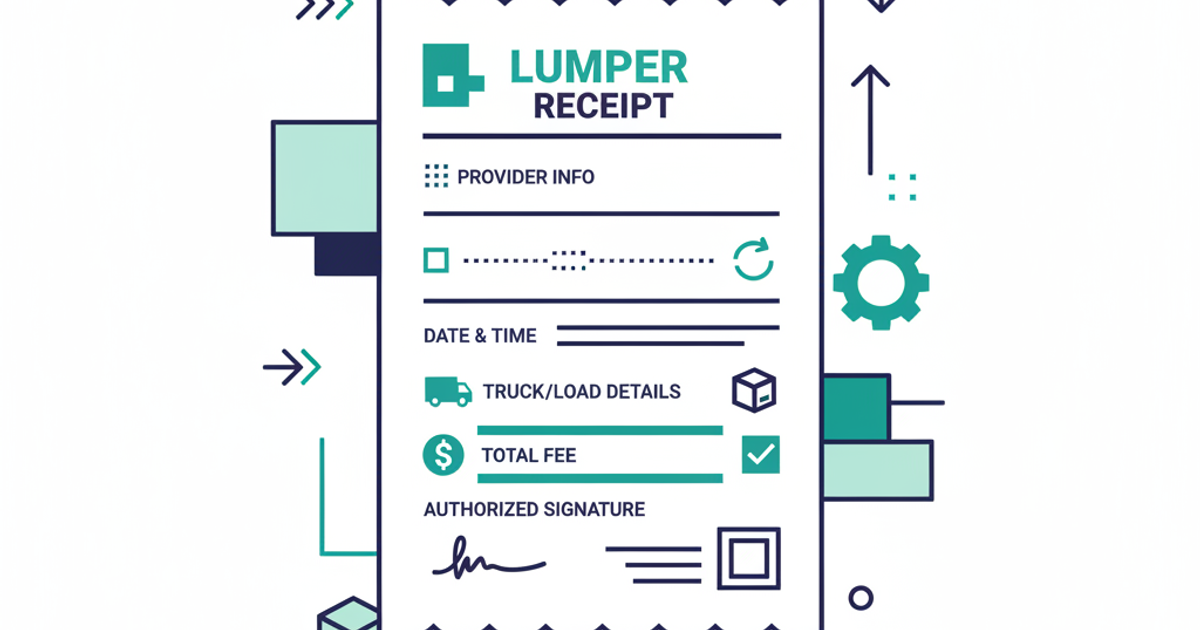
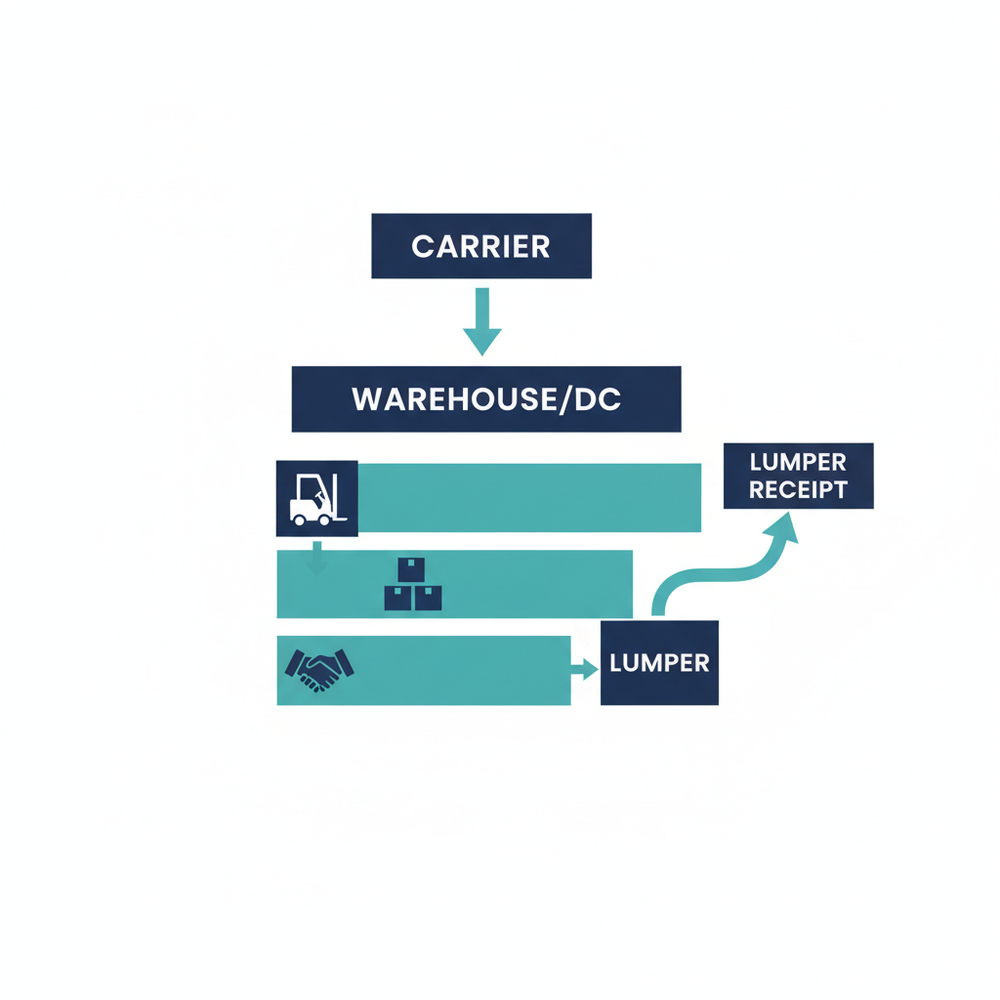
A lumper receipt is a written record confirming that a third-party lumper service loaded or unloaded a shipment at a warehouse or distribution center. It documents who performed the work, how much was charged, and which load the fee applies to. The shipper or receiver typically hires the lumper, but in most brokered freight scenarios, the broker or carrier ends up paying the fee and seeking reimbursement. According to FMCSA regulations on lumper coercion, drivers cannot be forced to use lumper services, and when they do, proper documentation is required. The problem? Roughly 10% of lumper receipts are lost before reimbursement ever happens. That number climbs higher when you count receipts that arrive incomplete, illegible, or mismatched. For brokers running hundreds of loads a month, each bad receipt is a margin leak that takes hours to resolve.
What Is a Lumper Receipt and Who Actually Pays the Fee
A lumper is a third-party worker (or crew) hired to physically unload or load freight at a warehouse, distribution center, or cold storage facility. Lumper services are most common at grocery DCs, retail distribution hubs, and food-grade warehouses where receivers want their own labor handling the product. The lumper receipt is the proof that the service happened and the fee was paid.
Who pays depends on the rate con language. In most brokered freight, the rate confirmation specifies whether lumper fees are included in the linehaul rate, reimbursed separately with receipt, or capped at a fixed dollar amount. When the rate con says "lumper fees reimbursed with valid receipt," the carrier's driver pays the lumper at the facility, keeps the receipt, and the carrier invoices the broker for reimbursement. The broker then bills the shipper. If you want a deeper breakdown of who holds financial responsibility and when, see our guide on lumper charges, liability, and reimbursement.
Why the Receipt Is the Only Thing That Matters
Without a valid lumper receipt, the broker has zero obligation to reimburse. The receipt is the carrier's proof of payment. It's also the broker's proof to the shipper that the charge was real. If the receipt is missing fields, the chain of proof breaks. According to Apex Capital's breakdown of lumper fee documentation, a lumper receipt must, at minimum, contain the date, amount, and description of the service performed. But "minimum" won't protect your margins in a dispute. You need more.
Every Field That Needs to Be on a Lumper Receipt
Most lumper receipts you'll see are handwritten on generic carbon-copy pads or printed from facility payment kiosks. The quality ranges from perfectly itemized to barely readable. Here's every field that needs to appear on a lumper receipt for it to hold up when a carrier submits it for reimbursement, and for your team to verify it without back-and-forth.
Required Fields for a Valid Lumper Receipt
- Facility name and address. The receipt must identify the warehouse or DC where the lumper service was performed. A receipt with no facility name could have come from anywhere.
- Date of service. The date the unloading or loading occurred. This needs to match the delivery date on the BOL and POD.
- Time of service. Start and/or end time. This helps verify the receipt aligns with the driver's actual appointment window.
- Load number or reference number. This is the link between the receipt and the specific shipment in your TMS. Without it, matching falls apart.
- Description of service performed. Unloading, sorting, palletizing, or other handling. This matters for verifying the charge amount is reasonable.
- Number of units handled. Pallet count, case count, or total weight. This supports the math behind the dollar amount.
- Total amount charged. The exact dollar figure paid to the lumper service.
- Payment method. Cash, Comchek, EFS, T-Chek, or facility payment system. Knowing the method helps trace the payment if disputed.
- Lumper company or individual name. Who performed the work. Some facilities use in-house lumper crews; others contract with companies like Capstone Logistics or Universal Lumpers.
- Driver signature or acknowledgment. Confirms the driver was present and agreed to the charge.
- Facility representative signature or stamp. Confirms the facility authorized the service.
As noted in Vector's lumper receipt breakdown, itemization is critical. A receipt that just says "$350, lumper" with no further detail gives your billing team nothing to verify against.
What Happens When Fields Are Missing
Example: A carrier submits a $350 lumper fee reimbursement request. The receipt shows a dollar amount and a payment method, but no facility name, no date, and no driver signature. Your billing coordinator has no way to verify the receipt is tied to an actual shipment. Was this from the load you brokered, or from a different load entirely? Was it fabricated? You can't prove it either way. Without the facility name, you can't call to confirm the charge. Without the date, you can't match it to the delivery. Without the driver signature, you can't confirm who was there. This receipt gets rejected, the carrier disputes the rejection, and your team spends 45 minutes going back and forth. Multiply that by 20 receipts a month and you've burned an entire workday on disputes that a complete receipt would have prevented.
How to Match a Lumper Receipt Against Your Rate Con and BOL
Having a receipt with all the right fields is step one. Step two is matching it against your rate confirmation and bill of lading. This is where most billing discrepancies hide.
The Three-Document Check
Every lumper fee reimbursement should pass a three-document check before payment is approved:
- Rate confirmation. Does the rate con authorize lumper fee reimbursement? Is there a cap? Does it require pre-authorization above a certain amount?
- BOL / POD. Does the delivery date on the BOL match the date on the lumper receipt? Is the consignee facility the same as the facility listed on the receipt?
- Lumper receipt. Does the amount fall within the rate con's authorized range? Does the load number match? Is every required field present?
If all three documents align, you approve the reimbursement. If any one of the three has a mismatch, you flag it before paying. This process sounds simple, but according to FreightWaves' coverage of freight document workflows, lumper receipts, bills of lading, and carrier invoices are a noted source of silent profit loss in logistics operations precisely because the matching happens manually and inconsistently.
Rate Con Caps and Pre-Authorization Language
Example: Your rate con authorizes a $200 lumper fee cap. The carrier submits a receipt for $275. No pre-authorization was requested or granted before the driver paid. That's $75 in exposure. The carrier will argue they had no choice at the facility. Your ops team will argue the rate con was clear. Here's how to prevent this:
- Add explicit cap language to every rate con: "Lumper fees reimbursed up to $200 with valid receipt. Fees exceeding $200 require broker pre-authorization prior to payment. Fees paid without pre-authorization above the cap will not be reimbursed."
- Include a contact number on the rate con for pre-authorization. Dispatchers should have a direct line to call, not a general office number.
- Train your dispatchers to confirm the lumper fee amount when the driver checks in at the facility. A quick call or text confirming "lumper is $275, do I have approval?" takes 30 seconds and saves the dispute entirely.
For more on the specific billing errors that create these disputes, read our breakdown of lumper fee billing mistakes that cost brokers thousands. The pattern is consistent: vague rate con language plus incomplete receipts equals margin erosion.
The Most Common Lumper Receipt Disputes and How to Shut Them Down Fast
Lumper receipt disputes fall into a handful of predictable categories. Once you know the patterns, you can build processes that catch them before they hit your invoice queue.
Dispute 1: Receipt Amount Exceeds Rate Con Cap
This is the most frequent dispute. The rate con says $200 max; the receipt says $275 or $300. The carrier's billing department submits the full amount. Your options: reject the overage and cite the rate con language, or approve it to maintain the carrier relationship. The right answer depends on your rate con language. If the pre-authorization clause is airtight, reject the overage with a copy of the signed rate con attached. If the language is vague, you'll probably split the difference, and that costs you $37 to $75 per occurrence.
Dispute 2: Wrong Load Number on the Receipt
Scenario: A lumper receipt lists load number 78432 instead of 78423 (a transposition error). Your TMS auto-matches it to load 78432, a completely different shipment. That shipment already had its own lumper fee paid. Result: a duplicate reimbursement request that goes undetected for two billing cycles. By the time someone catches it, you've paid the lumper fee twice on one load and the carrier has already cashed both checks. Recovery requires clawback negotiations, offsetting future invoices, or writing it off. On a $300 fee, that's $300 gone because a single digit was wrong.
Dispute 3: Carrier Claims Lumper Fee but No Receipt Exists
The carrier's invoice includes a $175 lumper fee line item. When your billing team requests the receipt, the carrier says the driver lost it. Now you're stuck: pay without proof and set a precedent, or reject and risk a carrier relationship. The right move is to reject and assist with recovery (see the next section). But you need a clear policy in place before this happens, not after.
Dispute 4: Receipt Is Real but Service Wasn't Authorized
Some facilities require lumper services even when the driver is willing to unload. Per FMCSA's guidance on lumper coercion, drivers cannot be coerced into using lumper services. But in practice, many facilities tell drivers "you can't unload here yourself." The driver pays, gets a receipt, and the carrier invoices you. If the rate con doesn't cover lumper fees at all, this becomes a dispute about who should have communicated the facility's requirements before the load was dispatched. Prevention: note known lumper facilities in your TMS and disclose expected lumper fees on the rate con.
What to Do When a Lumper Receipt Is Lost, Illegible, or Rejected
Lost receipts are more common than most brokers realize. According to industry analysis from Vector, approximately 10% of lumper receipts are lost before the carrier can submit them for reimbursement. That's not a rounding error. On 300 loads a month where 40% involve lumper fees, that's roughly 12 lost receipts per month.
Step-by-Step Recovery Process for a Lost Lumper Receipt
Example: A driver completes delivery at a busy grocery DC. During the unloading, the paper lumper receipt falls out of the clipboard in the cab, gets mixed in with other paperwork, and disappears. The carrier needs to submit for reimbursement but has no receipt. Here's the recovery process:
- Step 1: Contact the facility's receiving office. Call the DC directly (not the corporate number) and ask for the receiving supervisor or lumper coordinator. Have the BOL number, delivery date, and driver name ready.
- Step 2: Request a duplicate receipt or payment confirmation. Most large DCs (Kroger, Walmart, Costco facilities) use electronic lumper payment systems like RoadSync or Comdata. These systems retain transaction records. Ask for a printed or emailed duplicate.
- Step 3: If no duplicate is available, request a written facility confirmation. This email from the facility should include: the date of delivery, the carrier/driver name, the load or PO number, the lumper fee amount paid, and the payment method. The email should come from a facility email address (not a personal Gmail), and ideally reference the facility's internal transaction or receipt number.
- Step 4: Cross-reference the Comchek, EFS, or T-Chek transaction. If the driver paid via electronic payment, the carrier's billing department can pull the transaction record showing the amount, date, and facility. This serves as secondary proof of payment.
- Step 5: Document the recovery in your TMS. Attach the duplicate receipt, facility email, or payment transaction record to the load file. Note that the original was lost and the substitution was verified.
The Federal Register's guidance on retention of supporting documents provides context for how electronic records and mobile communications can substitute for original paper documents in freight operations. A facility confirmation email with the right details is a legitimate backup.
When the Receipt Is Illegible
Handwritten receipts on carbon-copy pads fade, smudge, and tear. If you can't read the amount or the facility name, treat it the same as a lost receipt and start the recovery process above. Do not approve reimbursement on a receipt you can't verify. That's how fabricated receipts get through.
Paper Receipts vs. Digital Receipts: What Holds Up Better in a Dispute
The shift from paper to digital lumper receipts is happening, but it's uneven. Large retail DCs increasingly use electronic payment systems, while smaller warehouses still hand drivers a piece of carbon paper. The difference in dispute outcomes is significant.
Side-by-Side Comparison
Scenario A: Paper receipt submitted via text message photo. The driver snaps a photo of a handwritten receipt and texts it to dispatch. The image is slightly blurry. The receipt shows "$225" and "unload" but no facility name, no load number, and no date. The photo has no metadata tying it to a specific location or time. When the carrier submits this for reimbursement, your billing team rejects it. The carrier pushes back. The dispute takes three to four emails and a phone call to resolve. Total time: 90 minutes.
Scenario B: Digital receipt from an electronic payment system. The driver pays via a facility kiosk linked to a lumper payment platform. The receipt is automatically generated with a timestamp, facility code, driver signature capture, load number, amount, service description, and a unique transaction ID. The carrier submits the digital receipt. Your billing team matches it to the rate con and BOL in under two minutes. No dispute. No back-and-forth.
According to CCJ Digital's reporting on digital lumper payment technologies, electronic systems dramatically reduce lost receipts and speed up reimbursement cycles. The data is tied to the transaction, not to a piece of paper a driver might lose between the dock and the truck stop.
What a Carrier's AR Department Will Push Back On

Carrier billing departments push back on rejections when they believe the service was rendered and the fee was real, regardless of documentation quality. A digital receipt with a facility code, timestamp, and load number leaves almost no room for dispute. A blurry photo of a handwritten receipt with missing fields gives the carrier's AR team just enough ambiguity to argue, and your team just enough doubt to spend time investigating instead of paying or rejecting quickly.
Approximately 10% of lumper receipts are lost before reimbursement, and incomplete receipts account for even more disputed charges. The cost isn't just the fee itself. It's the billing delay, the back-and-forth, and the margin erosion on every load.
The Cash Flow Cost of Lumper Receipt Disputes
Example: You're a broker running 300 loads per month. Based on Laneproof analysis of invoice data, the average lumper fee dispute rate for mid-size brokers is approximately 8%. That's 24 disputed loads per month. If the average disputed lumper fee is $150, you have $3,600 per month in reimbursements sitting in limbo. Each dispute adds 4 to 6 days to invoice resolution. Over a year, that's $43,200 in delayed payments, not counting the labor hours your billing coordinator spends chasing documentation. At 90 minutes per dispute (a conservative estimate for the back-and-forth), those 24 disputes consume 36 hours of billing labor per month. That's nearly a full work week dedicated to lumper receipt problems alone.
Build a Lumper Receipt Workflow That Protects Your Margins
You can't eliminate lumper fees, but you can eliminate the billing chaos they cause. Here's a practical workflow:
- Pre-dispatch: Flag known lumper facilities in your TMS. Note the expected fee range and any pre-authorization thresholds on the rate con. Include explicit cap and pre-auth language.
- At the facility: Require drivers to submit the lumper receipt photo or digital copy before leaving the facility. This is when the receipt is most likely to be complete and legible.
- Upon receipt submission: Run the three-document check (rate con, BOL/POD, lumper receipt). Verify facility name, date, amount, load number, and signatures.
- For incomplete receipts: Reject immediately with a specific list of missing fields. Don't send a vague "receipt not accepted" email. Tell the carrier exactly what's missing so they can fix it in one round, not three.
- For lost receipts: Initiate the recovery process within 24 hours. The longer you wait, the harder it is to get a facility confirmation.
- Monthly audit: Review all lumper fee reimbursements against carrier invoices. Look for duplicate load numbers, amounts that exceed caps, and patterns of incomplete documentation from specific carriers.
For more on how lumper fee disputes and overbilling patterns erode broker margins, that guide covers the broader landscape of who pays, what to dispute, and how to stop the cycle.
Frequently Asked Questions About Lumper Receipts
What is a lumper receipt?
A lumper receipt is a document that confirms a third-party lumper service loaded or unloaded freight at a warehouse or distribution center. It records the service date, facility, amount charged, payment method, and load details. Carriers use it as proof of payment when submitting for reimbursement from brokers. Without it, there's no verifiable record that the lumper fee was actually incurred.
Who pays the lumper fee?
It depends on the rate confirmation. In most brokered freight, the driver pays the lumper at the facility, the carrier invoices the broker for reimbursement with a valid receipt, and the broker bills the shipper. Some rate cons include lumper fees in the linehaul rate. Others cap reimbursement at a fixed amount. The rate con is the controlling document. If it doesn't mention lumper fees, reimbursement responsibility becomes a dispute.
What should a lumper receipt include to be considered valid?
A valid lumper receipt should include the facility name and address, date and time of service, load or reference number, description of services performed, unit count (pallets, cases), total amount charged, payment method, lumper company or individual name, driver signature, and a facility stamp or representative signature. According to Apex Capital, the minimum is date, amount, and service description, but brokers should require all fields to avoid disputes.
What happens if a lumper receipt is lost?
If the original receipt is lost, the carrier or driver should contact the facility's receiving office to request a duplicate receipt or a written confirmation email. Electronic payment systems (Comchek, EFS, RoadSync) retain transaction records that can serve as secondary proof. The substitute documentation should include the delivery date, load number, fee amount, and come from an official facility email address.
Can a broker refuse to reimburse a lumper fee without a receipt?
Yes. If the rate con specifies "reimbursed with valid receipt," the broker has no obligation to pay without documentation. This is standard industry practice. The receipt is the carrier's proof of payment. Brokers should reject incomplete or missing receipts promptly and provide the carrier with specific instructions on what documentation is needed to process reimbursement.
Sources
- FMCSA guidance on lumper coercion and driver rights — Federal Motor Carrier Safety Administration
- 49 CFR Part 373: Receipts and Bills — Electronic Code of Federal Regulations
- The Silent Profit Killer in Transportation & Logistics — FreightWaves
- Digital technologies grease lumper payments for carriers — CCJ Digital
- Simplify Lumper Fee Payments — RoadSync
- Lumper Receipt: What Is It and What Should Be on It? — Vector
- Policy on the Retention of Supporting Documents and the Use of Electronic Mobile Communications — Federal Register / FMCSA
- What Are Lumper Fees in Trucking? — Apex Capital
Stop Losing Money on Lumper Receipt Disputes
Every lumper receipt dispute that hits your billing queue is a process failure, not a one-off problem. The fix is knowing exactly which fields a receipt must contain, matching every receipt against the rate con and BOL before approving payment, and having a recovery process ready for the 10% of receipts that go missing. Put the rate con language in place now. Train your dispatchers on pre-authorization. Require receipt submission before the driver leaves the facility. These steps cost nothing and save thousands per year.
If your team processes more than 50 carrier invoices a week and lumper receipt matching is eating up billing hours, automated document extraction tools can pull the key fields from receipts, match them against rate cons, and flag mismatches before anyone on your team has to open a spreadsheet.
Full guide: Lumper Fees Explained: Who Pays, What to Document, How to Get Reimbursed