POD Automation Software That Stops Carrier Overbilling Cold
Researched and written with AI assistance. Reviewed by the Laneproof team.

A broker running 500 loads per month with a 6% disputed invoice rate and a 40% capitulation rate on disputes lacking documentation is absorbing roughly $27,000 to $51,000 per year in charges that were likely invalid. That number is not a worst case. It is the math on what happens when your billing coordinator cannot locate a proof of delivery (POD) fast enough to fight back. POD automation software built for freight operations, not for print-on-demand storefronts, exists to close that gap. It matches your PODs against rate cons, bills of lading (BOLs), and carrier invoices automatically, flagging discrepancies before you approve payment. According to a POD automation case study published by LunaPath, one deployment achieved a 45% reduction in labor costs tied to proof of delivery processing. This article breaks down exactly which mismatches cost you the most, where to start automating, and what to look for in software that actually fits your operation.
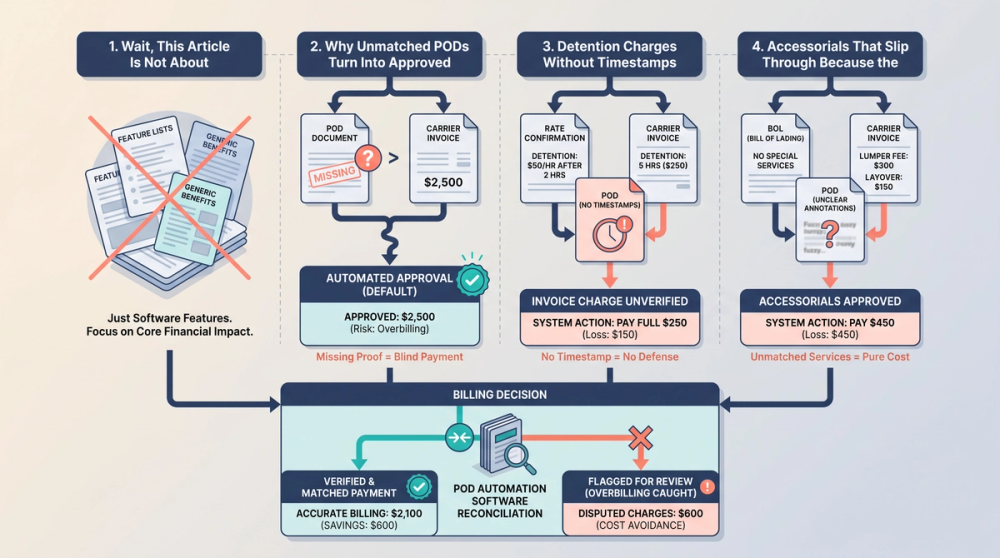
Wait, This Article Is Not About Print-on-Demand
If you searched "POD automation software" expecting Shopify integrations and mockup generators, you are in the wrong place. In the e-commerce world, POD means print-on-demand: software that automates product creation and fulfillment for online sellers. In freight and logistics, POD means proof of delivery: the signed, timestamped document confirming that a carrier delivered a shipment to its destination. These are completely different operations with completely different software needs.
This article covers POD automation for freight brokers, asset carriers, and 3PLs. The goal is not to print t-shirts. The goal is to stop paying carrier invoices that include inflated detention charges, fabricated lumper fees, and accessorial line items that your rate con never authorized. If you want a deeper breakdown of what a POD actually is and why a bad one costs you money, read POD in Freight: What It Is and Why a Bad One Costs You.
The fact that nearly every search result for "POD automation software" returns print-on-demand tools tells you something: the freight industry has been slow to claim this term. That is changing. According to GM Insights' logistics automation market report, the global logistics automation market was valued at $35.9 billion in 2025 and is projected to reach $104.9 billion by 2035. Document automation, including POD processing and freight document capture, is a growing slice of that spend. Brokers who automate their delivery confirmation workflow now are building a margin advantage that compounds with every load.
Why Unmatched PODs Turn Into Approved Detention and Accessorial Charges
Here is the cycle that costs you money. A carrier submits an invoice with a detention charge, a lumper fee, or another accessorial line item. Your billing coordinator opens the invoice, looks for the supporting POD, and cannot find it. Maybe it is buried in an email thread. Maybe it was never uploaded to your TMS. Maybe the driver submitted a blurry photo that is unreadable. Without a matched POD to cross-reference against the rate con, the coordinator has three options: spend 15 to 30 minutes hunting for the document, dispute the charge and wait 3 to 5 days for resolution, or approve the charge and move on to the next invoice.
Most of the time, especially under volume pressure, they approve the charge. That is not a failure of your people. It is a failure of your document workflow.
Detention Charges Without Timestamps
Detention charges average $75 to $150 per hour per carrier. A single load with an unsupported 2-hour detention claim represents $150 to $300 that a matched and timestamped POD can refute in under 60 seconds. Without that timestamp, you are taking the carrier's word for it. Multiply that across even a small percentage of your loads and the exposure adds up fast. A delivery confirmation that actually holds up in a dispute needs specific data points: arrival time, departure time, and a signature with a legible timestamp. If your POD does not have those fields captured and indexed, it is not useful for fighting a detention claim.
Accessorials That Slip Through Because the Rate Con Is Not Next to the Invoice
Lumper fees, TONU charges, layover fees, and fuel surcharges are all legitimate costs in the right circumstances. The problem is that your billing coordinator cannot validate them without seeing the original rate con alongside the carrier invoice and the POD. When those three documents live in different systems (or worse, in different email inboxes), mismatches go undetected. A $250 lumper fee on a load where the rate con explicitly states shipper-paid lumper gets approved because no one can locate the original document fast enough before the net-30 window closes.
Carrier overbilling does not usually happen through fraud. It happens through friction. When it takes longer to find the POD than to approve the charge, the charge gets approved.
The Manual Reconciliation Math: How Many Hours and Dollars You Are Actually Losing
Let's put specific numbers on the problem. These calculations use conservative estimates based on operational benchmarks reported across freight billing teams.
Time Cost Per Load
Manual POD retrieval and invoice matching takes billing coordinators an average of 4 to 7 minutes per load. That includes locating the POD, opening the rate con, comparing line items, and checking for accessorial discrepancies. At 500 loads per month, that is 33 to 58 hours of labor per month on a single task. For a billing coordinator earning $22 to $28 per hour, you are spending $726 to $1,624 per month just on the retrieval and matching step, not on resolving disputes, just on looking at documents.
According to a case study on POD automation in freight operations, automating proof of delivery processing reduced labor costs by 45% in a deployment with project44. That is not a theoretical number. It came from measuring actual hours before and after implementation.
Dollar Cost of Capitulation
The bigger cost is not the labor. It is the charges you approve because you cannot fight them. Carrier invoices disputed without a timestamped POD cost brokers an average of $180 to $340 per load in conceded accessorial charges, on loads where the charge was likely invalid.
Here is the full-year math for a mid-size brokerage:
- 500 loads per month
- 6% disputed invoice rate = 30 disputed loads per month
- 40% capitulation rate on disputes without documentation = 12 conceded disputes per month
- Average conceded charge: $180 to $340 per load
- Monthly exposure: $2,160 to $4,080
- Annual exposure: $25,920 to $48,960
Round those numbers and you land in the $27,000 to $51,000 range. That is pure margin erosion on loads you already moved.
What to Automate First in Your Proof of Delivery Workflow
You do not need to automate everything at once. Most brokers get the fastest ROI by attacking three specific bottlenecks in their delivery confirmation workflow, in this order.
1. Document Capture and Centralization
Before you can match anything, you need every POD, BOL, and rate con in one place. Today, these documents arrive through carrier portals, email attachments, TMS uploads, and sometimes fax machines. According to HighRadius' overview of POD backup automation, automated retrieval systems can pull documents from over 100 carrier portals without manual login. That eliminates the single biggest time sink in proof of delivery processing: the hunt.
Freight document capture is the foundation layer. If your PODs are scattered across inboxes and portals, no amount of downstream automation will help. Start here.
2. Data Extraction From PODs and BOLs
Once documents are centralized, the next step is pulling structured data out of them. A signed POD is useful. A signed POD with the delivery timestamp, consignee name, piece count, and reference number extracted into searchable fields is ten times more useful. This is where freight document data extraction fits into the workflow. Instead of your billing coordinator opening a PDF, squinting at a driver's handwriting, and manually typing the delivery time into your TMS, the software reads the document and populates the fields automatically.
According to Heavy Duty Parts Report's coverage of data entry automation for trucking companies, manual data entry is one of the top time bottlenecks in freight operations, and one of the most error-prone. A mistyped reference number can break a match that would have caught a $300 detention overcharge.
3. Automated Matching Against Rate Cons and Invoices
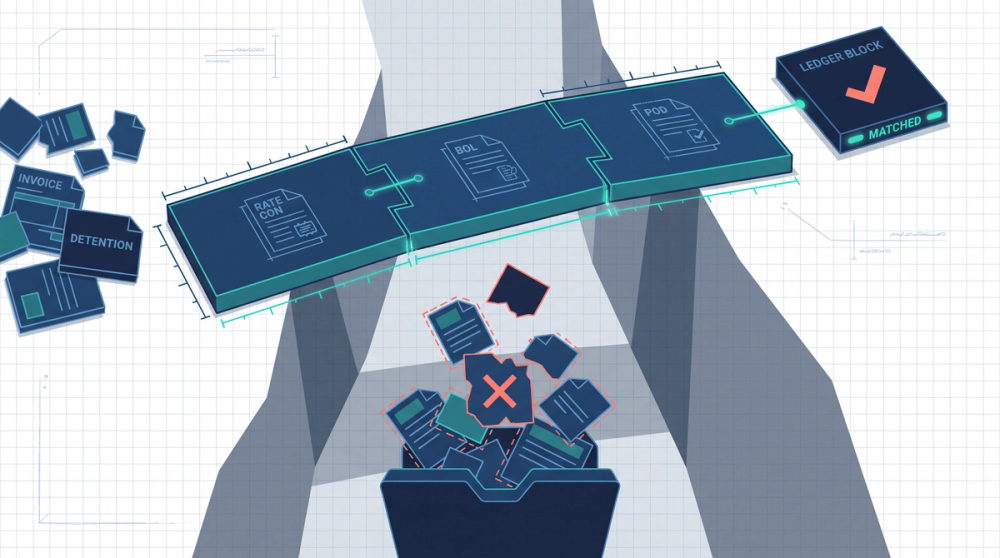
This is where the money shows up. Once you have PODs and BOLs captured and data-extracted, you can run automated matching against your rate cons and carrier invoices. The software checks: does the delivery timestamp on the POD match the appointment window on the rate con? Does the piece count on the BOL match the count on the POD? Does the carrier invoice include a lumper fee that the rate con says is shipper-paid? Does the invoice include a detention charge, and does the POD timestamp support the claimed wait time?
Brokers using automated BOL-to-POD matching report cutting invoice dispute resolution time from 3 to 5 days down to same-day in internal case studies and vendor benchmarks. That speed matters because the faster you dispute, the more likely you win. Carriers know that brokers on net-30 terms face a ticking clock, and slow dispute resolution favors the party who submitted the invoice.
How to Match PODs Against Rate Cons, BOLs, and Carrier Invoices at Scale
Matching documents manually works at 50 loads per month. At 500, it breaks. At 2,000, it is not even attempted. Here is what a scalable matching workflow looks like and the specific fields that matter most for catching overbilling.
The Five Fields That Catch the Most Overbilling
Not every field on a POD is equally important for billing disputes. Focus your matching rules on these five:
- Delivery timestamp (POD) vs. appointment window (rate con): This is your detention defense. If the POD shows delivery at 10:15 AM and the appointment was 10:00 AM, a 2-hour detention charge does not hold up.
- Piece count (POD) vs. piece count (BOL): Mismatches here indicate potential shortage claims or incorrect accessorial charges for partial deliveries.
- Reference/PRO number (all documents): If the carrier invoice references a different load number than the POD, that invoice may be misapplied or duplicated.
- Accessorial line items (carrier invoice) vs. rate con terms: Every accessorial on the invoice should map to a term on the rate con. If it does not, flag it.
- Consignee signature and name (POD): An unsigned POD or one signed by someone not at the delivery location weakens your position on delivery receipt disputes.
What Scale Looks Like in Practice
At scale, your POD automation software ingests every incoming carrier invoice, automatically retrieves or associates the matching POD and BOL, extracts the five critical fields listed above, and flags any variance. Your billing coordinator no longer spends 4 to 7 minutes per load hunting for documents. They spend 30 seconds reviewing a flagged exception. That is the difference between 58 hours per month and roughly 8.
Laneproof's reconciliation engine checks each of these fields automatically, flagging variances before payment goes out. Instead of your team reviewing every load, they review only the loads with mismatches, which is where the money is.
Real Scenarios: Where POD Automation Catches Money You Would Have Lost
Abstract numbers only go so far. Here are three concrete scenarios that freight brokers deal with regularly, showing exactly how POD automation software changes the outcome.
Scenario 1: The Fabricated Detention Charge
Example: A carrier invoices a 2-hour detention charge at $100 per hour on a load delivered to a distribution center in Dallas. Total charge: $200. Your billing coordinator opens the invoice and sees the detention line item. Without automation, they would need to find the POD, check the delivery timestamp, compare it to the rate con appointment window, and determine whether the wait was legitimate. That process takes 10 to 15 minutes if the documents are easy to find, longer if they are not.
With automated matching, the software already has the POD timestamp (10:22 AM) cross-referenced against the rate con appointment window (10:00 AM to 11:00 AM). The driver arrived at 10:05 AM and was unloaded by 10:22 AM. The system flags the detention charge as unsupported. Your coordinator rejects it in under 60 seconds. Savings: $200 on one load. Across 15 similar occurrences per year, that is $3,000 recovered from a single type of discrepancy.
Scenario 2: The Shipper-Paid Lumper Fee
Example: A carrier invoices a $250 lumper fee on a grocery distribution load. The rate con explicitly states "lumper: shipper-paid." Without automation, the billing coordinator sees the $250 line item and has to locate the rate con to verify the lumper terms. If the rate con is in a different system or buried in email, this takes time. Under volume pressure with a net-30 deadline approaching, the coordinator approves the charge.
With POD automation software that matches carrier invoices against rate con terms, the system immediately flags the lumper fee as a conflict. The rate con says shipper-paid. The invoice says carrier-paid. The coordinator disputes the charge with the rate con attached as evidence. Savings: $250 on one load. If this happens on even 2% of loads for a 500-load-per-month broker, that is 10 loads per month, or $2,500 per month, or $30,000 per year.
Scenario 3: The Unverifiable TONU
Example: A carrier invoices a $200 TONU (truck ordered, not used) charge, claiming they dispatched a driver who arrived at the shipper but the load was canceled. TONU charges averaging $150 to $300 per occurrence are among the most disputed accessorials, and among the easiest to refute or confirm with a timestamped delivery confirmation record matched against driver check-in logs.
With automated document matching, the system checks whether a driver check-in was recorded at the shipper facility, whether a BOL was ever generated for the load, and whether the load cancellation timestamp predates the driver's dispatch. If the evidence supports the TONU, you pay it. If it does not, you dispute with documentation attached. Either way, you have an answer in minutes instead of days.
Frequently Asked Questions About POD Automation Software in Freight
What does POD mean in printing vs. freight?
In printing, POD stands for print-on-demand, a fulfillment model where products like books, shirts, or mugs are printed only after a customer orders them. In freight and logistics, POD stands for proof of delivery, which is the signed document confirming a shipment was received at its destination. This article covers proof of delivery automation for freight brokers and carriers, not print-on-demand tools for e-commerce.
Which POD platform is best for freight brokers?
The best POD automation platform for freight depends on your volume and pain points. Look for software that captures documents from multiple carrier portals, extracts structured data from PODs and BOLs automatically, and matches those documents against rate cons and carrier invoices. Avoid platforms designed for print-on-demand sellers, as they solve a completely different problem. Integration with your existing TMS or ERP is also critical. A tool that requires manual export and re-upload adds friction instead of removing it.
How much does POD automation software cost for freight operations?
Pricing varies widely depending on load volume, integration requirements, and feature depth. Some platforms charge per document processed, others charge a flat monthly fee based on load count. For a broker running 500 loads per month and losing $27,000 to $51,000 per year in conceded disputes, even a $500 to $1,000 per month platform pays for itself quickly. The right question is not "how much does it cost" but "how much am I losing without it."
Can POD automation software integrate with my TMS?
Most freight-focused POD automation platforms offer API integrations with major TMS platforms. The key integration points are document ingestion (pulling PODs and BOLs from the TMS or carrier portals), data extraction (pushing structured fields back into the TMS), and invoice matching (flagging discrepancies within your existing billing workflow). If a vendor cannot explain exactly how their tool connects to your TMS, that is a red flag.
How long does it take to see ROI from POD automation?
Most brokers see measurable results within the first billing cycle. The labor savings from eliminating manual document retrieval are immediate. The dispute savings take slightly longer because you need to process enough invoices through the automated matching system to catch the first round of discrepancies. Based on the 45% labor cost reduction reported in a LunaPath case study, the timeline to positive ROI is typically measured in weeks, not months.
Sources
- 45% Labor Cost Reduction with POD Automation — LunaPath
- POD Backup Automation Software — HighRadius
- Logistics Automation Market Size, Share Report 2026-2035 — GM Insights
- Data Entry Automation Software for Trucking Companies — Heavy Duty Parts Report
- How Automation Affects the Freight Industry and What to Expect — Bureau of Transportation Statistics
Stop Paying Charges You Should Be Disputing
Every carrier invoice you approve without matching it against the POD and rate con is a bet that the charges are accurate. Based on the numbers above, that bet loses you tens of thousands of dollars per year. POD automation software built for freight operations eliminates the document hunt, extracts the fields that matter, and flags the mismatches before your billing coordinator hits "approve."
The steps are clear: centralize your documents, automate data extraction, and match every invoice against the rate con and POD before payment. If your team is still spending 30 to 60 hours per month on manual retrieval and matching, that is time and money you can recover starting now. See how Laneproof handles this at pricing and plans.
Related: How to Extract Data from Proof of Delivery (And Stop Losing Money)