How to Extract Data from Proof of Delivery (And Stop Losing Money)
Researched and written with AI assistance. Reviewed by the Laneproof team.
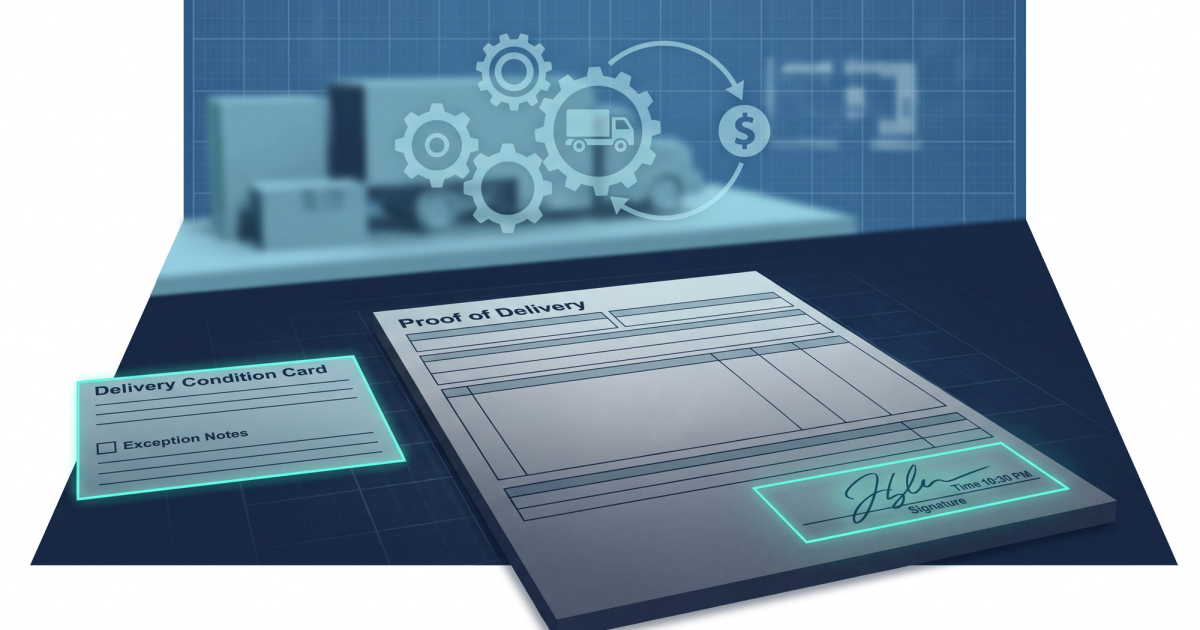
A carrier bills you $300 in detention. You know the truck showed up late. But when you pull the proof of delivery to dispute it, the delivery timestamp is missing from your records. You pay the full $300 because you cannot prove otherwise. Multiply that across 200 loads a month and the math gets painful fast. The ability to extract data from proof of delivery documents quickly and accurately is the difference between catching overbilling and absorbing it. According to Flock Freight's breakdown of POD vs BOL in trucking, the POD is the document that confirms what actually happened at delivery, not what was planned. Yet most freight brokerages still pull POD data by hand, one field at a time, from documents that arrive in six different formats. This guide covers the exact fields your team needs from every POD, how those fields connect to detention disputes, lumper fee overbilling, and accessorial charges, and how to build a basic extraction workflow without hiring a developer.
Why Pulling POD Data by Hand Is Costing You More Than You Think
Here is the math most ops managers already feel but have not written down. If your billing coordinator or ops manager spends 6 hours per week reviewing carrier invoices against POD documents, and their fully loaded labor cost is $28 per hour, that is $168 per week. Over 52 weeks, that comes to $8,736 per year in labor cost dedicated entirely to manual reconciliation.
That number only accounts for the labor. It does not include the overbilling that slips through because your team is tired, rushed, or working from a blurry scan of a handwritten POD. On a brokerage running $2.4 million in annual freight spend, even a 3.8% overbilling rate on accessorials means $91,200 in potential overbilling exposure sitting in your carrier invoices every year.
The problem is not that your team does not care. The problem is structural. PODs arrive as email attachments, carrier portal downloads, TMS exports, photographed images, and sometimes faxes. Each carrier formats them differently. The fields that matter for dispute resolution (timestamps, exception notes, signature blocks) are in different locations on every document. Manual review cannot keep up.
According to Vector's analysis of digital POD systems and billing delays, brokers and carriers who rely on manual POD processing experience slower invoicing cycles and weaker positions in disputes. The connection between POD data quality and cash flow is direct: bad data means slow billing, slow billing means late payment, and disputed invoices without backup documentation mean lost revenue.
How to View and Access a Proof of Delivery in Freight Operations
Before you can extract anything, you need reliable access to the document itself. In freight (as opposed to parcel delivery), viewing a POD is not as simple as clicking a tracking link. Here is how it typically works for FTL and LTL operations.
Step-by-Step: Getting Your Hands on the POD
- 1. Check your TMS. Most modern TMS platforms store PODs uploaded by carriers or drivers. Look under the load detail or document tab for the specific shipment.
- 2. Pull from the carrier portal. Many asset carriers and 3PLs post PODs to their online portals within 24 to 48 hours of delivery. You will usually need the PRO number or BOL number to search.
- 3. Request directly from the carrier. If the POD is not in your TMS or the carrier portal, email or call the carrier's billing department. Reference the load number and delivery date.
- 4. Check driver-submitted images. For owner-operators or smaller carriers, PODs often arrive as phone photos sent via text, email, or a driver app. These are the hardest to process but often contain the most critical handwritten notes.
- 5. Request from the consignee. If the carrier cannot produce the POD, contact the receiver directly. They typically retain a signed copy.
The bill of lading (BOL) tells you what was supposed to happen. The POD tells you what actually did. Both documents are essential, but for invoice reconciliation and dispute resolution, the POD is where the evidence lives. As Flock Freight explains, the BOL originates at pickup and travels with the shipment, while the POD is created at delivery and confirms receipt, condition, and any exceptions noted by the consignee.
If your team processes more than a handful of loads per day, you already know the bottleneck: the POD is rarely where you expect it, and it rarely looks the same twice. That is why extraction matters more than access. Getting the document is step one. Pulling the right fields from it is where the money is.
The Exact Fields You Need to Extract from Every POD (And Why Each One Matters)
Not every field on a POD carries the same weight. Some are administrative. Others are the only thing standing between you and a $1,200 shortage claim. Here are the fields that matter for freight brokers and carriers, organized by their role in billing and disputes.
Identity and Matching Fields
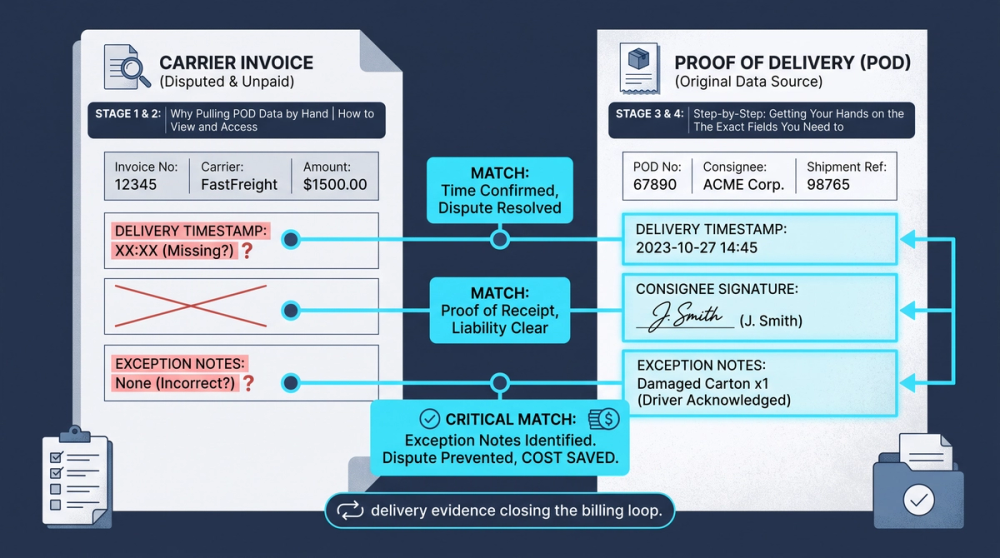
- Delivery date and time. This is the single most important field for detention disputes. If the carrier invoices 4 hours of detention but the POD timestamp shows 2.2 hours of legitimate wait time, this field is your evidence.
- PRO number or load reference. Matches the POD to the correct load in your TMS and the corresponding rate con. Without it, you are guessing which invoice this document belongs to.
- BOL number. Cross-references back to the original bill of lading. Essential for LTL shipments where multiple deliveries may share a single trailer.
- Carrier name and SCAC code. Confirms which carrier actually delivered the freight. Critical when using relay carriers or double-brokered loads.
Proof and Dispute Fields
- Consignee signature. The field that proves delivery occurred. According to Affinda's POD processing documentation, AI-powered extraction tools can detect signature presence, including handwritten signatures on scanned forms and photographed documents.
- Printed consignee name. The signature alone is not always enough. You need the printed name to verify authority to accept delivery on the receiver's behalf.
- Exception notes (damages, shortages, refusals). This is where consignees note damaged pallets, missing cartons, or refused items. These notes directly impact accessorial charges and shortage claims. If the carrier invoices a lumper fee but the exception notes say the receiver declined lumper service, you have your dispute evidence.
- Item count or piece count. Verifies that what was delivered matches the BOL quantity. Discrepancies here trigger shortage or overage claims.
Location and Condition Fields
- Delivery location or address. Confirms the freight went to the correct destination. Misdeliveries happen, and they create expensive redelivery charges.
- Seal number (if applicable). For sealed loads, matching the seal number on the POD to the BOL confirms the trailer was not opened in transit. Broken or mismatched seals are red flags for cargo claims.
- Temperature readings (for reefer loads). If you are moving perishables, the temperature at delivery noted on the POD is your first line of defense against spoilage claims.
According to Invoice Data Extraction's guide to POD field workflows, the core structured data fields on a POD include recipient name, signature presence, delivery date, delivery location, and exception notes. Missing any one of these fields weakens your position in a dispute. Missing two or more, and you are essentially writing a blank check to whoever filed the claim.
Where Carriers Win Disputes Because Brokers Pulled the Wrong Data
Most carrier invoice disputes are not won by whoever is right. They are won by whoever has better documentation. Here are three scenarios where brokers lose money because of incomplete or inaccurate POD data extraction.
Example: The Detention Charge You Could Have Cut in Half
A carrier invoices $300 in detention: 4 hours at $75 per hour. Your rate con specifies 2 hours of free time. When your billing coordinator reviews the invoice, they check the carrier's submitted arrival and departure times but do not cross-reference the POD delivery timestamp.
Here is what the POD actually shows: the driver arrived 47 minutes after the scheduled appointment. That means the clock did not start at the time the carrier claims. Legitimate detention time was 2 hours and 13 minutes, not 4 hours. After subtracting 2 hours of free time, the billable detention drops to 13 minutes (effectively zero under most rounding rules) or at most 0.2 hours. The real charge should be $15, not $300. That is $285 saved on a single load.
Without the extracted delivery timestamp matched against the rate con appointment window, your team has no basis to dispute. The carrier's invoice stands.
Example: The Lumper Fee That Never Should Have Been Billed
A carrier invoices $450 for lumper service at a grocery distribution center. Your ops team reviews the invoice and sees a lumper receipt attached. Looks legitimate. They approve the charge.
But the POD exception notes, which nobody extracted, clearly state: "Receiver declined lumper. Unloaded by warehouse staff." The carrier submitted a lumper receipt from a previous load or fabricated one entirely. The $450 is fully disputable and recoverable, but only if someone captures the exception notes from the POD and matches them against the carrier's invoice backup.
This is why what a signed delivery receipt actually does in a freight dispute matters so much. The signature confirms delivery. The exception notes tell you what happened during delivery. Both fields need to be extracted every time.
Example: The Missing Signature That Cost $1,200
An LTL shipment arrives at a consignee's dock. The driver gets the BOL stamped but the POD is not properly signed. No consignee signature, no printed name. The driver uploads a photo of the stamped BOL to the carrier portal and marks the load as delivered.
Two weeks later, the shipper files a shortage claim for $1,200 in goods. The carrier says the load was delivered in full. The shipper says it was not. Your brokerage is in the middle.
Without a signed POD showing who accepted delivery and whether any exceptions were noted, you cannot prove delivery occurred as stated. You eat the $1,200 claim. A proper POD in freight includes the consignee signature, printed name, and any exception notes. If your extraction process does not flag missing signatures, claims like this one slip through every month.
How to Handle Multi-Format and Multi-Carrier PODs Without Losing Your Mind
Here is a scenario that every freight broker with more than a dozen carrier relationships will recognize. You manage 14 active carrier relationships. PODs arrive in at least 6 different formats.
- Handwritten PODs photographed by drivers and sent via text or email
- PDF downloads from carrier portals
- eCMR (electronic consignment notes) from European or cross-border carriers
- Scanned images (often low resolution, sometimes sideways)
- Email attachments with no standardized naming convention
- TMS-generated digital PODs with structured data fields
A single manual extraction process breaks down here. Your billing coordinator cannot build one checklist that works across all six formats. The fields are in different locations, fonts vary, some are handwritten, and some are partially cut off in the scan.
What a Basic Multi-Format Workflow Looks Like
You do not need to solve all six formats at once. Start by categorizing your PODs by source and volume.
- Step 1: Identify your top 5 carriers by load volume. These carriers account for the majority of your PODs. Standardize extraction for their formats first.
- Step 2: Create a field map for each carrier's POD format. Document where the delivery timestamp, signature, exception notes, and reference numbers appear on each carrier's POD. This becomes your extraction checklist.
- Step 3: Separate digital from analog. TMS-generated and carrier portal PDFs have consistent layouts. Prioritize these for automated processing. Handwritten and photo-based PODs may need manual review or OCR with human verification.
- Step 4: Flag incomplete documents immediately. If a POD arrives without a signature, timestamp, or exception notes field, do not file it. Send it back to the carrier for completion before you close the load.
- Step 5: Store all PODs with the load file. Every POD should be indexed by load number, carrier, and delivery date. Retention best practices for freight brokers, as outlined in this documentation compliance checklist, recommend keeping PODs alongside rate cons, BOLs, and carrier packets for a minimum of 3 years.
According to Kognitos' POD automation use case, effective extraction workflows include matching extracted data against shipment records, identifying delivery exceptions like damages or shortages, and archiving documents in a searchable format. The goal is not perfection on day one. The goal is a repeatable process that catches the fields that cost you money when they are missing.
Connecting Extracted POD Data to Invoice Reconciliation and Billing Disputes
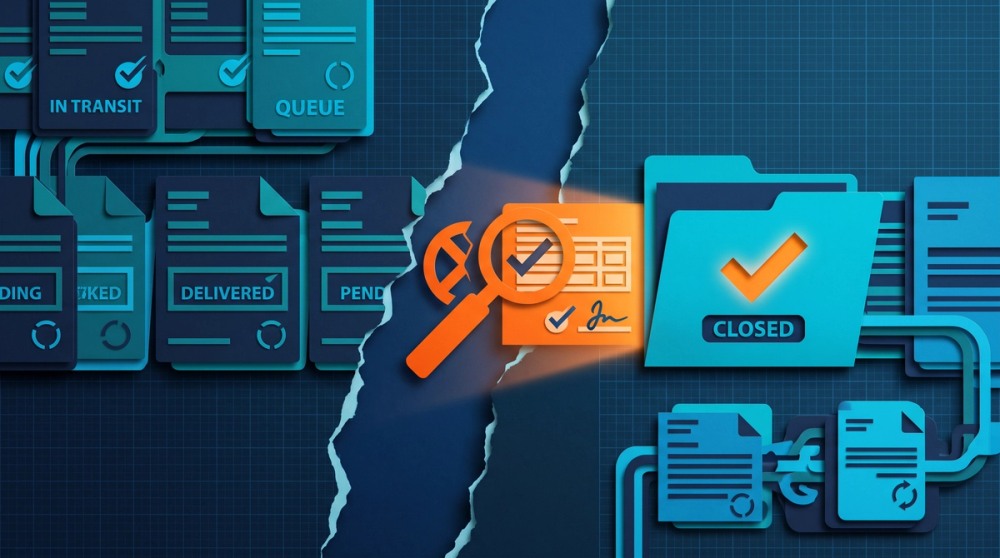
Extracting POD data is not the end goal. The end goal is matching that data against carrier invoices and catching discrepancies before you pay them. Here is how the fields connect to real billing line items.
Detention and Layover
The extracted delivery timestamp from the POD is matched against the appointment window on the rate con. If the carrier's invoice claims more detention hours than the POD supports, you have a dispute. The calculation is straightforward.
Detention charge = (Carrier-claimed wait time minus free time) × hourly rate. If POD timestamp shows shorter wait time than the carrier claims, the difference is your dispute amount.
For layover charges, the same logic applies but across multiple days. The POD timestamp on the first delivery attempt, combined with any exception notes about facility closures or reschedules, establishes whether the layover was carrier-caused or shipper-caused.
Lumper Fees and Accessorials
Lumper fee disputes come down to two questions: was the service performed, and does the amount match the receipt? The POD exception notes field answers the first question. If the consignee noted that lumper service was declined or not used, any lumper charge on the carrier invoice is disputable.
For other accessorials (lift gate, inside delivery, sort and segregate), the POD may or may not contain confirmation that the service was performed. Cross-referencing the POD exception notes with the BOL special instructions gives you the full picture.
TONU Disputes
Truck Order Not Used charges are among the hardest to dispute without timestamp data. A driver claims the truck arrived on time but the shipper canceled. The carrier invoices $250 for the TONU. The only way to resolve it: compare the extracted POD or arrival confirmation timestamp against the rate con appointment window. If the driver arrived after the window closed, the TONU may not be legitimate. If the driver arrived on time and the shipper did cancel, the charge stands.
The pattern across all of these disputes is the same. The POD contains the evidence. The rate con contains the agreement. The carrier invoice contains the claim. If you cannot quickly match all three, the carrier's version wins by default.
What This Looks Like at Scale
Consider a brokerage handling 400 loads per month. If even 5% of those loads have an accessorial discrepancy averaging $150, that is 20 loads × $150 = $3,000 per month in overbilling. Over a year, that is $36,000. Not catastrophic for a mid-size brokerage, but significant. Especially when most of that $36,000 is recoverable with better POD data extraction and a consistent reconciliation process.
For a deeper look at how delivery confirmation evidence holds up in freight disputes, including which document types courts and arbitrators prioritize, that guide covers the legal and practical standards your documentation needs to meet.
Frequently Asked Questions About Proof of Delivery in Freight
How do you view a proof of delivery in freight?
In freight operations, you view a POD through your TMS load detail screen, the carrier's online portal (search by PRO or BOL number), or by requesting it directly from the carrier's billing department. Unlike parcel tracking where you click a link, freight PODs often require manual retrieval. Many carriers upload them within 24 to 48 hours of delivery, but delays of a week or more are common with smaller carriers and owner-operators.
Is a proof of delivery a legal document?
A signed POD serves as evidence that delivery occurred and can be used in legal proceedings, insurance claims, and arbitration. However, its weight depends on completeness. A POD with a consignee signature, printed name, delivery date, and exception notes is far stronger evidence than one with just a dock stamp. For freight claims under the Carmack Amendment, the POD is one of the primary documents used to establish whether the carrier fulfilled its delivery obligation. See how PODs hold up in freight disputes for a detailed breakdown.
How do I get a copy of my delivery proof?
Contact the carrier's billing or customer service department with your load number, PRO number, or BOL number. Most carriers can provide a copy within a few business days. If the carrier is unresponsive, contact the consignee (receiver) directly, as they typically retain a signed copy. For loads booked through a broker, the broker should have a copy in the load file. If they do not, that is a documentation process gap worth fixing.
What is the difference between a POD and a BOL?
The bill of lading (BOL) is created at pickup and serves as the contract of carriage. It lists what was picked up, the origin, the destination, and the shipping terms. The proof of delivery (POD) is created at delivery and confirms what actually arrived, when, and in what condition. The BOL is the plan. The POD is the proof. Both are needed for complete load documentation, but the POD is the document that resolves most billing disputes.
How long should freight brokers retain POD documents?
Industry best practice is a minimum of 3 years, though some brokerages retain them for 5 years or longer depending on their shipper contracts and insurance requirements. PODs should be stored alongside the rate con, BOL, carrier packet, and any accessorial receipts for each load. Digital storage with searchable indexing by load number, carrier, and delivery date makes retrieval during disputes significantly faster.
Stop Paying for Disputes You Should Be Winning
Every missing POD field is a dispute you cannot win. Every timestamp you did not extract is a detention charge you pay in full. Every exception note you did not capture is a lumper fee or shortage claim that goes unchallenged.
The fields covered in this guide (delivery timestamps, consignee signatures, exception notes, reference numbers) are not obscure data points. They are the specific pieces of evidence that determine whether you keep your margin or give it back to the carrier.
Start with your top 5 carriers by volume. Map where each critical field appears on their POD format. Build a checklist. Flag incomplete documents before they enter your billing queue. The process does not require new software on day one, just discipline about which fields you capture and when.
If your team processes more than 50 invoices a week and you are still pulling POD data by hand, automated document extraction tools can capture these fields in seconds across carrier formats, flagging missing signatures, mismatched timestamps, and exception notes before your billing coordinator ever opens the file.
Sources
- Proof of Delivery Data Extraction: Fields and Workflow — Invoice Data Extraction
- What is Proof of Delivery in Trucking vs Bill of Lading? — Flock Freight
- AI Proof of Delivery Processing & Data Extraction Software — Affinda
- Proof of Delivery Automation Use Case — Kognitos
- Proof of Delivery System: Eliminate Billing Delays Instantly — Vector
- Documentation Compliance for Freight Brokers: Full Checklist — Laneproof
Related: POD Automation Software That Stops Carrier Overbilling Cold