POD in Freight: What It Is and Why a Bad One Costs You
Researched and written with AI assistance. Reviewed by the Laneproof team.
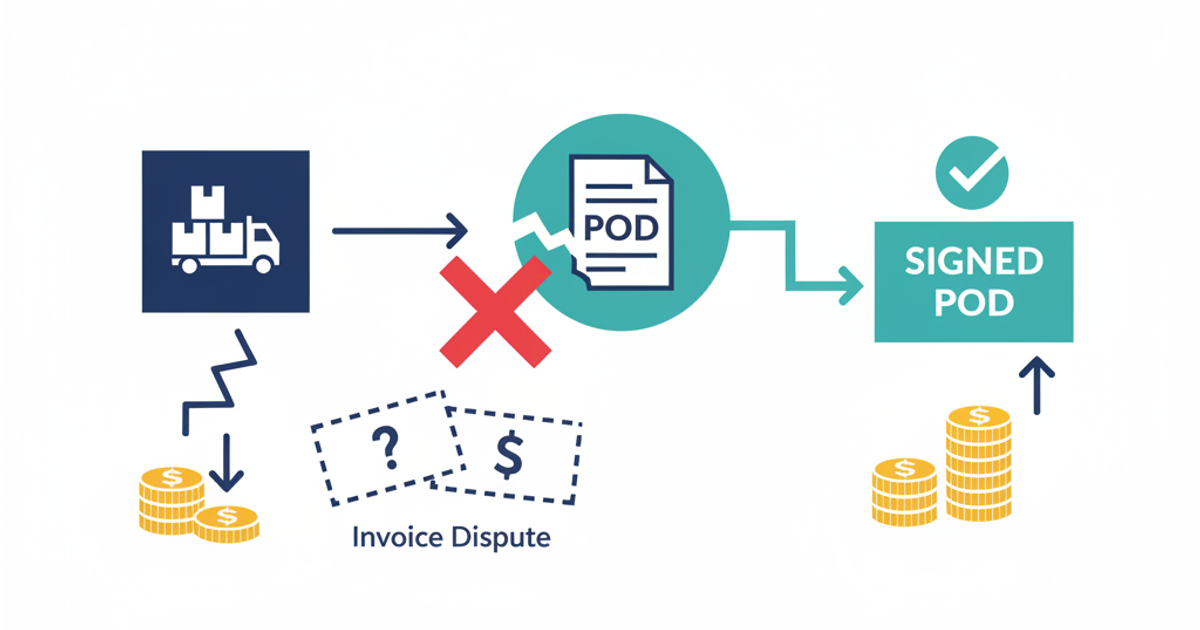
A broker bills $1,800 on a load. The carrier invoices an extra $350 for detention. The broker pushes back, but the POD has no timestamp, no arrival time, no departure time. There's no way to prove when the driver actually showed up or how long they waited. The detention charge sticks, and 19% of the load's margin disappears over a single missing field on a signed delivery document. This happens constantly. According to industry freight payment analysis, freight payment best practices emphasize that POD documents are the trigger for invoicing and a critical gate for cash flow. Yet most brokers treat POD collection as an afterthought, something the driver handles. That's the gap where your margin leaks out.
What Does POD Stand For in Freight and Shipping?
In freight and logistics, POD stands for Proof of Delivery. It is a document that confirms a shipment was received by the consignee at the delivery location. The POD typically includes the consignee's signature, the date and time of delivery, a count of the items or pallets delivered, and any notes about damage or shortages observed at the time of receipt.
That's the textbook definition. Here's the operational one: a POD is the single document that proves your load actually got where it was supposed to go, in the condition it was supposed to arrive in, at the time the carrier says it did. Without it, you have a carrier's word against yours, and in a billing dispute, the carrier's invoice is the document that defaults to "correct" when there's nothing to challenge it with.
The POD sits at the end of a chain of freight documents. It starts with the rate confirmation (rate con), which establishes what the carrier agreed to haul and for how much. Then the Bill of Lading (BOL) travels with the freight, documenting what was picked up, how much of it, and any special handling requirements. The POD closes the loop. It's signed at delivery, confirming the freight arrived and in what condition. Together, the rate con, BOL, and POD form the documentation triangle that every freight invoice is built on. If any leg of that triangle is weak, your ability to dispute a billing error collapses.
Federal motor carrier safety regulations under 49 CFR Part 390 establish foundational definitions and documentation requirements applicable to carrier recordkeeping, including delivery documentation. While the regulations don't prescribe a single universal POD format, they create the compliance framework within which carriers and brokers operate. This matters because it means there's no federal template for what a POD "must" look like, which is exactly why so many PODs show up incomplete, illegible, or missing the fields you need most when a dispute lands on your desk.
POD vs. BOL: They're Not the Same Document
A common mistake, especially at smaller brokerages, is treating the BOL and the POD as interchangeable. They're not. The BOL is created at origin. It documents what was picked up. The POD is created at destination. It documents what was delivered. A signed BOL with a delivery stamp on it can function as a POD in some cases, but only if it includes all the fields a real POD requires: consignee signature, date, time, item count, and exception notes. If your BOL is just a pickup document with a scribbled signature at the bottom, it won't hold up as proof of delivery in a dispute.
What Has to Be on a POD for It to Actually Mean Something
A POD is only as strong as the information on it. A signed piece of paper with no timestamp, no item count, and no legible name is not useful evidence. It's a receipt at best, and a liability at worst. Here's what a POD needs to contain if you want it to hold up when a carrier pushes back on a charge or when a shipper questions a shortage.
The Non-Negotiable Fields
- Consignee name (printed legibly): A signature alone is not enough. You need a printed name next to it so you can verify who accepted the freight.
- Consignee signature: The actual signature confirming receipt. If the consignee refuses to sign, that fact itself needs to be documented.
- Date of delivery: The calendar date. This seems obvious, but you'd be surprised how many PODs come back with a signature and nothing else.
- Time of delivery (arrival and departure): This is the field that matters most for detention disputes. Without arrival and departure times, you cannot calculate whether detention was actually incurred.
- Piece count or pallet count: Must match what was listed on the BOL at pickup. Any discrepancy here is a shortage claim waiting to happen.
- Exception notes: Damage, shortages, refused items, temperature concerns. If the consignee wrote anything on the POD, it needs to be captured clearly.
- Load or reference number: The number that ties this POD back to the rate con and BOL. Without it, matching documents to invoices becomes manual guesswork.
Fields That Protect You in Specific Disputes
Beyond the basics, certain fields become critical depending on the type of charge you're disputing. For detention claims, you need arrival time, unloading start time, and departure time. For lumper fee disputes, you need a notation on the POD or a separate lumper receipt signed by the driver and the warehouse personnel. For accessorial charges like liftgate or inside delivery, you need confirmation on the POD that the service was actually performed, not just invoiced. As noted in best practices for freight broker back-office operations, document management is the backbone of billing accuracy. Every field you fail to capture on the POD is a field a carrier can exploit on the invoice.
Paper POD vs. Electronic POD: Which One Wins in a Dispute?
This is a question that comes up constantly, and the answer is more nuanced than "electronic is always better." Both paper and electronic PODs are accepted as delivery confirmation. The question is which one gives you stronger footing when someone disputes the charges.
Paper PODs: Familiar but Fragile
Paper PODs are still common, especially with smaller carriers and owner-operators. The driver gets a signature at the dock, keeps the paper copy, and either scans it later, photographs it, or mails it in. The problems are well documented. Paper fades. Coffee spills. Signatures become illegible. Drivers lose the document in the cab. And even when the paper POD arrives intact, it often takes days. According to community discussions among freight brokers on realistic POD timelines, getting a paper POD back from a carrier can take anywhere from 48 hours to two weeks, depending on the carrier's back-office process. That delay can push your invoicing timeline out, which directly impacts cash flow.
Paper PODs also have an evidence problem. If the signature is illegible and there's no printed name, you can't prove who signed for the freight. If there's no timestamp, you can't challenge a detention charge. If the exception notes are written in shorthand that only the dock worker understands, good luck explaining that to a claims adjuster.
Electronic PODs: Faster, Harder to Dispute
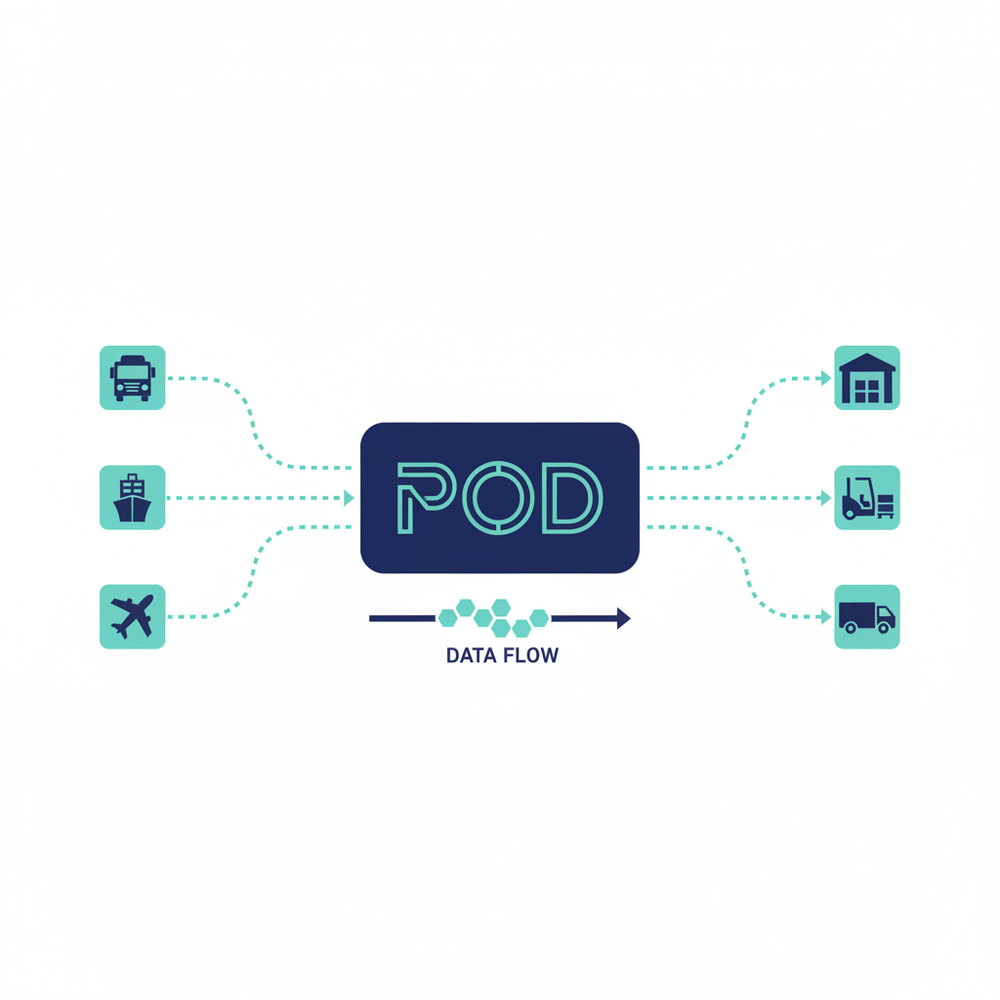
Electronic PODs (ePODs) are captured via a driver's phone or a TMS-integrated app. They typically include a photo of the signed document, GPS coordinates at the time of signature, and an automatic timestamp. Some systems also capture photos of the freight at delivery, which gives you visual evidence of condition on arrival.
The advantage in a dispute is clear. An ePOD with GPS coordinates proves the driver was at the delivery location. The timestamp proves when delivery occurred. The photo proves what was signed and what notes were written. This is significantly harder for a carrier or consignee to contest compared to a smudged paper copy that arrived in your inbox ten days after delivery.
There is a tension here, though. As reported by Overdrive's coverage of instant POD demands from brokers, some carriers and owner-operators push back on the expectation that they submit PODs immediately after delivery. The article discusses a proposed "Quick POD" fee structure where carriers would be compensated for expedited POD submission. If you're requiring instant ePOD from your carriers, build that expectation into the rate con upfront. Don't spring it on a driver at the dock.
Which One Actually Wins in Arbitration?
Consider this scenario: a carrier claims they delivered on time at 9:00 AM and invoices two hours of detention starting at 7:00 AM. You have an electronic POD showing GPS coordinates at the delivery address with a timestamp of 8:45 AM and a consignee signature at 9:15 AM. The carrier has a paper BOL signed illegibly with no time recorded. In an arbitration or collections process, the ePOD with verifiable metadata is going to carry more weight than an undated paper signature. That doesn't mean paper PODs are worthless. It means they need to be complete. A paper POD with a printed name, clear signature, date, time, and piece count is still strong evidence. An ePOD with a blurry photo of a half-signed document is not.
How a Missing or Incomplete POD Costs Brokers Real Money
This is where the discussion stops being theoretical. Missing or incomplete PODs don't just create administrative headaches. They create direct financial losses that compound across every load where documentation falls short.
The Detention Trap
Example: A broker books a load at $1,800 linehaul. The carrier invoices $2,150, adding a $350 detention charge. The broker's ops manager pulls up the POD. There's a consignee signature, a date, and a piece count. No arrival time. No departure time. No notation of how long the driver waited. The broker calls the consignee, who says they don't track driver wait times. The broker calls the carrier, who provides a driver log showing two hours at the facility. Without a timestamped POD to contradict that log, the broker pays the $350. On an $1,800 load, that's 19.4% of the gross margin gone because the POD didn't have two fields filled in.
The Lumper Fee Problem
Example: A carrier invoices $200 for a lumper fee that wasn't on the rate con. The broker asks for documentation. The carrier sends a handwritten lumper receipt with no consignee signature, no facility name, and no reference to the load number. The broker has no signed POD acknowledgment from the receiver confirming a lumper was required or used. In the absence of documentation from either side, the charge often defaults to the broker because the carrier has an invoice and the broker has nothing to contradict it. That $200 wasn't budgeted, wasn't on the rate con, and wouldn't have stuck if the POD process included a lumper acknowledgment step.
The Shortage Claim That Lands 45 Days Late
Scenario: A consignee signs the BOL at delivery but writes "short 3 cases" in the notes section. The driver photographs the BOL and sends it to the dispatcher. The dispatcher uploads it to the TMS but doesn't read the exception note. Forty-five days later, the shipper files a $600 shortage claim against the broker. The broker's billing coordinator pulls the POD and, for the first time, sees the "short 3 cases" notation. If that exception note had been flagged at the time of delivery, the broker could have filed against the carrier immediately, documented the discrepancy with the shipper, and avoided absorbing a claim that wasn't theirs to own. Instead, the 45-day gap makes it nearly impossible to recover from the carrier, and the broker eats the $600.
These aren't edge cases. According to freight payment process documentation from Transportation Management Group, the POD is the trigger document for carrier payment. When that trigger document is incomplete, the entire billing cycle downstream is built on a shaky foundation. For more on how specific POD details affect dispute outcomes, see our guide on what holds up in a freight dispute when proof of delivery is challenged.
How to Collect a POD That Holds Up When a Carrier Pushes Back
Knowing what a POD should contain is one thing. Getting carriers to actually deliver one that meets that standard is a different challenge entirely. Here are the operational steps that reduce your exposure.
Put POD Requirements on the Rate Con
Your rate confirmation is a contract. If your POD expectations aren't written into it, you have no contractual basis to demand them. Specify exactly what the POD must include: printed consignee name, signature, date, arrival time, departure time, piece count, and exception notes. Specify the submission timeline (e.g., within 2 hours of delivery, or within 24 hours). Specify the format (photo, scan, ePOD upload). Freight payment best practices recommend setting clear payment terms on every rate confirmation, and POD requirements are part of those terms. If it's not on the rate con, don't expect it to happen consistently.
Train Dispatchers to Review PODs at Submission, Not at Invoice Time
The worst time to discover a POD is incomplete is when you're trying to reconcile an invoice three weeks after delivery. By then, the driver doesn't remember the load, the consignee doesn't remember the delivery, and the carrier's accounts receivable team isn't going to chase down a better document for you.
Build a 60-second POD check into your dispatch workflow. When the driver sends the POD, a dispatcher or coordinator should verify: Is the signature legible? Is there a printed name? Are arrival and departure times listed? Does the piece count match the BOL? Are there any exception notes? If any of these are missing, the time to get them filled in is while the driver is still at the dock or within an hour of leaving. Not two weeks later. POD collection is cited as a key component of dispatch and back-office operations by compliance-focused carriers for good reason. The closer to delivery you review the document, the more accurate and complete it will be.
Capture Exception Notes Immediately
If a consignee writes anything on the POD at delivery ("damaged pallet," "short 3 cases," "refused 1 carton"), that note needs to be flagged and communicated to the broker's ops team within the hour. Exception notes are time-sensitive evidence. They tell you a claim is coming. If your POD collection process buries those notes in a file folder or a TMS attachment that no one reads until billing, you've lost the window to manage the claim proactively.

Use the POD to Stop TONU Claims Before They Start
Scenario: A dispatcher collects a photo of a signed POD via the driver's phone within 30 minutes of delivery. Two weeks later, the carrier files a Truck Order Not Used (TONU) claim, alleging the load was refused at delivery and the truck rolled empty. The broker pulls the timestamped, GPS-tagged ePOD showing a consignee signature at the delivery address on the correct date and time. The TONU claim is dead on arrival. Without that ePOD, the broker would need to call the consignee, hope someone remembers the delivery, and try to piece together evidence weeks after the fact. The 30 minutes the dispatcher spent collecting a proper POD saved hours of dispute resolution and potentially hundreds of dollars in a fraudulent TONU charge.
Set a Payment Gate
The simplest enforcement mechanism is also the most effective: don't process carrier payment until a complete POD is on file. This doesn't mean withholding payment as punishment. It means making POD submission a prerequisite in your payment workflow, the same way you require a signed rate con before dispatching a load. When carriers know that incomplete documentation delays their payment, POD quality improves. Pair this with clear communication on the rate con about what "complete" means, and you'll see a measurable drop in the number of PODs that come back with missing fields.
Frequently Asked Questions About POD in Freight
What does POD stand for in freight?
In freight and logistics, POD stands for Proof of Delivery. It is a document signed by the consignee at the delivery location confirming that a shipment was received. The POD typically records the date, time, piece count, consignee signature, and any exception notes about damage or shortages. It serves as the primary evidence that a load was delivered as contracted.
Is a BOL the same thing as a POD?
No. A Bill of Lading (BOL) is created at pickup and documents what was loaded onto the truck. A POD is created at delivery and documents what was received. A signed BOL can sometimes serve as a POD if the consignee signs it at delivery and it includes all the necessary fields (date, time, piece count, exception notes). But a BOL that only has a pickup signature is not a Proof of Delivery. For a deeper look at how these documents interact in dispute scenarios, read our breakdown of what proof of delivery holds up in a freight dispute.
How long should it take to get a POD from a carrier?
This varies widely. With electronic POD systems, you can receive a signed document within minutes of delivery. With paper-based carriers, timelines range from 48 hours to two weeks, according to freight broker community discussions on realistic POD timelines. Best practice is to specify your POD submission deadline on the rate con. Many brokers require submission within 24 hours of delivery, with a preference for photo or ePOD submission within 2 hours.
Can a carrier get paid without submitting a POD?
Technically, yes, if the broker's payment process doesn't gate on POD submission. But it's a bad practice. The POD is the document that confirms the carrier fulfilled their obligation under the rate con. Without it, you're paying based on the carrier's invoice alone, with no independent confirmation that the load was delivered, delivered on time, or delivered without shortage or damage. Most brokerages with strong billing controls require a complete POD before releasing payment.
What happens if the consignee refuses to sign the POD?
If a consignee refuses to sign, the driver should document the refusal on the POD or BOL, including the reason given (if any), the name of the person who refused, the date and time, and ideally take a photo of the freight at the delivery location. A documented refusal is far more useful than a blank signature line. It becomes evidence in any subsequent dispute about whether the load was tendered for delivery. The driver and dispatcher should communicate immediately so the broker can contact the consignee and shipper before the situation escalates into a TONU or refused freight claim.
Stop Losing Money to Documents You Already Have
Every example in this guide comes down to the same root cause: a POD that was collected but not collected well enough. The information was available at the moment of delivery. The driver was at the dock. The consignee was right there. But no one made sure the timestamp was filled in, or the piece count was recorded, or the exception note was flagged.
Fixing this doesn't require a massive process overhaul. It requires discipline at two points: at the rate con (where you set the expectation) and at the moment of delivery (where you verify the document). Get those two steps right, and the majority of the billing disputes covered here either don't happen or get resolved in your favor.
If your team processes more than 50 invoices a week and the idea of manually checking every POD for completeness sounds unrealistic, automated document extraction tools can flag missing fields, match POD data against rate cons, and catch the discrepancies covered in this guide before they become disputes.
Sources
- 49 CFR Part 390 — Federal Motor Carrier Safety Regulations — Electronic Code of Federal Regulations
- Want an 'instant POD', broker? You should pay truckers for that — Overdrive Online
- Streamline Your Freight Broker Back-Office Operations — Truckstop
- Realistic timeline for a POD — r/FreightBrokers, Reddit
- Understanding the Freight Payment Process — Transportation Management Group
- 6 Freight Payment Best Practices — Denim
- DOT Compliance — TruckingHub