Lumper Fee in Trucking: Who Pays, What It Costs, How to Not Get Stuck
Researched and written with AI assistance. Reviewed by the Laneproof team.
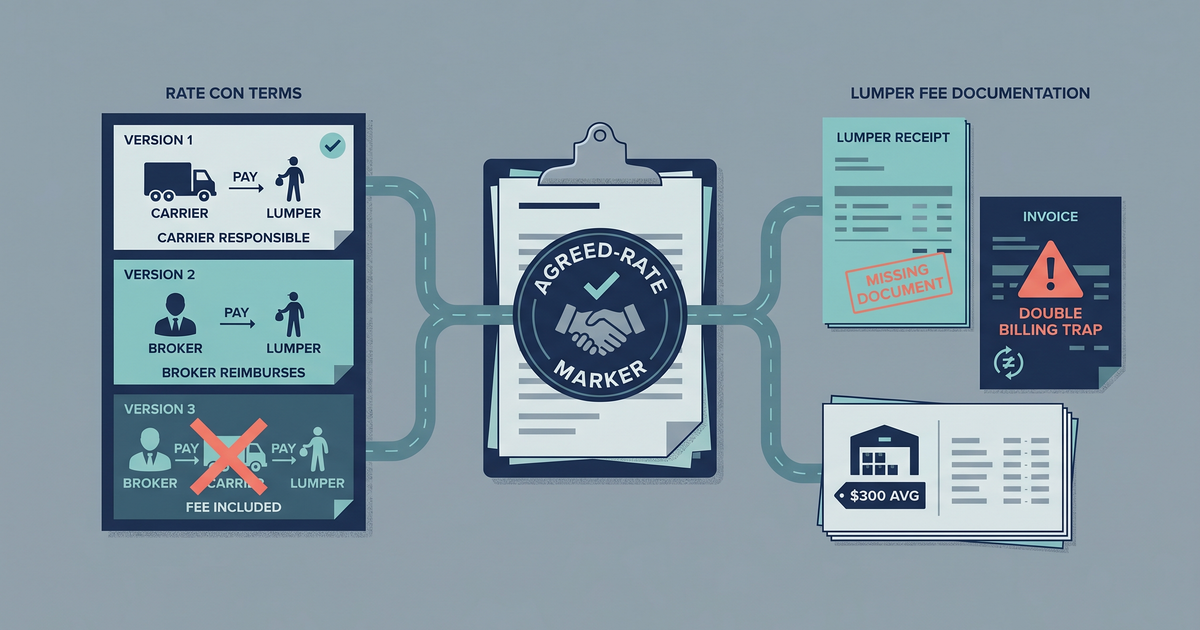
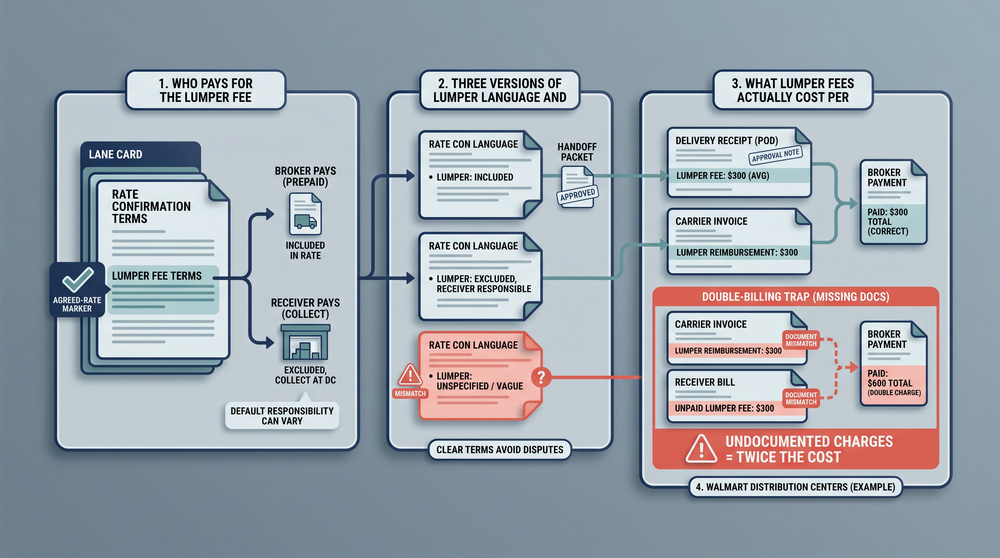
A single lumper fee in trucking runs about $300 on average, according to RoadSync. That's not a budget-breaker on one load. But when your rate con doesn't specify who pays, your driver accepts cash with no receipt, and the carrier invoices you 10 days later for the same charge, that $300 turns into $600. Multiply that by even a handful of loads per month and you're looking at a five-figure annual leak that never shows up in your P&L as a line item. It shows up as margin erosion you can't explain. This guide breaks down exactly who owes the lumper charge under different rate con terms, what documentation you need to protect yourself, and how to dispute a lumper fee when someone tries to push it back on you.
Who Pays for the Lumper Fee? It Depends on What Your Rate Con Says
The short answer: whoever the rate confirmation says pays. There is no universal rule in freight that assigns lumper fee responsibility to the broker, carrier, or shipper by default. The rate con is the contract, and the lumper language in it (or the absence of lumper language) determines who writes the check.
According to Apex Capital Corp's breakdown of lumper fee payment workflows, lumper fees are typically paid upfront by the driver at the point of delivery, with reimbursement then flowing back through the carrier or broker depending on the contractual arrangement. The problem for brokers starts when that arrangement is vague or unwritten.
Three versions of lumper language and what each one means
Here is a rate con comparison that every freight broker should be able to read cold:
- "Lumper included in linehaul rate": The carrier's all-in rate already accounts for potential lumper costs. If the carrier gets hit with a $300 lumper at the DC, that's their problem. They priced for it. The broker owes nothing additional.
- "Lumper at receiver/shipper expense": The facility itself pays the lumper service directly. Neither the carrier nor the broker should see a lumper charge on the invoice. If one appears, dispute it immediately.
- "Lumper reimbursable with receipt": This is the most common language, and the most dangerous for brokers. It means the broker will reimburse the carrier for the lumper fee, but only with a valid receipt. No receipt, no reimbursement. The catch? Plenty of brokers pay it anyway when pressured, even without the receipt.
If your rate con says nothing about lumper fees at all, you're in the worst position. With no written terms, carriers will argue the broker is responsible by default, and without documentation to the contrary, many brokers end up absorbing costs they never agreed to. For a deeper look at how lumper responsibility gets assigned, see our guide on who pays lumper charges and how liability works.
What Lumper Fees Actually Cost Per Load at Major Shippers Like Walmart, Amazon, and Kroger
Lumper fees aren't standardized. They vary by facility, freight type, pallet count, and whether the load is floor-loaded versus palletized. According to Relay Payments, lumper fees range from $25 to $500 per load, with the rate determined by the volume of work, hours required, and type of freight involved.
But "$25 to $500" is a huge range that doesn't help you budget. Here's what brokers actually see at the big three:
Walmart distribution centers
Walmart DCs are among the most frequent lumper-required facilities in the country. Fees typically land between $250 and $400 for a standard 26-pallet grocery load. Floor-loaded freight (beverages, canned goods) pushes fees toward the higher end because unloading takes longer and requires more labor. Most Walmart DCs use third-party lumper services, and drivers are expected to pay at the dock with either cash, a comcheck, or a digital payment platform.
Amazon fulfillment centers
Amazon's lumper fee range is wider: $150 to $500 depending on the fulfillment center, the freight type, and the pallet count. Smaller parcel-type freight on pallets tends to land closer to $150. Mixed SKU loads requiring sorting and separation at the dock can hit $400 to $500. Amazon facilities often have their own dock labor, but third-party lumper services still operate at many locations.
Kroger DCs
Kroger distribution centers often run flat-fee lumper programs, and many Kroger locations handle lumper costs as a shipper-paid expense. This means the fee doesn't flow through the broker or carrier at all. When it does, Kroger DC lumper fees tend to be lower, typically $150 to $300, because the work is often palletized grocery with standardized unloading procedures.
The takeaway for brokers: if you're moving grocery, beverage, or consumer goods into major retail DCs, you should expect a lumper fee on nearly every load. The question isn't whether it will happen. The question is whether your rate con addresses it before the truck arrives.
How Brokers End Up Paying Twice When Lumper Documentation Goes Missing
Double-paying lumper fees is one of the most common margin leaks in brokerage operations, and it almost always traces back to a documentation gap. Here's how it happens:
Scenario: A driver delivers a load to a Walmart DC. The facility charges a $350 lumper fee. The driver pays cash out of pocket. No one takes a photo of the receipt. The driver mentions the lumper charge to dispatch, who includes $350 as a line item on the carrier's invoice. The invoice arrives at the broker's billing team with no receipt attached. The broker's billing coordinator either pays it to avoid a dispute (and eats the cost) or rejects it and starts a 30-day back-and-forth with the carrier.
Meanwhile, if the shipper had actually pre-paid the lumper and the driver also paid at the dock, the broker just paid for something that was already covered. No one caught the overlap because there was no receipt to verify who paid first.
The math on undocumented lumper fees
Let's be specific. Per RoadSync's freight FAQ, the average lumper fee is approximately $300. If a broker location handles 100 loads per month into lumper-required facilities and 8 of those loads come through with no lumper receipt attached, that's 8 x $300 = $2,400 per month in charges that cannot be verified, disputed, or recovered. Over a year, that's $28,800 per location. For a brokerage with three offices, you're looking at potential exposure near $86,400 annually from a single documentation gap.
8 undocumented lumper fees per month at $300 average = $28,800 per year in unrecoverable costs per broker location. The problem isn't the fee itself. It's the missing receipt.
This is exactly the kind of billing error that compounds silently. For more on how these mistakes add up, see our breakdown of lumper fee billing errors that cost brokers thousands.
The Lumper Receipt Is Your Only Proof: Here Is How to Collect It Right
A lumper receipt is the single document that proves a lumper fee was paid, how much was paid, and who paid it. Without it, you have a carrier's word against your rate con, and that's a dispute you'll either lose or spend hours fighting.
What a valid lumper receipt must include
Not all lumper receipts are created equal. A valid receipt that will hold up in a billing dispute needs to include:
- Date and time of service
- Facility name and location (DC number if applicable)
- Name of the lumper service provider
- Dollar amount charged
- Payment method (cash, comcheck, digital payment)
- Load or PO number tying the receipt to a specific shipment
- Driver signature or acknowledgment
If any of these fields are missing, the receipt becomes harder to match to an invoice and easier for a shipper or carrier to dispute. We cover the full checklist in our article on what a valid lumper receipt must include to win a billing dispute.
Digital payment platforms versus cash: the receipt trail difference
Cash lumper payments are still common, and they're the number one source of missing documentation. When a driver pays cash, the receipt is a piece of paper that gets lost in the cab, thrown away at the next fuel stop, or never issued in the first place.
Digital lumper payment platforms like RoadSync create an automatic electronic receipt trail. Every payment is timestamped, tied to a load number, and stored digitally. The receipt can be forwarded to the broker or carrier immediately from the dock. No paper. No lost receipts. No "I forgot to take a picture."
For brokers who move volume through lumper-heavy facilities, requiring digital lumper payment in your carrier packet is one of the simplest ways to close the documentation gap. It doesn't eliminate the lumper fee, but it eliminates the scenario where you're paying a charge you can't verify.
How to build lumper receipt collection into your carrier onboarding
The best time to set expectations about lumper receipts is before a carrier ever hauls a load for you. Include these terms in your carrier packet:
- Lumper fees will be reimbursed only with a valid, itemized receipt submitted within 48 hours of delivery
- Receipts must include the load or PO number, facility name, dollar amount, and payment method
- Cash payments without receipts will not be reimbursed under any circumstances
- Digital payment receipts (RoadSync, Relay, comcheck) are preferred and will be processed faster
Example: Carrier packet with vs. without a lumper reimbursement clause. A carrier packet that states "all accessorials including lumper fees require itemized receipts for reimbursement" gives the broker a contractual basis to reject undocumented charges. A carrier packet that says nothing about lumper reimbursement leaves the broker exposed. When a dispute lands 30 days later, the carrier will argue that the absence of a restriction means the broker accepted responsibility. That missing clause can cost $300 per load, every time.
Can You Refuse to Pay a Lumper Fee?
Yes, a driver can refuse to pay a lumper fee personally, but there are practical and legal boundaries to understand. According to the FMCSA's enforcement guidance on lumper fees, the Motor Carrier Act of 1980 made it illegal under 49 U.S.C. § 14103 to coerce a driver into employing loading or unloading assistance and paying for it out of pocket. A receiver cannot force a driver to hire and personally pay for a lumper.
However, "can't be coerced" and "can refuse without consequences" are two different things. Here is what actually happens at the dock:
What the law says versus what happens in practice
The law protects drivers from being personally compelled to pay for lumper services. But many receiving facilities require lumper services as a condition of unloading. If a driver refuses to use the facility's lumper service, the facility may simply refuse to unload the truck. The driver isn't being coerced into paying, technically. The facility is just saying they won't do business without the lumper service being used.
For brokers, this creates a real-time operational problem. Your driver calls from the dock saying the facility wants $350 for a lumper. The rate con says "lumper at receiver expense," but the receiving dock says the driver needs to pay now. The load is sitting. Detention is accruing. As of 2026-04-01, average hourly earnings in truck transportation were $32.41/hr (BLS Current Employment Statistics, series CEU4348400008), so every hour that driver sits is real money.
Most experienced brokers handle this by issuing a comcheck to the driver on the spot and then billing it back to the shipper or receiver with the receipt. The alternative, letting the driver sit and accruing detention, almost always costs more than paying the lumper fee and sorting out the billing later.
When a shipper refuses to reimburse
If your shipper contract specifies that lumper fees are at the shipper's or receiver's expense, and the receiver refuses to reimburse after delivery, your options come down to documentation. A valid lumper receipt tied to the load number, combined with the rate con language assigning responsibility to the shipper, gives you a defensible position. Without the receipt, you have nothing to attach your claim to.
File the dispute in writing within 7 days of delivery. Include the lumper receipt, the rate con, the BOL, and the POD. If the shipper still won't pay, escalate to your contracts team or legal counsel. But understand: the receipt is the foundation of every successful dispute.
How to Avoid Lumper Fees or At Least Stop Getting Surprised by Them
You can't always avoid lumper fees. Many major retail DCs require them as a standard cost of doing business. But you can stop getting surprised, stop double-paying, and stop absorbing charges that belong to someone else.

Build a facility lumper database
Track which facilities charge lumper fees, what the typical fee is, and whether the fee is shipper-paid or carrier/broker-paid. After 60 to 90 days of tracking, you'll have a reliable reference that lets dispatchers set expectations before the truck arrives. When a driver calls from the dock surprised by a $400 lumper fee, your dispatcher can say, "Yes, that DC always charges $350 to $400. Here's the comcheck code." No delays. No confusion. No unpaid receipt.
Pre-negotiate lumper terms on every lane
Before you quote a lane that delivers into a known lumper-required facility, decide who pays and write it into the rate con. Don't leave it ambiguous. According to Trinity Logistics, lumper fees should be clearly addressed from both the carrier and shipper perspective before the load moves. If the shipper won't agree to cover the lumper, build it into your linehaul quote. If the carrier is expected to absorb it, make that explicit with "lumper included in rate" language.
Require receipts as a condition of payment
This is the simplest process change with the biggest impact. Make it policy: no lumper receipt, no lumper reimbursement. Communicate it in your carrier packet, repeat it during load confirmation calls, and enforce it consistently. Carriers will push back initially. But once they understand that receipt submission is non-negotiable, compliance improves quickly.
Catch overages before you pay them
Scenario: A carrier invoices your brokerage for $350 in lumper fees plus $150 in detention on a load where the rate con authorized a maximum of $250 in total accessorials. That's a $500 invoice against a $250 cap, an overage of $250.
Without a system that matches invoiced accessorials against the rate con terms, your billing coordinator might pay the full $500 because they're processing 40 invoices that day and don't have time to pull up the rate con for each one. With a process (or tool) that flags when invoiced amounts exceed rate con limits, the $250 overage gets caught before it's paid.
As of 2026-04-01, the Producer Price Index for truck transportation of freight stood at 174.6 (BLS PPI series WPU3012), reflecting continued cost pressure across the industry. In this environment, losing $250 per overage on even a few loads per month directly erodes margins that are already thin.
Factoring company scenario: what happens when the receipt is missing at settlement
Here's a scenario that plays out daily in carrier factoring. A driver delivers a load and submits the invoice to their factoring company. The invoice includes a $350 lumper line item, but no lumper receipt is attached. The factor advances on the linehaul amount only and excludes the $350 accessorial because it's undocumented. Thirty days later, the carrier comes back to the broker disputing the missing $350.
Now the broker is in a difficult position. The carrier says they paid the lumper. The broker has no receipt to verify it. The rate con says "lumper reimbursable with receipt." The broker is technically in the right to refuse, but the carrier relationship takes a hit, and the dispute consumes hours of back-and-forth between the broker's billing team, the carrier, and the factor.
This entire scenario disappears if the carrier submits the lumper receipt at the time of invoicing. That's it. One document. For a complete walkthrough on setting up this workflow, read our guide on lumper fee documentation and reimbursement processes.
Frequently Asked Questions About Lumper Fees in Freight
Who pays for the lumper fee?
The rate confirmation determines who pays the lumper fee. Common arrangements include "lumper included in rate" (carrier absorbs it), "lumper at receiver expense" (the facility pays), or "lumper reimbursable with receipt" (broker reimburses the carrier with valid documentation). If the rate con is silent on lumper fees, the broker is often pressured to pay by default, which is why clear lumper language before load pickup is critical.
Do lumpers make good money?
Lumper pay varies significantly. Individual lumper workers at third-party services typically earn between $12 and $20 per hour, though experienced lumpers at high-volume DCs can earn more through piece-rate or per-load pay. As of 2026-05-01, the truck transportation sector employed approximately 1,465 thousand workers (BLS CES series CES4348400001), and lumper services operate as a distinct but adjacent labor pool to over-the-road trucking. The lumper service companies themselves generate significant revenue given that fees per load average around $300.
Can you refuse to pay a lumper fee?
Drivers cannot be legally coerced into personally paying for lumper services under the Motor Carrier Act of 1980, codified at 49 U.S.C. § 14103. However, facilities can require lumper services as a condition of unloading, meaning a refusal to use the service may result in the truck not being unloaded. In practice, brokers typically issue a comcheck or authorize digital payment to avoid detention costs.
How can brokers avoid lumper fee disputes?
Three steps close most disputes before they start. First, include explicit lumper language in every rate confirmation. Second, require a valid, itemized lumper receipt as a condition of reimbursement, and put that requirement in your carrier packet. Third, use digital payment platforms instead of cash so that receipts are generated automatically and stored electronically. Brokers who enforce all three see significantly fewer disputed lumper charges.
How are lumper fees handled with factoring companies?
Most factoring companies will advance on the linehaul portion of a carrier invoice immediately but will exclude lumper fees and other accessorials unless a valid receipt is attached. If the receipt is missing, the factor holds back the accessorial amount, and the carrier must collect the lumper reimbursement directly from the broker. This delay creates friction for everyone, which is why submitting the lumper receipt with the initial invoice eliminates the problem entirely.
Sources
- May drivers be coerced into employing loading or unloading assistance (lumpers)? — FMCSA
- What is a lumper and lumper payment? — Relay Payments
- Freight FAQs: What is a Lumper? — RoadSync
- What are Lumper Fees in Trucking? — Apex Capital Corp
- Lumper Fees: What are They and Why are They Needed? — Trinity Logistics
Stop Letting Lumper Fees Eat Your Margins
Lumper fees aren't going away. Major retail DCs will keep requiring them, and drivers will keep paying them at the dock. What you can control is whether your brokerage absorbs costs it shouldn't, pays charges it can't verify, and loses disputes it should win. The fix comes down to three things: clear rate con language before the load moves, a receipt requirement that you actually enforce, and a billing process that catches overages before they're paid.
If your team processes more than 50 invoices a week and you're still manually matching lumper charges against rate con terms, automated document extraction tools can flag the discrepancies covered in this guide before your billing coordinator approves payment. The math is straightforward: catching even a few undocumented or double-billed lumper fees per month pays for itself.