Freight Dispute Resolution Software: What It Catches and What It Misses
Researched and written with AI assistance. Reviewed by the Laneproof team.
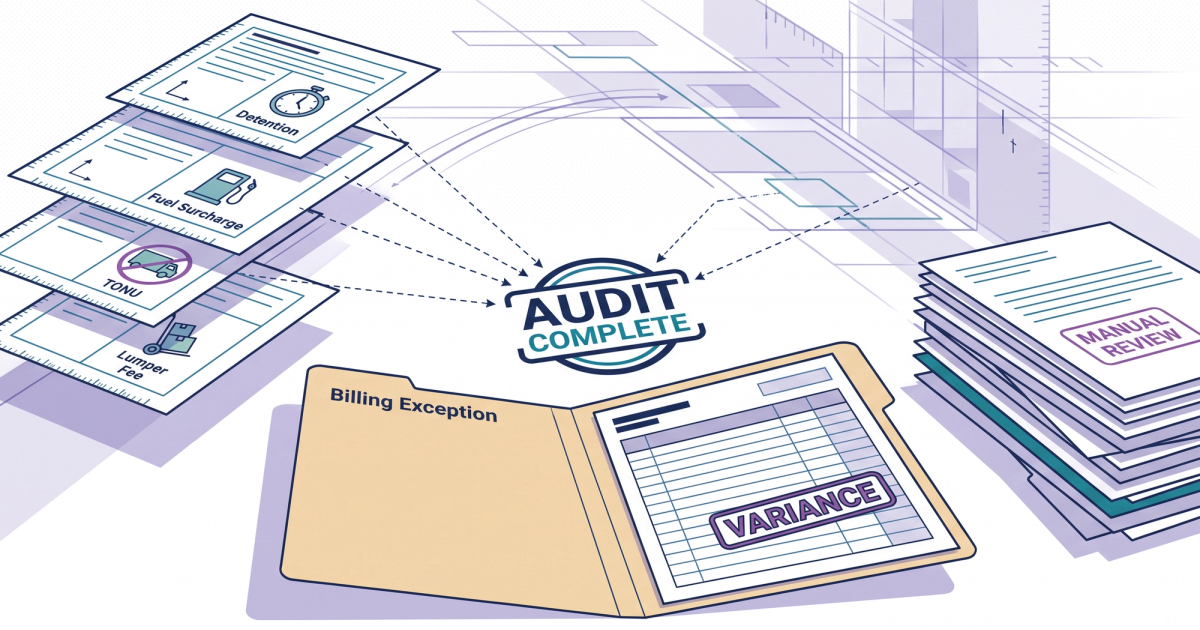
A broker running 400 loads per month with a 4.2% carrier overbilling rate on accessorials is leaving roughly $6,300 to $8,400 per month on the table. That math assumes an average load revenue of $1,500 and an average overbill of $40 to $50 per flagged freight invoice. Freight dispute resolution software exists to catch those variances before payment goes out. But the category has a honesty problem: vendors describe what their tools do in best-case conditions and skip the scenarios where the software can't help you without the right documents already in place. This post maps the specific billing disputes (detention, fuel surcharge, TONU, lumper fees) that software handles well, names the ones it still can't close on its own, and gives you the numbers to decide whether your dispute volume justifies the cost.
What Freight Dispute Resolution Software Actually Does (Skip the Sales Page Version)
Freight dispute resolution software is a category of tools that ingests shipment documents (rate confirmations, BOLs, PODs, carrier invoices) and compares them against each other to find mismatches. When a carrier invoice shows a linehaul of $2,350 but the rate con says $2,200, the software flags that $150 variance. When an accessorial appears on the invoice that doesn't exist on the rate con, the software surfaces it for review. That is the core function. Everything else (automated emails to carriers, audit dashboards, analytics) is built on top of that matching engine.
According to a DataIntelo market report on dispute management software for freight bills, the category segments into three distinct use cases: freight audit, invoice dispute resolution, and claims tracking. Those are not the same workflow, and brokers who buy software expecting it to cover all three often end up disappointed. A tool that is good at catching rate con mismatches may have no claims tracking workflow at all. A tool built for claims management may not do line-item invoice auditing.
The definition that actually matters for brokers
Here is the version stripped of marketing language: freight dispute resolution software automates the comparison of carrier invoices against rate confirmations, BOLs, and shipment records to flag billing discrepancies. It captures shipment evidence, generates structured dispute communications to carriers, and tracks resolution status per invoice. Good versions integrate with your TMS. Weak versions require manual uploads for every document. The difference between those two determines whether the software saves you hours per week or just moves the bottleneck from your billing coordinator's spreadsheet to a different screen.
What it replaces (and what it doesn't)
Before software, a billing coordinator would pull the rate con, open the carrier invoice, compare line by line, and flag anything that didn't match. For a brokerage handling 400 loads per month, that process takes 8 to 15 hours per week depending on the complexity of the accessorial structure. Software compresses that to minutes for the automated matching portion. But it does not replace the coordinator's judgment on ambiguous charges, and it definitely does not replace missing documents. If the rate con doesn't specify a detention policy and the carrier charges detention, the software can flag the charge, but resolving it still requires a phone call and proof. If you want a deeper look at what documents actually win billing disputes in freight, that is a separate playbook worth reviewing before you evaluate any software.
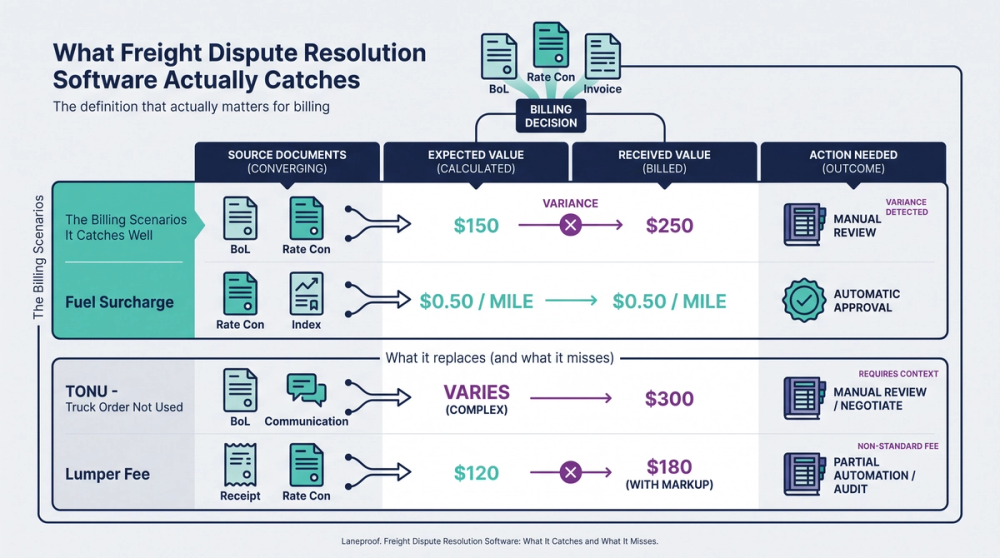
The Billing Scenarios It Catches Well: Detention, Fuel Surcharges, and Rate Con Mismatches
Not all carrier billing disputes are created equal. Some are pure data problems: one number on the invoice doesn't match the number on the rate con. Those are where software earns its keep. Others are documentation problems that require proof beyond what any matching engine can provide. Let's start with the scenarios where the software works.
Rate con vs. invoice linehaul mismatches
This is the easiest category. The rate con says $2,200 linehaul. The carrier invoices $2,350. The variance is $150. Any freight dispute resolution software that can parse both documents will catch this in seconds. There is no ambiguity, no judgment call. It is a number-to-number match. The same applies to mileage-based rates: if the rate con specifies $2.85/mile for 780 miles ($2,223) and the carrier invoices for 812 miles ($2,314.20), the software flags the 32-mile discrepancy and the $91.20 variance. These types of mismatches are the bread and butter of overbilling detection across the freight industry, and they represent the highest-confidence catches for automated audit.
Fuel surcharge miscalculations
Fuel surcharge disputes are more common than most brokers realize, because carriers sometimes calculate surcharges using internal fuel tables rather than the DOE weekly national average that rate cons typically reference. Here is a real-world example of how this adds up.
Scenario: Fuel surcharge drift across 60 loads. A carrier invoices a fuel surcharge based on a private fuel table that runs $0.04/mile higher than the DOE index specified in the rate con. On loads averaging 725 miles, that is an extra $29 per load. But the carrier also rounds up to the nearest dollar, adding another $0.45 on average, bringing the per-load overbill to roughly $29.45. Across 60 loads in a month, that is $1,767 in fuel surcharge overbilling. Some carriers go further. In a more aggressive scenario where the delta runs $0.12/mile and loads average 725 miles, the overbill hits $87 per load, or $5,220 across 60 loads in a single month. Software that matches the rate con's fuel surcharge formula against the invoice calculation catches this automatically. Software that only compares total invoice amounts against rate con totals may miss it entirely because the surcharge is baked into the total.
Detention overbilling with timestamp evidence
Detention is one of the most disputed accessorials in freight. Here is where software shows a clear advantage, but only when timestamp data is available.
Scenario: Carrier claims 3.5 hours, dock records show 2.1 hours. A carrier invoices detention at $75/hour for 3.5 hours ($262.50). The receiver's facility has timestamped gate-in and gate-out records showing the truck was on-site for 2 hours and 6 minutes. The correct charge is $157.50 (2.1 hours × $75), making the overbill $105. Software that ingests BOL timestamps or facility check-in/check-out data catches this automatically, comparing the carrier's claimed hours against documented dwell time. Software that doesn't have access to those timestamps, or that can't parse them from scanned documents, leaves it to the billing coordinator to pull the records manually. According to the FMCSA's guidance on handling carrier disputes, carriers are required to maintain formal arbitration programs for charge disputes, which means documented evidence of actual time carries weight in formal proceedings. The practical takeaway: if your TMS records appointment times and actual arrival/departure times, your dispute resolution software has something to compare against. If it doesn't, the software can flag the detention line item as an accessorial, but it cannot validate the hours.
Where It Falls Short: Lumper Fees, TONU Claims, and He-Said-She-Said Disputes
Here is where most freight dispute resolution software marketing gets quiet. There is an entire class of carrier billing dispute that no matching engine can resolve on its own because the answer depends on physical proof that doesn't live in your TMS or in the rate con.
Lumper fees: flagged but not resolved
Scenario: $325 lumper fee not on the rate con. A carrier invoices a $325 lumper fee. The rate con makes no mention of lumper fees, and the accessorial schedule doesn't include one. The software flags the line item as unapproved. That is the correct response. But now what? The billing coordinator needs to determine whether the lumper service was actually performed. That requires a signed lumper receipt from the warehouse or receiver. If the receiver doesn't provide one, the broker is stuck calling the warehouse to confirm. Software cannot make that phone call. It cannot verify whether a third-party lumper service was actually used. All it can do is flag the charge as outside the agreed terms. This is the documentation gap that software cannot close on its own. Winning freight invoice disputes in these scenarios comes down to having the receipt before the carrier sends the invoice, not after.
TONU disputes: no tender record, no case
Scenario: Carrier claims a cancelled tender within the cancellation window. A carrier invoices a $350 TONU (truck ordered, not used) charge, claiming the load was tendered at 2:15 PM and cancelled at 2:45 PM, within the 2-hour cancellation window specified in the carrier packet. The broker's dispatcher says the load was never formally tendered. Here is the problem: if the TMS has no timestamped tender record (because the tender was communicated over the phone or via text message outside the system), the broker has no evidence. The carrier has a line item on an invoice. The broker has a verbal claim. Software that integrates with the TMS can check for a tender event. If one exists with a timestamp, the software can compare it against the cancellation time and the carrier packet's cancellation policy. If no tender event exists in the TMS, the software has nothing to compare. This is not a software limitation in the sense of a bug or missing feature. It is a data availability problem. Freight dispute resolution software can only adjudicate what it can see. If your dispatch workflow happens partly outside the TMS (phone, text, email), the software has blind spots.
Accessorial he-said-she-said scenarios
Layover charges, driver assist fees, and reclassified accessorials fall into a gray zone. The carrier says the driver waited overnight because the appointment was missed. The broker says the carrier arrived late and the appointment was rescheduled. Both parties have a version of events. Software can flag the charge. It can even surface the appointment time from the TMS and compare it to the BOL timestamp. But if the discrepancy is 20 minutes and the carrier's version is plausible, you are in negotiation territory, not automation territory. According to the American Trucking Associations' arbitration program for loss and damage claims, formal arbitration is available when direct negotiation fails. But most small brokers handling 100 to 1,000 loads per month are not going to formal arbitration over a $175 layover charge. They need the documentation to win the phone call, not the hearing. A good carrier dispute playbook built on documentation matters more here than software features.
Proof of Custody Is the Real Variable: Why Most Brokers Lose Disputes Without It
Software catches data mismatches. Documentation wins disputes. Those are two different capabilities, and conflating them is the most common mistake brokers make when evaluating freight dispute resolution software.
The concept of proof of custody means having a verifiable, timestamped record that shows who had control of the freight, what services were performed, and when key events (pickup, delivery, detention start, detention end, lumper service, TONU notification) occurred. When this proof exists in a structured format that software can ingest, the software works beautifully. When it doesn't, the software becomes an expensive flagging tool that still requires a human to chase down the evidence.
The documentation chain that makes software effective
For freight dispute resolution software to resolve (not just flag) a carrier billing dispute, it needs access to at least these documents per load:
- Rate confirmation with all accessorial terms, detention policies, fuel surcharge formulas, and cancellation windows explicitly stated
- Bill of lading (BOL) with timestamps for pickup, ideally with appointment times noted
- Proof of delivery (POD) with receiver signature, delivery timestamp, and any exception notes
- Carrier invoice with line-item detail (not a lump-sum total)
- TMS event log showing tender timestamps, appointment confirmations, status updates, and dispatch notes
- Supporting receipts (lumper receipts, scale tickets, toll receipts) for any accessorial charges
When all six are present and machine-readable, the software can cross-reference and resolve most disputes automatically. When even one is missing, the resolution typically stalls until a human fills the gap. According to a Datagrid analysis of AI-driven freight bill auditing, AI agents are being deployed to automate these workflows, but their effectiveness still depends on having structured, accessible document inputs. The AI is only as good as the documents it can read.
Why the billing coordinator still matters
As of 2026-04-01, average hourly earnings in truck transportation stood at $32.41/hr according to BLS Current Employment Statistics (series CEU4348400008). A billing coordinator at a small brokerage is likely earning in that range. If that person spends 10 hours per week on manual dispute resolution and software cuts that to 3 hours, you are saving roughly $227 per week, or about $980 per month in labor costs alone. That is before counting recovered overbill amounts. But you cannot cut the coordinator to zero hours on disputes. Lumper receipts, TONU verification calls, he-said-she-said accessorial negotiations: those still require a person. The software shifts their work from finding discrepancies to resolving the ones that need human judgment.
How to Figure Out If Your Dispute Volume Justifies the Cost
Here is the calculation most freight dispute resolution software vendors won't walk you through, because it might tell you their product isn't worth it yet for your operation.
Step 1: Know your overbilling rate
Pull your last 90 days of carrier invoices. Compare them against rate cons. Count how many have a variance (any amount). Divide that by total invoices. If you process 400 loads/month and 17 invoices per month have discrepancies, your overbilling rate is 4.25%. According to Transportation Insight's analysis of freight audit and payment, 1 to 5 percent of total freight spend is recoverable through accurate audit and dispute resolution processes. If you are below 1%, software might not pay for itself. If you are above 3%, you are almost certainly leaving money on the table.
Step 2: Calculate your monthly exposure
Example: 400 loads/month broker. At an average load revenue of $1,500, total monthly freight spend is $600,000. A 4.2% overbilling rate means roughly 17 invoices per month carry a discrepancy. If the average overbill is $40 to $50 per flagged invoice, that is $6,300 to $8,400 per month in recoverable overbilling. Over 12 months, that is $75,600 to $100,800. Now compare that to the annual cost of dispute resolution software (typically $200 to $1,500/month for SMB brokers depending on load volume and features). Even at the high end, the software cost is $18,000/year against a potential recovery of $75,000+. The ROI is clear at this load volume. But for a broker running 50 loads/month with a 2% overbilling rate, the monthly exposure might be $300 to $400. At that volume, a disciplined spreadsheet process and better rate con language might be the smarter investment.
Step 3: Factor in resolution time
Industry benchmarks suggest that dispute resolution without dedicated software takes 11 to 18 days per disputed invoice. Brokers with structured documentation workflows and software support report resolving the same disputes in 2 to 4 days. That difference matters for DSO (days sales outstanding). If you carry 17 disputed invoices per month at an average of $2,200 each, that is $37,400 in receivables tied up in disputes at any given time. Cutting resolution time from 14 days to 3 days frees up cash flow faster and preserves carrier relationships. Carriers get paid sooner on clean invoices, and disputed invoices get resolved before they become relationship problems.
As of 2026-05-01, truck transportation employment stood at 1,465 thousand workers according to BLS CES data (series CES4348400001). The industry is large and the carrier pool is deep, but repeat carriers who trust your billing process are still worth protecting. Fast, fair dispute resolution is part of that trust.
Laneproof's reconciliation engine checks each of these fields automatically, flagging invoice variances against rate cons before payment goes out. For brokers running 200+ loads per month, the time savings alone typically cover the cost within the first billing cycle.

Concrete Scenarios: Software vs. Manual Resolution Side by Side
Let's put three billing disputes through both workflows to see where software adds value and where it doesn't.
Example 1: Detention overbill, timestamps available. A carrier invoices $262.50 for 3.5 hours of detention at $75/hour. The receiver's dock system recorded gate-in at 8:12 AM and gate-out at 10:18 AM, a total of 2.1 hours. Correct charge: $157.50. Overbill: $105. With software that ingests dock timestamps: the system matches the carrier's claimed hours against documented dwell time, flags the $105 variance, and generates a dispute communication to the carrier with the timestamp evidence attached. Resolution time: 1 to 2 days. Without software: the billing coordinator pulls the BOL, calls the receiver to request gate records, waits for an email response, manually calculates the correct charge, and sends a dispute email to the carrier. Resolution time: 7 to 14 days.
Example 2: Fuel surcharge miscalculation across a batch. A carrier invoices fuel surcharges on 60 loads using a private fuel table instead of the DOE weekly index specified in the rate con. The delta is $87 per load, totaling $5,220 in overbilling for the month. With software that parses fuel surcharge formulas from rate cons: the system recalculates each surcharge using the DOE index, identifies the per-load variance, and flags the entire batch. Resolution time: same day for the flag, 2 to 3 days for carrier acknowledgment. Without software: the billing coordinator might catch the discrepancy on one or two invoices but is unlikely to identify the pattern across 60 loads without a batch comparison. Some of the overbilling goes unnoticed. Partial recovery at best.
Example 3: TONU dispute, no TMS tender record. A carrier invoices a $350 TONU charge. The broker's dispatcher says the load was never tendered. The TMS has no tender event logged because the conversation happened over the phone. With software: the system searches for a tender event in the TMS, finds nothing, and flags the TONU as "unverifiable, no tender record." The billing coordinator still has to call the carrier and negotiate. The software flagged the issue but cannot resolve it. Without software: the billing coordinator reviews the invoice, sees the TONU charge, and has the same phone call. Net difference in resolution: minimal, because the bottleneck was the missing documentation, not the detection speed.
Software flags the line item as unapproved, but without a signed lumper receipt from the receiver, the broker still has to make the call. That is the documentation gap software cannot close on its own.
Frequently Asked Questions
What types of freight billing disputes does dispute resolution software catch automatically?
Software catches disputes that are pure data mismatches: linehaul rate vs. rate con, fuel surcharge formula errors, mileage discrepancies, and unapproved accessorial line items. Any dispute where both the correct value and the invoiced value exist in structured documents can be flagged automatically. Disputes that require external proof (lumper receipts, physical dock timestamps not in the TMS, verbal agreements) still need human follow-up.
How much does freight dispute resolution software cost for a small brokerage?
Most freight dispute resolution tools for SMB brokers (100 to 1,000 loads/month) range from $200 to $1,500 per month depending on load volume, integration depth, and feature set. The ROI calculation depends on your overbilling rate: if you are recovering $3,000+ per month in flagged variances, even a $1,000/month tool pays for itself. If your overbilling rate is below 1%, a manual process with better rate con language may be more cost-effective.
Does dispute resolution software integrate with my TMS?
It depends on the vendor and your TMS. The best freight dispute resolution software pulls rate con data, tender events, and shipment milestones directly from the TMS, which makes automated matching possible. Tools that require manual document uploads still work but add time to the process. According to DAT's guidance on TMS software selection for freight brokers, integration capability should be a primary evaluation criterion. If the software can't read your TMS data, its value drops significantly.
What documents do I need before dispute resolution software can help?
At minimum: a rate confirmation with explicit accessorial terms, a BOL with timestamps, a POD, and a line-item carrier invoice. For detention disputes, you also need facility check-in/check-out records. For lumper fees, you need signed lumper receipts. For TONU claims, you need timestamped tender records in the TMS. The software's effectiveness is directly proportional to the completeness of your document chain per load.
How long does it take to resolve a carrier billing dispute with software vs. without?
Industry benchmarks suggest 11 to 18 days per disputed invoice without dedicated software. Brokers using structured documentation workflows and dispute resolution software report resolving the same disputes in 2 to 4 days. The biggest time savings come from automated detection (seconds vs. hours of manual comparison) and structured dispute communications that include evidence, reducing back-and-forth with carriers.
The Bottom Line for Brokers Evaluating Freight Dispute Resolution Software
Freight dispute resolution software catches what your documents can prove. Rate con mismatches, fuel surcharge formula errors, detention overbills with timestamps, and unapproved accessorial line items are all within its reach. Lumper fee verification, TONU disputes without tender records, and he-said-she-said accessorial claims are not. That doesn't make the software useless. It means you need to fix your documentation workflow first and then let software multiply the value of that documentation.
If you are running 200+ loads per month with an overbilling rate above 3%, the math works. You are likely leaving $3,000 to $8,000 per month on the table, and software that catches even half of that pays for itself immediately. If you are at lower volume, start with better rate con language and a structured dispute process, then add software when the volume justifies it.
Laneproof is built for exactly this workflow: matching carrier invoices against rate cons at the line-item level, flagging variances before payment, and giving your billing coordinator the evidence to resolve disputes fast. See how it works with your load volume.
Sources
- What Should You Do if You Have a Dispute with Your Mover? — FMCSA
- Arbitration - Loss and Damages — American Trucking Associations
- How to Choose the Best TMS Software for Freight Brokers — DAT
- Dispute Management Software for Freight Bills Market — DataIntelo
- How AI Agents Automate Freight Bill Auditing and Dispute Resolution — Datagrid
- Freight Audit and Payment: Protecting Profit in Soft Rates — Transportation Insight
Related: Carrier Billing Dispute Automation: Close Cases in 30 Minutes