Invoice Disputes in Freight: Win Them Fast With the Right Docs
Researched and written with AI assistance. Reviewed by the Laneproof team.

A carrier bills you $300 for four hours of detention. Your BOL timestamps show the driver was on site for one hour and 45 minutes, well within the two-hour free-time window on your rate con. The actual liability: $0. That single invoice dispute, caught before payment, saves your margin on that load entirely. Now multiply it. According to freight billing error data from IntelliTrans, 27% of all accessorial fees levied on shipments are incorrect. If you're running 500 loads a month and even a fraction carry padded charges, you're looking at tens of thousands in annual margin erosion you never approved.
This guide is built for freight brokers who process real loads, not accounts payable departments at Fortune 500 companies. You'll learn which charges cause the most disputes, how to use the documents you already have (rate con, BOL, POD) as hard evidence, and how to resolve carrier billing disagreements in 48 hours or less without destroying the relationship.
What Is a Freight Invoice Dispute, and Why It Hits Brokers Hardest
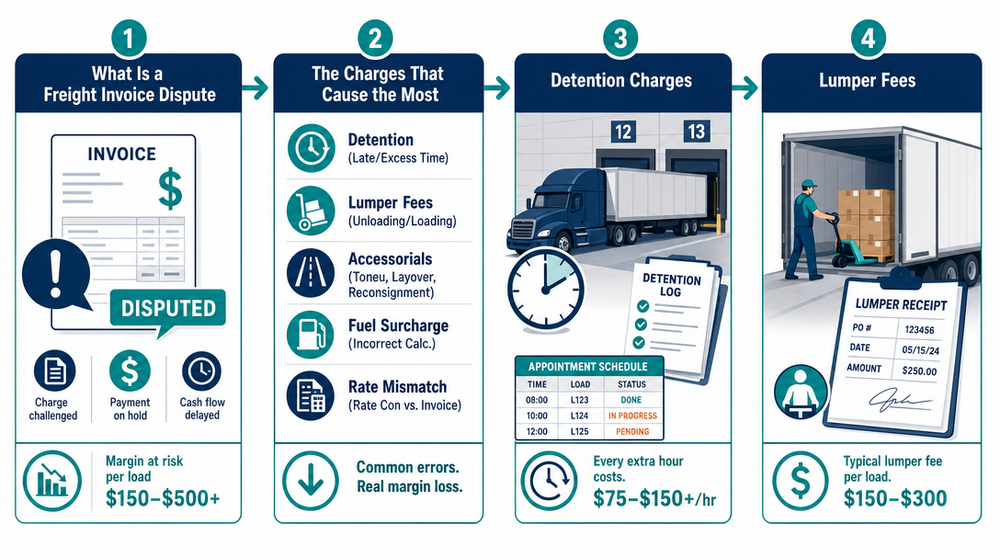
A freight invoice dispute is a formal challenge to a carrier's billing when the invoiced amount doesn't match the agreed-upon rate, authorized charges, or documented service. The most common triggers are rate con mismatches, unauthorized accessorials, inflated detention or lumper fees, and fuel surcharge calculation errors.
For brokers specifically, these disputes hit harder than they do for shippers or carriers. Here's why: you're stuck in the middle. Your shipper has already agreed to a customer rate. When a carrier invoices above the contracted amount, every extra dollar comes straight out of your margin. You can't pass it through. You eat it or you fight it.
According to ICC Logistics' analysis of freight invoice errors, an estimated 5 to 15% of all freight invoices contain errors, often tied to fuel surcharges, carrier rates, or accessorial charges. At the higher end of that range, a broker moving 500 loads per month could face 75 invoices per month that need review or correction. Per IOFM 2025 data cited by ZD SCS, 22% of freight invoices require manual correction, and each error costs an average of $53.50 to resolve. That's not just the overbill amount. That's the labor cost of catching, documenting, and fighting it.
Most brokers don't have a dedicated audit team. It's usually the billing coordinator, the ops manager, or the broker themselves scrolling through invoices at 7 PM trying to match numbers to rate cons. The result? Smaller overbills slip through. Larger ones get contested late. Margins shrink on loads that looked profitable when you booked them.
The Charges That Cause the Most Disputes (and How Much They Usually Cost You)
Not all freight billing discrepancies are created equal. Some charges are consistently inflated or outright unauthorized. If you know where to look, you can catch most overbills before they become disputes at all.
Detention Charges
Detention is the single most disputed accessorial in freight brokerage. Carriers commonly bill for time that exceeds what the BOL or facility gate logs actually support. A typical detention rate sits between $50 and $100 per hour after free time, and free-time windows (usually two hours) are spelled out in the rate con. The problem: carriers sometimes round up, start the clock early, or bill for time spent waiting in a queue before check-in. According to Broussard Logistics' breakdown of common freight billing discrepancies, accessorial overcharges including detention and demurrage are among the most frequent causes of invoice disputes in the industry.
Lumper Fees
Lumper fees range from $150 to $600 depending on the facility and commodity. The dispute isn't usually about the existence of a lumper fee. It's about authorization. Most rate cons require pre-approval before a carrier pays a lumper and seeks reimbursement. When that approval step is skipped, the broker has every right to dispute the charge. Without a lumper receipt and a documented pre-approval (even a text or email), the carrier's claim is weak.
Fuel Surcharge Miscalculations
Fuel surcharges (FSC) should be formulaic: a percentage of linehaul tied to the DOE national diesel index for the week of pickup. But carriers sometimes apply a flat FSC percentage that doesn't match the rate con or use a different index week. On a $2,200 linehaul, the difference between a 12% FSC (locked in the rate con) and an 18% FSC (billed by the carrier) is $132 per load. For more detail on how these miscalculations compound, see our guide on catching fuel surcharge overcharges before you pay.
TONU and Dry Run Charges
A Truck Order Not Used (TONU) charge, typically $200 to $400, is legitimate when a broker cancels a dispatched load. It's not legitimate when the carrier claims a dry run but the broker has a timestamped dispatch confirmation and a live delivery appointment. These disputes hinge entirely on documentation: who confirmed what, and when.
Layover Charges
Layover fees, usually $200 to $350 per day, apply when a driver is delayed between pickup and delivery beyond a contractually defined threshold (often 24 hours). Carriers sometimes bill layover for delays shorter than the threshold. The rate con and the driver's own check-in timestamps are your proof.
Across all these categories, IntelliTrans data shows that approximately 1 to 1.5% of all linehaul freight bills contain errors, while 27% of accessorial fees are incorrect. The accessorial line items are where your money disappears.
Your Three Best Weapons: Rate Con, BOL, and POD
You've probably heard this before: "keep good records." Here's the difference. In freight, three specific documents form the backbone of every successful invoice dispute. If you have all three, you win most disputes on the facts. If you're missing one, you're negotiating from a weak position.
The Rate Confirmation (Rate Con)
The rate con is your contract. It specifies the linehaul rate, fuel surcharge formula or cap, authorized accessorials, free-time windows for detention, lumper pre-approval requirements, and TONU terms. When a carrier's invoice doesn't match the rate con, you don't need to argue. You point to the number on the signed agreement.
Key fields to check on every invoice against the rate con:
- Linehaul amount (should match exactly)
- FSC percentage and calculation base
- Detention rate and free-time hours
- Lumper fee authorization requirements
- TONU and layover conditions and dollar caps
The Bill of Lading (BOL)
The BOL is your operational receipt. It captures pickup timestamps, commodity descriptions, piece counts, and weight. In detention disputes, the BOL's timestamps often prove or disprove the carrier's claimed wait time. In weight-based billing disputes, the BOL is the starting point for verifying whether the billed weight matches what was actually tendered.
The Proof of Delivery (POD)
The POD closes the loop. It confirms delivery time, condition of freight, and any exceptions noted at the consignee. If a carrier claims a layover between pickup and delivery, the POD's delivery timestamp, compared to the BOL's pickup timestamp, tells you whether the delay exceeded the rate con's layover threshold.
For a deeper look at how these three documents work together in real disputes, read our breakdown of the four documents that win billing disputes every time.
How to Dispute a Carrier Invoice in 48 Hours or Less
Speed matters. The longer a dispute sits, the harder it is to resolve. Carriers move on to the next load. Details get fuzzy. And some contracts include dispute windows that penalize late challenges. According to Freight Caviar's survey on broker back-office operations, 93% of freight brokers still rely on traditional methods to resolve invoice disputes, with 47% depending primarily on email. That means most disputes are already slow. Here's how to make yours fast.
Step 1: Flag the Discrepancy at Invoice Receipt (Hour 0 to 4)
The moment an invoice arrives, compare it line by line to the rate con. Don't just check the total. Check every line item: linehaul, FSC, detention, lumper, and any other accessorial. If you're processing invoices manually, this is the bottleneck. A single billing coordinator reviewing 30 invoices a day can easily miss a $132 fuel surcharge discrepancy buried in line three.
What to look for:
- Linehaul amount higher than the rate con
- FSC percentage that doesn't match the agreed formula or index week
- Detention hours that exceed what the BOL timestamps support
- Any accessorial not explicitly authorized in the rate con
- Duplicate invoice numbers from the same carrier for the same load
Step 2: Build Your Dispute File (Hour 4 to 12)
Once you've identified a discrepancy, pull together the evidence before you contact the carrier. Your dispute file should include:
- The carrier's invoice (highlighting the disputed line items)
- The signed rate con (highlighting the corresponding agreed terms)
- The BOL (with timestamps relevant to detention or weight disputes)
- The POD (with delivery timestamps and exception notes)
- Any supporting communication: dispatch confirmations, pre-approval emails, gate logs
Having this file ready before you reach out signals to the carrier that you've done your homework. It also prevents the dispute from dragging into a multi-week email chain of "can you send me the rate con?" and "let me check with my driver."
Step 3: Send the Dispute With Documentation (Hour 12 to 24)
Contact the carrier's billing department (not just the driver or dispatcher) with a clear, factual message. State the load number, the invoiced amount, the contracted amount, the specific discrepancy, and attach your dispute file. Keep the tone professional. You're correcting a billing error, not accusing anyone of fraud.
A strong dispute email includes:
- Subject line: "Invoice Dispute: Load #[number], [carrier name]"
- One sentence identifying the discrepancy: "Your invoice shows 4 hours of detention at $75/hr ($300). Our BOL timestamps confirm 1 hour 45 minutes on site, within the 2-hour free-time window per the attached rate con."
- The corrected amount you're willing to pay
- All supporting documents attached as PDFs
Step 4: Follow Up and Close (Hour 24 to 48)
If the carrier doesn't respond within 24 hours, follow up. Most legitimate overbills get resolved quickly once the carrier sees the documentation. If the carrier pushes back, you escalate within your dispute process (more on that below). But in the majority of cases, a well-documented dispute closes within 48 hours because the facts are clear.
Dispute Deadlines, Contractual Windows, and What Happens If You Miss Them
Timing isn't just about efficiency. It's about legal standing. Miss a contractual dispute window, and you may lose the right to challenge the charge entirely.
FMCSA Rules on Invoice Presentation
Under FMCSA regulations governing collection of charges, movers must present freight bills within 15 days of delivery. While this regulation applies specifically to household goods carriers, it establishes a useful benchmark: the expectation that billing happens promptly, and that disputes should be raised shortly after. Many carrier broker agreements include their own invoice submission and dispute deadlines, often 30 to 90 days from delivery.
What Your Broker-Carrier Agreement Probably Says
Most broker-carrier contracts include a clause along these lines: "Any dispute regarding charges must be raised in writing within [30/60/90] days of invoice receipt." If your agreement says 30 days and you challenge an invoice on day 45, the carrier can (and often will) argue the dispute is invalid regardless of the merits.
Per Freight Collection Solutions' legal analysis of freight invoice disputes, brokers who miss dispute deadlines significantly weaken their position, even when the overbill is clearly documented. The legal framework favors timely challenges.
The Cost of Delayed Disputes
Beyond contractual deadlines, delayed disputes cost you in labor. As of 2026-02-01, average hourly earnings in truck transportation were $31.94/hr according to BLS Current Employment Statistics (series CEU4348400008). Your billing coordinator's time isn't free. A dispute that takes two hours to resolve at that wage costs you roughly $64 in labor alone, on top of whatever the overbill was. Catching it the same day the invoice arrives, when the load details are still fresh, cuts that time in half.
Real Dispute Scenarios: The Math on What's at Stake
Theory is one thing. Here's what these disputes look like with actual numbers.
Example: Detention Overbill, $300 to $0
A carrier invoices 4 hours of detention at $75/hour for a total of $300. The rate con includes a 2-hour free-time clause. The BOL timestamp shows the driver checked in at 10:15 AM. The facility gate log shows departure at 12:00 PM. Total on-site time: 1 hour and 45 minutes. That's under the 2-hour free-time threshold. The entire $300 charge is disputable. With the BOL and gate log attached, this dispute closes in one email.
Example: Unauthorized Lumper Fee, $450
A carrier invoices a $450 lumper fee. No lumper receipt is attached. No pre-approval was requested or given. The rate con explicitly states: "Lumper fees require advance written authorization from broker." Without that authorization, the $450 charge is fully disputable. The broker's dispute file includes the rate con's lumper clause and a note confirming no authorization was issued. This is a clean win if documented properly.
Example: Fuel Surcharge Miscalculation, $132 Per Load

The rate con locks the fuel surcharge at 12% of linehaul, pegged to the DOE national diesel index for the week of pickup. The carrier invoices FSC at 18%. On a $2,200 linehaul, the difference is $132. The rate con is the only document needed here. Over a 10-load lane with this carrier, that's $1,320 in overbilling from a single percentage error. For more on how these overcharges compound across your book, see our analysis of what carriers pad most and how to recover it.
Example: TONU on a Live Load, $350
A carrier charges a $350 TONU, claiming the load was a dry run. The broker has a timestamped dispatch acceptance at 2:14 PM and a delivery appointment confirmation email from the consignee at 2:30 PM the same day. The load was live. The carrier no-showed. The TONU charge is not only disputable, the broker may have a counter-claim for the cost of rebooking.
Example: Layover Under the Threshold, $250
A carrier invoices a $250 layover charge. The rate con authorizes layover only after a 24-hour delay between pickup and delivery. The driver's own check-in log shows an 18-hour gap. That's six hours under the threshold. The $250 charge is unauthorized per the rate con terms.
The Annual Impact: $78,000 in Margin Erosion
Take a conservative scenario. A broker running 500 loads per month finds overbills on 10 loads per week, averaging $150 per incident. That's $1,500 per week or $6,000 per month. Annualized: $78,000. That's not revenue. That's profit you've already earned on loads you've already moved, disappearing to billing errors you didn't catch. According to American Shipper data cited by Hyland, an estimated 80% of carrier invoices contain some kind of discrepancy, with 15 to 20% requiring significant correction. The overbills are there. The question is whether you're catching them.
27% of all accessorial fees levied on shipments are incorrect. On a 500-load-per-month operation, that's thousands of dollars in disputed charges waiting to be caught.
How to Keep Disputes From Killing a Good Carrier Relationship
Here's the tension every broker feels: you need to dispute the charge, but you also need this carrier next Tuesday for a hot lane. Push too hard and you're blacklisted. Say nothing and you're subsidizing their billing errors.
Lead With Facts, Not Accusations
The fastest way to escalate a billing dispute into a relationship problem is to imply the carrier is dishonest. Most overbills aren't malicious. They're data entry mistakes, dispatcher miscommunications, or driver misunderstandings about what the rate con covers. When you lead with documentation instead of accusations, you give the carrier's billing team an easy path to correct the error without anyone losing face.
Separate the Dispute From the Operational Relationship
Keep your dispute communication in the billing channel. Don't bring it up with the dispatcher who books your loads unless you need operational details (like confirming pickup times). This separation prevents the carrier's ops team from feeling like every load with you is going to turn into an argument. You want them to think of you as a good, consistent shipper who also happens to audit invoices carefully.
Pay What's Undisputed Immediately
If a $3,500 invoice has a $300 detention charge you're disputing, pay the $3,200 immediately and dispute the $300 separately. Holding the entire invoice hostage over a single line item is the fastest way to damage a carrier relationship. It also signals that your dispute is about accuracy, not about delaying payment.
Track Patterns, Then Have the Conversation
If the same carrier consistently overbills on the same charge type, that's a pattern worth addressing proactively. After three or four disputes on detention, for example, schedule a call. Walk through the rate con terms together. Sometimes the carrier's billing team isn't even aware of the specific accessorial terms their sales team agreed to. One conversation can eliminate months of repetitive disputes.
Frequently Asked Questions About Freight Invoice Disputes
What is an invoice dispute in freight?
A freight invoice dispute is a formal challenge to a carrier's billing when the invoiced charges don't match the terms in the rate confirmation, the documented service (per the BOL and POD), or the pre-authorized accessorials. Common causes include detention overbills, unauthorized lumper fees, fuel surcharge miscalculations, and duplicate invoices. Unlike generic accounts payable disputes, freight invoice disputes rely on industry-specific documents like rate cons and bills of lading as primary evidence.
How do I professionally dispute a carrier invoice?
Start by comparing the invoice line by line to the signed rate con. Identify the specific discrepancy, pull supporting documents (BOL, POD, gate logs, approval emails), and send a clear written dispute to the carrier's billing department. State the load number, the invoiced amount, the contracted amount, and attach all evidence. Pay the undisputed portion immediately. Keep the tone factual. You're correcting a billing error, not starting a fight. For a complete step-by-step approach, see our document-first playbook for carrier disputes.
How do I dispute an invoice legally in freight?
Freight invoice disputes are governed primarily by your broker-carrier agreement, not by a single federal statute. Your contract specifies dispute windows (commonly 30 to 90 days), notice requirements, and escalation procedures. Per Freight Collection Solutions' legal overview, brokers should raise disputes in writing within the contractual window, document all communications, and retain copies of the rate con, BOL, and POD. If the dispute cannot be resolved directly, the broker bond and FMCSA broker regulations may come into play, but most disputes settle well before that stage.
How do you handle invoice discrepancies across multiple loads?
When the same type of discrepancy appears across multiple loads with the same carrier, batch them. Send a single dispute communication listing each load number, the invoiced charge, the contracted charge, and the variance. This approach is more efficient for both sides and makes the pattern visible, which often motivates the carrier to fix the root cause (a billing template error, a dispatcher misquoting terms, etc.) rather than just correcting individual invoices.
How long do I have to dispute a freight invoice?
It depends on your broker-carrier agreement. Most contracts specify a dispute window of 30 to 90 days from invoice receipt. Some carriers include shorter windows in their own payment terms. If no dispute window is specified, industry best practice is to raise disputes within 15 to 30 days. Missing the window doesn't necessarily mean you've waived all rights, but it significantly weakens your position and gives the carrier grounds to reject the dispute outright.
Stop Paying What You Don't Owe
Every freight broker deals with invoice disputes. The difference between the ones who lose $78,000 a year and the ones who don't comes down to three things: checking every invoice against the rate con before payment, having the BOL and POD ready to back up your challenge, and raising the dispute fast enough that the carrier takes it seriously.
The charges covered in this guide (detention, lumper fees, fuel surcharges, TONU, layover) account for the vast majority of carrier overbilling. You already have the documents to catch them. The bottleneck is the time it takes to review, match, and flag discrepancies across dozens or hundreds of invoices per week.
If your team processes more than 50 invoices a week and you're tired of manually comparing every line item to the rate con, tools that automatically flag invoice-to-rate-con discrepancies can catch the errors covered in this guide before they become disputes. The math is simple: $53.50 per error in resolution costs, multiplied by the number of errors you're not catching yet.
Sources
- Collection of Charges (Subpart H) — FMCSA
- Navigating Freight Invoice Disputes: A Legal Perspective — Freight Collection Solutions
- The Most Common Freight Billing Discrepancies — Broussard Logistics
- Why Freight Invoice Errors Keep Costing You — ICC Logistics
- The Fragile State of Freight Billing Processes and Audits — Hyland (citing American Shipper)
- Freight Billing Errors: 5 Most Expensive Mistakes — ZD SCS (citing IOFM 2025 data)
- Driving Millions of Dollars in Rail Freight Billing Errors Back Into Shippers' Pockets — IntelliTrans
- You're Spending 12% of Your Time Fixing Back-Office Issues — Freight Caviar
- BLS Current Employment Statistics, series CEU4348400008 — U.S. Bureau of Labor Statistics