Carrier Billing Dispute Automation: Close Cases in 30 Minutes
Researched and written with AI assistance. Reviewed by the Laneproof team.
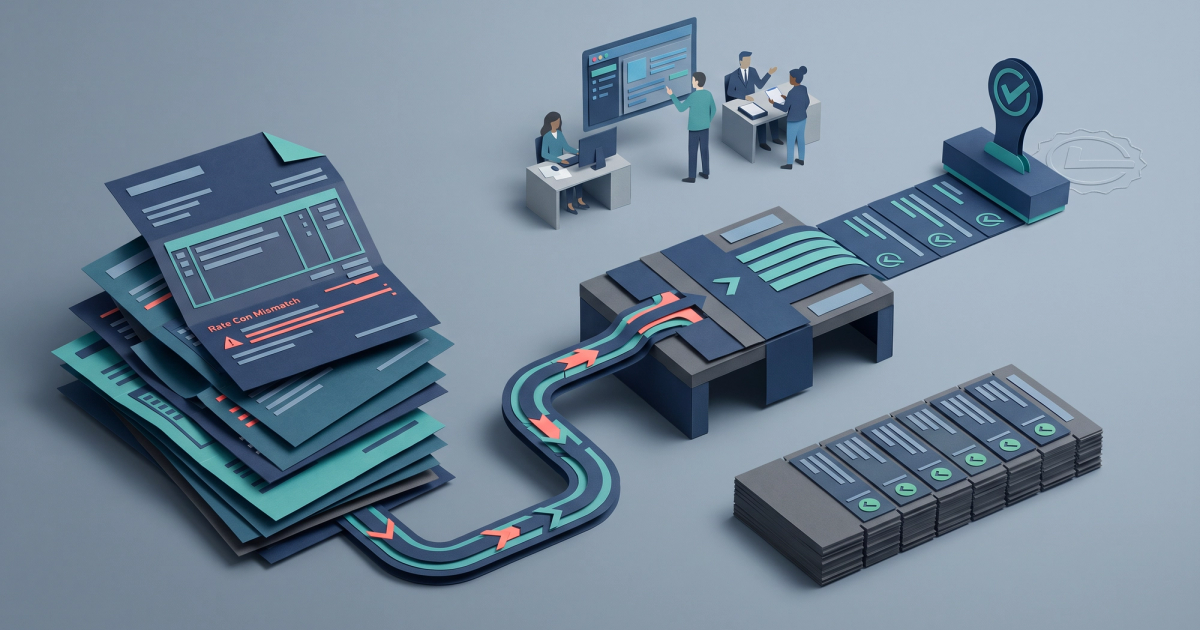
Carrier billing dispute automation cross-references every carrier invoice against contracted rates, flags discrepancies in real time, and submits documented disputes automatically. No spreadsheet hunting. No email chains. According to Overcharge.ai's industry analysis, 5 to 15% of freight invoices contain billing errors. For a broker moving 300 loads per month at an average freight bill of $1,800, even a conservative 3.8% overbilling rate means roughly $2,052 per month walking out the door. That is $24,624 per year in margin erosion, and most of it is recoverable if you catch it.
This article maps the six most common carrier billing errors to specific automated dispute workflows, shows you which disputes are most winnable, and lays out exactly how to cut your weekly dispute workload from 4 to 6 hours down to under 30 minutes.
What Carrier Billing Dispute Automation Actually Does (In Plain Terms)
Forget the buzzword version. Here is what this looks like operationally.
When a carrier invoice hits your inbox or TMS, an automated system does three things before anyone on your team touches it:
- Matches the invoice line items (linehaul, fuel surcharge, detention, lumper, accessorials) against the corresponding rate con.
- Flags any line where the invoiced amount exceeds the contracted amount by more than a threshold you set (typically $5 to $25, depending on load size).
- Pulls supporting documents (BOL, POD, rate con, carrier packet) into a dispute package and either queues it for your review or sends it directly to the carrier.
That is the full cycle. The system replaces the manual steps of pulling up the invoice, locating the rate con, digging for the BOL and POD, writing the dispute email, and following up. According to DataGrid's analysis of AI-driven freight bill auditing, agentic automation handles this entire chain end-to-end, from document ingestion through dispute submission, without requiring manual data re-entry at each step.
The goal is not to eliminate human judgment. It is to eliminate the 50+ minutes of document assembly that currently surround every 2-minute decision of "yes, this charge is wrong."
The 6 Carrier Billing Errors That Cost Brokers the Most Money
Not all billing errors are created equal. Some show up constantly but cost $15 per instance. Others are rarer but carry $200+ per occurrence. Here are the six error categories ranked by combined frequency and dollar impact for a typical SMB broker.
1. Rate Con Mismatch on Linehaul
The most straightforward error and the most common. The carrier invoices a linehaul of $1,950 when the rate con says $1,850. Sometimes it is a data entry mistake on the carrier's side. Sometimes it is intentional. Either way, you need the rate con in front of you to catch it. Per Avantiico's analysis of carrier invoice overcharges, linehaul discrepancies represent one of the most recoverable error categories because the rate con provides an unambiguous contracted price.
2. Detention Overbilling
Your rate con specifies 2 hours of free time at the shipper or receiver. The carrier invoices 4 hours of detention at $75/hour. That is a $150 overcharge per load. If this happens on 40 loads per month, you are looking at $6,000 in monthly margin loss. Detention disputes require timestamp evidence from the BOL or check-in/check-out records, which is why they slip through when teams are reconciling manually.
3. Fuel Surcharge Percentage Errors
The rate con pegs the fuel surcharge at 24% based on the DOE index. The carrier applies 28%. On a $1,500 linehaul, that 4-point delta costs you $60 per load. Multiply that across a month of loads and the number gets uncomfortable fast. The fix is an automated rule that checks the carrier's applied FSC percentage against the DOE index peg specified in the rate con.
4. Lumper Fee Discrepancies
Carrier invoices a $185 lumper fee. The BOL documents a pre-approved amount of $145. The $40 difference is pure margin leak. These are especially frustrating because each one looks small enough to ignore, but across dozens of loads per month, they compound into thousands. For more on how carriers pad these charges and how to recover the difference, the pattern is well documented.
5. TONU Charges on Delivered Loads
A truck-order-not-used charge on a load where a POD exists is one of the most clear-cut billing errors in freight. Either the delivery happened or it did not. If the POD shows a delivery, the TONU is invalid. Period. This is a binary proof category with one of the highest win rates when disputed.
6. Accessorial Overcharges (Layover, Dry Run, Drayage)
A carrier bills a $300 layover fee on a load that delivered same day per the POD timestamp. An automated cross-reference of POD delivery time against the layover eligibility window kills the charge before it is ever paid. According to WNS research on billing and cash flow in shipping, approximately 20% of invoices across shipping companies are disputed, with some firms assigning dedicated auditors solely to handle billing disputes. The volume of accessorial overcharges is a major driver of that number.
Which Disputes Are Most Winnable, and How to Prioritize Them
Not every dispute is worth the same effort. Here is how to think about prioritization.
Win Rates Depend on Documentation Quality
Disputes submitted with three or more supporting documents (rate con, BOL, POD) resolve in the broker's favor approximately 74% of the time. Disputes submitted without structured documentation win about 41% of the time. That gap is the entire argument for automation: the system does not make you more persuasive, it makes you more thorough, and thoroughness wins disputes.
As covered in billing disputes in freight: 4 documents that win every time, the specific combination of rate con, BOL, POD, and carrier packet creates an evidence package that most carriers will not challenge.
The Prioritization Matrix
Rank your disputes by two factors: dollar amount and proof clarity.
- High dollar, high proof clarity: Linehaul rate con mismatches over $50, TONU on delivered loads, detention with clear timestamp evidence. Dispute these first, always.
- High dollar, low proof clarity: Accessorial charges where the contract language is ambiguous. Worth disputing but expect longer resolution cycles.
- Low dollar, high proof clarity: Lumper fee differences under $25, minor fuel surcharge rounding. Automate these completely with no manual review. The win rate is high and the cost to dispute is near zero with automation.
- Low dollar, low proof clarity: Charges under $15 with no clear contract violation. Track the pattern but do not burn labor on individual disputes.
This matrix is how you turn dispute recovery into a revenue line. You are not chasing every $8 discrepancy. You are systematically recovering the $50 to $300 errors that happen dozens of times per month.
How to Build an Automated Dispute Workflow From Rate Con to Resolution
Here is the step-by-step process, from the moment a carrier invoice arrives to the moment the dispute resolves.
Step 1: Ingest and Parse the Invoice
The carrier invoice enters your system via email, EDI, or TMS upload. The automation engine parses every line item: linehaul, fuel surcharge, detention hours, lumper fees, accessorial charges, and any other billed amount.
Step 2: Match Against the Rate Con
Each parsed line item gets compared to the corresponding field on the rate con. The system checks linehaul against contracted rate, fuel surcharge percentage against the index peg, detention hours against the free time window, lumper fees against pre-approved amounts, and accessorial charges against contract eligibility rules.
Step 3: Flag Variances Above Your Threshold
You set the threshold. Common configurations are $10 for linehaul, any percentage for FSC, $25 for detention, and $0 for TONU (meaning every TONU gets flagged and cross-checked against POD existence). The system flags anything outside these bounds.
Step 4: Auto-Assemble the Dispute Package
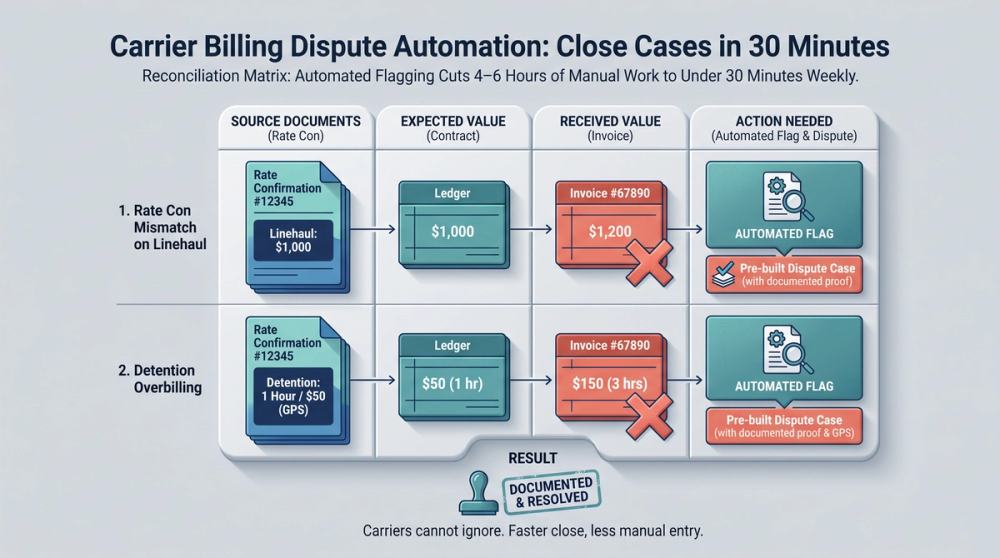
For each flagged variance, the system pulls the rate con, BOL, POD, and any relevant contract clause into a pre-formatted dispute package. It identifies the specific contract term the carrier violated and references it in the dispute. According to SysGenPro's analysis of logistics invoice automation, this document assembly step is where most manual processes break down, because teams waste 20 to 30 minutes per dispute just locating and organizing files.
Step 5: Submit or Queue for Review
Depending on your confidence threshold, the system either sends the dispute directly to the carrier or queues it for a 30-second human review. Most brokers start with human review on everything, then move to auto-submit for high-confidence categories (rate con mismatches, TONU with POD) after a few weeks.
Step 6: Track Resolution and Escalate
The system logs every dispute, tracks carrier response time, and escalates unresolved disputes at intervals you define (typically 48 hours, then 5 business days). This creates a complete audit trail from initial flag to final resolution. For regulatory context on formal dispute and data review processes, the FMCSA's appeals process for requests for data review outlines how federal dispute procedures work at the carrier compliance level.
The Audit Trail Carriers Can't Argue With
A dispute is only as strong as its documentation. Here is what a defensible audit trail needs to include.
The Four-Document Foundation
- Rate confirmation: The contracted price, fuel surcharge terms, free time window, and any accessorial pre-approvals. This is your primary evidence.
- Bill of lading (BOL): Pickup location, date, time, commodity, weight, and any special instructions. This proves what was actually tendered.
- Proof of delivery (POD): Delivery timestamp, receiver signature, and any notes about delays or issues. This is your timestamp evidence for detention and layover disputes.
- Carrier packet or broker-carrier agreement: The master terms that govern the relationship, including dispute resolution procedures, payment terms, and accessorial definitions.
When all four documents align and contradict the carrier's invoice, the dispute is nearly impossible to argue against. This is why automation matters: it does not just speed up the process, it ensures all four documents are included every single time. Manual processes miss documents. Automation does not.
Timestamps Are Everything
For detention, layover, and TONU disputes, timestamps are the deciding evidence. Your audit trail needs to capture:
- Arrival time at facility (from carrier check-in or GPS data)
- Free time start and end (calculated from rate con terms)
- Departure or delivery time (from POD)
- Invoice submission time (for TONU verification against delivery records)
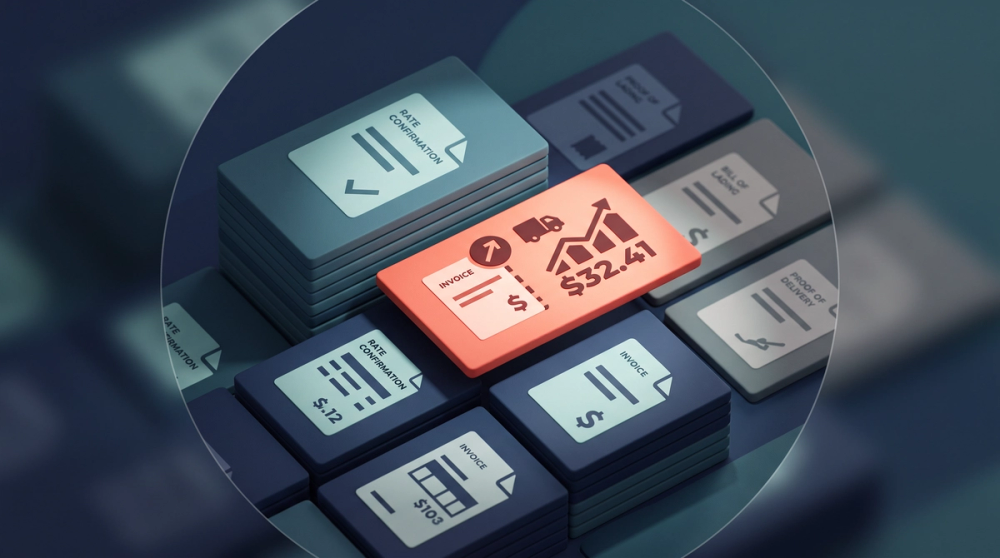
As of 2026-04-01, average hourly earnings in truck transportation were $32.41/hr (BLS). When carriers bill detention at $75/hour, they are billing at more than double the average hourly cost of the driver's time. That premium makes detention one of the most padded charges in the industry, and one of the most recoverable when you have the timestamps to back up your dispute.
Real Numbers: Manual vs. Automated Dispute Resolution
Here is where the time savings become concrete. Let's walk through three scenarios.
Scenario 1: The Manual Dispute Timeline
Your billing coordinator spots a rate con mismatch on a carrier invoice. Here is the clock:
- 18 minutes to pull the invoice and identify the discrepancy
- 12 minutes to locate the rate con in the TMS or email
- 9 minutes to find the BOL and POD
- 14 minutes to write the dispute email with all relevant details
- 8 minutes to follow up when the carrier does not respond within 48 hours
Total: 61 minutes per dispute. At 6 disputes per week, that is 6.1 hours of labor. As of 2026-05-01, truck transportation employs 1,465 thousand workers (BLS). The back-office labor supporting that workforce is already stretched thin, and spending 6+ hours per week on dispute paperwork is labor most SMB brokers cannot afford.
Scenario 2: The Automated Dispute Timeline
The same rate con mismatch hits the system:
- System flags the mismatch within seconds of invoice receipt
- Pre-populates the dispute package with rate con, BOL, POD, and contract clause reference
- Sends the dispute to the carrier within 4 minutes of invoice receipt
- Auto-escalates at 48 hours if unresolved
Total: under 5 minutes per dispute, with most of that being optional human review. At 6 disputes per week, that is under 30 minutes total. You just recovered 5.5 hours of your billing coordinator's week.
Laneproof's reconciliation engine checks each of these fields automatically, flagging variances before payment goes out. The goal is to catch every mismatch at the point of invoice receipt, not two weeks later when the payment has already been processed.
Scenario 3: The Compound Recovery Math
Take the detention example from earlier. Rate con shows 2 hours free time. Carrier invoices 4 hours at $75/hour. That is a $150 overcharge per load.
- 40 affected loads per month × $150 = $6,000/month in detention recovery alone
- Add lumper fee discrepancies: 25 loads × $40 average discrepancy = $1,000/month
- Add fuel surcharge corrections: 30 loads × $60 average delta = $1,800/month
- Total monthly recovery potential: $8,800
At a 74% win rate with full documentation, you are looking at roughly $6,512 in actual monthly recovery. That is $78,144 per year. For a broker running on 12 to 15% margins, that recovery is equivalent to booking 40+ additional loads per month in new revenue.
How This Fits Into Your TMS Without Breaking Your Current Process
The most common objection: "This sounds great, but I don't want to rip out my TMS or retrain my team."
Fair concern. Here is how dispute automation typically integrates.
Integration Points
- Invoice ingestion: The system reads carrier invoices from the same email inbox or EDI feed your team already uses. No new data entry required.
- Rate con lookup: The system pulls rate cons from your TMS via API or from a shared document store. If your rate cons live in email, the system can parse them from forwarded messages.
- BOL and POD matching: Documents are matched by load number, PRO number, or BOL number. If your team already uploads these to the TMS, the system reads them from there. If not, it can ingest them from email or a shared drive.
- Dispute output: Disputes are sent via email to the carrier, with your team CC'd. No new portal for carriers to learn. The carrier sees a professional dispute email with documents attached, same as they would receive from your billing coordinator.
According to ARDEM's analysis of LTL billing automation, automated systems with proper governance can keep billing error rates below 1% on the broker's side, compared to significantly higher manual processing error rates. That means automation is not just catching carrier errors. It is also preventing your own team from making mistakes during data entry that could undermine your position in a dispute.
Protecting Carrier Relationships
Disputing invoices at scale raises a legitimate concern: will carriers stop wanting to work with you?
The short answer is no, as long as your disputes are accurate and documented. Carriers respect brokers who hold them to the rate con because it signals professionalism, not hostility. Problems arise when brokers dispute charges without documentation or delay payments while disputes are pending.
Automated disputes actually improve carrier relationships for two reasons:
- Speed: The carrier gets the dispute within minutes, not weeks. They can resolve it while the load is still fresh in their system.
- Accuracy: Every dispute includes the rate con, BOL, and POD. The carrier sees exactly what the discrepancy is and can verify it immediately. No back-and-forth emails asking for more information.
For deeper coverage of the documentation strategy that makes disputes clean and fast, see how to win carrier disputes fast with a document-first playbook.
Frequently Asked Questions About Carrier Billing Disputes
What is the automation of the billing dispute process in freight?
It is software that reads carrier invoices, matches every line item against the rate con and supporting documents (BOL, POD, carrier packet), flags discrepancies above a threshold you set, and either sends the dispute to the carrier automatically or queues it for a quick human review. The entire process from invoice receipt to dispute submission takes under 5 minutes per case instead of the 45 to 60 minutes it takes manually.
What are valid reasons to dispute a carrier charge?
The most common valid reasons include linehaul rates that exceed the rate con, detention billed beyond the free time window, fuel surcharge percentages that do not match the contracted DOE index peg, lumper fees above pre-approved amounts, TONU charges on loads where a POD proves delivery occurred, and accessorial charges (layover, dry run, drayage) that do not meet the contract's eligibility criteria. In every case, the rate con and supporting documents are your evidence. For a detailed breakdown, see invoice disputes in freight: win them fast with the right docs.
How often do brokers win carrier billing disputes?
Win rates vary significantly based on documentation quality. Disputes submitted with three or more supporting documents (rate con, BOL, POD) resolve in the broker's favor approximately 74% of the time. Disputes submitted without structured documentation win about 41% of the time. The takeaway: the dispute itself matters less than the evidence package behind it.
How do AI tools support freight billing dispute resolution?
AI tools parse unstructured documents (invoices, BOLs, PODs) into structured data, match line items across documents by load number or PRO number, apply contract-specific rules to identify violations, and generate dispute packages with pre-populated evidence. According to DataGrid's coverage of AI-driven freight bill auditing, agentic AI handles the entire audit and dispute workflow without requiring manual data re-entry at each step. The AI does not make judgment calls. It makes document assembly instant.
Will disputing invoices at scale hurt my carrier relationships?
Not if your disputes are accurate and timely. Carriers prefer receiving a documented dispute within 24 hours over receiving a vague pushback email two weeks later. Automated disputes include the rate con, BOL, and POD, so the carrier can verify the discrepancy immediately. Most carriers correct clear errors quickly. The relationship damage comes from undocumented disputes and delayed payments, not from holding carriers to the terms they agreed to.
Stop Leaving Recovery Money on the Table
Carrier billing errors are not occasional glitches. According to Overcharge.ai, 5 to 15% of freight invoices contain billing errors. Per WNS research, roughly 20% of invoices across shipping companies end up in dispute. The money is real, and for most SMB brokers, it is recoverable with the right process.
The playbook is straightforward: match every invoice against the rate con, flag discrepancies automatically, assemble the documentation package without manual labor, and submit disputes within minutes instead of days. The brokers who treat dispute recovery as a revenue line, not a paperwork task, are the ones who hold their margins in a market where every dollar counts.
If you are ready to see how this works on your actual invoices, check out Laneproof's pricing and plans and run your first batch through the system. The math speaks for itself.
Sources
- Overcharge.ai: AI-Powered Freight Audit & Recovery — Overcharge.ai
- How AI Agents Automate Freight Bill Auditing and Dispute Resolution — DataGrid
- How to Catch & Dispute Carrier Invoice Overcharges — Avantiico
- Logistics Invoice Automation for Carrier Billing Dispute Resolution — SysGenPro
- LTL Billing Accuracy & Speed Improved with Agentic AI — ARDEM
- From Dispute to Profit: How Analytics & AI Transform Billing and Cash Flow in Shipping — WNS
- FMCSA Appeal Process: Requests for Data Review — FMCSA via Regulations.gov
- Billing Disputes in Freight: 4 Documents That Win Every Time — Laneproof
Full guide: Billing Disputes in Freight: 4 Documents That Win Every Time
Related: Freight Dispute Resolution Software: What It Catches and What It Misses