Freight Overcharges: What Carriers Pad Most and How to Get Your Money Back
Researched and written with AI assistance. Reviewed by the Laneproof team.

A carrier invoices you $2,110 on a load where the rate con says $1,850. That $260 gap is the single most common freight overcharge trigger brokers deal with, and if you're running 500 loads a month without auditing every invoice, you're leaving thousands on the table. According to Nuvo Cargo's analysis of mid-market shipping data, 3 to 8% of freight invoices contain overcharges from billing errors, duplicate charges, and unauthorized accessorials. Per Hyland's research on freight billing processes, when those overcharges do appear, they average 8 to 10% above the correct billed amount, representing roughly 3% of total freight spend. This article names the exact line items carriers pad most, puts dollar benchmarks on what you can realistically recover per 100 loads, and gives you the dispute workflow that actually gets money back before the federal clock runs out.
What Is a Freight Overcharge, and Why Your TMS Probably Isn't Catching It
A freight overcharge is any amount on a carrier invoice that exceeds what was agreed to on the rate confirmation, contract, or tariff. That includes linehaul variances, unauthorized accessorials, inflated detention hours, misapplied fuel surcharge percentages, and duplicate charges. The federal government defines and regulates the handling of these claims under 49 CFR Part 378, which establishes the procedures carriers must follow when processing overcharge claims from shippers and brokers.
Most brokers assume their TMS catches these. It doesn't. A TMS is built to manage loads, not to audit invoices. It stores the rate con amount, and it may flag an invoice that doesn't match, but it rarely digs into line-item detail. It won't compare the fuel surcharge percentage on the invoice against the percentage specified on the rate con. It won't cross-reference detention hours against BOL timestamps or gate logs. It won't catch a carrier stacking two accessorials that weren't authorized.
Where Overbilling Hides in Plain Sight
The most expensive overbilling doesn't show up as a big, obvious rate con mismatch. It shows up as small, defensible-looking line items: an extra hour of detention, a fuel surcharge calculated against the wrong base, a lumper fee without a receipt. These charges look normal individually. Across 100 or 500 loads a month, they compound into real margin erosion. The problem isn't that your team can't spot a bad invoice. The problem is that manual review doesn't scale, and the invoices that look "close enough" are the ones that cost you the most. Per Trimble's freight audit analysis, billing inaccuracies are so widespread that freight audit has become a distinct discipline, not just because errors are common, but because they're systematically difficult to detect without line-item comparison tools.
The Line Items Carriers Pad Most Often (and What Each One Costs You)
Not all carrier invoice errors are created equal. Some line items get padded far more often than others, and knowing where to look first saves your team hours of reconciliation time. Here are the five highest-risk categories, ranked by frequency and dollar impact.
1. Detention Charges
Detention is the most disputed accessorial in freight, and for good reason. Carriers routinely invoice detention hours that exceed what actually happened at the facility. The math is simple but the proof takes work.
Example: A carrier invoices 4 hours of detention at $75 per hour, totaling $300. But the BOL and facility gate log show the truck checked out in 1.5 hours. The recoverable amount is $187.50 per load. If this pattern holds across 100 loads, that's $18,750 in recoverable overcharges. The fix? Cross-reference every detention invoice against proof of delivery timestamps and gate logs. Carriers know most brokers don't bother.
2. Fuel Surcharge Miscalculations
Fuel surcharges are the most common accessorial published by shippers. According to a study covered by TruckingInfo, 93% of companies include a fuel surcharge in their published accessorial schedules. That ubiquity creates a massive surface area for billing errors, because the percentage applied, the base it's calculated against, and the index date used can all vary between what the rate con specifies and what the carrier actually invoices.
Example: Your rate con specifies a 22% fuel surcharge on linehaul. The carrier applies 28%. On a $2,400 linehaul, that's the difference between $528 and $672. The overcharge is $144 per load. Across 100 loads, that's $14,400. Most brokers don't catch this because the total invoice amount looks "in the ballpark." The surcharge percentage is buried in the line-item detail. For a deeper breakdown of how to catch these, read our guide on fuel surcharge disputes and how to spot overcharges before you pay.
3. Unauthorized Accessorials (Stacking)
Accessorial stacking is when a carrier adds multiple fees that weren't on the rate con, often combining charges that contradict each other or don't apply to the actual delivery circumstances.
Example: A carrier invoices a $75 liftgate fee and a $125 residential delivery fee on a load delivered to a commercial dock. Neither charge was authorized on the rate con, and the delivery location doesn't qualify as residential. That's $200 per disputed load, fully recoverable with the rate con and a photo or confirmation of the delivery location. This is one of the clearest cases where having the right documents ready wins the dispute outright.
4. TONU and Dry Run Charges
A Truck Order Not Used (TONU) fee is legitimate when a carrier dispatches a truck and the load cancels. But some carriers invoice TONUs on loads where the truck never showed up, or arrived hours after the pickup window closed.
Example: A carrier invoices a $450 TONU. Your dispatcher pulls timestamped driver tracking from the load board or ELD data showing the truck never arrived at the shipper's facility. The full $450 is recoverable. GPS evidence is the fastest way to kill a fraudulent TONU claim. Without it, the dispute becomes a he-said-she-said that usually goes nowhere.
5. Lumper Fees Without Documentation
Lumper fees are pass-through costs, but the rate con or load agreement usually requires pre-authorization and a receipt. Carriers that skip both steps and invoice a flat lumper charge are betting you won't push back.
Example: A carrier passes through a $350 lumper receipt, but the load agreement required pre-authorization and no receipt was submitted with the invoice. The dispute holds until the carrier produces proper documentation. In many cases, they can't, and the charge gets removed entirely. As of 2026-02-01, average hourly earnings in truck transportation were $31.94 per hour (BLS), which means a $350 lumper fee represents almost 11 hours of driver labor. If the receipt doesn't match, push back.
How Much Can You Actually Recover? Dollar Benchmarks Per 100 Loads
Most content about freight overcharges tells you to "audit your invoices" without telling you what the payoff actually looks like. Here are realistic recovery benchmarks based on industry freight audit data.
Per STB Freight's audit and payment analysis, shippers who audit every invoice recover between $4.20 and $6.80 per load on average. That sounds small per load. It isn't small at volume.
Monthly Recovery Math
- At 100 loads per month: $420 to $680 in monthly recoveries
- At 500 loads per month: $2,100 to $3,400 in monthly recoveries
- At 1,000 loads per month: $4,200 to $6,800 in monthly recoveries
These are averages. Brokers who focus on the high-risk line items listed above (detention, fuel surcharge, unauthorized accessorials) typically recover more because those categories carry the highest per-load dollar amounts.
Pre-Audit vs. Post-Audit Recovery Rates
Here's the number that should change how you think about invoice timing. According to STB Freight, overcharge recovery rates on post-audit claims (meaning you find the error after you've already paid) typically run 60 to 80%. That means for every $1,000 in identified overcharges, you're recovering $600 to $800, and writing off the rest because the carrier won't cooperate, the documentation is incomplete, or the dispute window has closed.
Pre-audit recovery, where you catch the error before payment, is nearly 100%. The carrier either corrects the invoice or doesn't get paid. That gap between 60 to 80% and nearly 100% is the entire argument for auditing invoices before they hit accounts payable, not after.
Catching a freight overcharge before payment recovers nearly 100% of the amount. After payment, recovery drops to 60-80%. The difference is timing, not effort.
The Real Cost of Specific Overcharge Patterns
To put the high-risk categories in perspective, here's what each pattern costs across 100 loads if left unaudited:
- Detention padding (2.5 extra hours at $75/hr): $187.50 per load, $18,750 per 100 loads
- Fuel surcharge inflation (6% overage on $2,400 linehaul): $144 per load, $14,400 per 100 loads
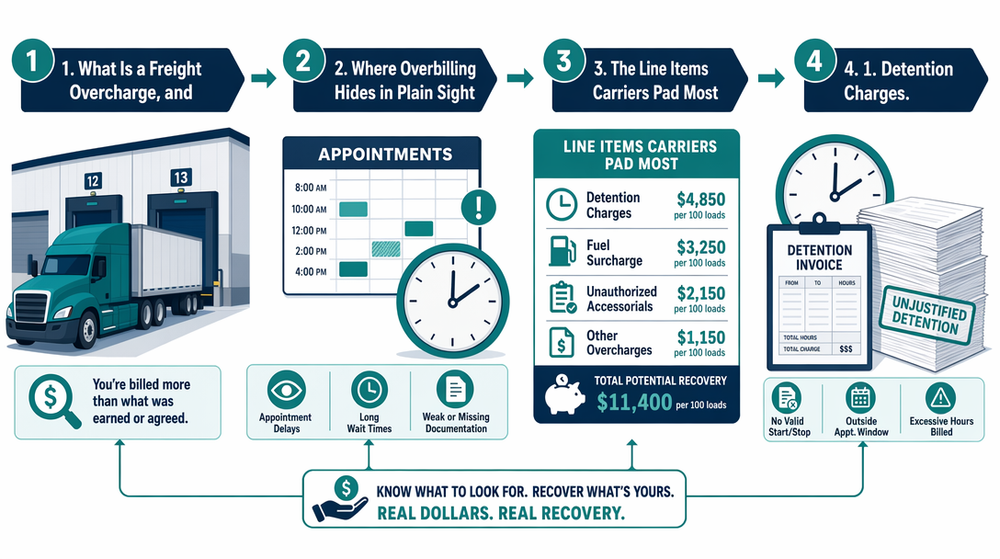
- Unauthorized accessorial stacking: $200 per load, $20,000 per 100 loads
- Fraudulent TONU: $450 per incident, fully recoverable with GPS evidence
Not every load will have an overcharge. But even if only 5% of your loads carry one of these errors, the annual recovery potential on 500 loads per month is significant.
The Step-by-Step Dispute Workflow: From Rate Con Mismatch to Recovered Funds
Most brokers know they should dispute bad invoices. Few have a documented workflow that their billing coordinator can follow consistently. Here's one that works, built around the documents and timelines that actually hold up.
Step 1: Compare Invoice Against Rate Con, Line by Line
Pull the rate confirmation and the carrier invoice side by side. Don't just compare totals. Check every line item: linehaul, fuel surcharge percentage and base, detention hours and rate, every accessorial. A rate con mismatch is the most common dispute trigger. In our rate con mismatch scenario, the rate con shows $1,850 all-in but the carrier invoiced $2,110. That $260 gap takes an average of 14 minutes to resolve when you have documentation ready, versus 2.3 hours when you don't.
Step 2: Gather Supporting Documents
For each disputed line item, you need the document that proves the correct amount:
- Detention: BOL with timestamps, facility gate log, driver check-in/check-out records
- Fuel surcharge: Rate con specifying the agreed percentage, DOE fuel index for the relevant week
- Accessorials: Rate con showing no authorization for the charged service, plus delivery confirmation showing the service wasn't needed (e.g., commercial dock delivery for a "residential" fee)
- TONU: GPS or ELD tracking data with timestamps, load board communications
- Lumper: Load agreement requiring pre-authorization, absence of receipt
The carrier disputes playbook covers each document type in detail, including what holds up in escalated disputes and what doesn't.
Step 3: Submit the Dispute in Writing
Email the carrier's billing department (not the driver, not dispatch) with a clear subject line: "Invoice Dispute — [Load Number] — [Dollar Amount]." Attach the rate con, the carrier invoice, and the supporting document for each disputed line item. State the correct amount and reference the specific line items. Under 49 CFR Part 378, carriers have specific obligations to acknowledge and process overcharge claims. Putting it in writing creates a paper trail and starts the clock on their response.
Step 4: Track the Dispute and Escalate on a Schedule
Set a follow-up cadence. If no response in 7 business days, escalate to the carrier's accounts receivable manager. If no resolution in 30 days, note the date for statute of limitations purposes and consider whether the amount justifies formal action. Document every communication. The brokers who recover the most are the ones who follow up consistently, not the ones who send a single email and hope for the best.
Step 5: Offset or Deduct (If Your Agreement Allows It)
Many broker-carrier agreements include an offset provision that allows the broker to deduct disputed amounts from future payments. If your carrier packet includes this language, use it. If it doesn't, add it to your standard agreement going forward. Deducting a disputed amount is the fastest way to resolve a billing dispute, because it reverses the burden. Now the carrier has to prove the charge was valid, rather than you having to chase a refund.
The 18-Month Clock Nobody Tells You About (49 USC 14705)
There is a hard federal deadline for recovering freight overcharges, and most brokers don't know about it until it's too late. Under 49 USC 14705, a shipper or broker must begin a civil action to recover overcharges within 18 months after the claim accrues. That means 18 months from the date the carrier billed you, not from the date you discovered the error.
This deadline is also summarized in the JDSupra overview of trucking rate and collection rules, which notes that the 18-month limitation period governs both shipper claims for overcharges and carrier claims for undercharges.
What Delayed Auditing Actually Costs You
Scenario: A broker identifies a pattern of fuel surcharge overbilling going back 22 months. Twenty loads are affected, each overcharged by $144. The total recoverable amount should be $2,880. But the claims older than 18 months are barred under 49 USC 14705. Depending on when the pattern started, a significant portion of that $2,880 is simply gone. Not because the broker couldn't prove the overcharge, but because they found it too late.
This is why reactive auditing (reviewing invoices only when something looks off) is so expensive. By the time you spot a pattern, the oldest claims in that pattern are often already past the filing deadline. Per Pando.ai's analysis of the payment recovery crisis, the systemic failure to recover identified overcharges is driven partly by the limitations of manual dispute processes, and partly by the reality that most overcharges simply aren't identified within the recoverable window.
How to Protect Your Filing Window
- Audit every carrier invoice within 30 days of receipt, not just the ones that look wrong
- Log every disputed amount with the invoice date (not the dispute date) to track statute exposure
- Escalate unresolved disputes at the 12-month mark, giving yourself 6 months of runway before the deadline
- Include a clause in your carrier agreement requiring carriers to respond to disputes within 30 days or forfeit the disputed amount
How to Stop Overcharges Before They Hit Your Invoice
Recovering overcharges is good. Preventing them is better. Pre-audit processes catch errors at nearly 100% recovery, compared to 60 to 80% post-audit, per STB Freight. Here's how to shift your operation from reactive recovery to proactive prevention.
Tighten Your Rate Con Language
The rate confirmation is your first line of defense against freight billing disputes. Every rate con should specify:
- All-in linehaul rate or, if accessorials are possible, the exact list of authorized charges with dollar caps
- Fuel surcharge percentage and the index it's based on (DOE national average, regional, etc.)
- Detention terms: free time window, hourly rate, and maximum billable hours
- Lumper fee policy: pre-authorization required, receipt required, maximum reimbursable amount
- TONU terms: conditions under which a TONU applies, required evidence (GPS, timestamp), and dollar cap
If the rate con is vague, the carrier has room to interpret. If the rate con is specific, the carrier has to match it or explain the difference.
Automate Line-Item Matching
Manual invoice reconciliation is the bottleneck. Your billing coordinator is comparing PDFs to rate cons, checking math, and flagging variances one load at a time. At 500 loads a month, that's not sustainable. As of 2026-03-01, the truck transportation industry employs 1,464 thousand workers (BLS), and a meaningful chunk of back-office labor is spent on exactly this kind of document comparison. Automated matching tools that compare invoice line items against rate con terms can flag discrepancies the moment a carrier invoice is uploaded. The $260 rate con mismatch that takes 2.3 hours to resolve manually takes 14 minutes with documentation already matched and highlighted.
Build a Carrier Scorecard for Billing Accuracy
Track which carriers send clean invoices and which ones don't. After 90 days, you'll have a clear picture of which carriers consistently pad detention, misapply fuel surcharges, or add unauthorized accessorials. Use that data to:
- Prioritize audit effort on high-error carriers
- Have a data-backed conversation with carriers about billing accuracy
- Make lane award decisions that account for the true cost of doing business with a carrier, including the hidden cost of disputing their invoices every week
Frequently Asked Questions About Freight Overcharges
What is overage in freight?
An overage in freight refers to any amount billed above what was agreed upon in the rate confirmation, contract, or tariff. This includes linehaul variances, inflated accessorial charges, fuel surcharge miscalculations, and unauthorized fees. According to Hyland's analysis, overcharges average 8 to 10% above the correct amount when they do occur, and represent roughly 3% of total freight spend across the industry.
How long do I have to dispute a freight overcharge?
Under 49 USC 14705, you have 18 months from the date the claim accrues to begin a civil action to recover a freight overcharge. That clock starts from the invoice date, not the date you discover the error. Practically, this means any invoice older than 18 months is beyond your legal recovery window, which is why auditing invoices within 30 days of receipt is critical.
Why are freight charges so high right now?
Freight charges reflect a combination of fuel costs, driver wages, equipment costs, insurance, and market demand. As of 2026-02-01, average hourly earnings in truck transportation are $31.94 per hour (BLS), which feeds directly into carrier operating costs. But "high" charges and overcharges are different problems. Your freight rate may be market-appropriate while your invoices still contain billing errors. The key question isn't whether the rate is high but whether the invoice matches what you agreed to.
How do I reduce freight charges without sacrificing service?
The fastest way to reduce effective freight costs is to stop paying for charges you didn't agree to. Auditing every invoice for rate con mismatches, unauthorized accessorials, and fuel surcharge errors can recover $4.20 to $6.80 per load on average, per STB Freight audit benchmarks. Beyond auditing, tighten your rate con language, negotiate all-in rates where possible, and track carrier billing accuracy to direct volume toward carriers with clean invoicing practices.
What documents do I need to win a freight billing dispute?
At minimum, you need the rate confirmation (showing what was agreed), the carrier invoice (showing what was billed), and the supporting document specific to the disputed charge: BOL timestamps for detention, DOE index data for fuel surcharges, delivery confirmation for accessorials, GPS data for TONUs. The more specific your documentation, the faster the resolution. We cover this in detail in our guide on documents that win billing disputes every time.
Sources
- 49 CFR Part 378: Procedures Governing the Processing of Overcharge Claims — Electronic Code of Federal Regulations
- Freight Audit Insights: The Truth About Freight Spend — Trimble Transportation
- Study Identifies Trends in Freight Charges for Shippers — TruckingInfo
- The Payment Recovery Crisis: Why Freight Overcharges Are Never Recovered — Pando.ai
- 49 USC 14705: Limitation on Actions by and Against Carriers — United States Code
- The Fragile State of Freight Billing Processes and Audits — Hyland
- Trucking Rate, Payment, and Collection Rules of the Road — JDSupra
- Freight Audit: Recover Overcharges and Prevent Billing Errors — STB Freight
- How to Reduce Freight Costs for Mid-Market Shippers — Nuvo Cargo
Stop Paying for Charges You Didn't Agree To
Freight overcharges aren't a mystery. They show up in the same line items, on the same types of loads, from the same carriers. Detention padding, fuel surcharge inflation, unauthorized accessorials, and undocumented lumper fees account for the majority of recoverable dollars. The brokers who recover the most aren't doing anything exotic. They're comparing every invoice against the rate con, line by line, and they're doing it before they pay, not after.
The 18-month filing deadline under 49 USC 14705 means every month you delay auditing is a month of claims that moves closer to being unrecoverable. Start with the high-risk categories covered in this guide. Document every dispute. Track carrier billing accuracy over time. If your team processes more than 50 invoices a week, automated tools that flag invoice discrepancies against rate con terms can catch the variances covered in this guide in seconds instead of hours, and make sure nothing slips past the deadline.