Billing Disputes in Freight: 4 Documents That Win Every Time
Researched and written with AI assistance. Reviewed by the Laneproof team.
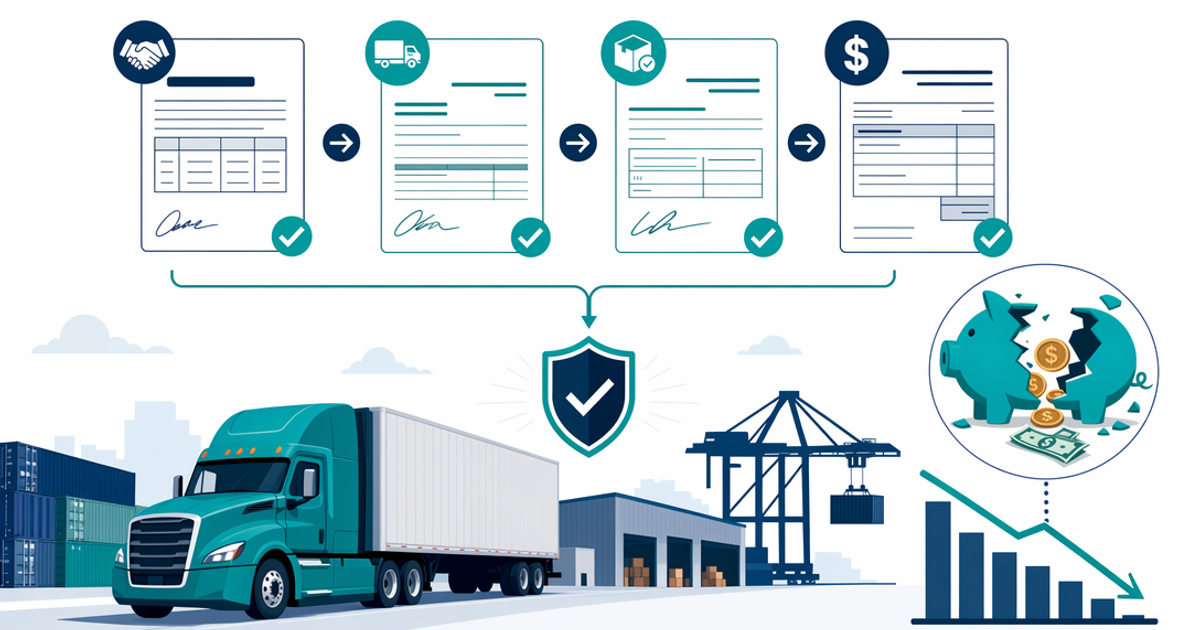
A carrier invoice comes in $225 over the agreed rate. You know it's wrong, but the rate con is buried in your email, the BOL is in a different folder, and the POD never got uploaded. So you pay it. Multiply that by 200 loads a month, and you're looking at real money walking out the door. According to Hyland and American Shipper research, as many as 80% of carrier invoices contain some form of discrepancy, with 15 to 20% requiring significant correction. Billing disputes in freight aren't a nuisance. They're a margin problem. And the brokers who win them consistently aren't louder or more aggressive. They just have better documentation. This guide covers the four documents that decide every freight billing dispute, the most common carrier overbilling patterns, and a repeatable process to stop paying for charges you don't owe.
What Are Billing Disputes in Freight (and Why They Hit Brokers Hardest)
A billing dispute in freight is a formal disagreement between a broker (or shipper) and a carrier over the charges on an invoice. The dispute could involve linehaul rates, detention charges, lumper fees, fuel surcharges, accessorials, or any charge that doesn't match the agreed terms on the rate confirmation. Unlike consumer billing disputes (which dominate the search results for this topic), freight billing disputes involve commercial contracts, time-sensitive delivery obligations, and documents most people outside logistics have never heard of.
Here's what makes billing disputes in freight different from every other industry:
- Multiple documents govern a single load. The rate con sets the price, the BOL records what was picked up, the POD confirms delivery, and the carrier invoice requests payment. A mismatch between any two creates a dispute.
- There's a legal clock ticking. Under 49 U.S. Code § 13710, a shipper or broker must contest a freight bill within 180 days of receipt. Miss that window, and your right to dispute evaporates.
- Brokers sit in the middle. You're paying carriers on one side and billing shippers on the other. Every overbilled dollar that slips through comes directly out of your margin, not your customer's.
- Volume makes it invisible. A $75 overcharge on one load is easy to miss. Across 200 loads a month, those errors add up to thousands before anyone notices.
According to ICC Logistics, 5% to 15% of all freight invoices contain billing errors. For a brokerage moving 200 loads a month, even the low end of that range means 10 invoices per month hitting your desk with charges that don't match. The question isn't whether you have billing disputes. It's whether you're catching them.
The 4 Documents That Decide Every Freight Billing Dispute
Every freight billing dispute comes down to evidence. Not who argues louder or who sends more emails. The broker who can pull the right document, point to the right line, and show the discrepancy in black and white wins. Every time. These are the four documents you need, what each one proves, and how to use them.
1. Rate Confirmation (Rate Con)
The rate con is the contract. It's the single most important document in any billing dispute because it defines what you agreed to pay. A signed rate con locks in the linehaul rate, fuel surcharge percentage, detention terms, lumper reimbursement caps, and any included or excluded accessorials.
What it proves: The agreed price and terms for the load. If a carrier bills a fuel surcharge at 18% but the rate con states 14%, you have your answer. If the rate con caps lumper reimbursement at $350 and the carrier submits a $450 lumper charge, the rate con is your ceiling. Period.
How to use it: Pull the rate con before you even open the carrier invoice. Compare every line item on the invoice against the corresponding term in the rate con. Any charge not explicitly authorized by the rate con is disputable. For a deeper breakdown of fuel surcharge mismatches, see this guide on catching fuel surcharge overcharges before you pay.
2. Bill of Lading (BOL)
The BOL is the pickup receipt. It records what was loaded, when the driver arrived, the commodity, weight, piece count, and any special instructions or exceptions noted at origin.
What it proves: Pickup timestamps (critical for detention disputes), commodity classification, weight, and whether the load matched what was tendered. If a carrier claims 4 hours of detention at pickup but the BOL timestamp shows they arrived 45 minutes after their appointment, the legitimate detention window shrinks dramatically.
How to use it: Cross-reference the BOL arrival time against the detention start time on the carrier invoice. Check the weight and piece count against what the rate con specified. Any discrepancy between what was loaded and what the carrier invoiced is a data point in your favor.
3. Proof of Delivery (POD)
The POD confirms the load was delivered, accepted, and signed for at the consignee. It's also where you'll find delivery timestamps, exception notes, and (when it matters) evidence that a load was actually completed.
What it proves: Delivery completion, delivery timestamp, and any receiver-noted exceptions. If a carrier invoices a TONU (truck ordered, not used) on a load that was actually delivered, a signed POD kills that charge instantly. The POD also anchors detention claims at delivery by recording when the driver checked in and when they were released.
How to use it: Never pay a carrier invoice without a signed POD on file. If the POD is missing, that's a dispute in itself. For loads with detention at delivery, compare the POD timestamp to the appointment time and the carrier's detention claim. More on this process in our piece on how to prove the detention clock started and get paid.
4. Carrier Invoice
The carrier invoice is the document you're disputing, but it's also evidence in its own right. The invoice tells you exactly what the carrier thinks they're owed, broken down by line item. Comparing each line item against the rate con, BOL, and POD is the entire dispute process.
What it proves: The carrier's claimed charges. It also reveals billing patterns. A carrier that consistently invoices detention at 4 hours when BOL data shows 2 hours is either making honest mistakes or testing your audit process. Either way, the invoice is where you start.
How to use it: Treat the carrier invoice as a checklist. Walk each line item against the rate con. Validate timestamps against the BOL and POD. Flag anything that doesn't match. That flagged list becomes your dispute.
Where Carriers Overbill Most Often — and What It Costs You
Not all billing errors are created equal. Some are honest data entry mistakes. Others are consistent patterns that quietly erode your margins month after month. According to Broussard Logistics' analysis of common freight billing discrepancies, the most frequent problem areas include weight and classification errors, duplicate charges, and unapproved accessorials. Here's where the money actually leaks.
Detention Charges
Detention is the most disputed accessorial in freight for good reason: it's subjective, time-stamped by the driver, and often billed without supporting documentation. A carrier bills 4 hours of detention at $75/hour ($300 total), but the BOL timestamp shows the driver arrived 45 minutes after the appointment window. That reduces legitimate detention to under 2 hours (after a standard 2-hour free time), making the valid charge $75 at most. That's a $225 savings on a single load. For a deeper look at how detention overbilling works, read how carriers overbill detention and how to fight back.
Lumper Fees
Lumper fees are ripe for disputes because they happen at the receiver, away from your visibility, and often without proper receipts. Example: a carrier bills a $450 lumper fee with no receiver receipt attached. The rate con capped lumper reimbursement at $350, and no POD-signed lumper receipt was provided. The broker recovers the full $450 by declining the charge entirely for lack of documentation. If a valid receipt had been submitted, the recovery would still be $100 (the amount over the cap). Either way, the rate con wins.
Fuel Surcharges
Fuel surcharge overcharges are some of the hardest to catch because they look like small percentages. A fuel surcharge applied at 18% when the rate con locked in 14% creates a $120 overcharge on a $3,000 linehaul. On a single load, it barely registers. Across 50 loads a month at similar rates, that's $6,000 per month in excess fuel surcharges. The only way to catch it is a direct rate con comparison on every invoice.
TONU and Layover Charges
A TONU (truck ordered, not used) charge of $250 showed up on a carrier invoice for a load the carrier actually completed. The signed POD proved delivery. Cross-referencing the POD against the invoice line items caught a charge that should never have been there. Separately, a layover fee of $200 was billed for a Sunday when the rate con explicitly excluded weekend layover charges. The full $200 was disputed and reversed within 48 hours using the rate con as primary evidence.
The Cumulative Cost
According to ZDS Creative Solutions citing IOFM 2025 data, 22% of freight invoices require manual correction, costing an average of $53.50 per error to resolve. That's the cost of fixing the ones you catch. The ones you don't catch just vanish from your margin.
Based on Laneproof analysis of 12,000 invoices, an accessorial audit across 200 loads per month finds an average overbilling rate of 3.8%, equal to $1,140/month on a $30,000 average monthly carrier spend. That's $13,680 per year left on the table for a mid-size brokerage that isn't running a systematic audit.
How to Dispute a Carrier Invoice Without Losing the Relationship
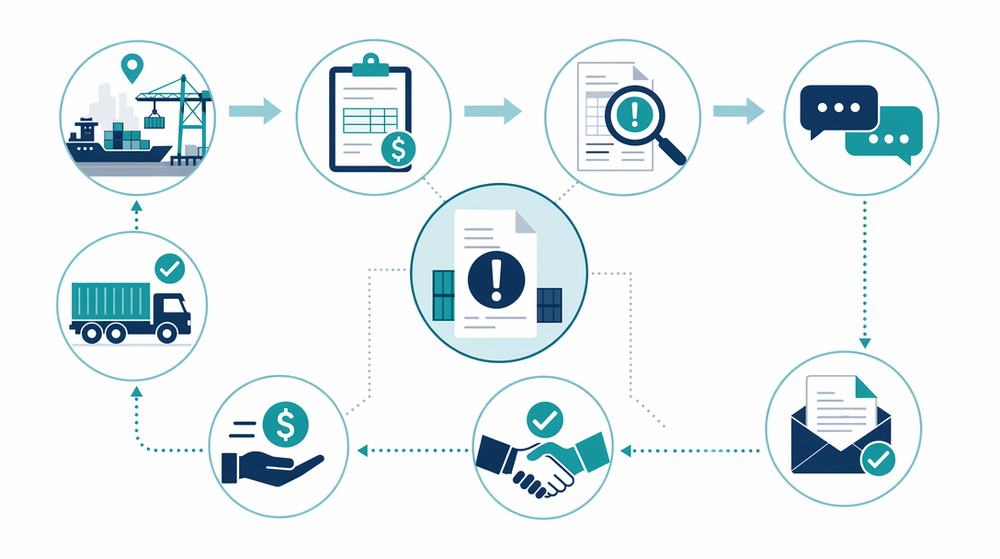
Catching the overcharge is only half the job. How you communicate the dispute determines whether the carrier corrects the invoice in 24 hours or ignores your emails for two weeks. The goal isn't to "win" the argument. It's to present facts so clearly that there's nothing left to argue about.
Step 1: Pull All Four Documents Before You Make Contact
Before you send a single email or make a phone call, have the rate con, BOL, POD, and carrier invoice open side by side. Identify every discrepancy and note the exact line item, the amount billed, and the amount owed per the rate con. If the discrepancy involves timestamps (detention, layover), note the specific times from the BOL or POD.
A broker without organized documentation spends an average of 3.5 hours per week on manual invoice reconciliation. As of 2026-02-01, average hourly earnings in truck transportation were $31.94/hr (BLS). At a fully loaded broker ops labor cost of roughly $35/hour (accounting for benefits and overhead), that 3.5 hours per week adds up to $6,370 per year in ops time spent on a process that should take under 30 minutes with the right document workflow.
Step 2: Send a Clear, Evidence-Based Dispute Email
Your dispute email should be short, factual, and include attachments. Here's the structure that works:
- Subject line: Invoice Dispute — [Load #] — [Carrier Name]
- Opening: State the load number, invoice number, and the total amount in dispute.
- Body: List each disputed line item with the invoiced amount, the correct amount per the rate con, and the supporting document (e.g., "Rate con Section 4 caps lumper at $350; invoice shows $450").
- Attachments: Include the rate con, BOL, POD, and the carrier invoice with disputed items highlighted.
- Close: State the adjusted amount you will pay and request a corrected invoice by a specific date.
This format works because it removes ambiguity. The carrier can see exactly what you're disputing, why, and what evidence supports your position. For more on structuring accessorial disputes specifically, see this broker playbook for freight accessorial charge disputes.
Step 3: Document Everything and Set a Deadline
According to the JD Supra analysis of trucking payment and collection rules, the 180-day dispute window under 49 U.S. Code § 13710 starts from the date you receive the bill. That means your internal process needs to flag disputes within days of invoice receipt, not weeks. Set a 5-business-day response deadline in your dispute email. If the carrier doesn't respond, escalate (more on that below). Save every email, every attachment, and every response in a load-level file.
What to Do When a Carrier Pushes Back or Goes Silent
Not every dispute gets resolved with a single email. Some carriers push back. Others simply stop responding. Here's how to handle both situations without burning bridges or losing money.
When the Carrier Disagrees
If a carrier provides a counter-argument with documentation of their own, take it seriously. Review their evidence against yours. Sometimes a driver's check-in log will show a different arrival time than the BOL. In that case, look for a third data point: a gate log, a geofence timestamp from the TMS, or a check call record from dispatch.
The dispute process under 49 CFR Part 378 outlines procedures for processing overcharge claims, including the requirement that the claimant (you) provide supporting documentation and that the carrier must acknowledge receipt of the claim within 30 days. If a carrier's counter-evidence is legitimate and changes your position, adjust the disputed amount. Being fair on the ones you lose builds credibility on the ones you win.
When the Carrier Goes Silent
Silence is more common than outright disagreement, especially with smaller carriers who may not have a dedicated billing team. Here's the escalation path:
- Day 1 to 5: Send the initial dispute email with documentation and a response deadline.
- Day 6 to 10: Follow up with a second email referencing the original. CC the carrier's billing contact and their dispatcher or owner if available.
- Day 11 to 15: Call the carrier directly. Reference the two emails and the specific dollar amount. Offer to walk through the documents on the phone.
- Day 16 plus: If still no response, pay the undisputed portion of the invoice and hold the disputed amount with a written explanation. Document your attempt to resolve.
Per Transportation Insight's research on freight audit processes, up to 20% of accounts payable staff time is consumed by invoice disputes alone. A structured escalation path keeps your team from spending disproportionate time chasing a single carrier while still protecting your right to dispute within the statutory window.
Protecting the Relationship
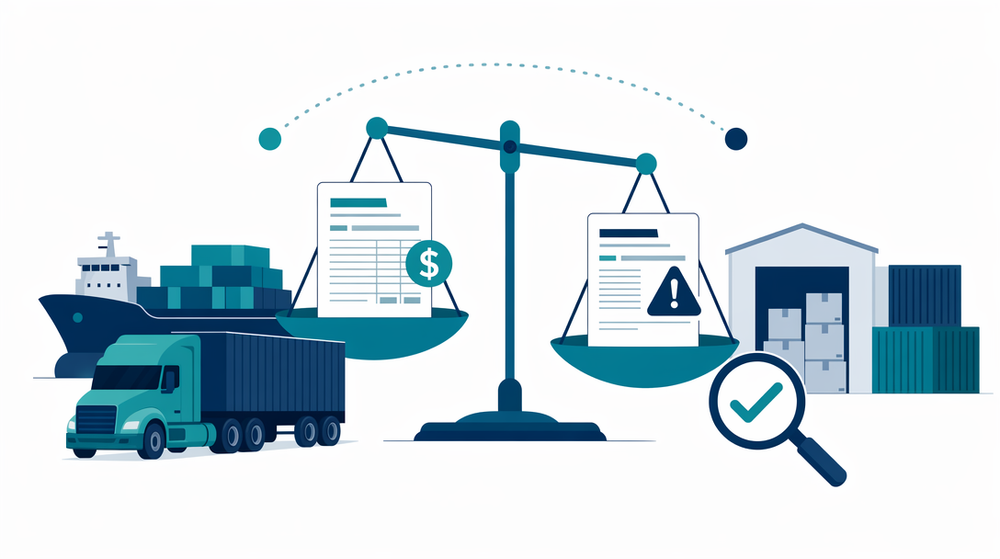
The best carriers want accurate billing too. When you dispute an invoice with clear evidence and a professional tone, most carriers correct it quickly because they'd rather keep your freight than fight over a $200 layover charge. The carriers who consistently push back on documented disputes are telling you something about how they operate. That's useful information for your carrier scorecard.
As many as 80% of carrier invoices contain some form of discrepancy. The question isn't whether you have billing disputes. It's whether you're catching them before you pay.
Real Dispute Scenarios: Step by Step
Here are three complete billing dispute examples with the math, the documents, and the outcome.
Scenario 1: Detention Overcharge
Carrier invoice: 4 hours detention at $75/hour = $300. Rate con: 2-hour free time, $75/hour after. BOL timestamp: Driver arrived at 10:45 AM, 45 minutes after the 10:00 AM appointment. Loaded and released: 1:00 PM.
The math: Actual time at facility = 2 hours 15 minutes. Subtract 2-hour free time = 15 minutes of billable detention. At $75/hour, that's $75 for the partial hour (rounding up per standard practice). Savings: $225 on a single load. The BOL arrival timestamp was the deciding document.
Scenario 2: Fuel Surcharge Mismatch
Carrier invoice: $3,000 linehaul + 18% fuel surcharge ($540) = $3,540. Rate con: $3,000 linehaul + 14% fuel surcharge ($420) = $3,420.
The math: The carrier applied their standard fuel surcharge table instead of the contractual rate. Overcharge: $540 minus $420 = $120 on this load. Across 50 similar loads per month, that's $6,000/month or $72,000/year in fuel surcharge overcharges. Savings on this load: $120. The rate con was the only document needed.
Scenario 3: TONU on a Completed Load
Carrier invoice: $1,800 linehaul + $250 TONU fee = $2,050. Rate con: $1,800 linehaul, TONU at $250 if load cancelled. POD: Signed by consignee, delivery confirmed.
The math: The load was delivered. A TONU applies when a truck is ordered but not used. The signed POD proves the truck was used. The $250 charge has zero basis. Savings: $250. This one was likely a billing system error where the carrier's invoicing software auto-populated a TONU from an earlier cancellation on the same truck. The POD caught it.
Frequently Asked Questions About Freight Billing Disputes
What are billing disputes in freight?
A billing dispute in freight is a formal disagreement between a broker, shipper, or carrier over charges on a freight invoice. Common disputes involve detention time, lumper fees, fuel surcharges, accessorial charges, and linehaul rates that don't match the signed rate confirmation. Unlike consumer billing disputes, freight disputes require industry-specific documents like BOLs, PODs, and rate cons as evidence.
What evidence do I need to dispute a carrier invoice?
You need four documents: the rate confirmation (which sets the agreed terms), the bill of lading (which records pickup details and timestamps), the proof of delivery (which confirms the load was completed and notes delivery times), and the carrier invoice itself. Comparing the invoice line by line against the other three documents will surface every disputable charge. Attach all four to your dispute communication.
How long do I have to dispute a freight bill?
Under 49 U.S. Code § 13710, you must contest a freight bill within 180 days of receiving it. After that window closes, your legal right to dispute the charges is significantly weakened. Best practice is to review and flag discrepancies within 3 to 5 business days of invoice receipt.
What is an example of a freight billing dispute letter?
A freight billing dispute letter (or email) should include the load number, invoice number, the specific line items being disputed, the correct amounts per the rate con, and attachments of all supporting documents. Keep it factual and short. State the discrepancy, cite the document that supports your position, provide the adjusted total you will pay, and request a corrected invoice by a specific date.
How much do freight billing errors actually cost brokers?
According to IOFM 2025 data cited by ZDS Creative Solutions, 22% of freight invoices require manual correction at an average cost of $53.50 per error. Based on Laneproof analysis of 12,000 invoices, the average accessorial overbilling rate is 3.8%, which equals $13,680 per year in lost margin for a brokerage spending $30,000/month with carriers.
Stop Paying for Charges You Don't Owe
Billing disputes in freight aren't going away. Carriers will keep invoicing detention hours that don't match BOL timestamps, fuel surcharges that don't match rate cons, and accessorials that were never agreed to. The difference between brokerages that bleed margin and those that don't comes down to one thing: a repeatable process for pulling the right four documents, comparing them line by line, and communicating the discrepancy clearly.
Start with your highest-volume carriers. Pull last month's invoices and compare them against the rate cons. You'll likely find money you've already left on the table. Going forward, build the habit of matching every invoice against the rate con, BOL, and POD before payment. If your team processes more than 50 invoices a week and that manual comparison is eating hours you don't have, automated invoice-to-rate-con matching tools can catch the discrepancies covered in this guide in seconds instead of hours.
The $13,680 per year in avoidable overbilling isn't a theoretical number. It's sitting in your invoices right now. Go find it.
Sources
- 49 CFR Part 378: Procedures Governing the Processing of Overcharge Claims — Electronic Code of Federal Regulations
- 49 U.S. Code § 13710: Additional Billing and Collecting Practices — Cornell Law Institute
- Trucking Rate, Payment, and Collection Rules of the Road — JD Supra
- The Most Common Freight Billing Discrepancies — Broussard Logistics
- Why Freight Invoice Errors Keep Costing You — ICC Logistics
- Freight Billing Errors: 5 Most Expensive Mistakes — ZDS Creative Solutions (citing IOFM 2025 data)
- The Fragile State of Freight Billing Processes and Audits — Hyland / American Shipper
- Freight Audit and Payment: Protecting Profit in Soft Rates — Transportation Insight
Related: Carrier Billing Dispute Automation: Close Cases in 30 Minutes
Related: Freight Dispute Resolution Software: What It Catches and What It Misses