How to Win Carrier Disputes Fast: A Document-First Playbook
Researched and written with AI assistance. Reviewed by the Laneproof team.
A broker running 500 loads per month with a 3.8% carrier overbilling rate on an average $1,800 linehaul is leaving roughly $34,200 per month on the table. That is $410,400 per year walking out the door, not because the disputes are unwinnable, but because most brokers cannot assemble the proof fast enough to fight back. Carrier disputes are not about being adversarial. They are about having the right documents, in the right order, before you pick up the phone. According to guidance on catching and disputing carrier invoice overcharges, companies recover 2% to 4% of total freight spend through structured audit and dispute programs. This guide gives you the exact playbook to start recovering that money today, covering the four dispute types that cost brokers the most, the documents that win each one, and the timelines you should expect.
What a Carrier Dispute Actually Is in Freight (Not the TV Kind)
A carrier dispute in freight is a formal disagreement between a broker (or shipper) and a carrier over billing accuracy, service charges, or contractual terms tied to a specific load or set of loads. It is not a carriage dispute about TV channel blackouts. If you landed here searching for that, this is not the article for you.
In freight, carrier disputes almost always start with a freight invoice that does not match the rate confirmation. The carrier bills one number. Your rate con says another. The difference might be $50 on a lumper fee or $300 on detention. Multiply that by dozens or hundreds of loads per month and you have a margin problem that no amount of prospecting can fix.
The FMCSA provides formal guidance on handling disputes between shippers and carriers, including documentation requirements and escalation paths. Under 49 CFR 375.211, carriers are required to provide a concise, accurate summary of their arbitration program, which means there is a defined process you can leverage even when a carrier stonewalls you.
Most broker teams treat disputes as an afterthought. An invoice looks wrong, someone flags it in Slack, and three weeks later it is either written off or still sitting in someone's inbox. The brokers who consistently win disputes treat them like a process, not a task. They know exactly which documents to pull, in what order, and they submit everything in a single packet. That difference alone can cut resolution time from 21 days to under a week.
The Four Dispute Types That Cost Brokers the Most Money
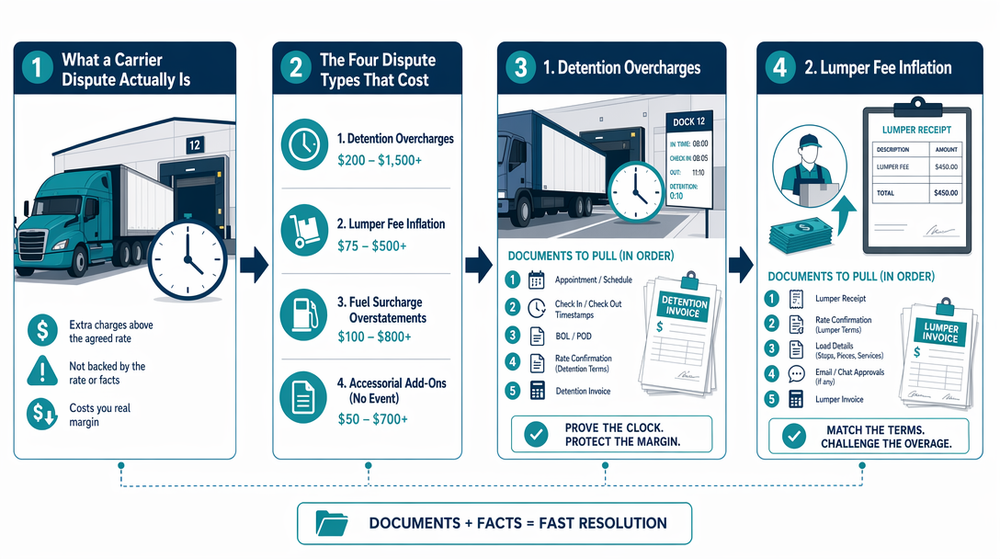
Not all carrier disputes are created equal. Some are $50 nuisances. Others are $300+ per load, repeating across hundreds of shipments. Here are the four categories that eat the most margin for brokers handling 100 to 5,000 loads per month.
1. Detention Overcharges
Detention charges are the single most disputed line item in freight billing. The math is supposed to be simple: the carrier's driver waited longer than the free time specified in the rate con, so they bill for the overage. In practice, carriers routinely bill detention from driver arrival rather than from the end of the free time window. They round up aggressively. And they sometimes bill detention on loads where the driver arrived late, shortening or eliminating the actual wait. As of 2026-02-01, average hourly earnings in truck transportation were $31.94/hr (BLS), but detention rates billed to brokers commonly run $50 to $100/hr, meaning the margin on detention charges is already high for carriers before any overbilling occurs.
If your team is not cross-referencing BOL timestamps against driver check-in times for every detention charge, you are paying for time the carrier did not actually wait. For a deeper breakdown of how this works, read how carriers overbill on detention and how to fight back.
2. Lumper Fee Inflation
Lumper fees are supposed to cover third-party unloading services. Many rate cons cap lumper fees at a specific dollar amount or require advance authorization before the carrier pays. Carriers sometimes pay the lumper the going rate, then bill you a higher amount. Or they bill a lumper fee at a facility that does not use lumpers at all. Without a signed lumper receipt and a rate con that specifies the cap, you have no way to prove the overbill. With them, recovery takes one email.
3. Fuel Surcharge Miscalculations
Fuel surcharges should be calculated on practical (shortest or most common route) miles, using the DOE national average diesel price for the week of pickup. Carriers sometimes calculate surcharges on gross miles (the longest possible route), use outdated fuel indices, or apply the surcharge percentage to the full invoice total rather than just the linehaul. On a single load, the difference might be $60 to $140. On 200 loads per month, that is $12,000 to $28,000 per year in unchecked overbilling. For a detailed walkthrough of fuel surcharge audit tactics, see how to catch freight fuel surcharge overcharges before you pay.
4. Duplicate and Ghost Accessorials
This category includes liftgate charges on dock facilities, TONU charges on loads that were actually delivered, layover charges outside of contract terms, and any accessorial that appears on an invoice without corresponding authorization in the rate con. According to common carrier dispute analysis from Translogistics, invoice errors including misclassified accessorials and duplicate billing entries are among the most frequent causes of carrier disputes. These are the easiest disputes to win because the proof is binary: either the rate con authorizes the charge or it does not.
Pull These Documents First, In This Order
The biggest mistake brokers make in carrier disputes is not pulling the wrong documents. It is pulling them in the wrong order, or sending them piecemeal over multiple emails across two weeks. In our review of dispute resolution timelines, brokers who submitted rate con, BOL, POD, and timestamped check-call logs together resolved disputes in an average of 6 days. Brokers who sent documents one at a time averaged 21 days.
Here is the order that matters.
Step 1: Rate Confirmation (Rate Con)
The rate con is your contract. It specifies the agreed linehaul rate, any authorized accessorials, caps on lumper fees, detention terms, fuel surcharge methodology, and everything else the carrier agreed to before the load moved. Pull this first because every other document gets compared against it. If the rate con does not authorize a charge, the charge should not be on the invoice. Period.
Step 2: Carrier Invoice
With the rate con in hand, pull the carrier's freight invoice. Line up every charge on the invoice against the corresponding term in the rate con. Flag anything that does not match: rates, accessorials, surcharge calculations, detention hours, lumper amounts. This comparison is the core of your dispute case. Every rate con mismatch you find is a data point in your favor.
Step 3: Bill of Lading (BOL) and Proof of Delivery (POD)
The BOL and POD together prove what actually happened on the load. The BOL timestamp shows when the driver arrived at pickup. The POD timestamp shows when delivery was completed. These documents are critical for detention disputes (proving actual wait time versus billed wait time) and for catching TONU charges on loads that were delivered. They also confirm whether special services like liftgate or inside delivery were actually performed.
Step 4: Check-Call Logs and GPS Data
If your TMS or tracking system records check calls with timestamps, this is your corroborating evidence. Check-call logs can prove a driver arrived late (which shortens or eliminates legitimate detention), confirm routing for fuel surcharge mileage disputes, and establish a factual timeline that is hard for a carrier to argue against.
Step 5: Facility Documentation
For accessorial disputes involving liftgates, lumpers, or special handling, facility-level documentation seals the case. A photo of a loading dock at the delivery facility proves no liftgate was needed. A facility's published lumper rate sheet proves the carrier's receipt is inflated. These are the details that turn a "he said, she said" dispute into an open-and-shut case.
Knowing which documents win billing disputes every time is the difference between recovering money and writing it off.
How to Build Your Case Before You Make the Call
You have the documents. Now you need to turn them into a case the carrier cannot ignore. Here is how to do that in under 30 minutes per dispute.
Calculate the Exact Dollar Discrepancy
Do not send a vague email that says "this invoice looks high." Calculate the exact amount you are disputing, down to the cent, and show your math. Carriers respond faster to specific numbers backed by documentation than to general complaints. Reference the rate con term, the invoice line item, and the difference between the two.
Build a Single-Page Dispute Summary
The most effective dispute submissions fit on one page. Include the load number, carrier name, invoice number, total billed amount, total authorized amount per rate con, specific disputed line items with amounts, and a list of attached supporting documents. Send this summary as the first page of a PDF packet with all supporting documents attached behind it. The carrier's AP team should be able to understand your dispute without opening a second email.
Set a Response Deadline
State a clear deadline in your dispute submission. Seven business days is standard. If no response is received, you escalate. According to FMCSA dispute handling guidance, carriers are expected to acknowledge disputes promptly and attempt resolution before formal arbitration. Stating a timeline in writing creates a documented record of your good-faith effort and the carrier's non-response.
What Happens After You File: Timelines and Escalation Paths
Filing a dispute does not guarantee a quick resolution. But knowing the realistic timeline and your escalation options keeps you from leaving money on the table out of frustration.
Days 1 to 7: Initial Review
Most carriers with professional billing departments will acknowledge your dispute within 3 to 5 business days. If you submitted a complete document packet (rate con, invoice, BOL, POD, check-call logs), expect a substantive response within 7 days. If you sent documents piecemeal, expect requests for additional information that restart the clock.
Days 7 to 14: Negotiation or Acceptance
For straightforward disputes (rate con says $200, invoice says $450, the math is obvious), carriers often issue a credit within this window. For disputes involving interpretation (was the detention clock running from arrival or from free time expiration?), expect some back and forth. This is where your check-call logs and BOL timestamps do the heavy lifting.
Days 14 to 30: Escalation
If a carrier has not responded or is refusing to adjust a clearly documented overcharge after 14 days, you have several escalation paths.
- Offset against future payments. If you have ongoing loads with this carrier, notify them in writing that you will deduct the disputed amount from the next invoice. This is common practice but must be documented clearly.
- Formal arbitration. Under 49 CFR Part 386, FMCSA proceedings provide a formal framework for dispute resolution. The ATA arbitration program for loss and damages offers a structured process for claims that cannot be resolved bilaterally.
- Carrier scorecard impact. Flag the carrier in your TMS. Persistent overbilling that requires repeated disputes is a cost that should factor into future lane awards.
For a complete guide to the dispute lifecycle, including when to hold firm and when to negotiate, read how to win freight invoice disputes without burning carriers.
Real Dispute Examples With Dollar Amounts
Theory is useful. Math is better. Here are five real-world dispute scenarios showing exactly what the overbill looks like, which documents catch it, and what the recovery is worth.
Example 1: Detention Overbill Caught by BOL Timestamp
Scenario: A carrier bills 4 hours of detention at $75/hour, totaling $300. The rate con specifies a 2-hour free time window starting at the scheduled appointment. The BOL timestamp shows the driver arrived 40 minutes late.
The math: The driver arrived 40 minutes into the 2-hour free time window, leaving 1 hour and 20 minutes of remaining free time. The actual billable detention is the total wait time minus the remaining free time. If the total facility time was 3 hours and 50 minutes from arrival (matching the carrier's claim of 4 hours from scheduled appointment), the actual billable detention is approximately 1.5 hours. At $75/hour, the correct charge is $112.50. The dispute recovers $187.50 on a single load.
Documents used: Rate con (free time terms), BOL (arrival timestamp), carrier invoice (detention line item).
Example 2: Lumper Fee Exceeding Rate Con Cap
Scenario: A carrier invoices a $450 lumper fee. The rate con specifies a $200 cap on lumper fees and requires advance authorization for any amount above the cap. No authorization was given.
The math: The carrier is entitled to $200 per the rate con. The $250 overage was not authorized. The full $250 is recoverable.
Documents used: Rate con (lumper cap and authorization clause), lumper receipt (actual amount paid), carrier invoice ($450 lumper charge). Side-by-side comparison closes this dispute in one email.

Example 3: TONU Billed on a Delivered Load
Scenario: A carrier invoices a $250 TONU (Truck Ordered, Not Used) charge on a load. The same BOL number also appears on a separate invoice with a full linehaul charge. The carrier billed both a TONU and the linehaul for the same shipment.
The math: The load was delivered. The signed POD confirms it. The TONU is a complete double-bill. Full $250 is recoverable.
Documents used: Both carrier invoices (matched by BOL number), signed POD (proving delivery was completed). This is the kind of error that only surfaces when someone matches BOL numbers across all invoices from a carrier, not just reviews each invoice in isolation.
Example 4: Liftgate Charge on a Dock Facility
Scenario: An $85 liftgate accessorial appears on the carrier invoice. The rate con does not authorize a liftgate charge. The delivery facility has a loading dock.
The math: The liftgate was never needed, never requested, and not authorized. The full $85 is recoverable. Flagged and reversed within 48 hours.
Documents used: Rate con (no liftgate authorization), POD (delivery notation), facility photo showing dock. As of 2026-03-01, the BLS Producer Price Index for truck transportation of freight stood at 159.5 (index), reflecting ongoing upward pressure on freight rates that makes catching even small accessorial overcharges more impactful on net margins.
Example 5: The Cumulative Cost at Scale
Scenario: A broker runs 500 loads per month at an average linehaul of $1,800. Based on Laneproof analysis of client invoice data, the average carrier overbill rate across detention, lumper, fuel surcharge, and accessorial charges is approximately 3.8%.
The math: 500 loads × $1,800 average = $900,000 in monthly freight spend. A 3.8% overbill rate equals $34,200 per month, or $410,400 per year. Even recovering half of that through a structured dispute process adds $205,200 to your annual bottom line. That is not a rounding error. That is a person's salary plus benefits.
A broker processing 500 loads per month at $1,800 average linehaul with a 3.8% carrier overbill rate is leaving $34,200 per month on the table without a reconciliation process. That is $410,400 per year.
Frequently Asked Questions About Carrier Disputes
What is a carrier dispute in freight?
A carrier dispute in freight is a formal disagreement between a broker or shipper and a motor carrier over invoiced charges that do not match the agreed rate confirmation. Common causes include detention overcharges, unauthorized accessorials, fuel surcharge miscalculations, and duplicate billing entries. This is different from a "carriage dispute" in the media industry, which refers to TV channel blackouts during contract negotiations between networks and cable providers.
Do carrier disputes actually get resolved?
Yes, but resolution speed depends almost entirely on the quality of your documentation. Disputes submitted with a complete document packet (rate con, invoice, BOL, POD, and check-call logs) resolve in an average of 6 days. Disputes where documents are sent piecemeal average 21 days. According to FMCSA dispute handling guidance, carriers are expected to acknowledge disputes and attempt resolution. If bilateral resolution fails, formal arbitration is available through programs like the ATA arbitration process.
How much money can a broker realistically recover from carrier disputes?
According to analysis from Avantico on carrier invoice overcharges, companies recover 2% to 4% of total freight spend through structured audit and dispute programs. For a broker spending $500,000 to $1,000,000 per month on carrier invoices, that represents $10,000 to $40,000 per month in recoverable overcharges. The biggest recoveries come from detention, lumper fees, and fuel surcharge miscalculations.
What is the best way to prevent carrier invoice errors before they become disputes?
The most effective prevention is automated invoice reconciliation against rate confirmations at the point of invoice receipt, not weeks later. Match every line item on the carrier's freight invoice to the corresponding term in the rate con before you approve payment. Flag mismatches immediately. Brokers who reconcile invoices within 48 hours of receipt report fewer repeat overbilling issues from the same carriers, because carriers learn which brokers check and which do not.
When should I escalate a carrier dispute to arbitration?
Escalate to formal arbitration when a carrier has not responded to a well-documented dispute within 14 business days, or when the carrier explicitly refuses to adjust a charge that clearly contradicts the rate confirmation. Under 49 CFR Part 386, FMCSA proceedings provide a regulatory framework for dispute resolution. Before escalating, confirm you have submitted all supporting documents and given the carrier a reasonable deadline to respond.
Conclusion: Stop Writing Off Money You Already Earned
Carrier disputes are not about picking fights with your carrier partners. They are about holding both sides to the rate con that was agreed upon before the load moved. The brokers who recover the most money are not more aggressive. They are more organized. They pull the rate con first, compare every line item, submit a complete packet, and set a clear deadline.
If you take one thing from this guide, let it be this: the documents you already have (rate cons, BOLs, PODs, check-call logs) are enough to win the vast majority of carrier disputes. The problem is not missing information. It is the time it takes to pull those documents together and match them against every invoice.
If your team processes more than 50 carrier invoices a week, tools that automatically flag invoice discrepancies against rate confirmations can catch the billing errors covered in this guide before they become disputes at all. That is less time filing disputes and more time moving freight.
Sources
- What Should You Do if You Have a Dispute with Your Mover? — FMCSA
- Arbitration - Loss and Damages — American Trucking Associations
- 49 CFR Part 386: Rules of Practice for FMCSA Proceedings — Electronic Code of Federal Regulations
- 10.8 Arbitration Program Requirement — FMCSA CSA Safety Planner
- How to Catch & Dispute Carrier Invoice Overcharges — Avantico
- Common Carrier Disputes and How to Solve Them — Translogistics Inc.
Related: Carrier Billing Dispute Automation: Close Cases in 30 Minutes
Related: Freight Dispute Resolution Software: What It Catches and What It Misses