Which Accessorial Charge Management Solutions Catch the Most Overcharges?
Researched and written with AI assistance. Reviewed by the Laneproof team.
Run 100 loads a month at $1,800 average linehaul and a 3.8% overbilling rate puts $6,840 of disputable charges in your payables every 30 days. That is $82,080 a year sitting in detention lines, lumper fees, fuel surcharge math, and TONU invoices nobody has time to verify. So the real question is not whether you are being overbilled. It is which accessorial charge management solutions identify the most overcharges once the invoices actually hit your queue.
Most comparison articles answer that with a feature grid. Feature grids do not pay your carriers. This one ranks three categories of solution by a single number: disputable dollars caught per 100 loads. The 3.8% figure above is a modeling input, not a law of physics, and we show you how to replace it with your own rate in about 20 minutes.
What Counts as an Accessorial Charge (Fast Answer)
An accessorial charge is any fee on a freight invoice that is not linehaul. It pays the carrier for work, time, or equipment outside of moving the trailer from A to B. The categories that generate the most billing disputes are consistent across truckload, LTL, and drayage.
- Time-based: detention, layover, driver assist, waiting time at the dock
- Non-performance: TONU (truck ordered not used), dry run, reconsignment, redelivery
- Facility and handling: lumper fees, inside delivery, liftgate, sort and segregate, pallet exchange
- Location-based: residential delivery, limited access, construction site, terminal handling
- Fuel and rating: fuel surcharge, reweigh, reclassification, overlength, over-dimension
- Drayage-specific: chassis rental, per diem, pier pass, congestion, pre-pull, storage
The comprehensive list of common accessorial charges published by Zipline Logistics runs to 20 line items, and a single LTL invoice can carry six of them at once. According to Freight Optics' breakdown of hidden freight and accessorial fees, accessorials can add 15% to 30% or more on top of base freight cost. On $180,000 of monthly linehaul, that is $27,000 to $54,000 in accessorial spend flowing through your payables with far less scrutiny than the rate con line ever gets.
If you want the full anatomy of each fee type and where the padding usually hides, we covered it in accessorial charges explained: costs, overbilling traps, and how to fight back. This article assumes you already know what a lumper fee is and want to know which tool catches the fake ones.
Why 'We Use Software' Isn't an Answer to Your Overbilling Problem
Every TMS on the market has an audit tab. Most brokers who tell you they audit accessorials mean a billing coordinator eyeballs invoices over $2,500 and pays the rest. The software is present. The detection is not.
The market for purpose-built tooling is growing fast. Per Dataintelo's accessorial charge management software market report, the category was valued at $484 million in 2025 and is projected to reach $1.07 billion by 2034, a 9.2% compound annual growth rate. That growth tells you buyers are spending. It does not tell you what they are catching.
Here is the gap. Detection requires three things to be true at the same time, and most stacks only get one or two:
- The invoice data has to be structured. A PDF sitting in a shared inbox cannot be compared to anything. If someone has to key detention hours into a field before the rule fires, the rule fires on whatever they keyed.
- The comparison source has to exist. You cannot flag a detention overcharge without the rate con free-time terms and the BOL or POD timestamps. Half of accessorial disputes are lost because the supporting document was never captured, not because the charge was legitimate.
- The variance has to reach someone before payment. A discrepancy found 40 days after the check cleared is a collections problem, not an audit finding.
That is why freight audit platforms that identify cost-saving opportunities focus on data capture first and rules second. The rules are the easy part. Getting clean, complete, load-level data into the rules within 24 hours of invoice receipt is where solutions separate.
Detection is not a rules problem. It is a document capture problem wearing a rules costume.
The Metric That Actually Matters: Overcharges Caught Per 100 Loads
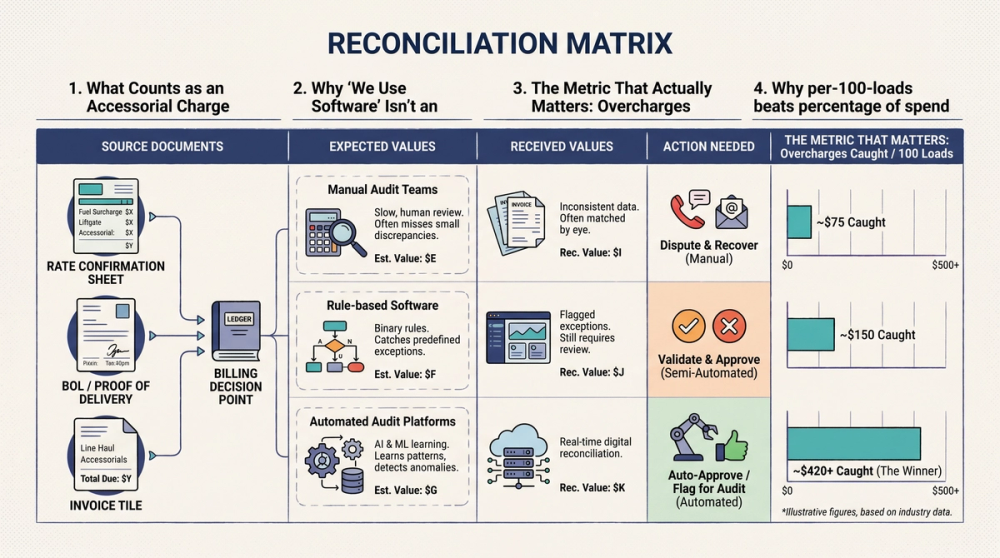
Vendors quote recovery rates as a percentage of spend audited, which is unfalsifiable. Audit 100% of spend, find nothing, and the percentage still looks fine. Ask instead for overcharges caught per 100 loads, broken out by charge type and by dollar value.
Two numbers make this metric useful:
- Catch count per 100 loads: how many individual invoice lines were flagged as variances and survived carrier response. A flag the carrier successfully rebuts is not a catch.
- Average dollars per catch: a tool that finds 60 small liftgate errors at $35 each ($2,100) is worth less than one that finds 20 detention and TONU errors at $180 each ($3,600).
Why per-100-loads beats percentage of spend
Load count is the unit you already manage against. You know how many loads you covered last month. You do not always know your true total spend including accessorials until the month closes. Per-100-loads also normalizes across brokers of different sizes, so a 400-load-per-month operation can compare its results honestly against a 3,000-load operation.
The four charge types that drive most of the dollars
In practice, disputable dollars concentrate. Fuel surcharge sits at the top: Dataintelo's market analysis attributes 20% to 35% of total accessorial overbilling to fuel surcharge errors alone, which makes it the single most frequently overbilled category. Detention comes next because it is time-based and rarely evidenced. Lumper fees follow because receipts go missing. TONU rounds it out because it is billed against an event (a cancellation) that often has no document trail on either side.
If your audit tool cannot check those four cold, the rest of its feature list is decoration. We broke down the padding patterns by charge type in freight overcharges: what carriers pad most and how to get your money back.
How We Scored Each Type of Solution (Methodology)
These are modeled estimates, not vendor-reported results. No independent body publishes verified catch rates by solution category, so we built a transparent model instead of quoting numbers we cannot source. Every input below is labeled. Replace them with your own and the ranking may shift, which is the point.
Model inputs (assumptions, replace with your data):
- 100 loads produce roughly 230 accessorial line items (2.3 accessorial lines per invoice)
- Roughly 50 of those 230 lines contain a variance worth disputing (unsupported, miscalculated, duplicated, or off-contract)
- Catches = variance-bearing lines x invoice coverage rate x field-level detection rate
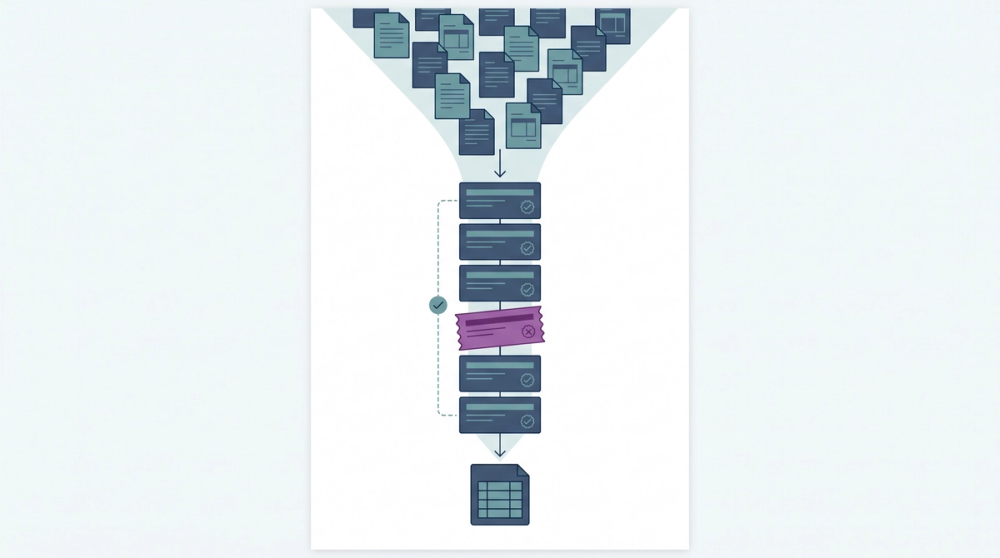
Coverage rate is the share of invoices actually examined line by line. Detection rate is the share of variances the method finds within the invoices it examines. The mid-post diagram maps how a single invoice moves from receipt through document capture, field-level matching, and dispute packet assembly, and each of those three stages is a place where coverage or detection leaks.
Scoring criteria beyond raw catch count
- Document capture depth: can it read the BOL, POD, lumper receipt, and rate con, or only the invoice?
- Field-level match: does it compare accessorial rates and free-time terms against the rate confirmation, or just totals?
- Carrier coverage: does detection work across every carrier that bills you, or only the top 20 with negotiated rate tables loaded?
- Latency: flag before payment or after?
- Dispute output: does it produce a packet with the supporting timestamps attached, or a spreadsheet row a human still has to build a case from?
Which Accessorial Charge Management Solutions Identify the Most Overcharges?
Three categories cover almost every option you will evaluate. Here is the math for each, then the criteria they win and lose on.
Manual audit teams: 8 to 12 catches per 100 loads
The math: 50 variance-bearing lines x 30% invoice coverage x 70% detection = 10.5 catches. Round to a range of 8 to 12.
A billing coordinator reviewing invoices by hand is accurate on what they look at. The 70% detection rate reflects genuine skill: an experienced coordinator spots a bad detention claim faster than most rule engines. The problem is coverage. At three to five minutes per invoice with document lookup, a full-time coordinator gets through roughly 25 to 30 invoices per 100 before the next batch arrives. Everything over the dollar threshold gets scrutiny. Everything under it gets paid.
Wins on: judgment calls, carrier relationship context, nonstandard charges. Loses on: coverage, consistency, and anything that requires cross-referencing 40 loads on the same lane to spot a pattern. A $13.50 fuel surcharge error on one load is invisible to a human. Repeated 40 times a month, it is $540.
Rule-based software and TMS audit modules: 20 to 28 catches per 100 loads
The math: 50 variance-bearing lines x 60% effective coverage x 80% detection = 24 catches. Range of 20 to 28.
Rule engines examine every invoice, so nominal coverage is 100%. Effective coverage is lower, around 60% in this model, because the rules only fire on fields that were populated correctly. If detention hours were keyed in wrong, the rule validates the wrong number. If the rate con free-time term never made it into the load record, there is nothing to compare against. Detection on the fields it does see is strong at 80%, especially for rate table mismatches and duplicate charges.
The accessorial charge management market analysis notes that automated tracking systems are the primary reason buyers are adopting these tools, and ParcelLogix's analysis of hidden accessorial fees makes the same point: automated tracking surfaces billing trends across carriers that no individual reviewer catches. Rule-based tools deliver that trend view. What they cannot do is validate a charge whose evidence lives in a scanned PDF nobody parsed.
Wins on: consistency, 100% invoice coverage, contract rate mismatches, duplicates. Loses on: document-dependent charges. Missing lumper receipts, TONU without dispatch confirmation, and detention timestamps buried on a POD are all invisible to a rules engine that only sees keyed fields.
Automated audit platforms with document extraction: 45 to 60 catches per 100 loads
The math: 50 variance-bearing lines x 95% coverage x 95% detection = 45 catches, with the upper end of the range reflecting document-level findings (unsupported charges, missing receipts, absent authorization) that the other two categories structurally cannot see.
The difference is not smarter rules. It is that the rate con, BOL, POD, lumper receipt, and invoice are all parsed into comparable fields before any rule runs. Detention gets checked against actual in and out timestamps rather than the hours the carrier typed. Fuel surcharge gets recalculated from contracted rate and billed miles. A lumper line with no attached receipt gets flagged as unsupported, which is a category of catch that does not exist for tools that never look at attachments.
Freehand's comparison of freight cost analytics platforms draws the same line between reporting-led tools and audit-led tools: the audit-led ones detect overcharges because they operate at the line-item and document level, not the summary level.
Wins on: coverage, evidence, dispute-ready output, pattern detection across lanes. Loses on: setup effort. You have to feed it rate cons and carrier documents consistently, and if your rate confirmations are missing accessorial terms in the first place, no tool can match against what was never agreed. That gap is worth fixing separately, and we listed the specific fields most brokers leave blank in the rate confirmation template guide.
Side-by-side summary
- Manual audit team: 8 to 12 catches per 100 loads. Coverage 30%. Best for low volume under roughly 150 loads per month.
- Rule-based software / TMS audit module: 20 to 28 catches per 100 loads. Effective coverage 60%. Best when your data entry is already clean and disciplined.
- Automated audit platform with document extraction: 45 to 60 catches per 100 loads. Coverage 95%. Best when accessorial evidence lives in PDFs and email attachments, which for most brokers is all of it.
The Math: What 3.8% Overbilling Actually Costs You Per Month
Run this on your own numbers. It takes 20 minutes and it is the only ROI calculation that matters before you sign anything.
Step 1: Establish your monthly linehaul base. 100 loads x $1,800 average linehaul = $180,000.
Step 2: Apply your overbilling rate. Using 3.8% as a working assumption: $180,000 x 0.038 = $6,840 per month in disputable charges, or $82,080 annually. If you do not know your rate, pull the last 50 invoices you actually disputed, total the recovered amount, and divide by the total invoiced value of those 50 loads. That is your floor, not your true rate, because it only counts what you already caught.
Step 3: Cross-check against accessorial spend. Freight Optics puts accessorials at 15% to 30% of freight cost, so your $180,000 base likely carries $27,000 to $54,000 in accessorials. If even 12% of those accessorial dollars are miscalculated or unsupported, you land between $3,240 and $6,480 per month. That brackets the 3.8% estimate, which is a good sign the model is not fantasy.
Step 4: Apply catch rate by solution type. Assume the $6,840 is spread across 50 variance-bearing lines at an average of $137 per line.
- Manual review at 10 catches: $1,370 recovered per month, $16,440 per year
- Rule-based software at 24 catches: $3,288 recovered per month, $39,456 per year
- Automated audit platform at 50 catches: $6,850 recovered per month, $82,200 per year
Step 5: Subtract cost. A billing coordinator spending 15 hours a week on invoice review at a fully loaded $32 per hour costs roughly $2,080 per month. Compare that against the recovery figure for each tier, not against the software subscription in isolation. The manual tier is frequently cash-flow negative once you price the hours honestly.
Step 6: Add the deterrent effect. Carriers that receive documented, evidence-backed disputes bill differently within two or three cycles. This is real but not quantifiable from public data, so leave it out of your ROI case and treat it as upside.
Examples: Four Overcharges and the Math Behind Each
Example: Detention billed at 4 hours, POD supports 2.5
Rate con terms: 2 hours free at the receiver, detention at $100 per hour after. Carrier invoices 4 hours of detention: $400.
The POD shows arrival at 09:15 and signature at 13:45, which is 4.5 hours on site. Subtract 2 hours free time and the supported detention is 2.5 hours, or $250. Overcharge caught: $150. The catch requires two documents (rate con for the free-time term, POD for the timestamps) and a subtraction. A rules engine that only sees the keyed detention hours has nothing to disagree with. This is the most common detention charge audit finding and also the one most often paid without question.
Example: $75 lumper fee with no receipt attached
Carrier invoices a $75 lumper at a grocery DC. No receipt is attached to the invoice or the load file. Lumper fee validation is binary: either there is a receipt from the unloading service showing the amount paid, or the charge is unsupported.
The dispute here is not accusatory, it is procedural: pay on receipt. On 100 loads with 18 lumper charges, if three arrive without documentation, that is $225 held pending evidence. Two of the three receipts usually show up within 48 hours. The third one never does. Recovered: $75, plus a carrier that starts attaching receipts.
Example: Fuel surcharge mismatch of $0.03 per mile
Contracted FSC on the lane is $0.42 per mile. The invoice bills $0.45 per mile across 450 miles.
450 x $0.03 = $13.50 per load. Small enough that no coordinator flags it and no dollar-threshold rule fires. Now run that lane 40 times a month: $540 per month, $6,480 per year, on one lane with one carrier. Fuel surcharge is the highest-volume overbilling category precisely because each individual error is beneath the threshold at which humans look. Catching it requires recalculating FSC from contracted rate and billed mileage on every single invoice, which is a coverage problem, not a difficulty problem.
Example: $250 TONU with no dispatch confirmation on file
Carrier invoices $250 TONU claiming the load was cancelled after dispatch. Your file shows a rate con issued but no dispatch confirmation, no check call, and no cancellation notice from the shipper.
TONU is legitimate when the truck was dispatched and then released. It is not legitimate when the load was never confirmed. Disputed: $250, resolved by producing the absence of a dispatch record and asking the carrier for their driver's dispatch timestamp. Roughly half of these resolve in your favor, which still makes the check worth running on every TONU line.
All four examples share one requirement: the supporting document has to be readable as data before the comparison can happen. That is why the highest catch rates come from platforms that pair automated freight document data extraction with field-level matching, rather than rules bolted onto manually keyed fields.
What to Ask a Vendor Before You Sign
Skip the demo script. Send them 25 of your own invoices with the matching rate cons and PODs, including at least three you already know are wrong, and ask for these five numbers back.
- How many of the 25 did you fully parse? Not received, parsed into comparable fields.
- Which of the three known errors did you find? If they miss the detention timestamp mismatch, they will miss it on your live freight too.
- What is your false positive rate on this sample? A tool that flags 40 lines and is right on eight of them will get ignored by your billing team inside a month.
- How long from invoice receipt to flag? Anything over 48 hours means you are disputing post-payment.
- What does the dispute output look like? Ask to see the actual packet: the flagged line, the contracted term, the supporting timestamp, and the dollar variance in one artifact you can email to a carrier.
Redwood Logistics makes a related point in its guide to LTL accessorials and how to avoid them: freight auditing catches incorrectly applied accessorial fees, but only when the auditing party has access to the underlying classification and service terms. Same principle applies to your software. No terms, no catch. We go deeper on evaluation criteria in accessorial charge audit software: which charges get inflated and how to catch them.
Frequently Asked Questions
What are the different types of shipping accessorial charges?
They break into six groups: time-based (detention, layover, driver assist), non-performance (TONU, dry run, reconsignment), handling (lumper, liftgate, inside delivery, sort and segregate), location-based (residential, limited access, construction site), rating and fuel (fuel surcharge, reweigh, reclassification, overlength), and drayage-specific (chassis, per diem, congestion, storage). Zipline Logistics' list of the top 20 accessorial charges covers the full set in detail. Fuel surcharge, detention, lumper, and TONU generate the majority of disputable dollars.
How do I calculate my own overbilling rate instead of using 3.8%?
Pull your last 50 to 100 invoices with all supporting documents. Recheck each accessorial line against the rate confirmation terms and the BOL or POD timestamps. Total the variances and divide by the total invoiced value of those loads. Expect the result to be higher than whatever you have historically recovered, because the historical number only counts errors someone happened to notice.
Is a freight audit provider better than software for accessorial overcharge detection?
Third-party audit firms typically operate at manual or rule-based coverage levels and usually bill a percentage of recovery, often 20% to 30% of what they find, so a $6,840 monthly finding costs you $1,368 to $2,052. That can still be worth it if your alternative is zero auditing. The structural weakness is latency: most audit firms review post-payment, which turns every catch into a claim against a carrier who already has your money.
How long does an accessorial dispute usually take to resolve?
A documented dispute raised before payment, with the rate con term and the timestamp evidence attached, typically resolves in one billing cycle because the carrier has nothing to argue with. An undocumented dispute, or one raised after payment, can run 45 to 90 days and often ends in a partial settlement. The single biggest driver of dispute win rate is whether the evidence is attached at the moment you raise it.
Do small brokers running under 200 loads a month need an audit platform?
Run the math from the section above with your own volume. At 150 loads and $1,800 average linehaul, 3.8% is roughly $10,260 a month in disputable charges. The question is not volume, it is whether the hours your billing coordinator currently spends on partial review cost more than the difference between a 10-catch and a 50-catch outcome. For most operations in that range, they do.
Sources
- Accessorial Charge Management Software Market — Dataintelo
- How Freight Audit Platforms Identify Cost-Saving Opportunities — Business Solutions US
- Best Freight Cost Analytics Platforms: 8 Compared — Freehand
- Accessorial Charges in Parcel Shipping: The Hidden Fees Destroying Your Budget — ParcelLogix
- Accessorials in LTL Shipping: What Business Owners Need to Know — Redwood Logistics
- Your Guide to Hidden Freight & Accessorial Fees — Freight Optics
- Top 20 List of Accessorial Charges — Zipline Logistics
The Takeaway
Catch rate tracks coverage, and coverage tracks document capture. Manual review is accurate on the 30% of invoices it reaches. Rule-based software reaches every invoice but only validates the fields somebody keyed correctly. Automated audit platforms that parse the rate con, BOL, POD, and lumper receipt into comparable data get to roughly 95% coverage, which is why the modeled gap between the bottom tier and the top tier is 8 to 12 catches versus 45 to 60 on the same 100 loads.
Do not take those ranges on faith. Run the six-step calculation on your own volume, then send 25 real invoices to whichever vendors make your shortlist and score them on what they actually find. If you want to see field-level variance detection running against your own rate confirmations and carrier invoices, invoice reconciliation that flags variances before payment goes out is the piece to test first, because everything downstream depends on catching the charge while you still hold the money.