Tools to Prevent Errors in Freight Contracts and Rates
Researched and written with AI assistance. Reviewed by the Laneproof team.

A detention clause that says "detention billable after 2 hours" without defining when the clock starts is worth about $30 an hour to the carrier and nothing to you in a dispute. Run that across 40 loads a month with one hour of unprovable detention each and you are paying $1,200 a month for a missing sentence. That is the real cost of vague paperwork, and it is why tools to prevent errors in freight contracts and rates matter more than another invoice audit service. Most guides tell you to catch the overbill after it hits your AP queue. By then you are negotiating, not enforcing. This article covers the exact rate con and carrier packet fields that generate detention, lumper, and accessorial disputes, how to verify them before you sign, and what to look for in software that flags a bad term at contract stage instead of 45 days later.
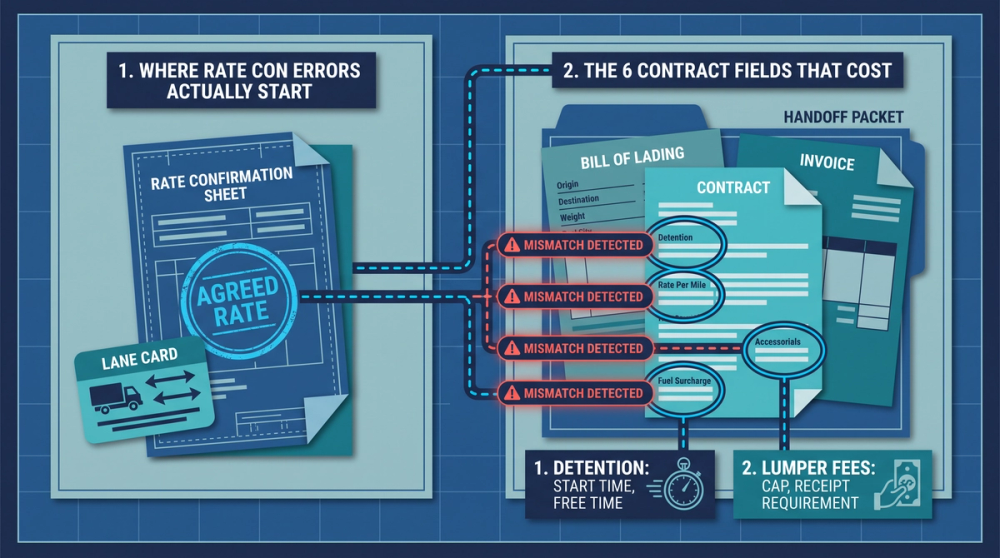
Where Rate Con Errors Actually Start (It's Not the Invoice)
You have probably been sold freight audit before. Someone showed you a percentage of spend recovered and a nice dashboard. Audit works, and the data backs it: TransImpact reports that automated freight audit and pay programs catch errors before payment and typically return 3 to 7 percent in cost savings. But recovery is the last line of defense, not the first. Every dollar recovered in audit is a dollar that already left your margin calculation, already sat in a dispute queue, and already cost your billing coordinator 20 minutes of email.
Here is what actually happens on a disputed accessorial. The carrier bills $340 in lumper reimbursement. Your rate con said "lumper reimbursed at cost with receipt." No cap. The receipt is legitimate. You have no basis to short-pay, so you eat it or you burn goodwill with a carrier you need on that lane next week. The invoice was correct. The contract was wrong.
Trimble's freight audit team makes the same point from the shipper side in their breakdown of the truth about freight spend: audit data is most valuable when it feeds back into procurement and contract terms, not just into a refund. If you are only auditing, you are paying to discover the same contract defect over and over.
The invoice is not where the error happened. It is where the error became visible.
Three structural reasons rate con errors start upstream:
- Rate cons are built from templates that nobody re-reads. Your dispatcher copies last week's confirmation, changes the lane and the linehaul, and sends it. The accessorial language rides along untouched for two years.
- Carrier packet terms and rate con terms conflict. The packet says detention starts at hour two. The rate con says free time is three hours. When they disagree, you are arguing about which document controls.
- Nobody owns the accessorial schedule. The linehaul gets negotiated. The fuel surcharge gets checked. The layover, TONU, dry run, and driver assist rates get whatever the last person typed.
The 6 Contract Fields That Cost Brokers the Most Money
These six fields generate the majority of billing disputes we see in freight documents. Each one has a specific failure mode and a specific fix you can apply before the load is covered.
1. Detention: start time, free time, hourly rate, and cap
A complete detention clause needs four values. Free time in hours. When the clock starts (appointment time or arrival time, and which timestamp proves it). The hourly rate after free time. A maximum per stop or per day.
Leave out the start-time definition and you get the argument every broker has had: the driver arrived at 06:40 for an 08:00 appointment and bills detention from 06:40. Leave out the cap and a 14-hour dock delay at $50 per hour turns into a $600 line item on a $1,850 load.
Fix: specify "detention accrues from scheduled appointment time or driver arrival, whichever is later, evidenced by check-in time on the BOL or GPS timestamp. Two hours free. $45 per hour thereafter in 15-minute increments. $400 maximum per stop."
2. Lumper fees: cap, receipt requirement, and reimbursement method
"Lumper reimbursed at cost" is an open checkbook. You need a cap, a receipt requirement with a legible vendor name, and language stating that lumper charges above the cap require written approval before payment is made at the dock.
The cap does not have to be low. It has to exist. A $250 cap with a pre-approval path for anything higher gives you a hard line to point at when a $340 receipt shows up with no notification.
3. Fuel surcharge: which index, which day, which mileage source
A fuel surcharge dispute is almost never about the concept. It is about the reference. Your contract says "DOE national average." The carrier calculates off a regional index, or off the previous Monday instead of the Monday preceding pickup, or off practical miles when you priced on shortest miles.
Every one of those is a small percentage that compounds across a lane. Specify the exact index (EIA DOE national on-highway diesel average), the exact publication day, the escalator table, and the mileage source and version. DAT's guidance on how to negotiate freight rates on your lanes is built on the same principle: you cannot negotiate or defend a rate you cannot reference to a specific benchmark.
4. The accessorial rate table: attached or absent
If your rate con references "accessorials per carrier agreement" and the agreement is a PDF in a folder nobody opens, you have no enforceable schedule. The most common expensive version of this: a $75 layover fee invoiced on a load where layover was never priced, never approved, and appears nowhere in the confirmation.
Fix: put the table on the rate con itself. Layover, TONU, dry run, driver assist, redelivery, reconsignment, stop-off, pallet exchange, detention, lumper. Every line gets a number or the word "not authorized without written approval."
5. TONU and dry run: cap, trigger, and notice window
Truck ordered not used is where ambiguity gets expensive fast. If the clause says "TONU billable when load cancels after dispatch" with no dollar figure, the carrier picks the figure. A dry run into a metro area at $150 versus $350 is entirely a drafting question.
Define the trigger (cancellation after driver is en route or after arrival), the notice window that voids the charge (cancellation more than four hours before appointment), and the flat amount. Cap it.
6. Payment terms, quick pay, and the short-pay clause
Your right to short-pay a disputed accessorial should be written down. So should the documentation standard: what proves detention, what proves a lumper, what proves an appointment time. Without a documentation clause you are in a credibility contest instead of a contract discussion, and credibility contests with a good carrier usually end with you paying.
FOB vs. PPD and Why Brokers Mix This Up in Contracts
This one costs money in a quieter way. FOB and PPD describe two different things, and mixing them on a rate con or a customer contract creates a billing party problem that shows up 30 days later when nobody wants to pay.
FOB (free on board) defines the point where title and risk of loss pass from seller to buyer. FOB Origin means the buyer owns the freight the moment it is loaded and carries the risk in transit. FOB Destination means the seller owns it until delivery is complete.
PPD (prepaid) and collect define who pays the freight charges. Prepaid means the shipper pays the carrier. Collect means the consignee pays.
They are independent. You can have FOB Origin, Freight Prepaid, where the buyer assumes risk at the dock but the seller still pays the linehaul. You can have FOB Destination, Freight Collect, though it is unusual. The combination that generates disputes is the one where the rate con says prepaid, the BOL is marked collect, and the carrier invoices the consignee, who calls you asking why they have a $2,400 bill.
How to keep it clean on the paperwork
- State the terms as a pair on every rate con: "FOB Origin, Freight Prepaid, bill broker."
- Make the bill-to party explicit and separate from the FOB term. "Bill to" is the line that actually controls who receives the invoice.
- Check the BOL against the rate con before the driver leaves the dock. A BOL marked "collect" overrides your intent in practice, because the carrier bills what the BOL says.
- Watch third-party billing language on drayage and cross-border moves, where an INCOTERM on the commercial invoice can contradict your domestic FOB term entirely.
Aljex's glossary of freight broker terminology is worth circulating to new dispatchers for exactly this reason. Terminology drift between your sales desk and your ops desk is a documented source of billing error, and it is free to fix.
A Rate Verification Checklist You Can Run Before Signing
This takes about 90 seconds per rate con once it becomes habit. The mid-post diagram shows where each check sits in the flow from carrier agreement to confirmation to invoice.
Financial terms
- Linehaul matches the rate you quoted and covered at, including any lane-specific commitment pricing
- Fuel surcharge method named by index, publication day, escalator table, and mileage source
- Total on the rate con equals linehaul plus FSC plus any pre-approved accessorials, with no rounding drift
- Payment terms and quick pay discount stated in days and percent
Accessorial terms
- Detention: free time, start trigger, hourly rate, increment, cap
- Lumper: cap, receipt requirement, pre-approval path above cap
- Layover, TONU, dry run: flat amount and trigger condition for each
- Stop-off, driver assist, pallet exchange, reconsignment: priced or marked not authorized
- Full accessorial table attached to the confirmation itself, not referenced by name
Party and document terms
- FOB term and prepaid/collect designation stated as a pair
- Bill-to party explicit, and it matches your customer contract
- Required documents for payment listed: signed BOL, POD, lumper receipt, scale ticket where applicable
- Documentation standard for detention claims stated (check-in time, gate time, or GPS)
- Carrier packet terms and rate con terms do not conflict, with a clause stating which controls
If you are running this manually across 300 loads a month, it will not survive a busy Tuesday. That is the argument for tooling, and it is also the argument for cleaning up the source documents first. If your team is still retyping fields off PDFs, start with stopping the retyping problem on BOLs and rate cons, because a checklist run against mistyped data catches nothing.
What to Look for in Tools to Prevent Errors in Freight Contracts and Rates
Most of the market sells audit. Fewer tools work upstream at the contract and confirmation layer. When you evaluate, judge on these criteria rather than on the savings percentage in the deck.
Centralized rate and contract storage with structured fields
Rates living in spreadsheets, email threads, and someone's TMS notes field cannot be validated against anything. Trade Tech's guidance on centralizing rate data for forwarders makes the case plainly: contract and rate errors drop when rate data is ingested into one system with defined fields instead of maintained by hand in parallel copies. CargoWise makes the same argument for dedicated carrier contract modules over static spreadsheets.
Ask the vendor: can I store an accessorial schedule per carrier, per lane, with effective dates, and have it populate a rate con automatically?
Standardized templates with required fields
The cheapest error prevention available is a template that will not send with a blank cap. Wisor's overview of freight rate management best practices points to standardized rate templates and automation as the main lever for reducing quoting errors, and it is the lever that costs you nothing but a configuration afternoon.
Extraction accuracy on real freight documents
Any tool that reads your rate cons, BOLs, and carrier invoices has to handle scanned PDFs, faxed BOLs, and the 40 different invoice layouts your carrier base uses. Ask for a field-level accuracy figure on documents you supply, not on the vendor's clean sample set. A tool that reads linehaul correctly but misses the accessorial table is not solving your problem.
Three-way matching, not two-way
Two-way matching compares invoice to rate con. Three-way matching compares invoice to rate con to the carrier's contracted accessorial schedule, and flags when the rate con itself deviates from the contract. The second one catches the dispatcher who typed $60 per hour detention on a carrier contracted at $45.
Anomaly detection on the fields that actually vary
Turing IT Labs describes how automated audit tools detect rate anomalies, duplicate charges, and tax errors faster than manual review. The useful version of this for a broker is narrower: flag any accessorial that appears on an invoice but not on the confirmation, any detention claim without a supporting timestamp, and any duplicate invoice number across carriers under the same MC.
Integration with your TMS and your document flow
If the tool requires a separate login and manual upload, adoption dies in week three. It needs to sit where documents already arrive: the email inbox, the carrier portal, the TMS attachment field. Once documents are parsed into structured fields, invoice-to-rate-con reconciliation that flags variances before payment runs without anyone opening a PDF.
Audit trail you can send to a carrier
When you short-pay $75, you need a one-page explanation showing the contracted rate, the billed rate, the variance, and the document reference. Tools that produce that automatically end disputes in one email. Tools that just show you a red flag on a dashboard create a research project.
How This Beats Auditing Invoices After the Fact
Post-invoice audit has a recovery ceiling set by how defensible your contract is. If the term is vague, the audit finds a variance and you still lose the argument. Upstream verification changes the math in four ways.
You bill your customer correctly the first time. Accessorials discovered after you have invoiced the shipper are frequently unbillable. You knew about the layover on day two but you invoiced on day one, and now the pass-through is a write-off.
Dispute cycle time collapses. A disputed accessorial that requires two emails and a phone call costs real labor hours before anyone gets paid. Cargofive's comparison of digital versus manual freight rate management covers the labor side of this directly: manual rate handling carries both an error cost and a per-quote time cost that automation removes.
Carrier relationships stay intact. Carriers do not like short-pays. They accept them without friction when the confirmation stated the cap in writing and the carrier's own dispatcher agreed to it. The prevention approach is also the relationship-preserving approach.
Your margin number is real on day one. If you cover a load at a 14 percent margin and lose 2 points to an unpriced accessorial, your lane profitability reporting was wrong the whole quarter. Xeneta's material on benchmarking contracted rates against market is aimed at pricing accuracy, but the operational takeaway is the same: a contracted rate you cannot verify is not a number you can plan on.
None of this means you stop auditing. Audit is your backstop and your feedback loop. It just should not be your only control. If you want a view of what the reactive layer catches, our breakdown of automated freight billing software and the errors it catches covers the downstream side in detail.
Real Numbers: What Bad Contract Fields Cost on Actual Loads
The arithmetic below uses representative rates. Plug in your own numbers, but the structure of each loss is the same every time.
Scenario 1: The missing detention start-time definition
A broker runs 40 loads a month into two grocery DCs known for slow dock turns. The rate con says "detention after 2 hours free, $45/hr." It does not say when hour zero begins.
Drivers routinely arrive 60 to 90 minutes before their appointment window. Carriers bill from arrival. The broker has no contractual basis to reject the claim, so roughly one extra hour of detention gets paid per load.
- 40 loads x 1 hour x $45 = $1,800 per month billed

- With an appointment-time trigger, an estimated two thirds of those hours fall inside free time
- Net avoidable cost: roughly $1,200 per month, $14,400 annualized, on one sentence of contract language
Scenario 2: The blank lumper cap
Carrier packet says lumper reimbursed at cost with receipt. No cap, no pre-approval requirement. Load delivers at a retail DC that runs an outside unloading vendor.
- Lumper receipt: $340
- Broker's customer agreement caps pass-through lumper reimbursement at $200 without prior notice
- Broker absorbs $140 on a load with $268 of gross margin, a 52 percent margin hit on that load
With a $250 cap and a pre-approval clause, the driver calls before paying, the broker calls the customer, and the excess either gets approved and billed through or gets declined at the dock. Same outcome for the carrier, completely different outcome for the broker.
Scenario 3: The fuel surcharge index mismatch
A dedicated lane runs 90 loads a quarter at $2,150 linehaul. The contract says "DOE index." The carrier bills off a regional index that runs a few cents higher and uses practical miles where the broker priced on shortest miles.
- Average FSC variance: $45 per load
- 90 loads x $45 = $4,050 per quarter
- Against $193,500 of quarterly linehaul, that is a 2.1 percent margin drag on the lane
Nothing here is fraud. Two parties read the same three words differently. Naming the index, the publication day, and the mileage source removes the ambiguity in one line of text.
Scenario 4: Line-item comparison on a single invoice
A dry van load, Columbus to Atlanta. Here is the contract term next to the billed amount and the variance.
- Linehaul: contract $1,850, billed $1,850, variance $0
- Fuel surcharge: contract $0.38/mi x 567 mi = $215.46, billed $228.00, variance $12.54
- Detention: contract 2 hr free then $45/hr, 3.5 hr on site, billed 3.5 hr at $50 = $175.00, contract-supported amount $67.50, variance $107.50
- Layover: not on the rate con, billed $75.00, variance $75.00
- Lumper: receipt $118, billed $118, variance $0
- Total billed $2,446.00 against contract-supported $2,250.96. Variance $195.04 on one load
Two of those three variances were preventable at the confirmation stage. The layover was never priced. The detention rate on the rate con did not match the carrier's contracted rate. Only the fuel surcharge line required post-invoice math. This is the split we see repeatedly: most of the dollar variance traces back to a document defect, not a carrier trying anything. Reconciliation that compares each invoice line against the rate con and the contracted accessorial schedule surfaces all three before the payment run, and the same field-level comparison run at confirmation stage would have caught two of them a week earlier.
For a fuller breakdown of which charges get padded most often and how to recover them, see our piece on freight overcharges and how to get your money back.
Frequently Asked Questions
What is the difference between FOB and PPD?
FOB (free on board) defines where title and risk of loss transfer from seller to buyer, either at origin or at destination. PPD (prepaid) defines who pays the carrier, with prepaid meaning the shipper pays and collect meaning the consignee pays. They are separate terms and appear together, as in "FOB Origin, Freight Prepaid." Always state the bill-to party explicitly on the rate confirmation, because the FOB term alone does not tell the carrier who to invoice.
How do you audit freight bills?
Match each invoice line to the rate confirmation, then match the rate confirmation to the carrier's signed contract and accessorial schedule. Check linehaul, fuel surcharge calculation method and mileage source, every accessorial against the contracted rate and cap, and required documents including signed BOL, POD, and lumper receipts. Flag anything billed that was never authorized in writing. Per TransImpact's freight audit and pay overview, automated audit that catches errors before payment typically returns 3 to 7 percent in savings, though prevention at the contract stage removes the dispute entirely.
Will freight rates go up in 2026?
Nobody can promise a direction, and any broker who tells you otherwise is guessing. What you can control is your exposure to rate movement inside your contracts: index-linked fuel surcharges with a named source, defined rate review windows, and accessorial schedules with fixed caps. Benchmarking your contracted rates against market data, which is the use case behind Xeneta's rate benchmarking tools and DAT's lane rate guidance, matters more than a forecast.
What freight terms require the seller to pay the freight cost?
Freight Prepaid requires the seller or shipper to pay the carrier. FOB Destination also generally puts the transportation cost on the seller, since the seller retains title and risk until delivery. In international moves the equivalent INCOTERMS are CIF, CFR, CPT, and DDP, where the seller arranges and pays the main carriage. Confirm that the domestic FOB and prepaid/collect terms on your rate con do not contradict the INCOTERM on a commercial invoice for cross-border or drayage moves.
Do I need software, or can a good template fix this?
A required-field template fixes a meaningful share of the problem and costs nothing. It stops blank caps and missing accessorial schedules. Software becomes necessary when your volume makes manual field-by-field checking impossible, when your carrier base is large enough that contracted rates differ by carrier and lane, or when you need three-way matching between invoice, confirmation, and contract. Our comparison of invoice reconciliation tools for freight brokers covers the options at different volume levels.
Sources
- Freight audit insights: The truth about freight spend — Trimble Transportation
- Freight Broker Tips: How to negotiate freight rates on your lanes — DAT Freight & Analytics
- Freight Audit & Pay: Catch Errors Before You Pay — TransImpact
- How to Optimize Freight Payments and Eliminate Billing Errors — Turing IT Labs
- Freight Rate Management in 2026: Best Practices — Wisor.ai
- Digital vs Manual Freight Rate Management: A Cost Comparison — Cargofive
- 5 New Tools to Level-Up Your Freight Strategy — Xeneta
- Freight Rate Management for Freight Forwarders — Trade Tech
- Prevent Freight Bill Errors with Ocean Carrier Contracts — CargoWise
- Freight Broker Terminology: 50 Terms Brokers Should Know — Aljex
Fix the Document, Not the Dispute
Detention, lumper, and accessorial overbilling almost always trace back to a field that was blank, vague, or inconsistent across your carrier packet and your rate confirmation. Define the detention start trigger. Cap the lumper. Name the fuel index, the publication day, and the mileage source. Attach the accessorial table to the confirmation instead of referencing it. Price TONU, dry run, and layover, or mark them not authorized. State the FOB term and the prepaid/collect designation as a pair, with an explicit bill-to party.
Run the pre-signature checklist above on your next 20 rate cons and count how many are missing at least two of those fields. That count is your real exposure number, and it will be higher than you expect. Once you know where the gaps are, field-level reconciliation that compares every invoice line to the rate con and the contracted accessorial schedule keeps them from reopening on load 400.