Best Invoice Reconciliation Tools for Freight Brokers (2026)
Researched and written with AI assistance. Reviewed by the Laneproof team.

The best invoice reconciliation tools for brokers are the ones that match carrier invoices against rate confirmations, BOLs, and PODs at the load level, then flag freight-specific billing errors (detention padding, lumper disputes, fuel surcharge mismatches) before payment goes out. Generic accounting reconciliation software doesn't do this. It wasn't built for freight. If your billing coordinator is spending three hours a day cross-referencing invoices in Excel, the tool isn't the problem. The category of tool is.
According to US Tech Automations' analysis of LTL freight billing, 18 to 27% of total freight invoice value on LTL shipments contains billing errors. That's not a rounding error. That's margin disappearing load by load. And most of those errors sit in accessorial charges, the exact line items that generic accounting software treats as pass-throughs. This post breaks down which reconciliation tools actually catch those errors, which ones don't, and how to calculate whether any of them pay for themselves inside 30 days.
The best invoice reconciliation tool for freight brokers does one thing generic software can't
Every reconciliation tool on the market can match numbers. That's table stakes. QuickBooks, Xero, and NetSuite all let you compare an invoice total against a PO or purchase record. But freight invoices aren't structured like standard vendor invoices. A single carrier invoice can include a linehaul rate, a detention charge, a lumper fee, a fuel surcharge calculated off a DOE index, and a TONU for a load that may or may not have actually been cancelled. Each of those line items needs to be validated against a different source document.
The linehaul matches the rate confirmation. The detention charge matches the BOL timestamps. The lumper fee matches the POD and the rate con's terms on who pays it. The fuel surcharge matches the DOE index for the week the load moved. Generic accounting software doesn't know what a rate con is. It doesn't parse BOL timestamps. It doesn't flag that a lumper receipt is missing from the POD. As noted in a detailed breakdown of freight-specific reconciliation workflows, the core challenge for freight brokers is matching invoice line items against multiple source documents per load, not just comparing totals.
Load-level matching vs. total-level matching
Here's the distinction that matters. Total-level matching asks: does the invoice total match what I expected to pay? Load-level matching asks: does every line item on this invoice match the corresponding source document for this specific load? A freight invoice can be correct at the total level and still contain a $300 detention overcharge offset by a $300 undercharge on linehaul. Total-level matching misses that entirely. Load-level matching catches it.
This is the single most important filter when evaluating invoice reconciliation tools for a freight brokerage. If the tool can't break an invoice into its component line items and validate each one against the correct document (rate con for linehaul and FSC terms, BOL for timestamps and pickup/delivery data, POD for lumper receipts and delivery confirmation), it's an accounting tool being forced into a freight workflow. You can read more about which line items carriers inflate most frequently and why load-level validation matters.
Here's what carrier overbilling actually costs a mid-size brokerage every month
Before evaluating tools, let's put real numbers on the problem. Most brokers know they're getting overbilled on some loads. Few know the monthly total because manual reconciliation only catches what the billing coordinator has time to check.
The math on 500 loads per month
Consider a brokerage moving 500 loads per month at an average freight bill of $1,800. According to US Tech Automations, 18 to 27% of LTL freight invoice value contains billing errors. Even using the conservative end of that range for a TL-heavy operation and estimating a 3.8% overbilling rate on accessorial charges, the brokerage is losing roughly $34,200 per month in unverified accessorial overcharges. That's $410,400 per year. Most of it goes unchallenged because the billing coordinator is processing invoices manually and doesn't have time to verify every detention charge or lumper fee.
A 3.8% overbilling rate on 500 loads at $1,800 average equals $34,200 per month in unverified accessorial charges. Most of it goes unchallenged because reconciliation is manual.
The labor cost of manual reconciliation
Now add the labor cost. A billing coordinator spending 3 hours per day on invoice matching at $22/hour is burning $1,320/month in labor on a task that should take 45 minutes with the right tool. As multiple brokers shared in a Reddit thread on invoice reconciliation workflows, reconciliation at many small and mid-size brokerages still relies on email threads and Excel margin checks. That means the billing coordinator is toggling between email, TMS screens, and spreadsheets to verify charges that a freight-specific tool could flag in seconds.
Combined, a mid-size brokerage is often spending $35,000+ per month on overbilling losses and reconciliation labor. Any tool that pays for itself needs to offset a meaningful portion of that number within 30 days. Understanding what invoice reconciliation actually means in freight helps contextualize why the threshold for ROI is so much lower than brokers expect.
Which reconciliation tools catch freight-specific billing errors (and which ones don't)
Not every tool marketed as "invoice reconciliation" is useful for freight brokers. Here's how to sort them into categories based on what they actually do at the load level.
Category 1: Generic accounting reconciliation (QuickBooks, Xero, NetSuite)
These tools reconcile invoices against purchase orders or expected totals. They're designed for accounts payable teams in non-freight industries. They handle total-level matching well, but they have zero awareness of freight documents like rate confirmations, BOLs, or PODs. They won't flag a detention charge that exceeds what the BOL timestamps support. They won't catch a lumper fee that should be shipper-paid per the rate con. They won't verify that the fuel surcharge percentage matches the DOE index. If you're using one of these for carrier invoice matching, you're relying entirely on your billing coordinator's memory and attention to catch every error.
Category 2: Freight audit and payment platforms (enterprise-focused)
Platforms reviewed in Gartner's freight audit and payment provider category handle load-level auditing, but most are built for enterprise shippers managing thousands of carriers across complex routing guides. They audit inbound freight invoices against contract rates, tariff schedules, and routing rules. For a brokerage with 5 to 50 employees, these platforms are typically oversized and overpriced. The implementation timelines run months, the contracts lock you in annually, and the workflows assume you have a dedicated freight payment team.
Category 3: TMS-embedded billing modules
Several TMS platforms include built-in billing and reconciliation features. According to Tai Software's guide on freight broker accounting management, integrated TMS accounting modules can automate invoice generation and payment tracking. The upside is that these modules already have access to your load data, rate cons, and carrier records. The downside is that their reconciliation logic is usually basic: they compare the carrier's invoice total to the rate con total and flag mismatches. They rarely decompose accessorial charges or validate individual line items against supporting documents like BOL timestamps or lumper receipts.
Category 4: Freight-specific invoice reconciliation tools
This is the category built for the problem. Freight-specific reconciliation tools are designed to ingest carrier invoices (often from email or EDI), parse them at the line-item level, and match each charge against the corresponding source document. As outlined in a feature breakdown of freight invoice reconciliation software, the critical capabilities include AI-driven document matching, automated exception flagging, and integration with TMS platforms to pull load-level data in real time. These tools don't just tell you the invoice total is wrong. They tell you which line item is wrong, by how much, and which document proves it.
Laneproof falls into this category. Its reconciliation engine checks each line item on a carrier invoice (detention, lumper, fuel surcharge, TONU, accessorials) against the rate confirmation, BOL, and POD, then flags variances before payment goes out. You can see how the matching process works to understand the difference between total-level and load-level validation.
How to match carrier invoices against rate cons, BOLs, and PODs without losing your mind
Even with the right tool, understanding the matching logic is critical. Here are the specific error types a freight broker should be checking for, with dollar figures on each one.
Detention overbilling
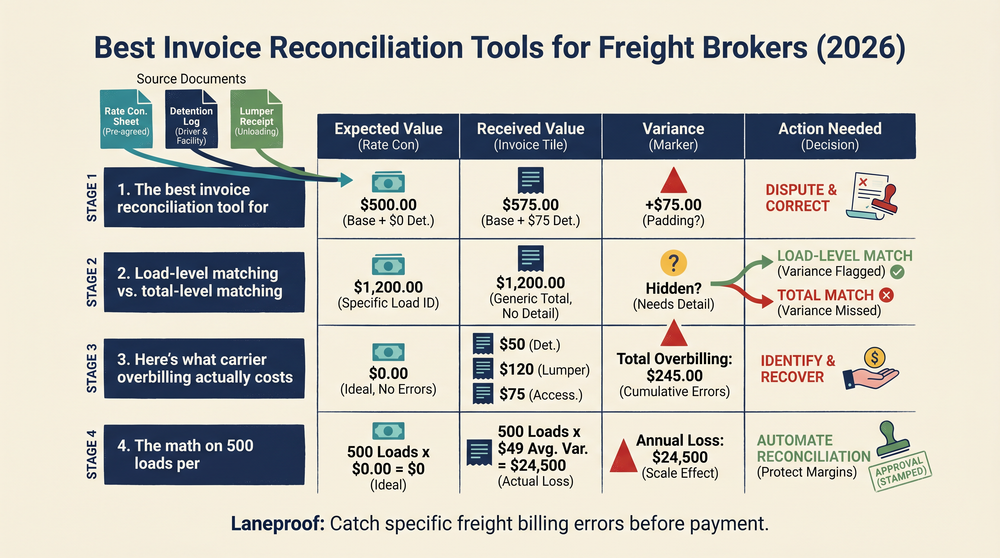
Scenario: A carrier invoices 4 hours of detention at $75/hour, totaling $300. But the BOL timestamp shows the truck was on-site for 2.5 hours. The verified charge should be $187.50, a $112.50 discrepancy on a single load. If your brokerage handles 40 loads per week with detention charges and even 15% of them contain this type of padding, you're losing roughly $675/week, or $2,700/month, on detention alone. The fix: any reconciliation tool you choose needs to extract timestamps from the BOL and compare them to the detention hours invoiced. If it can't do this, it won't catch the most common form of accessorial inflation.
Lumper fee disputes
Scenario: A carrier invoices a $450 lumper fee. But the rate confirmation specifies that lumper is shipper-paid, and the POD shows no lumper receipt attached. Without a tool that flags this charge against the rate con terms, the broker pays $450 for a service that was never the broker's responsibility. This is not a gray area. It's a document mismatch that a freight-specific tool catches in seconds by cross-referencing the "lumper" field on the invoice against the rate con's accessorial terms and checking the POD for a supporting receipt.
Fuel surcharge mismatches
Scenario: A carrier applies a 28% fuel surcharge, but the rate con was locked at 24% based on the DOE index for the week the load moved. On a $1,200 linehaul, that's a $48 overcharge per load. Across 200 carrier invoices per month with fuel surcharge lines, that adds up to $9,600/month. The tool needs to store (or pull) the agreed FSC percentage from the rate confirmation and compare it to the percentage the carrier invoiced. Bonus points if it also checks the DOE index to verify the rate con's percentage was correct in the first place.
TONU and double-billing errors
Scenario: A carrier invoices a $300 TONU (truck ordered, not used), but the load was reassigned and covered by a different carrier, not cancelled. Without load-status matching tied to TMS data, this TONU charge gets paid without question. Similarly, a carrier submits an invoice twice under slightly different reference numbers. Generic accounting software won't catch it because it doesn't have load-level deduplication logic tied to the BOL number. A freight-specific tool matches both invoices to the same BOL and flags the duplicate before the second payment goes out.
Each of these errors is individually small enough to slip through manual review. Together, they add up to the $34,200/month figure calculated above. If you want to build your own manual checking process before investing in software, you can start with a freight broker invoice reconciliation template that covers these exact fields.
Where TMS integration makes or breaks your reconciliation workflow
A reconciliation tool that isn't connected to your TMS forces your billing coordinator to export load data, upload it manually, and re-enter reference numbers. That's the same bottleneck you're trying to eliminate. TMS integration is what turns a reconciliation tool from a standalone audit into an automated freight billing workflow.
What the integration needs to pull
At minimum, the reconciliation tool needs to pull these fields from your TMS for every load:
- Rate con data: agreed linehaul rate, fuel surcharge percentage or cap, accessorial terms (who pays lumper, detention rate and free time), TONU terms
- Load status: covered, in transit, delivered, cancelled, reassigned. This is what prevents paying a TONU on a load that was actually covered.
- BOL and POD documents: timestamps, signatures, lumper receipts, delivery confirmation. These are the evidence documents for detention and lumper disputes.
- Carrier information: MC number, payment terms, billing contact. This matters for deduplication and dispute routing.
If your TMS doesn't expose these fields via API or export, the reconciliation tool can't automate matching. You'll still be copying data between systems. Before evaluating any reconciliation tool, check whether it has a documented integration with your specific TMS, not just a generic "we integrate with most platforms" claim.
The compliance angle brokers overlook
There's also a regulatory reason to care about reconciliation accuracy. Under 49 CFR Part 371, brokers acting in a payment transmittal capacity must abide by applicable billing regulations. And the 2026 Broker and Freight Forwarder Financial Responsibility Final Rule requires surety and trust providers to notify FMCSA when minimum financial thresholds are breached. Chronic overbilling that goes uncaught doesn't just eat margin. It can push a brokerage's financial position below the thresholds that keep its operating authority active. Accurate reconciliation is a compliance function, not just an accounting one.
Calculating whether a tool pays for itself in 30 days
Here's the formula. Add up three numbers:
- Overbilling recovered: Estimate 2 to 4% of your total monthly carrier spend as potential recoverable overcharges. For a brokerage spending $900,000/month on carrier invoices, that's $18,000 to $36,000.
- Labor saved: If your billing coordinator currently spends 3 hours/day on manual reconciliation at $22/hour, that's $1,320/month in labor that can be redirected.
- Dispute prevention: Every invoice dispute you catch before payment avoids the time and friction of clawing back money from a carrier after the fact. Estimate 2 to 5 hours per month in dispute handling time saved.
If the tool costs less than the sum of those three numbers, it pays for itself in month one. Most freight-specific reconciliation tools land in the $500 to $2,000/month range for a mid-size brokerage. Against $19,000 to $37,000 in monthly savings, the ROI calculation is straightforward.
Real-world examples: what reconciliation tools catch (and what they miss)
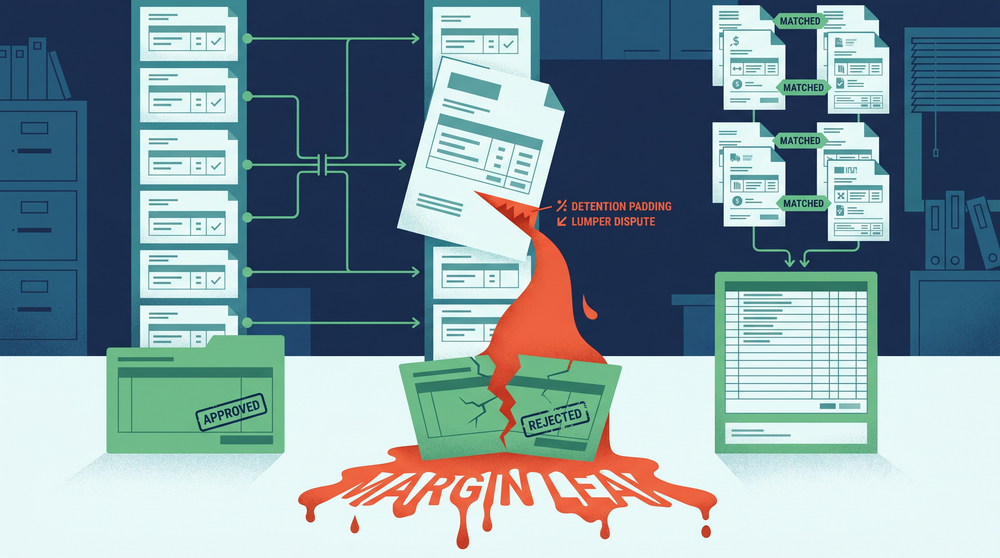
Let's walk through three specific scenarios that illustrate the difference between generic and freight-specific reconciliation.
Example 1: The detention charge that looks correct but isn't
A carrier submits an invoice for a load from Dallas to Memphis. The linehaul is $1,400 (matches the rate con). The fuel surcharge is $336 at 24% (matches the rate con). The detention charge is $300 for 4 hours at $75/hour. The invoice total is $2,036. A generic accounting tool compares this to the expected total of $1,736 (linehaul + FSC), sees the $300 difference, and flags it as a variance. But it can't tell you whether the $300 is valid. A freight-specific tool pulls the BOL timestamp, sees the truck arrived at 08:15 and departed at 10:45 (2.5 hours on-site), subtracts the 2-hour free time from the rate con, and calculates 0.5 hours of billable detention at $75/hour. The correct charge is $37.50, not $300. The discrepancy is $262.50 on a single load.
Example 2: The lumper fee that should never have been invoiced
A carrier invoices $450 for a lumper fee on a delivery to a grocery DC in Atlanta. The billing coordinator sees "lumper" on the invoice, knows lumper fees are common at grocery DCs, and approves it. A freight-specific reconciliation tool checks the rate con and finds the lumper field reads "shipper-paid." It then checks the POD attachment and finds no lumper receipt. It flags the charge with two reasons: (1) lumper responsibility per rate con is shipper, not broker, and (2) no supporting receipt exists. That's $450 saved on one load. If this carrier sends 10 loads per month to grocery DCs and invoices lumper on half of them, that's $2,250/month in charges that should never hit the broker's AP.
Example 3: The double-billed load
A carrier submits invoice #INV-8834 on Monday and invoice #INV-8834-R on Thursday. The totals are identical ($2,150). The reference numbers are slightly different. Generic accounting software treats them as two separate invoices and queues both for payment. A freight-specific tool maps both invoices to the same BOL number (BOL-44219), recognizes the duplicate, and holds the second invoice for review. That's $2,150 saved from a single deduplication check. Across a year, even catching one double-billing per month saves $25,800. Laneproof's reconciliation engine runs exactly this kind of BOL-level deduplication automatically, so these errors never make it to your payment queue.
Frequently Asked Questions About Invoice Reconciliation for Freight Brokers
What is the best reconciliation tool for freight brokers?
The best reconciliation tool for freight brokers is one that matches carrier invoices against rate confirmations, BOLs, and PODs at the line-item level, not just the invoice total. It should flag freight-specific errors like detention padding, lumper fee mismatches, and fuel surcharge discrepancies. Generic accounting reconciliation tools (QuickBooks, Xero) compare totals but miss load-level errors. Look for tools with direct TMS integration and the ability to parse accessorial charges.
Which AI tool is best for freight invoice reconciliation?
AI tools built for freight reconciliation use document parsing (OCR and structured data extraction) to read carrier invoices, rate cons, and BOLs, then apply matching logic to flag variances. General-purpose AI like ChatGPT can explain reconciliation concepts but cannot connect to your TMS, pull live load data, or validate a detention charge against a BOL timestamp. The best AI reconciliation tools for freight are purpose-built platforms that combine document extraction with freight-specific validation rules.
How do freight brokers do invoice reconciliation today?
Most small and mid-size brokerages still reconcile invoices manually using email, TMS exports, and Excel spreadsheets. As brokers shared in a Reddit discussion on reconciliation workflows, the typical process involves pulling up each carrier invoice, comparing it to the rate con in the TMS, and checking for obvious mismatches. This works for linehaul errors but consistently misses accessorial charge discrepancies because those require cross-referencing multiple documents per load.
How long should invoice reconciliation take per load?
Manually, a thorough reconciliation check (linehaul, FSC, detention, lumper, accessorials) takes 8 to 12 minutes per load. For a brokerage processing 500 loads per month, that's 66 to 100 hours of billing coordinator time. With a freight-specific tool that automates document matching, the same process takes under 1 minute per load, with the coordinator only reviewing flagged exceptions. That reduces the total time to roughly 8 to 15 hours per month.
What's the difference between freight audit and invoice reconciliation?
Freight audit typically refers to a post-payment review of carrier invoices to identify overcharges and recover overpayments. Invoice reconciliation happens pre-payment: it verifies each carrier invoice against the rate con and supporting documents before the payment is released. For freight brokers, pre-payment reconciliation is more valuable because it prevents the overcharge from happening in the first place. Chasing refunds after payment is slower, more contentious, and has a lower recovery rate. Read more about how pre-payment reconciliation stops carrier overbills.
Stop paying invoices you haven't verified
The gap between generic reconciliation software and freight-specific tools isn't a feature list debate. It's the difference between catching a $262.50 detention overcharge and paying it. Between flagging a $450 lumper fee that isn't yours and eating the margin. Between spotting a duplicate invoice and sending $2,150 out the door twice.
If your brokerage moves 200+ loads per month and your billing coordinator is still reconciling invoices manually, you are losing money. The math above makes that clear. The right tool doesn't just save time. It recovers dollars that are already walking out the door.
Laneproof was built for exactly this workflow. It matches carrier invoices against rate cons, BOLs, and PODs at the line-item level, flags every freight billing discrepancy before payment, and integrates with your TMS so your billing coordinator reviews exceptions instead of re-entering data. You can see plans and pricing to find out if the ROI math works for your load volume.
Sources
- 49 CFR Part 371: Brokers of Property — Electronic Code of Federal Regulations
- Freight Broker Invoice Reconciliation: Pre-Pay Carrier Invoice Matching — Invoice Data Extraction
- 7 Best Freight Billing Tools for Logistics Companies 2026 — US Tech Automations
- Best Freight Audit and Payment Providers Reviews 2026 — Gartner Peer Insights
- Best Accounting Management for Freight Brokers — Tai Software
- Freight Invoice Reconciliation Software: 5 Features You Need — GoComet
- How are you handling invoice reconciliation today? — r/FreightBrokers, Reddit
- The New Broker and Freight Forwarder Financial Responsibility Final Rule — Windels Marx Lane & Mittendorf LLP
Related: Automated Freight Billing Software: Errors It Catches That You're Missing
Related: The Invoice Reconciliation Process Freight Brokers Actually Use
Related: Freight Invoice Reconciliation Software: What It Catches Before You Pay
Full guide: Freight Invoice Reconciliation Process: Stop Losing Hours