Shipping Invoice Discrepancy Tool: 3 Real Catches, Line by Line
Researched and written with AI assistance. Reviewed by the Laneproof team.

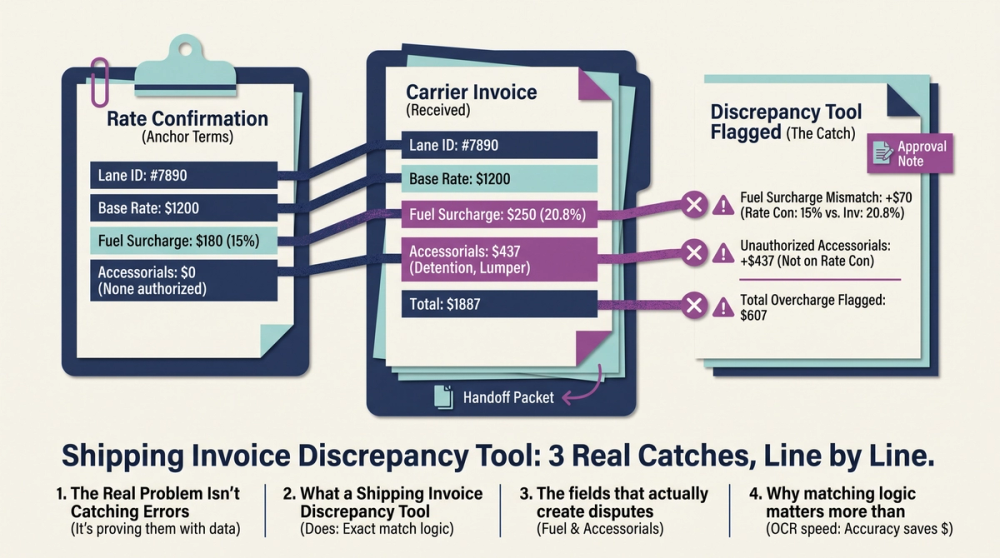
Three line items on three different carrier invoices: a $340 detention charge, a $175 lumper overage, and a $92 fuel surcharge error. Total exposure on those three loads alone: $607. None of them were fraud. All three would have been paid without a second look if nobody compared the invoice to the rate con and the POD. That is the entire job of a shipping invoice discrepancy tool: put the billed number next to the agreed number next to the proof-of-delivery timestamp, and flag the gap before payment goes out.
This post walks through all three catches with the actual math, then gives you the three-way matching process and a red-flag checklist you can run manually today. One disclosure up front: the dollar figures here are composite scenarios built from common carrier billing patterns, not a single client account. The match logic behind them is the part that transfers to your operation.
The Real Problem Isn't Catching Errors. It's Proving Them in Under 10 Minutes.
Most ops managers already suspect they are getting overbilled. That is not the bottleneck. The bottleneck is that when a carrier invoice shows five hours of detention at $68/hour, proving it should have been 3.5 hours means pulling the rate confirmation out of email, finding the signed BOL in a shared drive or a driver's photo upload, reading two handwritten timestamps, and doing the subtraction. That is fifteen minutes of work to recover $340. Do it on 200 invoices a month and you have a full-time job nobody has budgeted for.
So the invoice gets paid. Not because the billing coordinator agrees with it, but because the load is closed, the customer already got billed, and chasing $340 across four systems costs more in labor than it returns. That is how margin leaks in freight: not in one bad invoice, but in the compounding decision to not fight small ones.
The freight audit industry exists because of that gap. Guides on freight audit and payment best practices consistently point to the same root cause: carrier bills are audited after payment, if at all, and post-payment recovery is slower and less successful than pre-payment review. Practitioner walkthroughs on how to catch and dispute carrier invoice overcharges make the same point from the dispute side, where the carrier's willingness to credit drops sharply once the funds have cleared.
You don't win a billing dispute with an argument. You win it with a timestamp, a rate con clause, and a receipt that doesn't exist.
Everything below is built around that idea. If you can produce the document evidence in the same message where you raise the dispute, most carriers issue the credit without escalation. If you cannot, you are negotiating.
What a Shipping Invoice Discrepancy Tool Actually Flags on a Carrier Invoice
Generic accounts payable software matches an invoice to a purchase order on two things: vendor and total amount. That model breaks immediately in freight, because a carrier invoice is not one number. It is a linehaul rate plus a fuel surcharge plus somewhere between zero and eight accessorials, each of which has its own trigger condition, its own supporting document, and its own dispute path.
The fields that actually create disputes
In practice, carrier invoice mistakes cluster into a short list of fields. A freight-specific tool checks each one against a source document rather than checking the total against a budget:
- Linehaul rate: invoiced amount vs. the rate confirmation rate. Simple, and still one of the most common mismatches when a load gets re-rated after a reconsignment.
- Fuel surcharge: billed as a flat amount or a per-mile figure that does not tie back to the index and effective date named in the rate con.
- Detention: billed hours vs. arrival and departure timestamps on the BOL or POD, minus free time, capped at the rate con maximum.
- Lumper and unloading fees: billed as a pass-through with no receipt attached, or a receipt that does not match the invoiced amount.
- Weight and class: rebilled after a reweigh or reclass, with no inspection certificate or corrected BOL.
- TONU, layover, dry run, and stop-off charges: billed without the dispatch record showing the trigger event.
- Duplicates: same load number, same accessorial, two invoices, often thirty days apart from two different billing addresses after a factoring change.
Why matching logic matters more than the software category
The useful distinction is not "manual vs. automated." It is "field-level vs. total-level." A tool that compares totals will pass an invoice where the linehaul is $75 under and detention is $340 over. A tool doing field-level comparison flags both. Tools built for automated carrier invoice analysis describe the same core checks: price mismatches against the agreed quote, weight and volume differences, and duplicate charge detection. Freight-native platforms extend that to accessorials and document presence, which is where broker margin actually goes.
There is also a volume threshold worth knowing. Reviewing every line on every invoice by hand is realistic at 20 invoices a week. Around 50 or more per week, most operations either stop doing full-line review or start missing things, which is exactly the point where freight invoice auditing software starts to pay for itself. If you are still deciding whether you are at that threshold, the breakdown in our guide to invoice matching in freight and where carrier bills go wrong covers the failure modes by volume tier.
Catch #1: The $340 Detention Charge That Didn't Match the BOL Timestamp
Load: dry van, Joliet to Memphis. Rate con: $1,850 linehaul, two hours free time at each stop, detention at $68/hour after free time, capped at eight hours.
Carrier invoice line: Detention, consignee, 7.0 hours at $68 = $476.
The math the match ran
The signed POD showed in-time of 08:15 and out-time of 13:45. That is 5.5 hours on site. Free time under the rate con is two hours. Billable detention is therefore 3.5 hours, not 7.0.
- Billed: 7.0 hours × $68 = $476
- Supported by POD: 3.5 hours × $68 = $238
- Variance flagged: $238 overcharge
The carrier's dispatch note explained the gap: the driver logged arrival at the facility's outer gate at 06:45 and counted from there, while the receiver's stamp started at the dock check-in. Under the rate con language, detention runs from the appointment time or check-in time, whichever is later. The gate queue was not billable.
Run that same pattern with a longer gate queue and an $85/hour rate and you get to the $340 headline number fast. Detention is the single most argued accessorial in brokerage, and it is also the easiest to resolve, because the evidence is a timestamp on a document both parties already signed.
How to dispute it without burning the carrier relationship
Send one message with three things: the invoice line, the POD image with the in/out times circled, and the rate con clause defining free time and the detention start point. Ask for a corrected invoice rather than a credit memo, because a corrected invoice keeps your AP and their AR in sync. Most carriers rebill within 48 hours when the evidence is in the first message. Detention rules also interact with hours-of-service planning, and the FMCSA has studied driver detention at length, so treat the conversation as a scheduling problem you both have, not an accusation.
Catch #2: A Lumper Fee Padded by $175 With No Receipt Attached
Load: refrigerated, grocery DC delivery in Atlanta. Rate con: lumper reimbursed at cost, receipt required, no markup.
Carrier invoice line: Lumper fee, $250. No document attached.
Why the flag fired before anyone knew the real number
This is the part people get wrong about discrepancy detection. The flag did not fire because $250 was too high. It fired because the rate con conditions reimbursement on a receipt, and no receipt was attached to the invoice packet. That is a document-presence check, not a pricing check, and it is one of the highest-yield rules you can run.
When the receipt came back, it showed $75 paid to the unloading service at that DC. The remaining $175 was a service fee the carrier had added without disclosure.
- Billed: $250
- Receipt: $75
- Rate con permits: cost, no markup
- Variance recovered: $175
Multiply that by the number of grocery and retail DC loads you run in a month. If you move 60 loads a month into facilities that use third-party unloading crews and even a fifth of them carry an undisclosed markup, that is roughly $2,100 a month sitting in a line item most people approve on sight because $250 for a lumper does not look unusual.
The rule to write into your carrier packet
Add one sentence: accessorials submitted without supporting documentation will be held, not denied, until documentation is provided. Held, not denied, matters. It keeps the tone cooperative and it makes the receipt the fastest path to payment for the carrier. Broader documentation requirements for brokers are covered in our documentation compliance checklist for freight brokers, which is worth reviewing against your current carrier packet.
Catch #3: A Fuel Surcharge Miscalculated Against the Rate Con
Load: 620 miles, flatbed. Rate con: linehaul $1,420, fuel surcharge calculated from the current DOE national average diesel price using the carrier's published scale, updated weekly on Tuesday.
Carrier invoice line: FSC, 620 miles at $0.52/mile = $322.40.
The math the match ran
The applicable rate for the pickup week, per the scale referenced in the rate con, was $0.37/mile. The carrier's billing system had a stale rate loaded from a prior period.
- Billed: 620 × $0.52 = $322.40
- Correct: 620 × $0.37 = $229.40
- Variance: $93.00 on a single load
Nobody eyeballs a fuel surcharge. It is a mid-three-figure number on a mid-four-figure invoice and it looks plausible at almost any value. That is exactly why it is worth automating. Fuel surcharge errors are systematic, not random: when a rate table is stale, it is stale on every load that carrier bills you until someone catches it.
The rollup that changes the conversation
Take that $93 variance across 40 loads a month with the same carrier:
- $93 × 40 loads = $3,720 per month
- $44,640 per year on one carrier's stale fuel table
That is the number that justifies a tool. Not the $93. Guides on optimizing freight payments and eliminating billing discrepancies make the same argument: systematic errors compound quietly, and the recovery case is built on frequency rather than severity. A single flagged load looks like rounding. Forty of them looks like a quarter of somebody's salary.
How Three-Way Matching Works in Freight (Rate Con, Invoice, POD)
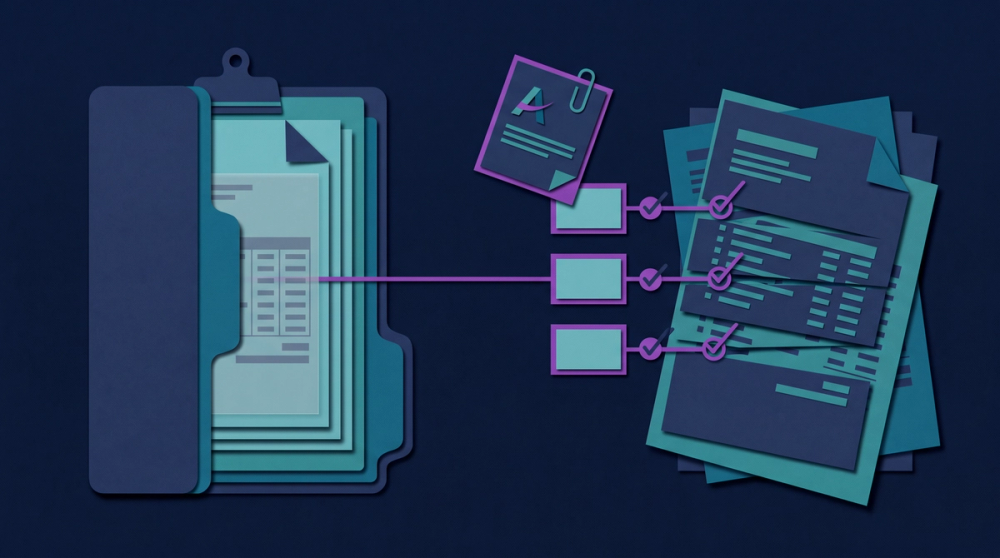
In standard accounts payable, three-way matching means purchase order, invoice, and receiving report. In freight, the documents change names but the logic is identical: the rate confirmation is the PO, the carrier invoice is the invoice, and the signed BOL/POD is the receiving report. The mid-post diagram above shows the three documents side by side with the fields that get compared between each pair.
The step-by-step process
- Step 1. Pull all three documents for the same load ID. Match on load number first, then PRO number, then BOL number. If you cannot tie all three to one load, stop. Everything downstream is unreliable.
- Step 2. Compare invoice linehaul to rate con linehaul. Exact match expected. Any variance requires a written amendment, a reconsignment note, or an approved re-rate on file.
- Step 3. Recalculate fuel surcharge from the rate con method. Do not compare it to last month's invoice. Recalculate it from the index, effective date, and mileage source named in the rate con.
- Step 4. Validate every accessorial against a trigger document. Detention against POD timestamps. Lumper against a receipt. Layover against a dispatch record. TONU against a cancellation message. No trigger document means the charge is unsupported, not necessarily wrong.
- Step 5. Check weight, pieces, and class against the BOL. A reweigh or reclass needs an inspection certificate. Absent that, the original BOL governs.
- Step 6. Screen for duplicates. Same load, same charge type, any invoice number. Factoring company changes are the most common source of accidental double billing.
- Step 7. Classify each variance. Three buckets: approve, hold pending documentation, dispute with evidence. Only the third bucket needs a phone call.
Steps 2 through 6 are pure comparison work. They require no judgment, only accurate field values from three documents, which is why they automate well. Step 7 is the part that stays human. If you want a longer definition of the underlying process and how it differs from customer-side reconciliation, see what invoice reconciliation actually means in freight.
Where the process breaks in real operations
The failure point is almost never the comparison. It is Step 1. Rate cons live in email, PODs arrive as phone photos in a driver app or as scans from a factoring portal, and invoices come in as PDFs with load numbers formatted four different ways. Overviews of invoice discrepancy types and resolution methods note the same pattern outside freight: the matching logic is straightforward, and the data capture is what actually costs the hours. This is also why fuzzy matching on load and PRO numbers matters more in freight than in most AP workflows.
Two More Scenarios Worth Running the Math On
Scenario: the quiet reclass. LTL shipment, 1,840 lbs, tendered and billed at class 85 per the BOL. The carrier's inspection at the terminal rebills it as class 92.5, adding $210 to the linehaul, with an inspection certificate that lists a cubic dimension but no density calculation.
Step one: pull the original BOL and confirm the tendered class and weight. Step two: request the density worksheet, not just the certificate. Step three: run the density yourself (weight divided by cubic feet). If the shipper's dimensions on the BOL produce a density that lands in the class 85 band, the reclass is unsupported and the $210 comes off. If the pallets were actually stacked taller than the BOL stated, the reclass is valid and the real problem is upstream at the shipper. Either way you learn something worth acting on. Ten reclass events a quarter at $210 each is $8,400 a year, and roughly half of them typically resolve in the broker's favor when the density worksheet is requested.
Scenario: the time cost of doing this by hand. Assume 200 carrier invoices a month and a billing coordinator who spends four minutes per invoice on a genuine line-level review: opening the rate con, opening the POD, checking six fields.
- 200 invoices × 4 minutes = 800 minutes = 13.3 hours per month, or roughly 3 hours a week
- At a loaded labor cost of $28/hour, that is $372 per month in review labor
- Push volume to 500 invoices a month and the same standard costs 33 hours and $930 per month
That is the honest tradeoff. At low volume, manual review is cheap and works fine. The math flips when your invoice count grows faster than your back office, which is when line-level review quietly degrades into total-level review and the $93 fuel surcharge errors start sailing through. Field-level tools that reconcile carrier invoices against the rate confirmation and POD automatically exist to hold the review standard constant while volume grows, flagging only the loads with variances so your coordinator works exceptions instead of every invoice. If you are comparing options, our roundup of the best invoice reconciliation tools for freight brokers breaks down what each category actually checks.
Red Flags to Check on Every Carrier Invoice Before You Pay
Print this. Tape it to the monitor. It takes about 90 seconds per invoice once it becomes habit, and it catches the majority of what a discrepancy tool catches.
- Accessorial with no supporting document. Any charge beyond linehaul and fuel that arrives without a receipt, timestamp, or dispatch record. Hold it.
- Detention hours that end in .0. Real detention is 3.4 hours. Estimated detention is 4.0 hours. Round numbers are a tell worth checking against the POD.
- Fuel surcharge that hasn't moved in three months. Diesel moves. A flat FSC across a quarter means a stale rate table on one side of the transaction.
- Linehaul that is off by an odd amount. A $37 or $114 variance from the rate con is usually a re-rate, a mileage source difference, or a keying error, not a negotiation.
- Invoice date well before or after the delivery date. A bill dated three days before delivery usually means the accessorials were estimated, not recorded.
- A new remit-to address or factoring company. The most common source of true duplicate payments. Check the load number against paid history before releasing.
- Class or weight that differs from the BOL. Requires an inspection certificate with a density calculation, not just a corrected number.
- Charges listed as "other" or "misc." Ask for the charge code. Undescribed line items are the easiest to remove and the easiest to overlook.
- Mileage that exceeds the rate con routing by more than 5%. Out-of-route miles are billable only when the rate con says so.
One note on tone. None of these flags mean the carrier is cheating you. Most carrier invoice mistakes are billing-system defaults, stale tables, and drivers estimating times from memory at the end of a long day. Treating them as errors rather than accusations is why brokers who audit aggressively still keep their capacity.
Frequently Asked Questions
How do you handle discrepancies between purchase orders, invoices, and receiving reports in three-way matching?
In freight, substitute the rate confirmation for the PO and the signed BOL/POD for the receiving report, then compare field by field rather than total to total. The governing document depends on the field: the rate con governs pricing terms, the POD governs event timing like arrival and departure, and the BOL governs weight, pieces, and class. When two documents disagree, the one that recorded the event at the time it happened wins, which is almost always the POD.
What is a red flag in an invoice?
A red flag is any line item that cannot be traced to a source document or an agreed term. In carrier billing, the most common ones are accessorials without receipts, detention hours that do not tie to POD timestamps, fuel surcharges that do not recalculate from the index named in the rate con, undescribed "miscellaneous" charges, and a changed remit-to address on a load you may have already paid. Every one of those is a hold-and-request situation, not an automatic denial.
How do you handle a discrepancy between an invoice and a PO?
Document it before you contact anyone. Pull the specific invoice line, the corresponding clause from the rate confirmation, and the supporting document that proves the correct value, then send all three in one message and request a corrected invoice rather than a credit. Set a standing rule for small variances, for example auto-approve anything under $25 in your favor or theirs, so your team spends its time on the disputes that actually move margin.
What's a common method for handling a gap between the amount invoiced and the amount paid?
Short-pay with a written variance explanation attached to the remittance, referencing the load number, the disputed line, and the supporting document. This keeps cash moving on the undisputed portion while preserving your position on the rest. It works far better than holding the entire invoice, which strains the carrier relationship over a charge that may represent 8% of the bill.
At what volume does an automated discrepancy tool actually pay for itself?
The usual inflection point is somewhere around 50 invoices per week, which is roughly where full line-level manual review stops being sustainable and teams start reviewing totals instead of fields. Run your own math first: multiply your monthly invoice count by four minutes of genuine review time, then compare that labor cost against a realistic recovery estimate from your last 30 disputed loads. If you are already skipping line-level review at your current volume, you have your answer. A deeper feature comparison lives in our breakdown of what carrier invoice audit software should catch before you pay.
Sources
- Federal Motor Carrier Safety Administration — FMCSA
- Automated Carrier Invoice Analysis — ShippyPro
- How to Catch & Dispute Carrier Invoice Overcharges — Avantiico
- Freight Invoice Auditing Software — FreightPOP
- 5 Freight Audit and Payment Best Practices — Shipware
- How to Optimize Freight Payments and Eliminate Billing Discrepancies — Turing IT Labs
- What is Invoice Discrepancy: Types and How to Resolve — Scry AI
- Documentation Compliance for Freight Brokers — Laneproof
- Freight Billing Process for Brokers — Truckstop
The Takeaway
The three catches in this post came to $607 across three loads, and every one of them was found the same way: compare the invoice line to the rate con term, then confirm it against the POD or a receipt. Detention against timestamps. Lumper against a receipt. Fuel surcharge recalculated from the index in the rate con, not eyeballed. The variance is usually small on one load and significant across a month, which is why the case for auditing is built on frequency rather than any single dramatic overcharge.
Start manually. Run the red-flag checklist on your next 30 carrier invoices and track what you find and how long it took. If the recovery is real but the hours are not sustainable, that is the point where pulling the fields off rate cons, invoices, and PODs automatically turns a three-hour weekly review into an exception queue you clear in twenty minutes. Either way, you will have your own numbers, which beats anybody's demo.