Liftgate Delivery Charges: What Carriers Bill vs What's Fair
Researched and written with AI assistance. Reviewed by the Laneproof team.
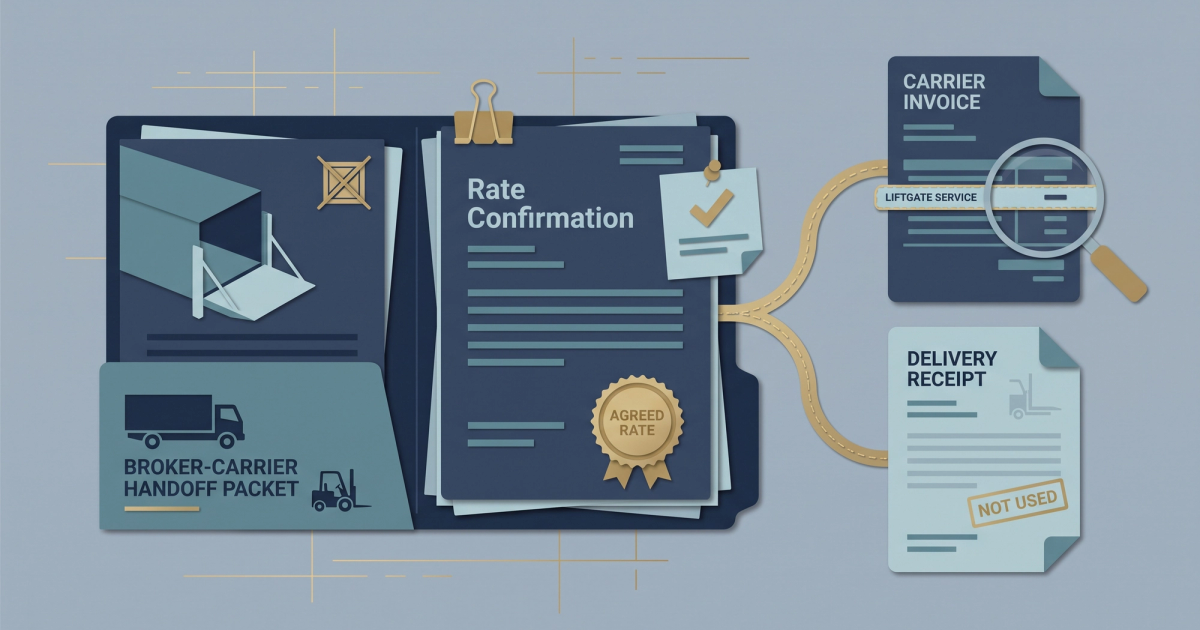
A $175 liftgate line item shows up on a freight invoice for a load that moved dock to dock. The consignee has four dock doors and a forklift on site. Nobody lowered a liftgate. The charge gets paid anyway, because your billing coordinator has 60 more invoices to clear before Friday and no fast way to prove the equipment was never used.
Published liftgate delivery charges run $75 to $150 per use according to Shapiro's breakdown of liftgate service in freight shipping, and higher on some tariffs. The price itself is rarely the problem. The problem is that liftgate is the easiest accessorial in freight to bill and the hardest to disprove after the fact. This guide covers the real ranges by carrier type, the invoice patterns that signal you paid for equipment nobody touched, and the dispute language that actually gets a credit issued.
Why Liftgate Is the Easiest Accessorial to Overbill
Detention has a clock. Lumper fees have a receipt. Layover has a date stamp. A liftgate charge has none of that. It is a yes or no field on a bill of lading, and once the driver checks the box or the carrier's billing system defaults it on, the burden of proof lands on you.
That asymmetry is why liftgate shows up so often on invoices that do not warrant it. The carrier does not need to fabricate anything. A dispatcher marks the delivery as residential during booking, the carrier's rating engine attaches liftgate automatically because residential deliveries usually need one, and the charge rides through even though the actual delivery happened at a commercial building with a dock. Nobody lied. The freight invoice is still wrong.
Volume makes it worse. The Bureau of Transportation Statistics freight indicators track the sheer scale of shipment activity moving through the U.S. network every month, and for a brokerage running 500 loads a month, an accessorial that gets reviewed for two seconds per invoice is an accessorial that never gets reviewed at all. Liftgate is a small enough number to feel unarguable and a frequent enough number to matter at the end of the quarter.
Liftgate is the only accessorial that can be billed on a load where nothing unusual happened. Detention needs a delay. Lumper needs a receipt. Liftgate just needs a checkbox.
If you already run a process for the bigger accessorials, the mechanics here are the same. Our guide on how accessorial charges get inflated and how to fight back covers the broader category. Liftgate deserves its own treatment because the evidence trail is thinner than anything else on the sheet.
What Does Liftgate Delivery Mean (And Why It's Not Optional)
Liftgate delivery means the truck carries a hydraulic platform on the rear that raises and lowers freight between trailer floor height and ground level. It exists for one reason: the pickup or delivery location has no dock and no forklift. Without it, a 900 lb palletized shipment sitting 52 inches off the ground has no way down.
That is why it is not a convenience upgrade. It is equipment. The carrier either dispatches a liftgate-equipped trailer or it does not, and that decision has to happen at dispatch, not at the delivery door. When a driver arrives at a no-dock location without a liftgate on the trailer, the shipment does not get delivered. It goes back to the terminal, gets redelivered, and now you are paying a liftgate charge plus a redelivery fee.
What the liftgate actually can and cannot handle
Liftgates have hard limits, and those limits are the most common reason a service that was booked correctly still fails at the door. Per Go-Freight's 2026 breakdown of liftgate and limited-access LTL fees, liftgate service commonly caps out around 2,500 to 2,900 lbs and has platform dimension limits that a wide or long pallet will exceed.
Operationally, that means three things for your team:
- A single pallet over roughly 2,500 lbs may need to be broken down or moved on a different equipment type, not a liftgate trailer
- Oversized crates can exceed the platform footprint even when they are under the weight cap
- If the driver cannot complete the lift, you will often still see the liftgate accessorial billed alongside an attempted delivery charge
Get the piece count, weight per pallet, and pallet dimensions on the BOL before booking. Those three numbers determine whether liftgate is even a viable answer.
Do I Need Liftgate Delivery? Here's the Quick Check
You need liftgate delivery if the pickup or delivery location has no loading dock and no forklift or pallet jack capable of taking freight off the trailer. If either end has a dock, or the receiver confirms on-site material handling equipment, you do not need it. Residential addresses, storage units, small retail, job sites, and self-storage almost always need it.
Run this check at booking, before the rate confirmation goes out:
- Is there a dock? If yes, no liftgate. Confirm with the receiver, not the shipper.
- Is there a forklift on site during your delivery window? A forklift that goes home at 3 p.m. does not help a 5 p.m. delivery.
- Is the address residential or residential-adjacent? Home businesses, farms, and converted storefronts almost always require liftgate.
- What does each pallet weigh? Over roughly 2,500 lbs and liftgate is off the table entirely, per Go-Freight's published limits.
- Is the freight going inside? Liftgate gets it to the ground. Inside delivery fees in freight are a separate accessorial and get billed separately.
That last point matters. Brokers routinely assume liftgate covers placement. It does not. The driver's obligation ends at the tailgate, on the ground, at curbside. Anything past that is inside delivery, and it carries its own charge.
Does Residential Delivery Include Liftgate, or Is That a Separate Charge?
No. Residential delivery and liftgate service are two separate accessorial charges, and most LTL carriers bill both on the same shipment. A residential fee covers the cost of routing a truck into a non-commercial area. The liftgate fee covers the equipment. A house with no dock triggers both, which is why residential LTL invoices climb fast.
On a typical residential LTL delivery, you can expect to see a residential delivery fee, a liftgate fee, and often a limited access or appointment fee stacked together. Warp's breakdown of liftgate delivery walks through how the accessorial applies and why it can attach at more than one point in the move.
Where the stacking becomes a problem
The issue is not that these charges exist. It is that they show up on invoices for commercial deliveries where the residential flag was set in error during booking, and once residential is flagged, liftgate usually follows automatically. When you audit, do not just check whether liftgate was needed. Check whether the residential classification was correct in the first place, because the two charges travel together.
If the rate confirmation only authorized linehaul plus fuel surcharge and the invoice arrives with three accessorials attached, you are looking at the exact pattern covered in our breakdown of additional charges in freight that lack rate con backing. No authorization, no automatic payment.
Liftgate Delivery Charges by Carrier Type: LTL, Parcel, and Regional
Published ranges vary widely by source, which tells you something important: there is no market rate for liftgate. There is only what each carrier's tariff says and what you agreed to.
National LTL carriers
The most commonly cited band is $75 to $150 per liftgate use, per Shapiro's liftgate service guide. Redstag Fulfillment's shipper guide to liftgate delivery reports carrier-specific variance that pushes the top of the range higher, and FreightAmigo's liftgate fee explainer documents a broader spread depending on carrier and shipment profile. Go-Freight's 2026 figures run higher still, into the $185 to $290 territory on heavier or limited-access shipments.
Translation: if you are quoting a customer from a number you memorized in 2022, you are underquoting.
Regional carriers
Regional carriers are where the savings live. Davis Delivery's Atlanta liftgate cost comparison shows regional operators offering flat-rate liftgate service around $50 against national carrier averages in the $100 to $200 band for the same metro. On a lane you run weekly, that spread is real money, and it is negotiable in a way national tariff accessorials usually are not.
Parcel and small-package carriers
Parcel networks generally do not offer liftgate at all, because parcel freight moves by hand. When a shipment is heavy enough or palletized enough to need a liftgate, it has already moved into the carrier's LTL or freight division, and it is rated on the freight tariff, not the parcel tariff. If you see a liftgate charge on a true parcel invoice, question it immediately. That is a rating error, not a service.
What to build into your rate math
Accessorials are not an afterthought in pricing. Aljex's explanation of how freight brokers calculate rates treats liftgate and similar charges as line items that belong in the quote before it goes to the customer. If your margin model assumes linehaul plus fuel surcharge and nothing else, a single unbudgeted $150 liftgate can erase the profit on a short LTL move.
The Invoice Line Patterns That Mean You're Being Overbilled
Here is the checklist your billing coordinator should be able to run in under 30 seconds per invoice. If any of these are true and a liftgate charge is present, flag it before it gets paid.
Five red flags on a liftgate line item
- Commercial address with dock doors on both ends. Pull the address on Google Maps street view. Docks are visible from the road. If the consignee has a dock and the delivery receipt shows a normal delivery, liftgate should not be there.
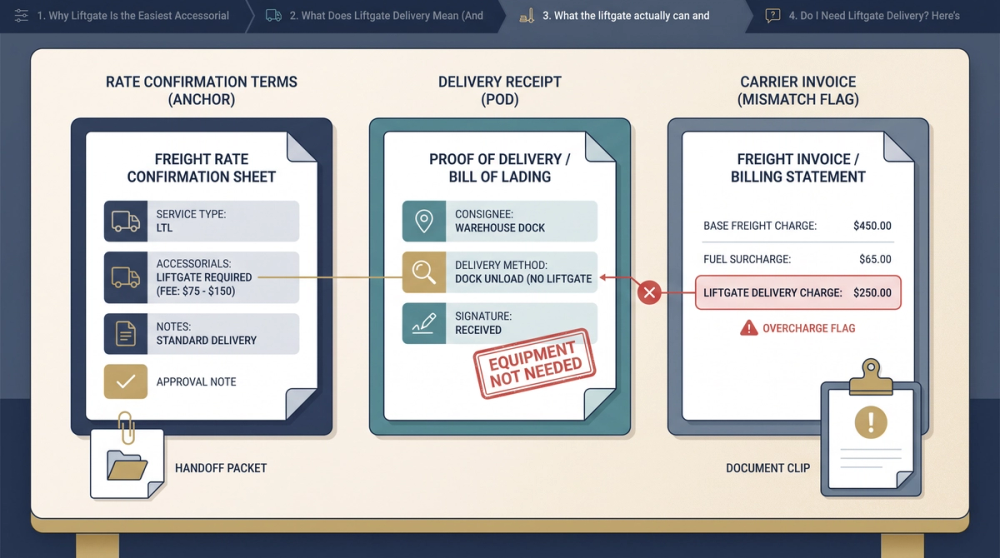
- Liftgate billed but not listed on the rate confirmation or the BOL. The BOL is where the service is requested. If neither document mentions it, the charge originated in the carrier's rating system, not in the field.
- Liftgate paired with a forklift-equipped facility. Distribution centers, manufacturing plants, and 3PL warehouses have material handling equipment. A liftgate charge into a 200,000 square foot DC is almost always a system default.
- Liftgate charged on both ends of a dock-to-dock move. Two liftgate lines on a shipment that never left a paved dock is the loudest red flag on this list.
- A liftgate rate that does not match your contracted tariff. If your agreement says $95 and the invoice says $150, that is a rating variance, not a service dispute, and it is the easiest one to win.
The signed delivery receipt is your best evidence on the first three. A clean POD with no notation about ground-level delivery, combined with a consignee address that clearly has dock access, is enough to open a dispute. Our breakdown of what a signed delivery receipt actually proves in a freight dispute covers exactly which notations carry weight and which do not.
How to Catch a Double Liftgate Charge on Pickup and Delivery
This is the single most expensive liftgate mistake, and it is invisible if you only scan totals. As Warp notes in its liftgate delivery overview, the fee applies each time the equipment is used, meaning a shipment needing liftgate at both origin and destination gets billed twice.
That is legitimate when both ends genuinely lack docks. It is not legitimate when the shipper loaded from a dock and only the consignee needed the gate. And carrier billing systems frequently attach the accessorial to the shipment record rather than to a specific stop, which means one flag produces two charges.
The three-document match that catches it
Line up the rate confirmation, the BOL, and the invoice side by side. Then answer three questions:
- Does the BOL request liftgate at pickup, at delivery, or both? The service box is usually stop-specific.
- Does the rate confirmation authorize one liftgate charge or two? If it says one and the invoice bills two, the variance is documented before you even call.
- Does the pickup address have a dock? If the shipper is a warehouse that loaded your trailer with a forklift, the origin liftgate charge cannot stand.
On a single BOL with a $150 pickup liftgate and a $150 delivery liftgate, that is $300 on one shipment. Catching one of these per week at a 500-load-a-month operation is not a rounding error.
How to Negotiate Liftgate Fees Before They Hit the Rate Con
Auditing after the fact recovers money. Negotiating up front prevents the charge. Do both, but front-load the effort.
Set a flat rate in the carrier agreement
If you move consistent liftgate volume on known lanes, ask for a flat accessorial instead of tariff pricing. The Davis Delivery Atlanta comparison shows regional carriers already pricing this way at roughly $50 flat against $100 to $200 national averages. Carriers with liftgate trailers sitting idle will trade rate for committed volume. Get the number written into the carrier packet and the contract, not agreed to on a phone call.
Kill the charge at the source with better booking data
Most disputable liftgate charges start as bad booking data. Build these fields into your load entry so the classification is right the first time:
- Dock available at pickup: yes or no
- Dock available at delivery: yes or no
- Forklift or pallet jack on site during the delivery window: yes or no
- Address type: commercial, residential, limited access, or construction site

- Heaviest single pallet weight and largest pallet dimensions
Call the receiver, not the shipper, for the delivery-side answers. Shippers guess. Receivers know.
Write the authorization language into the rate confirmation
One line does most of the work: "Accessorials not listed on this rate confirmation require written authorization prior to service. Unauthorized accessorials will not be paid." It does not eliminate disputes, but it moves the burden of proof back onto the carrier where it belongs, and it gives your billing team something concrete to quote when they call.
Three Liftgate Billing Scenarios, With the Math
Scenario 1: The phantom liftgate on a dock-to-dock move
A 6-pallet LTL shipment moves from a manufacturing plant in Greenville to a distribution center outside Charlotte. Both facilities have docks. The invoice arrives with linehaul at $612, fuel surcharge at $147, and a $175 liftgate delivery charge.
The audit path: the rate confirmation lists linehaul and fuel only. The BOL has the liftgate box unchecked. The signed POD shows a clean delivery with no exceptions and a dock door number written in the receiver's notes. Three documents, zero support for the charge.
Dispute language that works: "Requesting removal of the $175 liftgate accessorial on PRO [number]. Rate confirmation dated [date] authorized linehaul and fuel surcharge only. The BOL does not request liftgate service and the signed delivery receipt notes delivery at dock door 14. No liftgate equipment was used. Please issue a corrected invoice." Short, specific, document-backed. That gets credited.
Scenario 2: The double charge on a single BOL
A single BOL moving 4 pallets from a 3PL warehouse to a retail storefront. The storefront has no dock, so liftgate at delivery is legitimate. The invoice shows two liftgate lines: $150 at pickup and $150 at delivery, for $300 total.
The origin was a 3PL with eight dock doors and forklifts. The pickup liftgate line is a system default attached to the shipment record instead of the stop. Recovery: $150 on one shipment. The delivery charge stands, and you pay it without argument, which is exactly why the dispute on the pickup side gets taken seriously.
Scenario 3: Running the volume math on your own book
Do not take anyone's overbill percentage on faith, including ours. Run your own. Pull 30 days of freight invoices, total your linehaul plus accessorial spend, then audit a random sample of 50 invoices line by line against the rate confirmation and BOL.
Here is how the arithmetic works. If you run 500 loads a month at an average of $1,850 in total billed freight per load, that is $925,000 in monthly spend. If your sample audit finds a 3.8% variance rate on accessorials (use whatever number your own audit produces, not this one), the disputable amount is roughly $35,000 a month across the book. Even if only a fraction of that is winnable and only accessorials are in scope rather than total spend, a 500-load operation finding $4,200 a month in disputable liftgate and related accessorial charges is entirely ordinary. That is $50,000 a year sitting in invoices nobody has time to read.
The reason this money stays on the table is not that brokers do not care. It is that the three-document match takes four to six minutes per invoice by hand, and at 500 invoices a month that is 40 hours of labor. The economics of manual auditing only work if you sample, and sampling means most of the overbilling ships through. Teams that solve this either build a rules-based check into their process or use accessorial charge audit software that flags inflated charges automatically.
Frequently Asked Questions
What is a standard delivery fee?
A standard delivery fee is the base linehaul charge for moving freight from origin to destination dock, with no special equipment or handling. It typically covers the driver bringing the trailer to a commercial loading dock where the receiver unloads with their own forklift. Everything beyond that (liftgate, inside delivery, residential, limited access, appointment scheduling) is a separate accessorial charge billed on top.
Do I need liftgate delivery?
You need liftgate delivery only when the pickup or delivery location lacks both a loading dock and a forklift or pallet jack capable of removing freight from the trailer. Residential addresses, small retail, storage facilities, and job sites almost always need it. Warehouses, distribution centers, and manufacturing plants almost never do. Confirm with the receiver directly, not the shipper.
Does residential delivery include liftgate?
No. They are two separate accessorials and most LTL carriers bill both on the same residential shipment. The residential fee covers routing a truck into a non-commercial area. The liftgate fee covers the hydraulic equipment. Expect both, plus possibly a limited access or appointment fee, on a typical residential LTL delivery.
Can I still dispute a liftgate charge after the invoice is paid?
Yes, though it is harder. Most carrier agreements allow overcharge claims within a defined window, commonly 180 days, and your specific contract governs. Post-payment recovery requires the same evidence as pre-payment: rate confirmation, BOL, and signed POD showing the service was not requested or not rendered. Catching it before payment is always faster and has a higher success rate.
What happens if the freight is too heavy for the liftgate?
The delivery fails and gets returned to the terminal. Liftgate service commonly caps around 2,500 to 2,900 lbs per Go-Freight's published limits, and oversized pallets can exceed platform dimensions even under the weight cap. You will typically see the liftgate charge billed anyway, plus an attempted delivery or redelivery fee, so verify weight per pallet before booking the service.
Sources
- Latest Supply Chain and Freight Indicators — Bureau of Transportation Statistics
- What Is Liftgate Service in Freight Shipping? — Shapiro
- Liftgate Delivery — Warp
- What Is Liftgate Delivery? Complete Guide for Shippers — Redstag Fulfillment
- Liftgate & Limited-Access LTL Fees: What They Cost in 2026 — Go-Freight
- Liftgate Fees Explained — FreightAmigo
- How Do Freight Brokers Calculate Rates? — Aljex
- What Liftgate Delivery Actually Costs in Atlanta — Davis Delivery
The Short Version
Liftgate delivery charges are legitimate when the equipment is used, and published ranges run from $75 to $150 on most national LTL tariffs, with 2026 figures reaching $185 to $290 on heavier or limited-access shipments. Regional carriers will often flat-rate the service well below that. The money you lose is not on the fair charges. It is on the ones attached by a rating system to a dock-to-dock move, or doubled across pickup and delivery when only one end needed the gate.
Fix it in two places: better booking data so the classification is right at entry, and a three-document match (rate confirmation, BOL, invoice) before anything gets paid. Do the match by hand on a sample if your volume is low. If your team is clearing more than 200 freight invoices a month and the manual math no longer works, automated invoice versus rate confirmation matching flags the same variances covered in this guide without the 40 hours of labor. Either way, the charge you catch before payment is worth three you chase after.